Choosing the right EV charger in 2025 means navigating a shifting landscape of connectors, electrical requirements, and pricing. With Tesla's North American Charging Standard (NACS) now adopted by nearly every major automaker and a new generation of smart Level 2 hardware hitting the market, buyers need precise numbers — not marketing fluff — to make the right call. This guide breaks down charging speeds in kW (power, or how fast energy flows) versus kWh (energy, or how much your battery holds), real installation costs, connector compatibility, and specific equipment recommendations so you can budget accurately and charge efficiently.
Charging Levels Explained: Speeds in kW and Miles Per Hour
EV charging falls into three tiers. Understanding the difference between kW (kilowatts — the rate of energy delivery, like water pressure from a hose) and kWh (kilowatt-hours — the total energy stored, like the size of a bucket) is the single most important concept in EV ownership. Every charger is rated in kW; every battery is rated in kWh.
| Level | Voltage | Max Power (kW) | Miles of Range Added Per Hour | Typical Use |
|---|---|---|---|---|
| Level 1 | 120V AC | 1.0–1.4 kW | 3–5 miles/hr | Overnight top-ups, PHEVs, low-mileage drivers |
| Level 2 | 240V AC | 3.3–19.2 kW | 14–75 miles/hr | Home daily charging, workplace, retail destinations |
| DC Fast Charge | 400–900V DC | 50–350 kW | 150–1,200+ miles/hr (peak) | Road trips, highway corridors, rapid top-ups |
A few real-world caveats: DC fast-charging speeds peak only in a narrow state-of-charge (SoC) window — typically 10–50% — then taper significantly above 80% to protect battery health. A charger rated at 350 kW might only sustain that rate for a few minutes. Expect a 10–80% session on a 150 kW charger to take roughly 25–35 minutes for a 75–85 kWh battery, and longer on a cold battery that hasn't been preconditioned.
- 60 kWh battery (e.g., base Nissan Ariya, Chevrolet Equinox EV) on a 150 kW DCFC: ~22–28 minutes
- 82 kWh battery (e.g., Hyundai Ioniq 5, Tesla Model Y Long Range) on a 250 kW DCFC: ~18–22 minutes
- 110 kWh battery (e.g., Ford F-150 Lightning Extended Range, GMC Hummer EV) on a 350 kW DCFC: ~30–42 minutes
- Level 2 at home (11.5 kW) fully recharges a 75 kWh battery from 10% in ~6–7 hours — perfect for overnight
Home EV Charger Installation: Electrical Requirements and Costs
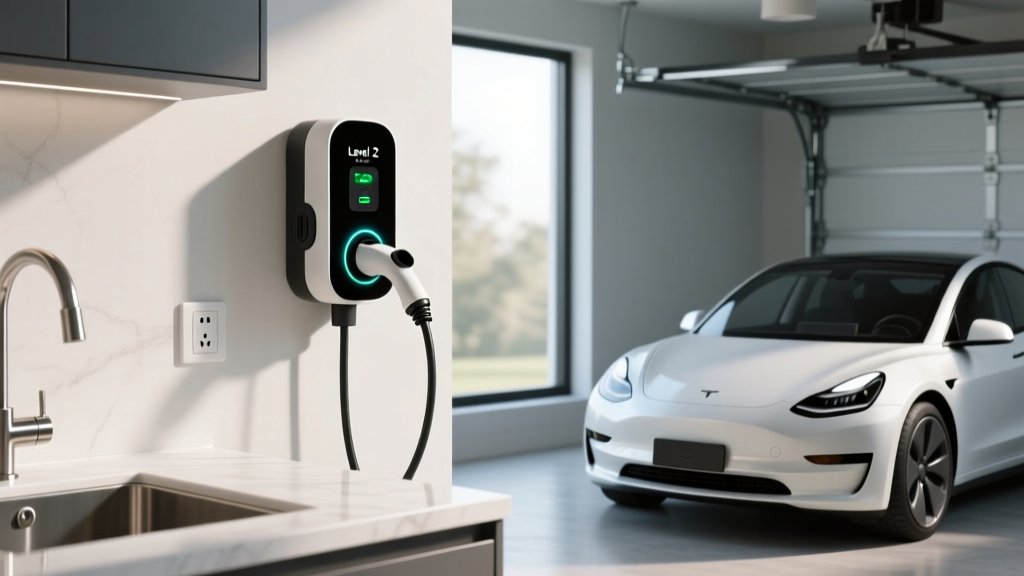
Most EV owners install a Level 2 charger at home, and this is where budgeting honestly matters. The total cost depends on your electrical panel's capacity, the distance from the panel to the charger location, and local permitting. Here's what you're working with electrically:
Typical Level 2 requirements: A 240-volt dedicated circuit, most commonly 40-amp or 48-amp, which supports chargers rated at 9.6 kW or 11.5 kW respectively (EV chargers draw 80% of a circuit's rated amperage per National Electrical Code continuous-load rules). A 60-amp circuit with a 48-amp charger is the sweet spot for most modern EVs, adding roughly 35–44 miles of range per hour — enough to fully replenish any daily commute overnight.
| Component | Low Estimate | High Estimate | Notes |
|---|---|---|---|
| Level 2 Charger (Equipment) | $300 | $700 | Smart Wi-Fi chargers with 25-ft cable; hardwired or NEMA 14-50 plug |
| Electrician Labor | $400 | $1,500 | Depends on run distance, conduit, and wall penetration |
| Permit & Inspection | $50 | $300 | Varies by municipality; some jurisdictions waive for simple installs |
| Electrical Panel Upgrade (if needed) | $1,500 | $4,000+ | Required if your panel is 100A or maxed out; 200A service is standard for modern EV homes |
| Total (No Panel Upgrade) | $750 | $2,500 | Most homes with 200A service fall in this range |
| Total (With Panel Upgrade) | $2,250 | $6,500+ | Older homes (pre-2000) with 100A panels are most affected |
The panel-upgrade reality: If your home has a 100-amp main service panel that's already near capacity (common in homes built before 2000), adding a 40–60 amp EV circuit may require upgrading to 200-amp service. This is a significant cost — typically $2,000–$4,000 including a new panel, utility coordination, and inspection. Some utilities and state programs offer rebates that offset this. Always have a licensed electrician perform a load calculation before assuming you need an upgrade; sometimes a panel with unused breaker slots can accommodate a Level 2 circuit without a full replacement.
Safety and code essentials: NEC Article 625 governs EV charging installations. Key requirements include a dedicated circuit (no sharing with other appliances), GFCI protection for outdoor receptacles, a disconnect switch within sight of hardwired units (or a plug that can be unplugged), and outdoor-rated (NEMA 4 or IP65) enclosures for exterior installations. Hardwired installations are generally preferred over plug-in NEMA 14-50 outlets for reliability — several charger manufacturers and fire investigators have documented failures with cheaply installed 14-50 receptacles under continuous high-amperage loads.
Connector Compatibility: NACS, CCS1, CHAdeMO, and Adapters
The connector landscape has consolidated dramatically. As of 2025, the NACS (North American Charging Standard), originally developed by Tesla, is the dominant plug for new EVs sold in North America. Ford, GM, Rivian, Hyundai/Kia, BMW, and most other automakers have transitioned to NACS for 2025 model-year vehicles. The legacy CCS1 (Combined Charging System) connector still appears on vehicles sold through 2024 and remains supported at public chargers, while CHAdeMO is effectively discontinued on new vehicles (the Nissan Leaf, its last major user, ended US sales).
| Connector | Brands Using It (2025 MY) | Adapter Needed for Tesla Superchargers? |
|---|---|---|
| NACS (native) | Tesla, Ford, GM, Rivian, Hyundai, Kia, BMW, Mercedes, Volvo, Polestar, Nissan (Ariya) | No — plugs in directly |
| CCS1 | Remaining 2024 MY vehicles still on roads; some VW ID.4 (2024), older Ford/GM EVs | Yes — CCS-to-NACS adapter (~$100–$200) required for Tesla Superchargers |
| CHAdeMO | Discontinued on new vehicles; legacy Nissan Leaf (2011–2024) | Not compatible; CHAdeMO stations are declining |
What this means for charger shopping: If you're buying a 2025 or newer EV, it almost certainly uses NACS. Buy a NACS-terminated Level 2 charger for your home. If you own a 2024 or older CCS-equipped vehicle, purchase a CCS-terminated charger — or use a NACS charger with a NACS-to-CCS adapter (sold by Tesla and third-party manufacturers for roughly $100–$250). Always verify adapter compatibility with your specific vehicle before purchasing, as not all adapters support DC fast charging at full rates.
How Much Does Charging Cost Per Mile vs. Gas?
The economics of EV charging depend heavily on where and when you charge. Home charging on an off-peak utility rate is almost always cheaper than gasoline; public DC fast charging can approach or exceed gas costs depending on the network and your local electricity rates.
| Scenario | Rate ($/kWh) | Vehicle Efficiency | Cost Per Mile |
|---|---|---|---|
| Home, off-peak utility rate | $0.08–$0.12 | 3.0 mi/kWh (avg EV) | $0.03–$0.04 |
| Home, standard residential rate | $0.13–$0.18 | 3.0 mi/kWh | $0.04–$0.06 |
| Public Level 2 (workplace, retail) | $0.20–$0.35 | 3.0 mi/kWh | $0.07–$0.12 |
| DC Fast Charge (Electrify America, EVgo, etc.) | $0.35–$0.55 | 3.0 mi/kWh | $0.12–$0.18 |
| Gasoline vehicle (28 MPG combined, $3.40/gal) | — | 28 MPG | $0.12 |
| Gasoline vehicle (22 MPG combined, $3.40/gal) | — | 22 MPG | $0.15 |
The bottom line: Charging at home on a time-of-use (TOU) rate during off-peak hours (typically 9 PM–6 AM) delivers fuel costs at roughly one-quarter to one-third the price of gasoline. Even at standard residential rates, most EV owners save $800–$1,500 per year on fuel compared to a comparable gas vehicle, according to EPA fueleconomy.gov data. Public DC fast charging is a convenience premium — use it for road trips, not daily fueling.
Top 2025 EV Charger Equipment Recommendations
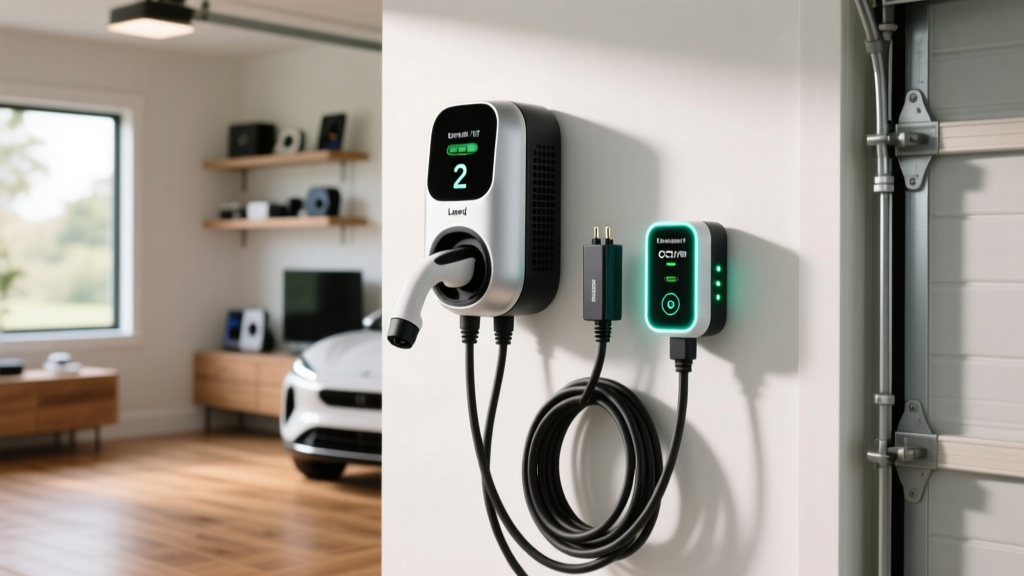
The best home Level 2 chargers in 2025 combine reliable hardware, smart scheduling features (to take advantage of off-peak utility rates), adequate cable length, and proper safety certifications (UL-listed or ETL-listed). Here are specific picks based on power output, connector availability, and real-world reliability:
Emporia Vue Level 2 Smart Charger
- Power: 11.5 kW (48A) on a 60A circuit; configurable down to 40A/32A
- Connector: NACS or J1772 (CCS adapter included in some bundles)
- Cable: 24 feet
- Smart features: Wi-Fi, solar integration, TOU scheduling, energy monitoring via Emporia app
- Price: ~$399–$449
- Best for: Budget-conscious buyers who want full smart features and solar-home integration
ChargePoint Home Flex
- Power: Up to 12 kW (50A) on a 60A circuit; adjustable via DIP switches from 16A–50A
- Connector: NACS or J1772 (configurable at purchase)
- Cable: 23 feet
- Smart features: Wi-Fi, Alexa/Google Home, scheduled charging, ChargePoint app, works with utility demand-response programs
- Price: ~$549–$699
- Best for: Reliability-focused buyers who want a proven brand with broad utility partnerships
Tesla Wall Connector (Gen 4)
- Power: 11.5 kW (48A) on a 60A circuit
- Connector: NACS native; J1772 adapter included for non-Tesla EVs
- Cable: 24 feet
- Smart features: Wi-Fi, OTA firmware updates, Tesla app integration, power sharing between two units on one circuit
- Price: ~$450–$495
- Best for: Tesla owners and mixed-Tesla households; cleanest aesthetic and tightest Tesla ecosystem integration
Grizzl-E Smart (United Chargers)
- Power: 10 kW (40A) on a 50A circuit
- Connector: NACS or J1772
- Cable: 24 feet
- Smart features: OCPP-compatible (works with multiple energy management platforms), adjustable amperage, outdoor-rated (IP65)
- Price: ~$449–$549
- Best for: Outdoor installations and Canadian/cold-climate owners; known for robust build quality in extreme temperatures
Key buying advice: Match the charger's amperage to your circuit (charger draws 80% of breaker rating — a 48A charger needs a 60A breaker). Choose hardwired over plug-in for permanent installations to avoid receptacle overheating risks. Ensure the charger is UL-listed (not just CE-marked, which is a European standard with less rigorous North American testing). And verify that the connector matches your vehicle — buying a J1772 charger for a 2025 NACS vehicle means you'll need an adapter for every home session.
Public Charging Networks: What to Expect in 2025
Public charging in 2025 is more reliable than it was three years ago, but it remains inconsistent by region and network. The major networks and their typical characteristics:
- Tesla Supercharger: Now open to non-Tesla NACS-equipped vehicles via the Tesla app. 150–350 kW (V3 and V4 stalls). Highest uptime (~97%+ per Tesla's reports). Pricing: $0.25–$0.40/kWh depending on location and time.
- Electrify America: 150–350 kW CCS and NACS chargers. Uptime improving but still variable (~85–90% by third-party audits). Pricing: $0.35–$0.55/kWh; Pass+ membership reduces to ~$0.31/kWh.
- EVgo: 100–350 kW; strong urban presence. Pricing: $0.30–$0.50/kWh; subscription plans available.
- ChargePoint: Predominantly Level 2 (6.6–19.2 kW) at retail/workplace; limited DCFC. Pricing set by site host — highly variable ($0.10–$0.49/kWh).
For road trips, plan around Tesla Superchargers if your vehicle is NACS-equipped — the network's reliability advantage is measurable. For CCS vehicles, Electrify America's corridor coverage along major interstates is the most extensive option. Always check PlugShare or your vehicle's built-in navigation for real-time charger status before relying on a specific stop.
Federal and State Incentives for Home Charger Installation
The federal Alternative Fuel Vehicle Refueling Property Credit (IRS Form 8911) covers 30% of home EV charger equipment and installation costs, up to $1,000. However, eligibility is restricted to residences in census tracts that are classified as low-income or non-urban. Check your address against the IRS eligibility tool before counting on this credit.
Many utilities and state energy offices offer additional rebates — commonly $250–$750 off the charger or installation, and sometimes covering panel-upgrade costs. Contact your local utility's EV program page or search the Alternative Fuels Data Center for state-specific incentives. These programs change frequently, so verify current availability before purchasing.
Frequently Asked Questions
How much does it cost to install a home EV charger?
A typical Level 2 home charger installation costs $750–$2,500 when your electrical panel has sufficient capacity (200A service with available breaker slots). If a panel upgrade to 200A is needed, total costs rise to $2,250–$6,500+. The equipment itself runs $300–$700; the rest is electrician labor, conduit, wiring, and permitting. Always get two to three quotes from licensed electricians who have specific EV charger installation experience.
How fast will each charging level add range?
Level 1 (120V) adds 3–5 miles per hour — adequate for plug-in hybrids with small batteries but too slow for most BEV owners. Level 2 (240V) at 11.5 kW adds roughly 35–44 miles per hour, fully recharging most EVs overnight. DC fast charging at 150 kW adds 150–400+ miles per hour at peak rates, but sessions are typically limited to 10–80% in 20–35 minutes due to charge-curve taper above 80%.
Which connector and charger is compatible with my EV?
If your EV is a 2025 model year from Tesla, Ford, GM, Rivian, Hyundai, Kia, BMW, or most other major brands, it uses NACS. Buy a NACS-terminated Level 2 charger. If your EV is a 2024 or older model with CCS1 (common on VW ID.4, older Mustang Mach-E, Bolt EV/EUV), buy a CCS-terminated charger or use a NACS charger with an adapter. CHAdeMO is limited to legacy Nissan Leaf owners — find a compatible charger or plan for eventual vehicle replacement.
How much does charging cost per mile compared to gas?
Home charging on off-peak electricity ($0.08–$0.12/kWh) costs roughly $0.03–$0.04 per mile for an average EV — about one-quarter the cost of gasoline at $3.40/gallon in a 28 MPG vehicle ($0.12/mile). Even on standard residential rates, most EV drivers save $800–$1,500 annually on fuel. Public DC fast charging ($0.35–$0.55/kWh) costs $0.12–$0.18 per mile, approaching gas-car costs, so reserve it for road trips rather than daily use.
What electrical upgrades might I need?
The most common upgrade is a panel replacement from 100A to 200A service, needed in many pre-2000 homes, costing $1,500–$4,000. You may also need a new conduit run from the panel to the charger location (add $200–$800 depending on distance), a sub-panel if the main panel is full, or a utility service upgrade if your transformer cannot support additional load. A licensed electrician's load calculation (typically $100–$200 as a standalone service) will determine exactly what's required before you commit to a charger purchase.