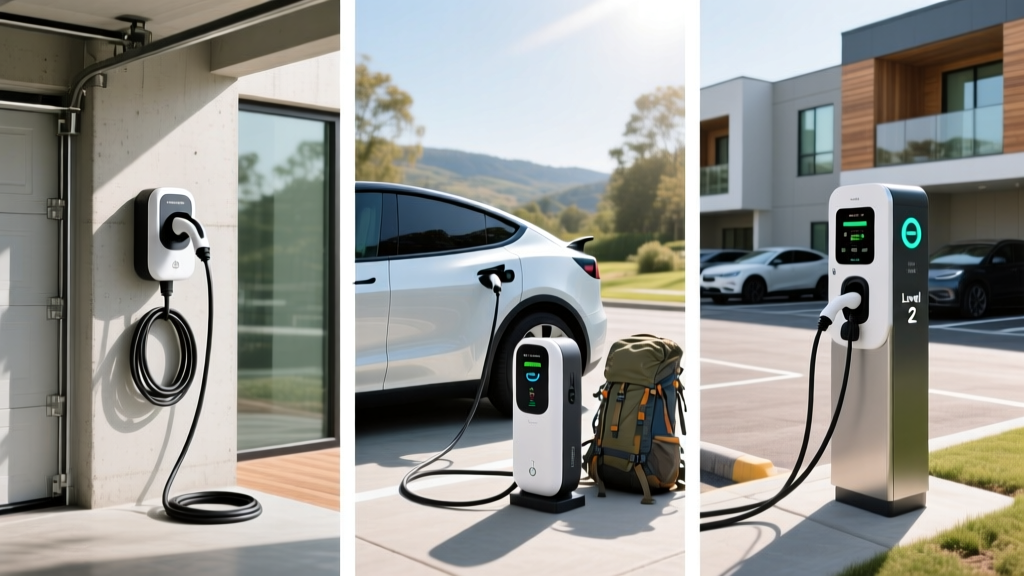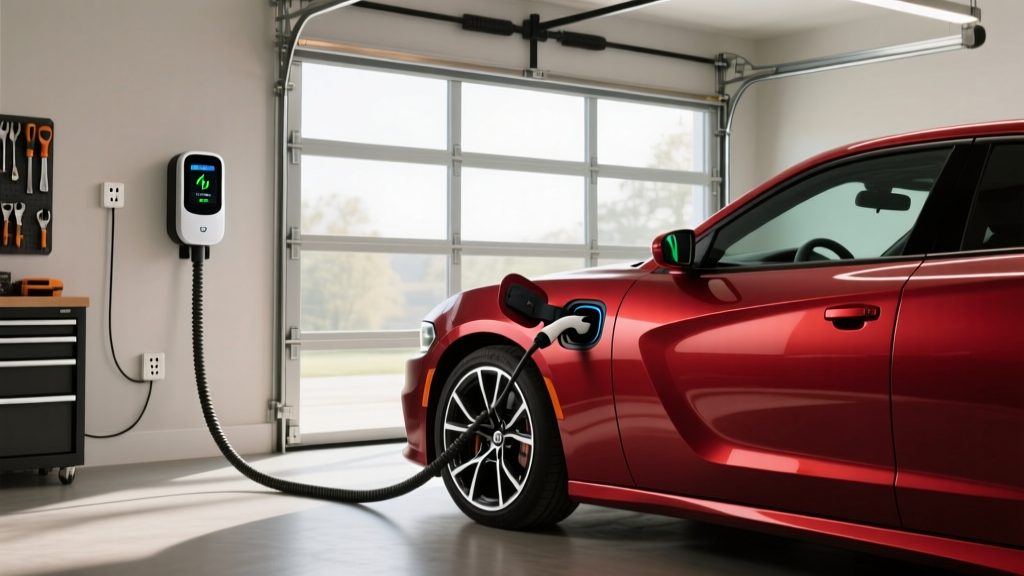
The 2025 Dodge Charger Daytona represents a fundamental shift for the brand: a full battery-electric muscle car built on Stellantis' STLA Large platform. But owning a high-performance EV means getting your home charging infrastructure right before delivery day. Whether you're eyeing the R/T with its 317-mile EPA range or the Scat Pack pushing 590 horsepower, understanding charging requirements, electrical upgrades, and real-world costs is essential to a smooth ownership experience.
This guide breaks down everything you need to know about charging a 2025 Dodge Charger Daytona at home and on the road — from Level 1 trickle charging to DC fast-charging speeds, home installation costs, and how per-mile charging costs stack up against the HEMI V8 you might be trading in.
Understanding Charging Levels: How Fast Will Each Add Range?
Before we talk equipment, let's clarify the single most important distinction in EV charging: kW (kilowatts) measures power — how fast energy flows into your battery. kWh (kilowatt-hours) measures energy — the total capacity of your battery pack. Think of kW as water flow rate through a hose, and kWh as the size of the tank you're filling. The 2025 Dodge Charger Daytona's battery pack holds approximately 100.6 kWh (usable capacity), so the charge rate in kW directly determines how long you're waiting.
| Charging Level | Voltage / Amperage | Power (kW) | Miles of Range Added Per Hour | Typical Use Case |
|---|---|---|---|---|
| Level 1 (120V) | 120V / 12A | ~1.4 kW | ~3-4 miles | Overnight top-up, emergencies |
| Level 2 (240V) | 240V / 32A-48A | 7.7 - 11.5 kW | ~22-33 miles | Daily home charging |
| DC Fast Charge | 400V+ architecture | Up to ~175 kW peak | ~150+ miles in 15 minutes | Road trips, highway corridors |
Real-world context for Charger Daytona owners: Level 1 charging from a standard 120V wall outlet will add roughly 3-4 miles of range per hour. That's enough if you drive under 30 miles daily and can plug in for 10+ hours overnight, but it's impractical as a primary strategy for a 317-mile battery. Level 2 is the home-charging standard — a 48A, 11.5 kW station will replenish the Charger's ~100.6 kWh pack from 10% to 80% in roughly 7-8 hours, meaning you plug in at bedtime and wake up with a full charge. DC fast charging is your road-trip solution: Stellantis rates the Daytona at up to ~175 kW peak on a compatible CCS1 DC fast charger, meaning a 10-80% session takes approximately 28-32 minutes under ideal conditions.
Home Charger Installation: Electrical Requirements and Costs
Installing a Level 2 home charger isn't just buying a wall box — it's an electrical project that requires proper circuit sizing, potentially a panel upgrade, and a permit. Here's what to expect when outfitting your garage for a 2025 Dodge Charger Daytona.
Electrical Requirements
The 2025 Dodge Charger Daytona accepts up to 11.5 kW on Level 2 (48 amps at 240V). To deliver this, you need a dedicated 60-amp circuit (the National Electrical Code requires circuits to be rated at 125% of continuous load, so a 48A charger needs a 60A breaker). If you opt for a 40A charger, a 50A circuit suffices — a more common and slightly less expensive setup in homes with limited panel capacity.
- 48A charger (11.5 kW): Requires a dedicated 60A, 240V circuit with 6 AWG copper wire
- 40A charger (9.6 kW): Requires a dedicated 50A, 240V circuit with 8 AWG copper wire
- 32A charger (7.7 kW): Requires a dedicated 40A, 240V circuit with 10 AWG copper wire
Do You Need a Panel Upgrade?
This is the variable that can double or triple your installation cost. Most modern homes built after 2000 have a 200-amp electrical service panel, which typically has enough spare capacity for a 50A or 60A EV circuit. Older homes — particularly those with 100-amp or 150-amp service — may need a panel upgrade to 200A to safely accommodate an EV charger alongside existing loads like electric dryers, HVAC, and ranges.
A licensed electrician will perform a load calculation (NEC Article 220) to determine whether your panel can handle the additional draw. If you're running near capacity, a panel upgrade to 200A typically costs $1,500-$3,000. In rare cases where your utility service entrance also needs upgrading, costs can reach $4,000-$5,000.
Installation Cost Breakdown
| Cost Component | Simple Install (panel nearby, no upgrade) | Complex Install (long run or panel upgrade) |
|---|---|---|
| Level 2 Charger Equipment | $400 - $750 | $400 - $750 |
| Electrician Labor (2-4 hrs simple; 6-10+ hrs complex) | $300 - $600 | $800 - $2,000 |
| Electrical Materials (wire, conduit, breaker) | $100 - $300 | $300 - $800 |
| Permit Fee | $50 - $150 | $50 - $200 |
| Panel Upgrade (if needed) | $0 | $1,500 - $3,000 |
| Total Estimated Cost | $850 - $1,800 | $3,050 - $6,750 |
The wide range reflects real-world variability: a simple install where your panel is in the garage next to the charger location and has spare capacity might cost under $1,000 all-in. A complex install requiring a 60-foot wire run through finished walls, a new sub-panel, or a full 200A service upgrade can push well past $5,000. Always get at least two quotes from licensed electricians, and confirm they pull a permit — it protects your warranty and your homeowner's insurance coverage.
Connector Compatibility: CCS1, NACS, and the Charger Daytona
The 2025 Dodge Charger Daytona ships with a CCS1 (Combined Charging System) port, which is the current standard used by most non-Tesla EVs in North America. This matters for both home and public charging:
| Connector | Used By | Level 2 AC Charging | DC Fast Charging | Charger Daytona Compatible? |
|---|---|---|---|---|
| CCS1 | Ford, GM, Hyundai, VW, Stellantis, most others | Yes (J1772 upper portion) | Yes | Native — no adapter needed |
| NACS (Tesla) | Tesla; Ford, GM, Rivian, others transitioning 2025+ | Yes | Yes | Requires NACS-to-CCS adapter for Tesla Superchargers |
| CHAdeMO | Nissan Leaf (legacy), Mitsubishi | No | Yes (declining network) | No — not applicable |
What this means practically: For home Level 2 charging, any J1772-connector charger will plug directly into the Charger Daytona — no adapter needed, since CCS1 incorporates the J1772 connector for AC charging. For public DC fast charging, the vast majority of Electrify America, EVgo, and ChargePoint stations have CCS1 cables that connect natively.
The evolving factor is Tesla's Supercharger network, which uses the NACS connector. As of 2025-2026, Stellantis has not announced a native NACS transition for the Charger Daytona. To access Tesla Superchargers, you'll need a NACS-to-CCS adapter (approximately $200-$250 from approved manufacturers). Several automakers are adopting NACS for future model years, so check for Stellantis updates if Supercharger access is a priority for your road-trip planning. You can verify the latest Supercharger access policies on Tesla's NACS support page.
Charging Cost Per Mile: EV vs Gas for the Charger Lineup
One of the strongest ownership arguments for the Charger Daytona over a gas-powered Charger is per-mile fuel cost. Let's compare real numbers using the Charger Daytona Scat Pack (rated at approximately 2.0 kWh/mile or ~100 MPGe combined) against a comparable gas Charger with a 3.6L V6 (~23 MPG combined) and a 5.7L HEMI V8 (~19 MPG combined).
| Scenario | Cost per kWh / Gallon | Charger Daytona EV (per mile) | Gas Charger 3.6L V6 (per mile) | Gas Charger 5.7L V8 (per mile) |
|---|---|---|---|---|
| Home charging (off-peak utility rate) | $0.13/kWh | $0.026 | — | — |
| Home charging (average US rate) | $0.17/kWh | $0.034 | — | — |
| Public Level 2 | $0.30/kWh | $0.060 | — | — |
| DC Fast Charging (public) | $0.40/kWh | $0.080 | — | — |
| Gasoline (US average) | $3.40/gal | — | $0.148 | $0.179 |
The bottom line: Charging at home at the national average electricity rate of ~$0.17/kWh (per EIA data), the Charger Daytona costs roughly $0.034 per mile — about 4-5× cheaper than fueling a gas Charger. Over 15,000 annual miles, that's approximately $510 in electricity vs. $2,220 in gasoline (V6) or $2,685 (V8). Even frequent DC fast charging at $0.40/kWh still undercuts gasoline on a per-mile basis.
Keep in mind: electricity rates vary dramatically by state and utility. California averages ~$0.28/kWh, while Louisiana and Washington can dip below $0.11/kWh. Time-of-use (TOU) plans reward overnight charging with rates as low as $0.08-$0.10/kWh, which maximizes your savings. Check your utility's EV rate plans — many now offer dedicated EV tariffs.
Recommended Level 2 Home Chargers for the Charger Daytona
The Charger Daytona's 11.5 kW onboard charger means you can benefit from a 48A Level 2 station. Here are proven options that match the car's capabilities:
ChargePoint Home Flex
- Power: Up to 12 kW (50A) — configurable down to 16A
- Connector: J1772 (CCS1 compatible)
- Cable length: 23 feet
- Smart features: Wi-Fi, app scheduling, Alexa, energy tracking
- NEMA rating: NEMA 4 (indoor/outdoor)
- Price: ~$550-$650
Best for: Flexibility — adjustable amperage lets you match your circuit capacity without buying a different unit.
Emporia Level 2 EV Charger
- Power: Up to 11.5 kW (48A)
- Connector: J1772 (CCS1 compatible)
- Cable length: 24 feet
- Smart features: Wi-Fi, app with real-time energy monitoring, solar integration
- NEMA rating: NEMA 4 (indoor/outdoor)
- Price: ~$400-$450
Best for: Budget-conscious buyers who still want smart features and full 48A output.
Tesla Wall Connector (with J1772 adapter)
- Power: Up to 11.5 kW (48A)
- Connector: NACS native — requires Tesla J1772 adapter (~$50) for CCS1 vehicles
- Cable length: 24 feet
- Smart features: Wi-Fi, OTA updates, power sharing between units
- NEMA rating: NEMA 3R (outdoor rated)
- Price: ~$425 + adapter
Best for: Households with both a Tesla and a CCS1 vehicle like the Charger Daytona.
Grizzl-E Smart
- Power: Up to 10 kW (40A)
- Connector: J1772 (CCS1 compatible)
- Cable length: 24 feet
- Smart features: Wi-Fi, app, OCPP protocol support
- NEMA rating: NEMA 4 (indoor/outdoor)
- Price: ~$450-$550
Best for: Extreme cold climates — built and tested in Canada, rated to -40°F.
Safety, Code, and Permit Considerations
EV charging involves sustained high-current draw over many hours — this is fundamentally different from plugging in a dryer that cycles on and off. The NEC (National Electrical Code) treats EV charging as a continuous load, which drives several critical requirements:
- Dedicated circuit: Your Level 2 charger must have its own dedicated circuit — it cannot share with other outlets or appliances.
- GFCI protection: NEC 2020 and later require GFCI (Ground Fault Circuit Interrupter) protection for all EV charging outlets. Many modern hardwired chargers have built-in GFCI, but if you're installing a NEMA 14-50 receptacle, your electrician must add a GFCI breaker (adds ~$50-$100 to material costs).
- Outdoor rating: If your charger is mounted outside or in an unenclosed carport, it must carry a NEMA 4 rating (weatherproof against rain, snow, and dust). NEMA 3R is acceptable for covered outdoor locations.
- Permit and inspection: Virtually all jurisdictions require an electrical permit for a new 240V circuit. Your electrician pulls the permit, and a local inspector verifies the work meets code. This typically adds $50-$200 in permit fees and may require a 1-2 week wait for inspection. Skipping the permit risks voiding your homeowner's insurance if an electrical fire occurs.
- Wire gauge and conduit: Your electrician will size wire based on circuit amperage and run length. Longer runs (over 50 feet) may require upsized wire to prevent voltage drop — this adds material cost but is non-negotiable for safety.
Frequently Asked Questions
How much does it cost to install a home EV charger for the 2025 Dodge Charger Daytona?
A straightforward Level 2 installation with an adequate electrical panel typically costs $850-$1,800 including equipment, electrician labor, materials, and permit. If your home needs a panel upgrade (common in homes with 100A or 150A service), total costs can reach $3,000-$6,750. Always get a load calculation from a licensed electrician before committing.
How fast will each charging level add range to the Charger Daytona?
Level 1 (120V) adds approximately 3-4 miles of range per hour — adequate only for very low daily mileage. Level 2 (240V, 48A) adds roughly 28-33 miles per hour, fully replenishing the ~100.6 kWh battery overnight. DC fast charging at up to 175 kW can add 150+ miles in about 15-20 minutes during the optimal 10-50% SoC window.
Which connector and charger is compatible with my 2025 Dodge Charger Daytona?
The Charger Daytona uses a CCS1 port, which accepts any standard J1772 connector for Level 2 AC charging — no adapter needed. For DC fast charging, CCS1 stations at Electrify America, EVgo, and ChargePoint plug in natively. To use Tesla Superchargers, you'll need a NACS-to-CCS adapter. For home charging, any J1772 Level 2 station (ChargePoint Home Flex, Emporia, Grizzl-E) works directly.
How much does charging cost per mile compared to gas?
At the US average residential electricity rate of ~$0.17/kWh, the Charger Daytona costs approximately $0.034 per mile. A gas-powered Charger with the 3.6L V6 at 23 MPG costs about $0.148 per mile at $3.40/gallon. That's roughly a 4× savings per mile, or about $1,700 less per year over 15,000 miles. Even public DC fast charging at $0.40/kWh (~$0.080/mile) undercuts gasoline.
What electrical upgrades might I need for a Level 2 charger?
The most common upgrade is a new dedicated 50A or 60A, 240V circuit run from your panel to the charger location. If your panel is at or near capacity (determined by a NEC Article 220 load calculation), you may need a panel upgrade from 100A/150A to 200A service ($1,500-$3,000). Older homes with outdated wiring (aluminum branch circuits, ungrounded outlets) may need additional remediation. A smart load-management device can sometimes avoid a panel upgrade by throttling charger draw when other appliances are running.
Can I charge the 2025 Dodge Charger Daytona on a regular 120V outlet?
Yes, but slowly. Level 1 charging at 120V delivers roughly 1.4 kW, adding about 3-4 miles of range per hour. A full charge from near-empty would take 60-70 hours. Level 1 is viable as a supplement for low-mileage days or as a backup, but it's not practical as your primary charging strategy for a ~100.6 kWh battery pack.
Does the Charger Daytona qualify for the federal EV tax credit?
Federal tax credit eligibility under IRS §30D depends on several factors that change frequently: the vehicle's MSRP must not exceed $55,000 for sedans, your adjusted gross income must fall below IRS thresholds ($150,000 single / $300,000 joint), and the battery must meet critical-mineral and component sourcing requirements. The Charger Daytona's pricing starts above the sedan MSRP cap for higher trims, which may limit eligibility. Always verify current-year eligibility on the IRS website or with a tax professional before purchasing — rules and qualifying vehicle lists update regularly.