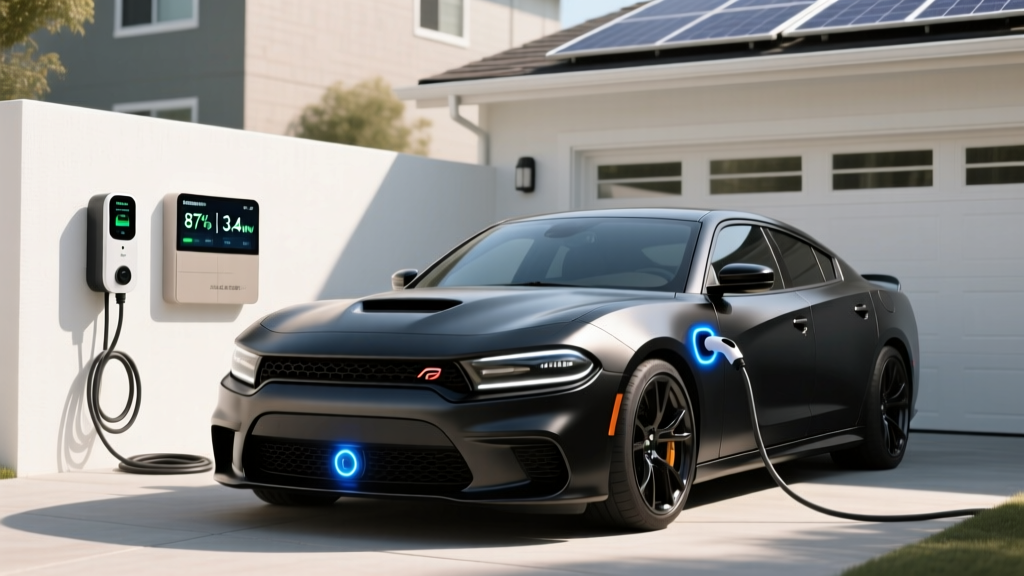
The 2025 Dodge Charger Daytona EV marks Stellantis' first muscle car built on the STLA Large platform, packing up to 670 horsepower and a usable 84 kWh battery. But raw power means nothing if you can't keep it charged. This guide breaks down exactly what Charger Daytona owners — and prospective buyers — need to know about charging at home, on the road, and what the real costs look like per mile.
2025 Dodge Charger Daytona EV: Charging & Battery Specs at a Glance
| Spec | Daytona R/T | Daytona Scat Pack |
|---|---|---|
| Battery (usable) | 84 kWh (NMC) | 84 kWh (NMC) |
| EPA Range | 317 miles | 260 miles |
| Real-World Highway Range | ~260-280 mi | ~215-235 mi |
| Max DC Fast Charge | 183 kW | 183 kW |
| 10-80% DC Fast Time | ~27 minutes | ~27 minutes |
| Level 2 Onboard Charger | 11.5 kW (48A) | 11.5 kW (48A) |
| Connector (Factory) | CCS1 | CCS1 |
| 0-60 mph | 4.7 seconds | 3.3 seconds |
| Horsepower | 496 hp | 670 hp |
| Base MSRP | $59,595 | $73,595 |
| Battery Warranty | 8 yr / 100,000 mi | 8 yr / 100,000 mi |
Before we get into charging logistics, a critical distinction: kW (kilowatts) measures power — how fast energy flows into the battery, like water pressure from a hose. kWh (kilowatt-hours) measures energy capacity — the total amount stored, like the size of the tank. The Charger Daytona has an 84 kWh battery and accepts up to 183 kW of charging power. Confusing these two is the single most common mistake new EV buyers make.
Charging Levels Explained: How Fast Will Each Add Range?
The 2025 Charger Daytona supports three charging tiers. Your daily routine determines which matters most.
| Level | Voltage | Max Power | Miles Added/Hour | Best Use Case |
|---|---|---|---|---|
| Level 1 (120V) | 120V / 12A | ~1.4 kW | ~4-5 mi/hr | Emergency/overnight trickle only |
| Level 2 (240V) | 240V / 48A | 11.5 kW | ~35-40 mi/hr | Daily home charging |
| DC Fast Charge | 400V DC | 183 kW peak | ~400+ mi/hr (peak) | Road trips, rapid top-ups |
Level 1 is essentially useless for an 84 kWh battery. Plugging into a standard 120V outlet adds roughly 4-5 miles of range per hour. A full charge from empty would take over 60 hours — fine for a PHEV with a small pack, impractical for the Daytona.
Level 2 is where daily life happens. At the car's maximum 11.5 kW onboard acceptance rate, you'll add roughly 35-40 miles of range per hour. An overnight session from 20% to 100% takes approximately 7-8 hours on a properly sized 60-amp dedicated circuit (delivering 48 amps continuous). This is the setup most Charger Daytona owners should install at home.
DC Fast Charging is for road trips. The Daytona peaks at 183 kW, but — and this is critical — that peak is not sustained. Like all EVs, the charge curve tapers significantly above 80% state of charge (SoC) to protect the NMC battery chemistry. Expect 10-80% in roughly 27 minutes at a 200+ kW station, but the final 80-100% could take nearly as long. Always plan fast-charge stops around the 10-80% window for time efficiency.
Real-World Range Reality Check
The R/T's EPA 317-mile rating assumes mixed driving at moderate temperatures. In real-world highway testing at 70-75 mph, expect 260-280 miles. In cold weather (below 30°F), NMC batteries lose 15-25% of range due to reduced chemical efficiency and cabin heating demands — putting the R/T closer to 235-265 miles and the Scat Pack near 175-200 miles in winter conditions. Preconditioning the battery while plugged in mitigates some of this loss.
Home Charger Installation: Costs, Electrical Requirements & Panel Upgrades
Installing a Level 2 home charger for the Charger Daytona requires a dedicated 240V circuit — the same voltage as your electric dryer or oven. Here's what the installation actually involves and what it costs.
Electrical requirements: The Daytona's 11.5 kW onboard charger pulls up to 48 amps continuous. Per National Electrical Code (NEC), continuous loads require a circuit rated at 125% of the draw, meaning you need a 60-amp breaker on a dedicated 240V line. Some owners opt for a 50-amp circuit (40A continuous / 9.6 kW), which charges slightly slower but may avoid a panel upgrade.
Home Level 2 Installation Cost Breakdown
| Component | Typical Cost Range | Notes |
|---|---|---|
| Level 2 Charger (Equipment) | $350 - $750 | 48A smart charger, 20-25 ft cable |
| Electrician Labor | $600 - $2,500 | Depends on panel-to-garage distance, conduit runs |
| Electrical Permit | $50 - $300 | Required in most jurisdictions; varies by city/county |
| Panel Upgrade (if needed) | $1,500 - $4,000 | Upgrading from 100A to 200A service; common in older homes |
| Total (no panel upgrade) | $1,000 - $3,550 | Most newer homes with 200A panels |
| Total (with panel upgrade) | $2,500 - $7,550 | Homes with 100A service or maxed-out panels |
The panel upgrade gotcha: If your home has a 100-amp electrical panel or your existing 200-amp panel is near capacity (running electric heat, a hot tub, and multiple large appliances), adding a 60-amp EV circuit may require a service upgrade. This is the single biggest cost variable. Get a licensed electrician to perform a load calculation before committing to a charger purchase.
Safety and code considerations: Your installation must include a dedicated circuit (never share with other appliances), a GFCI breaker if the charger is outdoors or in a garage per local code, and a NEMA 14-60 outlet or hardwired connection. Hardwired installations are generally preferred for 60-amp circuits — they eliminate the outlet as a potential failure point and are required by code in some jurisdictions for circuits above 50 amps. For outdoor installations, ensure your charger carries a NEMA 4 or IP65 weather rating.
For the most current electrical code requirements, consult the National Fire Protection Association's NEC guidelines and always hire a licensed electrician familiar with EV charging installations.
Which Connector Does the 2025 Charger Daytona Use?
The 2025 Dodge Charger Daytona ships with a CCS1 (Combined Charging System) connector — the standard used by most non-Tesla EVs sold in North America. However, the industry is rapidly shifting toward the NACS (North American Charging Standard) connector developed by Tesla, and this creates some adapter considerations for Daytona owners.
| Connector | Charger Daytona Compatible? | Network Access | Adapter Needed? |
|---|---|---|---|
| CCS1 | Yes (native) | Electrify America, EVgo, ChargePoint, Ionity | No |
| NACS (Tesla) | Yes (with adapter) | Tesla Supercharger network (15,000+ stalls) | Yes — CCS-to-NACS adapter (~$200-$250) |
| CHAdeMO | No | Limited legacy stations | N/A — not relevant for this vehicle |
The Tesla Supercharger adapter question: Stellantis has announced that future models will adopt NACS natively, but the 2025 Charger Daytona still uses CCS1. To access Tesla's Supercharger network — the largest and most reliable DC fast-charging network in North America — you'll need a CCS-to-NACS adapter. Tesla sells an official adapter, and third-party options from brands like Lectron are also available. Expect to pay $200-$250. This adapter is worth buying if you road-trip frequently; Supercharger stalls now outnumber CCS stations roughly 2-to-1 in many regions.
For Level 2 home and public AC charging, the J1772 connector is universal across all EVs sold in North America, including the Daytona. No adapter needed for home charging.
Level 2 Charger Recommendations for the Charger Daytona
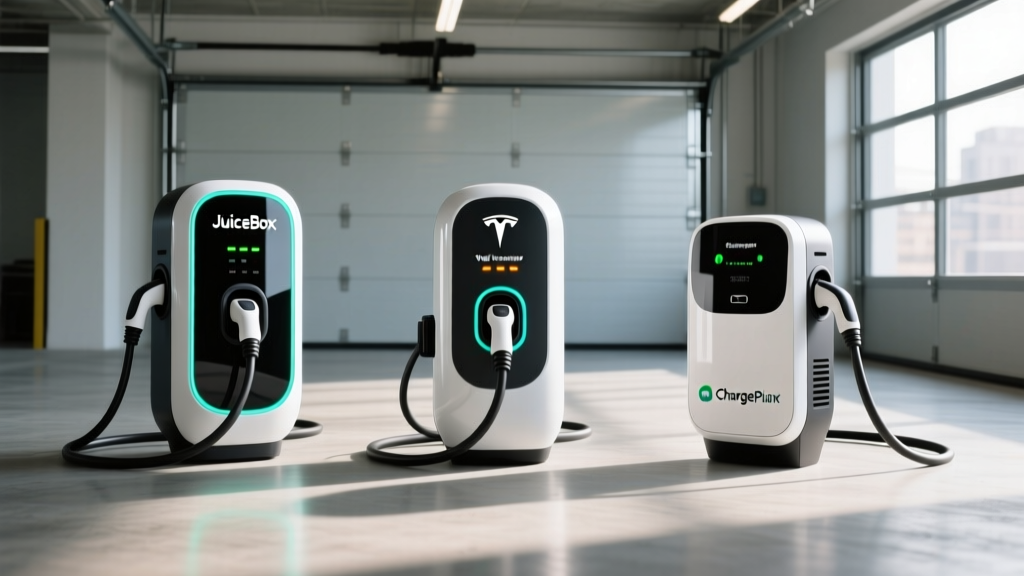
To take full advantage of the Daytona's 11.5 kW onboard charger, you need a 48-amp Level 2 unit on a 60-amp circuit. Here are three proven options that meet the requirements.
Emporia Vue Level 2 Smart Charger
Power: 48A / 11.5 kW | Cable: 24 ft | Connector: J1772 (CCS1 compatible) | Price: ~$399
Features: Wi-Fi connected, energy monitoring, solar integration, scheduled charging, load management. Works with the Emporia home energy monitor for whole-home load balancing — useful if your panel is near capacity. Hardwire or NEMA 14-60 plug. NEMA 4 outdoor rated.
ChargePoint Home Flex
Power: Up to 50A / 12 kW (configurable down to 16A) | Cable: 23 ft | Connector: J1772 | Price: ~$699
Features: Amperage adjustable via app (set to 48A for Daytona), Alexa integration, detailed charging history, ChargePoint network access for public charging. UL listed. Hardwire recommended for 50A+ configurations. NEMA 4 outdoor rated.
Wallbox Pulsar Plus (48A)
Power: 48A / 11.5 kW | Cable: 25 ft | Connector: J1772 | Price: ~$599
Features: Compact form factor, Wi-Fi + Bluetooth, Power Sharing (daisy-chain two units on one circuit), Eco-Smart mode for solar, scheduled charging. Hardwire installation required for 48A. NEMA 4 outdoor rated.
Any of these chargers will fully replenish the Daytona's 84 kWh battery overnight. If you opt for a 50-amp circuit instead of 60-amp, the ChargePoint Home Flex can be dialed down to 40A (9.6 kW) via its app — adding roughly one extra hour to a full charge but potentially avoiding a panel upgrade.
Cost to Charge: Home vs. Public vs. Gas Comparison
One of the strongest arguments for EV ownership is lower fueling cost — but the savings depend heavily on where you charge. Here's how the Charger Daytona stacks up against a comparable gas-powered Dodge Charger Scat Pack (6.4L V8, 16 MPG combined).
| Scenario | Rate | Cost for Full 84 kWh | Cost Per Mile (R/T, 317 mi) |
|---|---|---|---|
| Home — Off-Peak Utility Rate | $0.09/kWh | $7.56 | $0.024/mi |
| Home — Average US Residential | $0.17/kWh | $14.28 | $0.045/mi |
| Public Level 2 (ChargePoint, etc.) | $0.25-$0.35/kWh | $21.00-$29.40 | $0.066-$0.093/mi |
| DC Fast (Electrify America) | $0.38-$0.56/kWh | $31.92-$47.04 | $0.101-$0.148/mi |
| Gas Equivalent (Charger Scat Pack, 16 MPG) | $3.40/gal | N/A | $0.213/mi |
The bottom line: Charging at home on an off-peak utility rate costs roughly 9 times less per mile than fueling a gas Charger Scat Pack. Even at average residential rates, the Daytona costs about $0.045/mile vs. the gas car's $0.213/mile. However, exclusive reliance on DC fast charging narrows the gap significantly — at peak Electrify America rates ($0.56/kWh in some markets), you're paying $0.15/mile, which is still cheaper than gas but not the dramatic savings EV advocates often cite.
For current average electricity rates by state, the U.S. Energy Information Administration publishes monthly residential pricing data.
Charging Time Examples: What to Expect With the 84 kWh Battery
Charging times vary by starting state of charge, station output, and battery temperature. The following examples assume the battery is preconditioned (warmed to optimal charging temperature, which the Daytona does automatically when you navigate to a charger).
| Scenario | Starting SoC | Charger Type | Time to Target |
|---|---|---|---|
| Overnight home charge | 15% | Level 2, 11.5 kW (48A) | ~6.5 hours to 100% |
| Work-day top-up | 40% | Level 2, 7.7 kW (32A public) | ~4.5 hours to 90% |
| Road trip fast charge | 10% | DC Fast, 183 kW peak (200+ kW station) | ~27 minutes to 80% |
| Quick top-up | 30% | DC Fast, 150 kW station | ~20 minutes to 70% |
| Emergency trickle | 5% | Level 1, 1.4 kW (120V) | ~10 hours to 20% |
Charge curve reality: The 183 kW peak only applies roughly between 10-40% SoC. From 40-60%, expect around 140-150 kW. From 60-80%, the rate drops to 80-100 kW. Above 80%, it falls below 50 kW. This is why we always recommend planning road-trip stops around the 10-80% window — the last 20% takes nearly as long as the first 70%.
Federal Tax Credit & Charger Installation Incentives
The 2025 Dodge Charger Daytona R/T starts at $59,595 — under the IRS §30D MSRP cap of $80,000 for sedans. The Scat Pack at $73,595 also qualifies on price. However, eligibility for the full $7,500 federal tax credit depends on several factors that change annually:
- Buyer income caps: Modified AGI must not exceed $150,000 (single), $225,000 (head of household), or $300,000 (joint)
- MSRP caps: $80,000 for sedans — both trims qualify
- Battery sourcing: Critical minerals and battery components must meet phased-in percentages from US/FTA countries — Stellantis sourcing compliance varies by build date
- Point-of-sale transfer: As of 2024, you can transfer the credit to the dealer for an immediate price reduction at purchase
For the home charger itself, the Alternative Fuel Vehicle Refueling Property Credit (IRS §30C) provides up to $1,000 (30% of equipment and installation costs, capped at $1,000 for residential). This credit is available for chargers installed in census tracts classified as low-income or non-urban — check your eligibility on irs.gov.
Frequently Asked Questions
How much does it cost to install a home EV charger for the Dodge Charger Daytona?
Expect $1,000-$3,550 for a standard installation (equipment + electrician + permit) if your home has a 200-amp panel with available capacity. If you need a panel upgrade from 100A to 200A service, add $1,500-$4,000, bringing the total to $2,500-$7,550. Always get a load calculation from a licensed electrician first.
Can I use a Tesla Supercharger with the 2025 Charger Daytona?
Yes, but you need a CCS-to-NACS adapter (~$200-$250). The Daytona ships with a CCS1 connector, while Tesla Superchargers use NACS. With the adapter, you gain access to over 15,000 Supercharger stalls nationwide. Charging speed will be limited to the Daytona's 183 kW peak regardless of the stall's maximum output.
How fast will each charging level add range to the Charger Daytona?
Level 1 (120V): ~4-5 miles per hour. Level 2 (240V, 48A): ~35-40 miles per hour. DC Fast Charging: peaks above 400 miles per hour at 183 kW but tapers significantly above 80% SoC. For daily use, Level 2 at home is the practical standard.
How much does charging cost per mile vs. a gas Dodge Charger?
At home on average US electricity rates ($0.17/kWh), the Daytona costs about $0.045/mile. The gas Charger Scat Pack at 16 MPG and $3.40/gallon costs $0.213/mile — roughly 4.7 times more. Off-peak home rates ($0.09/kWh) drop the Daytona to just $0.024/mile. However, exclusive DC fast charging at peak public rates can push costs to $0.15/mile.
What electrical upgrades might I need for a Level 2 charger?
You need a dedicated 240V/60-amp circuit for full 48A charging. Homes with 100-amp electrical service or panels near capacity may need a service upgrade to 200 amps ($1,500-$4,000). A licensed electrician should perform a load calculation to determine if your existing panel can handle the additional draw alongside your other appliances.
Does cold weather affect the Charger Daytona's charging speed?
Yes. NMC battery chemistry charges slower at low temperatures. Below 30°F, DC fast charging speeds may be reduced by 20-30% until the battery warms up. The Daytona's thermal management system includes battery preconditioning — always navigate to a DC fast charger via the built-in navigation so the car can begin warming the battery before you arrive.