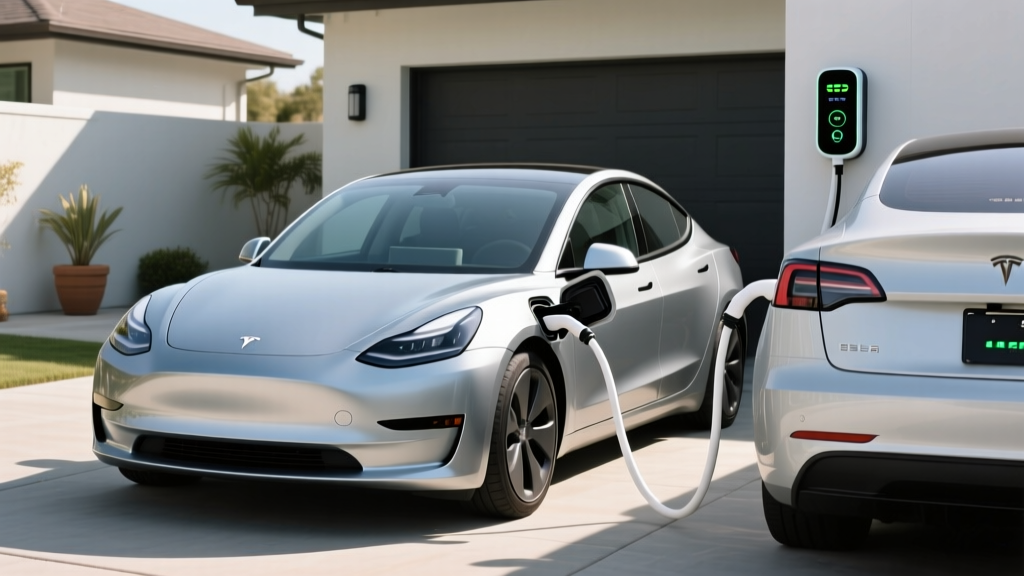
The 2024 Tesla Model 3 Long Range (Highland refresh) pairs a blistering 0-60 mph time of 4.2 seconds with an EPA-estimated 341 miles of range from its 79 kWh (usable) NMC lithium-ion battery. But that performance and range are only as useful as your ability to replenish the pack efficiently. Whether you're evaluating home charging for daily use or planning road trips on Tesla's Supercharger network, understanding the exact charging speeds, costs, and electrical requirements is essential.
This guide breaks down every charging scenario for the 2024 Model 3 Long Range — from a standard 120V wall outlet to a 250 kW DC fast charger — with real numbers, install costs, and equipment picks.
Charging Levels Explained: How Fast Can a Model 3 Long Range Replenish?
EV charging falls into three tiers, each defined by voltage, power output (measured in kilowatts, or kW), and the energy delivered to the battery (measured in kilowatt-hours, or kWh). The distinction matters: kW is the rate of flow (like water pressure), while kWh is the total energy stored (like gallons in a tank). The Model 3 Long Range's 79 kWh battery needs different amounts of time depending on the kW delivered.
| Level | Voltage / Amps | Max Power (kW) | Miles of Range per Hour | 10–80% Time (approx.) |
|---|---|---|---|---|
| Level 1 (120V outlet) | 120V / 12A | ~1.4 kW | ~3–5 mi/hr | ~45+ hours |
| Level 2 (240V home/public) | 240V / 48A | 11.5 kW | ~37–44 mi/hr | ~5.5–6 hours |
| DC Fast Charging | 400V+ architecture | 250 kW (peak) | ~175 mi in 15 min | ~25–30 min (10–80%) |
Real-world caveat: The 250 kW peak rate on a V3 Supercharger is only sustained between roughly 10–30% state of charge (SoC). Above 50%, the charge curve tapers significantly — by 80% you're pulling closer to 40–60 kW. This is why manufacturers quote 10–80% times rather than 0–100%. In cold weather (below 32°F), expect 10–80% DC fast charging to add 5–10 minutes unless you precondition the battery via the car's navigation-routed Supercharger preconditioning.
Home Level 2 Installation: Electrical Requirements, Costs, and Panel Upgrades
For daily ownership, a Level 2 home charger is the backbone of EV convenience. The 2024 Model 3 Long Range accepts up to 11.5 kW on Level 2 (48 amps on a 240V circuit). To deliver that, you need a dedicated 60-amp breaker (electrical code requires circuits to be rated at 125% of continuous load, so 48A × 1.25 = 60A).
Electrical Requirements at a Glance
- Circuit: Dedicated 60A, 240V breaker
- Wire gauge: 6 AWG copper (or 4 AWG aluminum for longer runs)
- Connector: NACS (Tesla's native connector — no adapter needed for the Model 3)
- Outlet option: NEMA 14-50 receptacle (allows charger portability) or hardwired (preferred for 48A+ units)
- Permit: Required in most jurisdictions; electrical permit typically $50–$200
Installation Cost Breakdown
| Component | Low Estimate | High Estimate | Notes |
|---|---|---|---|
| Level 2 Charger (hardware) | $400 | $750 | Tesla Wall Connector, ChargePoint, Emporia |
| Electrician labor | $400 | $1,500 | Depends on run length, wall type, conduit |
| Electrical permit | $50 | $200 | Varies by municipality |
| Panel upgrade (if needed) | $1,500 | $4,000 | 100A → 200A service; older homes may need this |
| Total (no panel upgrade) | $850 | $2,450 | Most homes with 200A service |
| Total (with panel upgrade) | $2,350 | $6,450 | Homes with 100A or maxed-out panels |
Panel upgrade reality check: If your home has a 100-amp electrical panel — common in homes built before the 1990s — adding a 60A EV circuit may max out your service, especially if you run electric HVAC, a dryer, and an oven. A licensed electrician will perform a load calculation (NEC Article 220) to determine whether a panel upgrade to 200A is required. This is the single biggest variable in install cost, and it's one many online guides gloss over. Always get a site assessment before buying hardware.
Connector Compatibility: NACS, CCS, and Adapters
The 2024 Tesla Model 3 Long Range ships with the North American Charging Standard (NACS) connector — Tesla's proprietary plug, now adopted industry-wide. This means:
- Tesla Superchargers: Plug directly in. No adapter. Full access to V3 (250 kW) and V4 stalls.
- CCS1 public chargers (Electrify America, EVgo, etc.): Require a NACS-to-CCS adapter. Tesla sells one for ~$250. Without it, you cannot use CCS-only stations.
- CHAdeMO: Effectively obsolete in the US. No adapter available from Tesla. Avoid reliance on CHAdeMO infrastructure.
| Connector | Native Support? | Adapter Needed? | Network Examples |
|---|---|---|---|
| NACS (Tesla) | Yes — native | No | Tesla Supercharger, Tesla Destination |
| CCS1 | No | Yes (~$250 Tesla adapter) | Electrify America, EVgo, ChargePoint |
| CHAdeMO | No | Not available | Largely deprecated in US |
| J1772 (Level 2 public) | No | Yes (included with vehicle) | Public Level 2 stations, hotels |
The included J1772-to-NACS adapter lets you use any public Level 2 station. For road trips beyond the Supercharger network, the CCS adapter is a worthwhile investment — it opens up thousands of Electrify America and EVgo DC fast chargers.
Cost to Charge: Home vs. Public vs. Gas Comparison
Charging economics depend heavily on where and when you plug in. Here's a realistic breakdown for the 2024 Model 3 Long Range, which consumes approximately 25 kWh per 100 miles (per EPA data).
| Scenario | Rate ($/kWh) | Cost per 100 Miles | Cost per Mile |
|---|---|---|---|
| Home (off-peak utility rate) | $0.08–$0.12 | $2.00–$3.00 | $0.02–$0.03 |
| Home (standard rate) | $0.14–$0.18 | $3.50–$4.50 | $0.035–$0.045 |
| Public Level 2 (ChargePoint, etc.) | $0.20–$0.35 | $5.00–$8.75 | $0.05–$0.09 |
| Tesla Supercharger (V3) | $0.28–$0.40 | $7.00–$10.00 | $0.07–$0.10 |
| Electrify America (DC fast) | $0.35–$0.48 | $8.75–$12.00 | $0.09–$0.12 |
| Gas car (28 MPG, $3.40/gal) | — | $12.14 | $0.12 |
The takeaway: Home charging on an off-peak or time-of-use (TOU) plan is 4–6× cheaper per mile than gasoline. Even exclusive Supercharger use undercuts gas on a cost-per-mile basis. The worst-case EV scenario — frequent DC fast charging at peak public rates — still roughly matches a 28 MPG gas car. For the Model 3 Long Range, a full home charge (0–100%) at $0.12/kWh costs about $9.48 for 341 miles of range.
Many utilities offer EV-specific TOU plans that drop rates to $0.06–$0.09/kWh overnight. If your utility offers this, schedule charging for off-peak hours via the Tesla app to minimize costs. Some utilities also offer rebates of $250–$500 for installing a smart Level 2 charger — check with your provider.
Equipment Picks: Best Home Chargers for the Model 3 Long Range
Since the Model 3 uses NACS natively, you have purpose-built Tesla chargers plus a growing list of third-party options. Here are three strong picks across price and feature tiers:
Tesla Wall Connector (Gen 3)
- Power output: Up to 11.5 kW (48A) on a 60A circuit
- Connector: NACS — native, no adapter
- Cable length: 24 feet
- Smart features: Wi-Fi for OTA firmware updates, load sharing with a second Wall Connector, Tesla app integration
- Price: ~$475
- Best for: Tesla-only households wanting seamless integration
Emporia Vue Level 2 EV Charger
- Power output: Up to 11.5 kW (48A) on a 60A circuit
- Connector: J1772 (NACS adapter included) or NACS version available
- Cable length: 24 feet
- Smart features: Energy monitoring via Emporia app, solar integration, scheduled charging, TOU optimization
- Price: ~$399
- Best for: Homes with solar panels or those wanting detailed energy tracking
ChargePoint Home Flex
- Power output: Up to 12 kW (50A) on a 60A circuit (adjustable down)
- Connector: J1772 (NACS adapter included with newer kits)
- Cable length: 23 feet
- Smart features: Alexa integration, amperage adjustment via app, scheduling, charging history
- Price: ~$699
- Best for: Multi-EV households (non-Tesla vehicles) or those wanting flexible amperage settings
All three units are hardwired-capable, outdoor-rated (NEMA 4), and UL-listed. If you opt for a NEMA 14-50 plug instead of hardwiring, note that the ChargePoint and Emporia units support this; the Tesla Wall Connector can be ordered with a NEMA 14-50 plug as well but limits output to 40A (9.6 kW) due to the receptacle's 50A rating.
Safety, Code, and Installation Considerations
A Level 2 EV charger is a significant continuous electrical load. Proper installation isn't optional — it's a safety and insurance requirement. Key considerations:
- Dedicated circuit: NEC 625 requires EVSE to be on a dedicated circuit. Do not share the breaker with other appliances.
- GFCI protection: NEC 2020 and later require GFCI protection for 14-50 receptacles in garages. Hardwired installations may be exempt depending on local code — your electrician will advise.
- Outdoor rating: If mounting outside, ensure the charger is rated NEMA 4 (weather-resistant). All three picks above meet this standard.
- Cable management: A 24-foot cable draped across a driveway is a tripping hazard and a code violation in some areas. Consider a cable retractor or wall-mounted holster.
- Permit and inspection: Most jurisdictions require an electrical permit and post-install inspection. Skipping this can void home insurance coverage and create liability issues.
Always hire a licensed electrician familiar with NEC Article 625 (Electric Vehicle Charging System Equipment). Ask for a load calculation before committing to a 60A circuit.
2024 Tesla Model 3 Long Range: Key Specs at a Glance
| Specification | Value |
|---|---|
| EPA Range | 341 miles (real-world highway: ~280–310 mi; cold weather: ~250–280 mi) |
| Battery Capacity (usable) | ~79 kWh (NMC chemistry) |
| 0–60 mph | 4.2 seconds |
| Horsepower | ~346 hp (dual motor AWD) |
| Max DC Fast Charge Rate | 250 kW (peak, V3 Supercharger) |
| 10–80% DC Fast Charge Time | ~25–30 minutes |
| Max Level 2 Charge Rate | 11.5 kW (48A) |
| Efficiency | 132 MPGe combined / 25 kWh per 100 mi |
| Base MSRP (Long Range AWD) | ~$47,740 (before incentives) |
| Federal Tax Credit (§30D) | Up to $7,500 (subject to income, sourcing, and MSRP caps — see IRS guidelines) |
| Battery/Drive Unit Warranty | 8 years / 120,000 miles (minimum 70% capacity retention) |
Frequently Asked Questions
How much does it cost to install a home EV charger for a Tesla Model 3?
Expect $850–$2,450 for a straightforward installation (Level 2 charger, electrician labor, and permit) in a home with an adequate 200A electrical panel. If your home requires a panel upgrade from 100A to 200A, add $1,500–$4,000. The Tesla Wall Connector itself costs ~$475. Always get a licensed electrician's load assessment before purchasing hardware.
How fast will each charging level add range to the Model 3 Long Range?
Level 1 (120V) adds roughly 3–5 miles per hour — essentially a trickle, suitable only for emergencies or very low-mileage drivers. Level 2 (240V, 48A) adds approximately 37–44 miles per hour, fully replenishing the battery overnight. DC fast charging at a V3 Supercharger (250 kW peak) can add up to 175 miles in 15 minutes, with a 10–80% session taking about 25–30 minutes.
Which connector and charger is compatible with the 2024 Model 3?
The 2024 Model 3 uses the NACS connector natively. It plugs directly into any Tesla Supercharger or Tesla Wall Connector without an adapter. For CCS1 public DC fast chargers (Electrify America, EVgo), you'll need Tesla's NACS-to-CCS adapter (~$250). The included J1772 adapter covers public Level 2 stations.
How much does charging cost per mile compared to gas?
Home charging on a standard utility rate ($0.14/kWh) costs approximately $0.035–$0.045 per mile in the Model 3 Long Range. Off-peak rates drop this to $0.02–$0.03. A comparable gas car at 28 MPG and $3.40/gallon costs about $0.12 per mile. Even the most expensive public DC fast charging ($0.40+/kWh) costs roughly $0.07–$0.10 per mile — still competitive with or cheaper than gasoline.
What electrical upgrades might I need for a home charger?
The most common upgrade is a panel capacity increase. Homes with 100A service often need a 200A upgrade ($1,500–$4,000) to safely accommodate a 60A EV circuit alongside existing loads. Other potential needs include: running new conduit from the panel to the garage or driveway (adds $200–$800 depending on distance), installing a GFCI breaker for code compliance, or upgrading wiring in older homes. A licensed electrician's load calculation will identify exactly what's required.
Can I charge the 2024 Model 3 Long Range at non-Tesla Supercharger stations?
Yes, with the appropriate adapter. Tesla now sells a NACS-to-CCS adapter (~$250) that enables DC fast charging at Electrify America, EVgo, and other CCS-equipped networks. Many of these networks are also beginning to install NACS cables natively. For Level 2 public charging, the included J1772-to-NACS adapter works at any standard public Level 2 station.