Quick Verdict: Charging the 2024 Kia EV6 Light Long Range
The 2024 Kia EV6 Light Long Range is built on Hyundai Motor Group's E-GMP platform with an 800-volt architecture, which means it can accept DC fast charging at up to 240 kW — placing it among the fastest-charging mainstream EVs on the market. Its 77.4 kWh usable battery delivers an EPA-estimated 310 miles of range (RWD), and a proper home Level 2 setup will replenish that pack from 10% to 100% overnight in roughly 7–8 hours. This guide breaks down exactly what you need to charge the EV6 Light Long Range at home, on the road, and what it all costs per mile.
| Spec | Value |
|---|---|
| Battery (usable) | 77.4 kWh (NMC chemistry) |
| EPA Range (RWD) | 310 miles |
| Real-World Range (highway/cold) | ~250–280 mi highway; ~220–250 mi in freezing temps |
| Max DC Fast Charge Rate | 240 kW peak (800V architecture) |
| 10–80% DC Fast Charge Time | ~18 minutes (ideal conditions) |
| Level 2 Onboard Charger | 10.9 kW (48A) |
| Level 2 10–100% Time | ~7–8 hours |
| Connector (2024 model year) | CCS1 (J1772 + DC pins) |
| EPA Combined MPGe | 134 MPGe |
| Efficiency | 26 kWh/100 mi |
| 0–60 mph | 7.2 seconds (RWD) |
| Horsepower | 225 hp (RWD) |
| Base MSRP (Light Long Range RWD) | ~$42,600 (2024 launch MSRP) |
| Battery/Powertrain Warranty | 10 years / 100,000 miles |
Charging Levels Explained: How Fast Each Adds Range
Before plugging in, it is critical to understand the difference between kW (kilowatts — the rate of power delivery, like water pressure in a hose) and kWh (kilowatt-hours — the amount of energy stored, like gallons in a tank). The EV6's battery holds 77.4 kWh of energy. A charger rated at 11 kW delivers 11 kWh of energy per hour. Higher kW means faster charging, but the actual speed depends on the vehicle's acceptance rate, battery temperature, and state of charge.
| Level | Voltage / Amps | Power (kW) | Miles of Range Added Per Hour | 10–80% Time (77.4 kWh) |
|---|---|---|---|---|
| Level 1 (standard outlet) | 120V / 12A | ~1.4 kW | ~3–4 mi/hr | ~40+ hours (impractical for full charges) |
| Level 2 (home / public AC) | 240V / 48A | 10.9 kW (vehicle-limited) | ~28–32 mi/hr | ~5.5 hours (10–80%); ~7–8 hrs (10–100%) |
| DC Fast Charging | 400–800V DC | Up to 240 kW peak | ~150–200+ mi in 10 min (peak) | ~18 minutes (10–80%, ideal conditions) |
Understanding the DC Fast-Charging Curve
The EV6's advertised 18-minute 10–80% time applies under ideal conditions: battery preconditioned to optimal temperature, a charger capable of 240+ kW, and a low starting state of charge. In practice, the charging curve tapers significantly above 80% SoC to protect the NMC battery cells. Charging from 80–100% on DC fast can add another 20–30 minutes for relatively few miles of range. On road trips, the most time-efficient strategy is to charge from 10–80% and move on rather than waiting for a full top-off.
Also note: many public DC fast chargers max out at 50 kW or 150 kW. On a 50 kW charger, the EV6's 10–80% time stretches to roughly 70–80 minutes. On a 150 kW CCS1 station, expect about 25–30 minutes. Always check the station's rated output before pulling in.
Home Level 2 Installation: Requirements, Costs & Electrical Upgrades
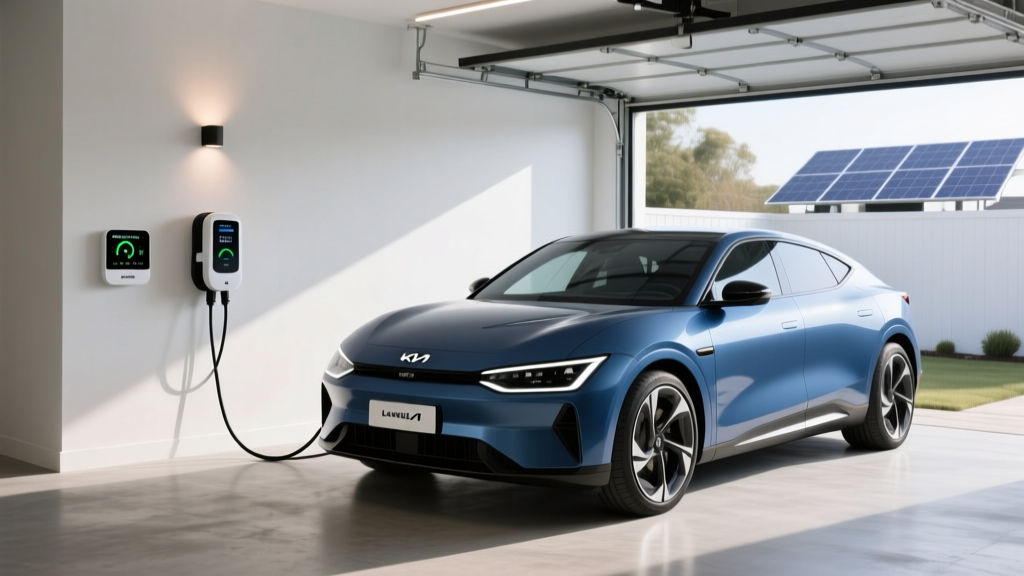
A Level 2 home charger is the backbone of practical EV ownership. For the EV6 Light Long Range, you want a charger capable of delivering at least 40A continuous (9.6 kW) or ideally 48A (11.5 kW) to match the vehicle's 10.9 kW onboard charger. This requires a dedicated 240V circuit — typically a 50A or 60A breaker, since the National Electrical Code (NEC) requires circuits to be rated at 125% of the continuous load.
Electrical Requirements for the EV6 at Home
- Circuit: Dedicated 50A (for 40A chargers) or 60A (for 48A chargers) 240V breaker
- Outlet: NEMA 14-50 (50A) or hardwired connection (60A); a NEMA 6-50 is also an option for 40A circuits
- Wire gauge: 6 AWG copper for 50A; 4 AWG copper for 60A (may vary by run length and local code)
- GFCI protection: Required by NEC 2020+ for receptacle-based EV charging; hardwired units may not require a GFCI breaker, which avoids nuisance tripping
- Outdoor rating: If installing in a garage-exterior or driveway location, the charger must carry a NEMA 4 (weatherproof) rating
Panel Upgrade: The Hidden Cost Many Buyers Miss
Most modern homes with a 200A electrical panel can accommodate a 50A or 60A EV circuit without issue. However, older homes with 100A service, homes with heavy existing loads (electric heat, tankless water heater, electric range, dryer), or homes where the panel is at capacity may require a service upgrade to 200A — adding $1,500–$4,000+ to the project. Before purchasing a charger, have a licensed electrician perform a load calculation to determine if your panel can handle the additional draw.
| Item | Typical Cost Range | Notes |
|---|---|---|
| Level 2 Charger (Equipment) | $350–$700 | Smart Wi-Fi chargers cost more; dumb chargers are cheaper |
| Electrician Labor | $400–$1,200 | Depends on panel proximity, wall type, conduit run length |
| Materials (wire, conduit, breaker) | $100–$300 | Longer runs and 60A circuits cost more in copper |
| Permit & Inspection | $50–$250 | Varies by municipality; some jurisdictions waive for EV installs |
| Panel Upgrade (if needed) | $1,500–$4,000+ | 100A→200A service upgrade; not required in most homes |
| Total (no panel upgrade) | $900–$2,450 | Most homeowners fall in this range |
| Total (with panel upgrade) | $2,400–$6,500+ | Older homes or high-load homes |
Always hire a licensed electrician and pull a permit. Unpermitted EV charger installations can void homeowner's insurance coverage and create a fire risk. The National Electrical Code (NEC) has specific requirements for EV charging circuits, and local inspectors enforce them.
Connector Compatibility: CCS1, NACS & Adapter Options
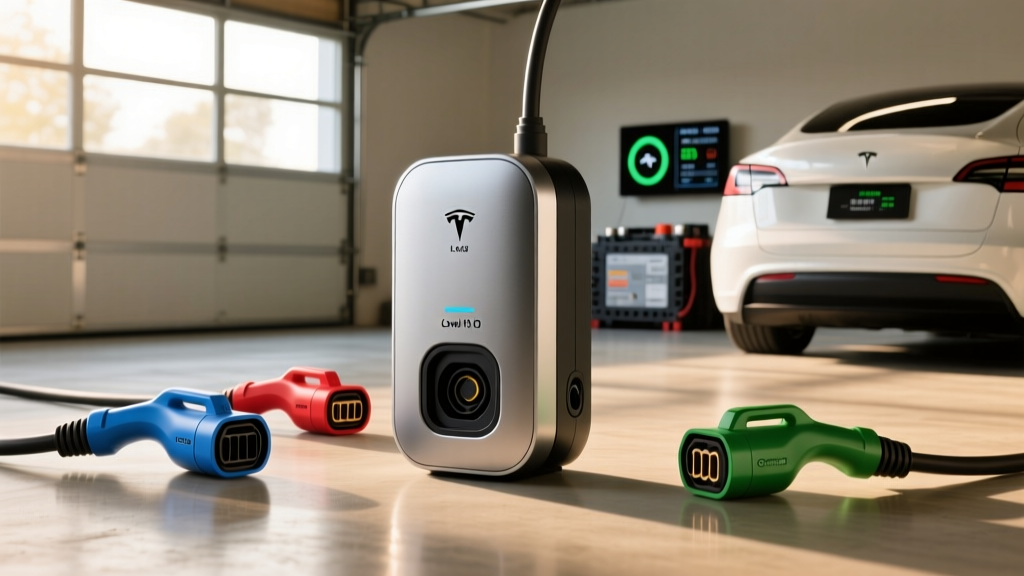
The 2024 Kia EV6 ships with a CCS1 (Combined Charging System) port, which combines a J1772 AC connector with two DC fast-charging pins below it. This is the standard for most non-Tesla EVs sold in North America through the 2024 model year. However, the charging landscape is shifting rapidly toward Tesla's NACS (North American Charging Standard) connector.
| Connector Type | Native Compatibility | Adapter Needed? | Network Access |
|---|---|---|---|
| CCS1 (J1772 + DC) | Yes — native port on 2024 EV6 | No | Electrify America, EVgo, ChargePoint, most non-Tesla networks |
| NACS (Tesla) | No — native on 2025+ Kia models | Yes — CCS1-to-NACS adapter | Tesla Supercharger network (via adapter; Kia has confirmed compatibility) |
| CHAdeMO | No | No adapter available (obsolete standard) | Legacy Nissan Leaf infrastructure; increasingly rare |
| J1772 (AC only) | Yes — via CCS1 upper port | No | All public Level 2 stations |
Key takeaway for 2026 owners: Kia began equipping 2025+ EV6 models with NACS ports natively. For your 2024 EV6 with CCS1, Kia and third-party manufacturers offer CCS1-to-NACS adapters (typically $200–$300) that enable access to the Tesla Supercharger network. This dramatically expands your road-trip charging options, as Tesla's Supercharger network remains the most reliable and widespread DC fast-charging infrastructure in North America. Check Kia's official accessory store or certified adapter manufacturers for compatibility confirmation.
Cost to Charge: $/kWh Scenarios & Cost Per Mile vs Gas
One of the strongest ownership arguments for the EV6 Light Long Range is the per-mile fuel cost. The vehicle's EPA efficiency is 26 kWh per 100 miles (or 0.26 kWh/mi). Using that figure, we can calculate real charging costs across different scenarios.
| Scenario | $/kWh | Cost Per Mile | Cost for 310-Mi Full Range |
|---|---|---|---|
| Home (off-peak utility rate) | $0.08–$0.12 | $0.021–$0.031 | $6.50–$9.60 |
| Home (average US residential) | $0.16 | $0.042 | $13.00 |
| Public Level 2 (ChargePoint, etc.) | $0.20–$0.35 | $0.052–$0.091 | $16.10–$28.20 |
| DC Fast (Electrify America / EVgo) | $0.35–$0.55 | $0.091–$0.143 | $28.20–$44.30 |
| Tesla Supercharger (via adapter) | $0.25–$0.40 | $0.065–$0.104 | $20.20–$32.20 |
Compared to a Gas Vehicle
According to fueleconomy.gov, a comparable gas-powered midsize crossover averaging 27 MPG combined at $3.40/gallon costs approximately $0.126 per mile in fuel alone. The EV6 Light Long Range charged at home at average residential rates costs roughly $0.042 per mile — a savings of about 67%. Even at public DC fast-charging prices ($0.35–$0.55/kWh), the EV6 often matches or slightly undercuts gasoline on a per-mile basis.
Over 15,000 miles per year, home charging at $0.16/kWh costs roughly $630 in electricity. The same distance in a 27 MPG gas car at $3.40/gallon costs about $1,889 — an annual fuel savings of roughly $1,260. Over a 5-year ownership period, that is $6,300 in fuel savings before factoring in reduced maintenance (no oil changes, fewer brake replacements due to regenerative braking).
Equipment Recommendations: Best Home Chargers for the EV6
To maximize the EV6's 10.9 kW onboard charger, you want a Level 2 unit that can deliver at least 48A. Below are well-regarded options across different budgets, all compatible with the CCS1/J1772 port.
ChargePoint Home Flex (NEMA 14-50 or Hardwired)
- Power Output: Up to 11.5 kW (48A hardwired) / 9.6 kW (40A on 14-50 plug)
- Cable Length: 23 feet
- Connector: J1772 (plugs directly into EV6 CCS1 port)
- Smart Features: Wi-Fi, app scheduling, Alexa/Google Home, energy tracking
- Price: ~$550–$650
- Best For: EV owners who want app control and flexible amperage settings
Emporia Level 2 EV Charger
- Power Output: Up to 11.5 kW (48A hardwired) / 9.6 kW (40A on plug)
- Cable Length: 24 feet
- Connector: J1772
- Smart Features: Wi-Fi, app, solar integration, energy monitoring, load management
- Price: ~$400–$500
- Best For: Budget-conscious buyers with solar panels or energy monitoring needs
Grizzl-E Smart (United Chargers)
- Power Output: Up to 10 kW (40A)
- Cable Length: 24 feet
- Connector: J1772
- Smart Features: Wi-Fi, OCPP-compatible, adjustable amperage, extreme cold rating (-40°F)
- Price: ~$450–$550
- Best For: Cold-climate owners who need rugged, outdoor-rated durability
Wallbox Pulsar Plus
- Power Output: Up to 11.5 kW (48A hardwired)
- Cable Length: 25 feet
- Connector: J1772
- Smart Features: Wi-Fi + Bluetooth, app scheduling, Power Sharing (dual charger), compact size
- Price: ~$550–$650
- Best For: Tight garage spaces and multi-EV households
For the EV6 Light Long Range specifically, hardwiring a 48A charger on a 60A circuit is the optimal setup — it matches the vehicle's 10.9 kW onboard charger and avoids the GFCI nuisance-tripping issues that sometimes plague NEMA 14-50 receptacles. If you prefer plug-in flexibility for portability, a 14-50 outlet with a 40A charger delivers 9.6 kW, which still charges the 77.4 kWh battery overnight comfortably.
Safety, Code & Best Practices
EV charging draws sustained high current for hours — this is fundamentally different from short-duration appliance loads. Follow these safety guidelines:
- Dedicated circuit only: Never share the EV charger circuit with other appliances. The NEC requires a dedicated branch circuit for EVSE.
- Hardwired vs. plug-in: Hardwired installations eliminate the receptacle as a failure point, avoid GFCI tripping issues, and allow higher amperage (48A+). Plug-in (NEMA 14-50) offers portability but limits you to 40A continuous.
- GFCI: NEC 2020 and later require GFCI protection for receptacle-based EV charging. Many EVSE manufacturers recommend hardwiring specifically to avoid double-GFCI conflicts (one in the breaker, one in the charger).
- Outdoor rating: Any charger mounted outside must carry at least a NEMA 4 rating. All recommended chargers above meet this standard.
- Cable management: Use a wall-mounted cable organizer to prevent tripping hazards and connector damage. Never let the cable rest on the ground where vehicles can drive over it.
- Permit and inspection: Always pull an electrical permit and schedule a final inspection. This protects your insurance coverage and ensures code compliance.
- Preconditioning: Use the EV6's scheduled departure feature to precondition the battery before DC fast charging or before leaving in cold weather. A warm battery charges faster and delivers more range.
2024 Kia EV6 Light Long Range: Tax Credit & Ownership Notes
The 2024 Kia EV6 is assembled in West Point, Georgia, which made it eligible for the federal §30D EV tax credit (up to $7,500) at the time of purchase, subject to buyer income limits (AGI caps: $150K single / $300K joint), MSRP caps ($55,000 for sedans, $80,000 for SUVs/vans — the EV6 classifies as a small SUV), and critical-mineral/battery-component sourcing requirements. Under current IRS §30D rules, the credit can be transferred to the dealer at point of sale for an instant price reduction.
However, battery-sourcing requirements have tightened significantly since 2024, and eligibility for the full credit varies by production batch and model year. Always verify current eligibility using the IRS clean vehicle credit tool at fueleconomy.gov before purchasing. If buying a used 2024 EV6, the §25E used clean vehicle credit (up to $4,000 or 30% of sale price, whichever is lower) may apply, subject to income caps and a $25,000 maximum sale price threshold.
Frequently Asked Questions
How much does it cost to install a home EV charger for the 2024 Kia EV6?
Most homeowners pay between $900 and $2,450 for a complete Level 2 installation (charger + electrician + materials + permit) when no panel upgrade is needed. If your home requires a 100A-to-200A service upgrade, total costs can reach $2,400–$6,500+. Get at least two quotes from licensed electricians and request a load calculation before committing.
How fast will each charging level add range to the EV6?
Level 1 (120V) adds roughly 3–4 miles of range per hour — adequate only for emergency trickle charging. Level 2 (240V, 48A) adds about 28–32 miles per hour, fully replenishing the 77.4 kWh battery overnight in 7–8 hours. DC fast charging at 240 kW can add approximately 150–200 miles in a 10-minute session under ideal conditions, with a 10–80% charge in about 18 minutes.
Which connector is compatible with the 2024 Kia EV6?
The 2024 EV6 uses a CCS1 port (J1772 for AC + two DC pins). It is natively compatible with all CCS1-equipped public chargers (Electrify America, EVgo, ChargePoint). To access Tesla Superchargers, you need a CCS1-to-NACS adapter ($200–$300). CHAdeMO is not compatible and no adapter exists.
How much does charging cost per mile compared to gas?
Charging at home at the US average residential rate ($0.16/kWh), the EV6 costs about $0.042 per mile. A comparable 27 MPG gas crossover at $3.40/gallon costs about $0.126 per mile. That is roughly a 67% per-mile savings with home charging, translating to $1,200+ in annual fuel savings for a driver covering 15,000 miles per year.
What electrical upgrades might I need for a Level 2 charger?
You need a dedicated 240V circuit with a 50A or 60A breaker. Homes with a 200A panel and moderate existing loads usually accommodate this without issue. Homes with 100A service, heavy electric loads, or an already-maxed-out panel may need a service upgrade ($1,500–$4,000+). A licensed electrician can perform a load calculation to determine your specific needs.
Does the EV6's 800V architecture really make a difference for charging?
Yes. The E-GMP platform's 800-volt architecture allows the EV6 to accept higher charge power (up to 240 kW) without requiring proportionally higher current, which reduces heat and cable weight. On a 350 kW-capable charger, the EV6 charges significantly faster than 400V competitors like the Volkswagen ID.4 (peak ~170 kW) or Subaru Solterra (peak ~100 kW). However, you must use a charger rated for 240+ kW to see the full benefit — a 150 kW station will bottleneck the EV6's capability.
Should I precondition the battery before DC fast charging?
Absolutely. The EV6's thermal management system can precondition the battery when you navigate to a DC fast charger via the built-in route planner. A preconditioned battery (roughly 70–95°F) charges significantly faster, especially in cold weather. Without preconditioning, peak charge rates may be cut by 30–50% until the battery warms up. Use the scheduled departure feature for daily charging and the navigation preconditioning feature for road trips.