Why the 2023 Tesla Model Y Long Range AWD Demands a Smart Charging Strategy
The 2023 Tesla Model Y Long Range AWD remains one of the most popular electric vehicles on the road in 2026, and for good reason. With an EPA-estimated 330 miles of range, a 75 kWh usable battery (NMC chemistry), and peak DC fast charging at 250 kW, it's a capable daily driver and road-trip machine. But owning one means understanding how to charge it efficiently — at home, at work, and on the highway.
This guide covers every charging scenario Model Y Long Range owners face, from a standard 120V outlet to a 250 kW Supercharger, with real costs, install requirements, and equipment picks.
Battery: 75 kWh usable (NMC lithium-ion)
EPA Range: 330 miles (real-world highway: ~275–295 mi; cold weather: ~230–260 mi)
Max DC Fast Charge: 250 kW (10–80% in ~22 minutes)
Max Level 2 (AC): 11.5 kW / 48A onboard charger
Connector: NACS (Tesla proprietary — native Supercharger access)
Efficiency: 122 MPGe combined (fueleconomy.gov)
Charging Levels Explained: How Fast Will Each Add Range?
EV charging comes in three tiers. The critical distinction: kW (kilowatts) measures power — how fast energy flows into your battery. kWh (kilowatt-hours) measures energy — the total capacity of your battery. Think of kW as the width of a hose and kWh as the size of the bucket.
| Level | Voltage | Max Power (kW) | Miles of Range Added Per Hour | Typical Use Case |
|---|---|---|---|---|
| Level 1 (120V) | 120V AC | 1.4 kW | ~3–5 mi/hr | Emergency / overnight trickle |
| Level 2 (240V) | 240V AC | 11.5 kW (48A) | ~37–44 mi/hr | Home daily charging |
| DC Fast Charging | 400V+ DC | 250 kW peak | ~162 mi in 15 min (peak) | Road trips / Superchargers |
Real-world note on DC fast charging: The Model Y Long Range peaks at 250 kW only when the battery is warm (preconditioned) and at a low state of charge (below ~30%). Above 50% SoC, the charge curve tapers significantly — expect ~100–120 kW at 60%, dropping to ~40 kW above 85%. This is why Tesla quotes 10–80% times (~22 minutes) rather than 0–100%.
Home Level 2 Charging: Electrical Requirements and Installation Costs
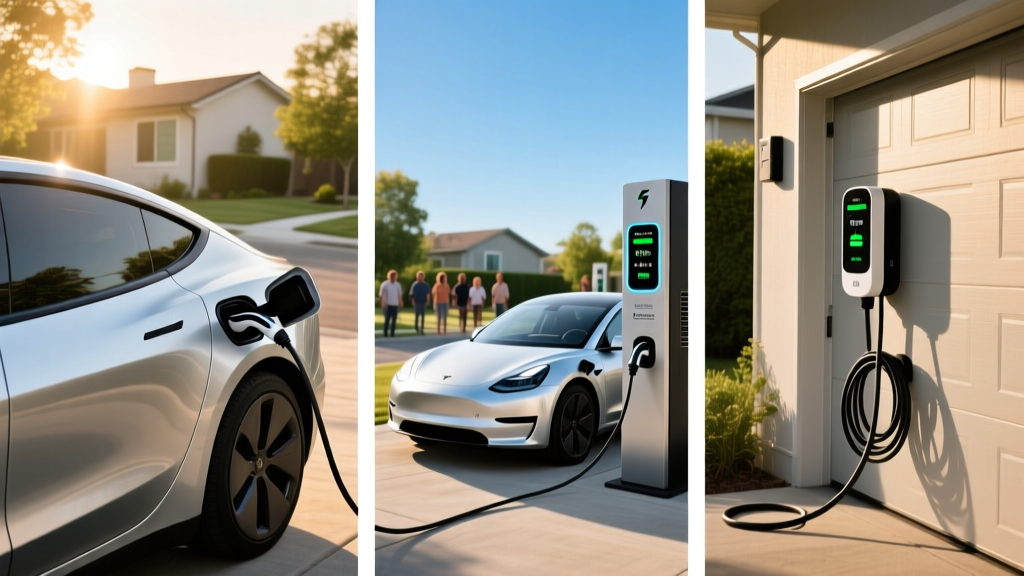
Level 2 home charging is where most Model Y owners do 90%+ of their charging. The 2023 Model Y Long Range has an 11.5 kW (48-amp) onboard charger, meaning it can accept up to 48 amps from a 240V circuit. To deliver that, you need a 60-amp dedicated circuit (the National Electrical Code requires circuits to be rated at 125% of the continuous load — 48A × 1.25 = 60A).
Electrical Panel Considerations
Before installing, check your home's electrical panel. Most modern homes have a 200-amp main panel, which can typically accommodate a 60-amp EV circuit. However:
- Older homes (100-amp service): A panel upgrade to 200A may be required — adding $1,500–$3,000 to the project.
- Maxed-out panels: If your panel is near capacity (large HVAC, electric oven, dryer), an electrician may recommend a load-management device or sub-panel.
- Distance from panel to garage: Longer wire runs (100+ feet) increase material costs significantly — roughly $8–$15 per linear foot for 6-gauge wire.
Installation Cost Breakdown
| Component | Low End | High End | Notes |
|---|---|---|---|
| Level 2 Charger (hardware) | $400 | $700 | Wall Connector, ChargePoint, Emporia |
| Electrician labor (60A circuit) | $600 | $1,800 | Depends on wire run length and complexity |
| Electrical permit | $50 | $200 | Varies by municipality |
| Panel upgrade (if needed) | $1,500 | $3,000 | Only for 100A service or full panels |
| Total (no panel upgrade) | $1,050 | $2,700 | Most homes fall in $1,200–$1,800 |
| Total (with panel upgrade) | $2,550 | $5,700 | Older homes or high-load situations |
Tip: Some utilities offer rebates of $200–$500 for Level 2 charger installation. Check with your local provider. The federal Alternative Fuel Vehicle Refueling Property Credit (30C) may cover up to 30% of installation costs (max $1,000) if you live in an eligible census tract — consult a tax professional for eligibility.
Connector Compatibility: NACS, CCS, and Adapters
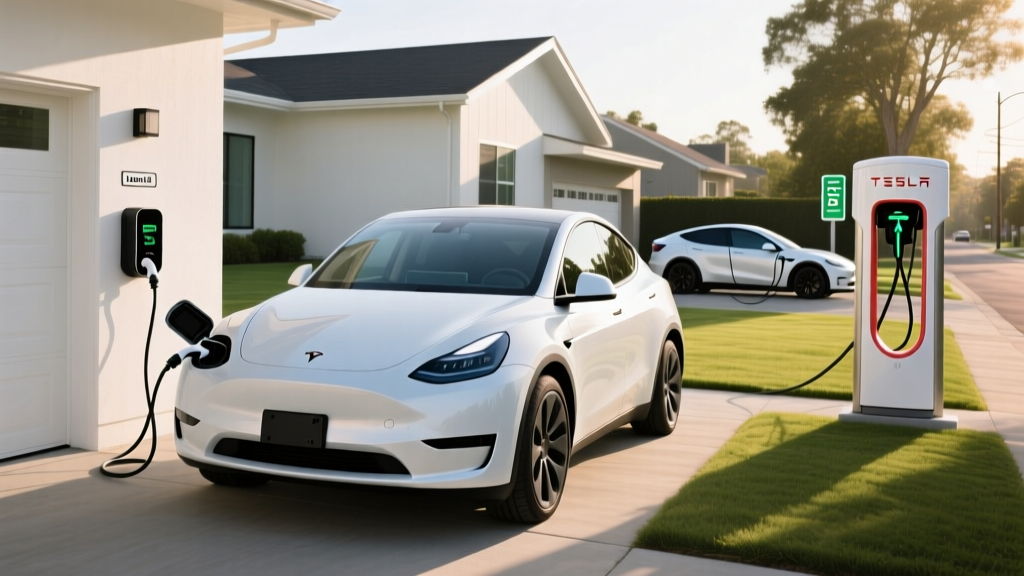
The 2023 Tesla Model Y Long Range AWD uses the NACS (North American Charging Standard) connector — Tesla's proprietary plug, now adopted industry-wide. This gives you native access to the entire Tesla Supercharger network (17,000+ stalls in North America) without any adapter.
| Connector Type | Native Compatibility? | Adapter Needed? | Network Access |
|---|---|---|---|
| NACS (Tesla) | Yes — built in | No | Tesla Superchargers, Destination Chargers |
| CCS1 | No | Tesla CCS Adapter (~$175) | Electrify America, EVgo, ChargePoint DC stations |
| CHAdeMO | No | Not available (Tesla does not support) | Legacy Nissan Leaf network — avoid |
| J1772 (Level 2 public) | No | Tesla J1772 Adapter (included with car) | Public Level 2 stations everywhere |
Practical advice: For road trips beyond Supercharger coverage, the Tesla CCS Adapter is worth the $175 investment. It unlocks Electrify America and other CCS networks, giving you backup options in rural areas. The J1772 adapter (included in your glovebox) handles public Level 2 stations at hotels and shopping centers.
Cost to Charge: Home vs. Public vs. Gas Comparison
One of the strongest arguments for the Model Y Long Range is fuel cost savings. Here's how charging costs break down across scenarios, based on the 75 kWh battery and 330-mile EPA range:
| Scenario | Rate ($/kWh) | Cost for Full Charge (75 kWh) | Cost Per Mile | Annual Cost (12,000 mi) |
|---|---|---|---|---|
| Home (off-peak utility rate) | $0.12 | $9.00 | $0.027 | $324 |
| Home (average US rate) | $0.17 | $12.75 | $0.039 | $468 |
| Public Level 2 (ChargePoint, etc.) | $0.25–$0.39 | $18.75–$29.25 | $0.057–$0.089 | $684–$1,068 |
| Tesla Supercharger (avg) | $0.30–$0.40 | $22.50–$30.00 | $0.068–$0.091 | $816–$1,092 |
| Gas equivalent (25 MPG avg, $3.50/gal) | — | — | $0.140 | $1,680 |
Bottom line: Home charging at off-peak rates saves the average Model Y owner roughly $1,200–$1,350 per year compared to a comparable gas SUV getting 25 MPG. Even exclusive Supercharger use saves $500–$850 annually. These figures make the home charger installation pay for itself within 1–2 years.
Best Home Chargers for the 2023 Tesla Model Y Long Range
Since the Model Y's onboard charger maxes out at 11.5 kW (48A), you'll want a Level 2 unit that can deliver at least that. Here are top picks for 2026:
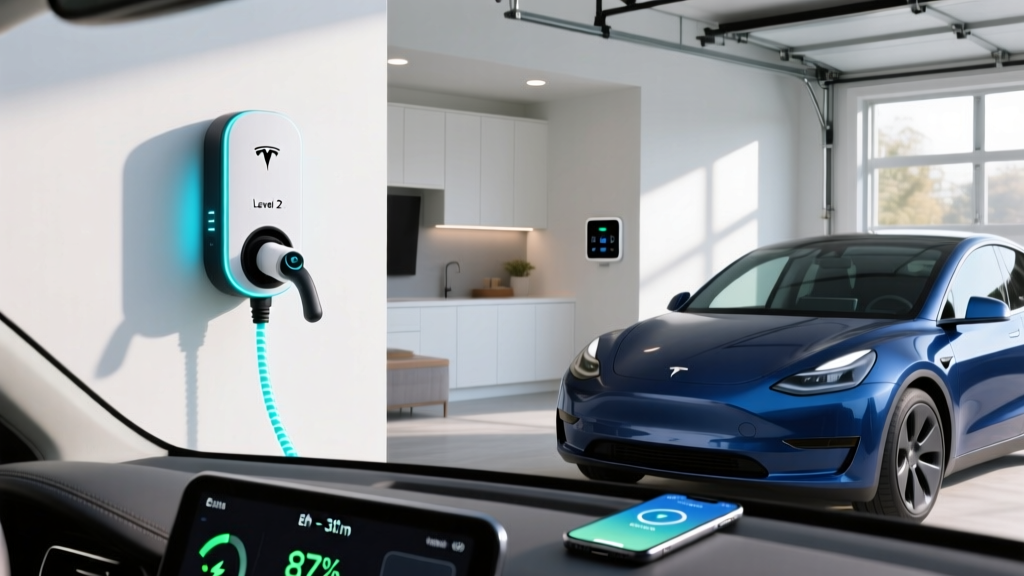
Tesla Wall Connector
Power: 11.5 kW (48A)
Connector: NACS (native — no adapter)
Cable length: 24 ft
Smart features: Wi-Fi updates, Power Sharing (link multiple units), load management
Price: ~$475
Verdict: The default choice. Seamless Tesla integration, fastest Level 2 charge your Model Y can accept. No app needed — plug and charge.
ChargePoint Home Flex
Power: Up to 12 kW (50A) — configurable 16–50A
Connector: J1772 (use Tesla's included adapter) or NACS pigtail
Cable length: 23 ft
Smart features: App scheduling, Alexa integration, detailed energy tracking
Price: ~$550
Verdict: Best for multi-EV households (non-Tesla + Tesla). Flexible amperage lets you match your circuit capacity.
Emporia Vue Level 2 Charger
Power: Up to 11.5 kW (48A)
Connector: J1772 or NACS
Cable length: 24 ft
Smart features: Solar integration, real-time energy monitoring, EV-only circuit tracking
Price: ~$400
Verdict: Best value pick. Excellent if you have solar panels and want to charge only on excess production.
Safety, Code, and Installation Best Practices
A Level 2 charger draws significant current for hours at a time. Proper installation isn't optional — it's a fire-safety necessity.
- Dedicated circuit: Your EV charger must have its own dedicated 60A breaker. Never share a circuit with a dryer, oven, or HVAC unit.
- GFCI protection: NEC 2020 and later requires GFCI protection for outdoor receptacles. For hardwired indoor installations, this may not apply — your electrician will advise based on local code.
- Outdoor rating: If mounting outside, ensure the charger is NEMA 4 rated (weatherproof). The Tesla Wall Connector and ChargePoint Home Flex both carry NEMA 4 ratings.
- Hardwired vs. plug: Hardwired installations (no plug) are preferred for 48A+ circuits. A NEMA 14-50 receptacle is rated for 50A but only 40A continuous — it cannot safely deliver 48A continuously. If you want full 48A, go hardwired.
- Permit and inspection: Most jurisdictions require an electrical permit and post-installation inspection. Skipping this can void home insurance coverage in the event of an electrical fire.
DC Fast Charging on Road Trips: Superchargers and Beyond
The 2023 Model Y Long Range's 250 kW peak charge rate puts it among the faster-charging EVs available. On a Tesla Supercharger V3 or V4 stall:
- 10–80% charge: ~22 minutes (preconditioned battery)
- Range added in 15 minutes: ~162 miles (EPA basis)
- Full 10–100%: ~55 minutes (the final 20% tapers to ~15–25 kW)
Preconditioning matters. When you navigate to a Supercharger in the Tesla app or in-car navigation, the car automatically warms the battery to optimal temperature (roughly 95°F). Without preconditioning — for example, arriving at a non-Tesla DC charger without the car knowing — peak charge rates may be limited to 150–180 kW for the first several minutes, especially in cold weather.
Non-Tesla DC chargers: With the Tesla CCS Adapter, the Model Y can charge at Electrify America, EVgo, and other CCS networks. Expect similar speeds at 350 kW-rated stations (the car limits intake to 250 kW). At older 50–150 kW stations, expect proportionally longer charge times — a 50 kW stall will take roughly 1 hour for 10–80%.
Frequently Asked Questions
How much does it cost to install a home EV charger for the Model Y?
Most homeowners spend between $1,200 and $1,800 for a professional Level 2 installation (charger + electrician + permit) assuming no panel upgrade is needed. Homes with 100-amp service or full panels may spend $2,500–$5,700 including a panel upgrade. Always get 2–3 quotes from licensed electricians.
How fast will each charging level add range to my Model Y Long Range?
Level 1 (120V) adds roughly 3–5 miles per hour — essentially an overnight trickle. Level 2 (240V, 48A) adds approximately 37–44 miles per hour, fully replenishing the 75 kWh battery in about 7–8 hours. DC fast charging at 250 kW adds up to 162 miles in 15 minutes under ideal conditions.
Which connector and charger is compatible with my 2023 Model Y?
Your Model Y uses the NACS connector natively, giving direct access to all Tesla Superchargers and Destination Chargers. For public Level 2 stations (J1772), use the adapter included with your car. For non-Tesla DC fast chargers (CCS1), purchase the Tesla CCS Adapter (~$175). CHAdeMO is not supported.
How much does charging cost per mile versus gas?
Home charging at average US electricity rates ($0.17/kWh) costs roughly $0.039 per mile — about 72% less than a 25 MPG gas SUV at $3.50/gallon ($0.14/mile). Even exclusive Supercharger use at $0.35/kWh costs ~$0.08/mile, still a 43% savings over gasoline.
What electrical upgrades might I need for a Level 2 charger?
You'll need a dedicated 60-amp, 240V circuit. If your home has a 200-amp panel with available capacity, no upgrade is typically needed. Homes with 100-amp service, older wiring, or panels near capacity may require a panel upgrade ($1,500–$3,000) or a smart load-management device that throttles the charger when other large appliances are running.
Can I charge my Model Y on a regular 120V outlet?
Yes, but slowly. Level 1 charging at 120V/12A delivers about 1.4 kW — roughly 3–5 miles of range per hour. A full charge from 10% would take approximately 50+ hours. It's viable for emergency top-ups or if you drive fewer than 30 miles daily, but a Level 2 installation is strongly recommended for regular ownership.