The 2023 Tesla Model 3 Rear-Wheel Drive (RWD) is one of the most affordable entry points into the Tesla ecosystem, starting at an MSRP of $38,990 before incentives. But buyers researching the 2023 Tesla Model 3 RWD range quickly discover that the EPA sticker is only part of the story. This guide pairs the Model 3 RWD's real-world range and efficiency data with a complete home and public charging breakdown — including installation costs, electrical requirements, equipment picks, and per-mile cost comparisons — so you know exactly what to expect before and after purchase.
2023 Tesla Model 3 RWD Range: EPA vs. Real World
| Spec | Value |
|---|---|
| EPA Range | 272 miles |
| Battery (usable) | ~57.5 kWh (LFP) |
| Battery Chemistry | Lithium Iron Phosphate (LFP) |
| EPA Efficiency | 132 MPGe combined (25 kWh/100 mi) |
| Max DC Fast Charge | 170 kW peak |
| 10–80% DC Fast Charge | ~30 minutes |
| Level 2 Charge Rate | 11.5 kW (48A onboard charger) |
| 0–60 mph | 5.8 seconds |
| Horsepower | 283 hp |
| Battery Warranty | 8 years / 100,000 miles |
| Base MSRP (2023) | $38,990 |
The EPA rates the 2023 Model 3 RWD at 272 miles of range on a full charge. That figure is derived from standardized lab testing via fueleconomy.gov. In practice, expect variation based on conditions:
Real-World Range Expectations (2023 Model 3 RWD):
- Mild weather, mixed driving: 255–270 miles
- Highway-only at 75 mph: ~235–250 miles
- Cold weather (below 32°F): ~200–225 miles (20–25% reduction typical for LFP packs)
- City/regen-heavy driving: 260–275+ miles
The Model 3 RWD uses an LFP (lithium iron phosphate) battery, which differs from the NMC chemistry in the Long Range and Performance trims. LFP offers superior cycle life and can be safely charged to 100% daily — Tesla actually recommends it. The trade-off is lower energy density (hence the smaller usable capacity of ~57.5 kWh versus 75+ kWh in Long Range trims) and slightly worse cold-weather performance.
Charging Levels Explained: kW, Speeds, and Range Added
Before we cover costs and equipment, a critical distinction: kW (kilowatts) measures power — how fast energy flows into the battery. kWh (kilowatt-hours) measures energy — the battery's total capacity. Think of kW as the flow rate of a hose and kWh as the size of the bucket.
| Level | Voltage / Power | Typical kW | Miles of Range Added per Hour | Best For |
|---|---|---|---|---|
| Level 1 | 120V / 12A | ~1.4 kW | ~3–4 mi/hr | Emergency top-ups, overnight trickle |
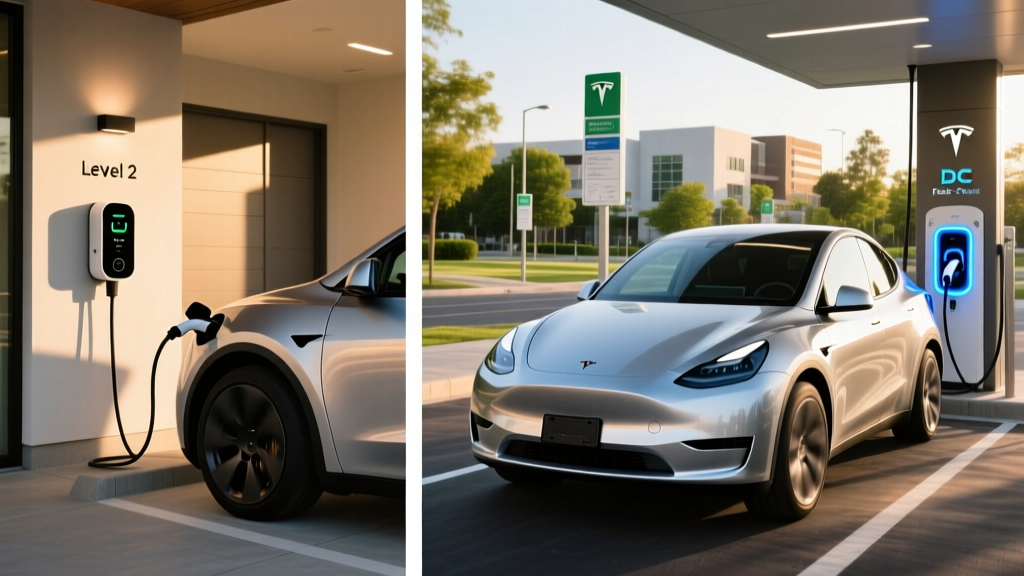
| Level 2 (Home) | 240V / 48A | 11.5 kW | ~37–44 mi/hr | Daily home charging |
| DC Fast Charge | 400V+ / up to 170 kW | 170 kW peak (avg ~95 kW) | ~400+ mi/hr (at peak) | Road trips, rapid top-ups |
With the Model 3 RWD's 11.5 kW onboard charger, a full Level 2 charge from 10% to 100% takes roughly 5.5 hours. On a DC fast charger, the LFP pack peaks at 170 kW but tapers significantly above 60% SoC. Expect a 10–80% session in approximately 30 minutes, with the curve flattening considerably past 80% — a characteristic of LFP chemistry that makes charging to 100% at a DC station time-inefficient.
Home Charger Installation: Electrical Requirements and Costs
Installing a Level 2 home charger is the single highest-impact upgrade for EV ownership. Here's what the Model 3 RWD requires and what you'll spend.
Electrical Requirements
To deliver the Model 3 RWD's maximum 11.5 kW (48A) Level 2 charge rate, you need a 240V / 60A dedicated circuit (NEC code requires circuits rated at 125% of continuous load, so 48A continuous demands a 60A breaker). If you opt for a 40A charger, a 50A circuit suffices.
Key considerations:
- Panel capacity: Most modern homes with 200A service can accommodate a 60A EV circuit. Older homes with 100A panels may need a panel upgrade ($1,500–$3,000+).
- Dedicated circuit: EV chargers require their own breaker — not shared with other appliances.
- GFCI protection: NEC 2020+ requires GFCI breakers for EV receptacles in garages; many hardwired installations avoid this requirement.
- Outdoor rating: If installing outside, the charger and conduit must carry a NEMA 4 or 4X rating.
- Permit: Most jurisdictions require an electrical permit ($50–$250) and inspection.
How Much Does It Cost to Install a Home EV Charger?
| Component | Cost Range |
|---|---|
| Level 2 Charger (hardware) | $300–$700 |
| Electrician labor (standard install, panel within 30 ft) | $400–$1,200 |
| Electrical permit | $50–$250 |
| Panel upgrade (if needed — 100A to 200A) | $1,500–$3,500 |
| Total (no panel upgrade) | $750–$2,150 |
| Total (with panel upgrade) | $2,250–$5,650 |
The wide range reflects variables like conduit run length, whether you choose hardwired versus NEMA 14-50 receptacle, and local labor rates. A straightforward hardwired install in a garage with an adjacent panel typically lands around $1,000–$1,500 all-in. Always get a licensed electrician's assessment before purchasing equipment — they'll confirm your panel's available amperage and the optimal circuit size.
Connector Compatibility: NACS, CCS, and Adapters
The 2023 Model 3 RWD was built with Tesla's proprietary connector (now formally designated NACS — North American Charging Standard). This means native compatibility with the Tesla Supercharger network — over 50,000 stalls globally — without any adapter.
| Connector | Native Support? | Adapter Needed? | Notes |
|---|---|---|---|
| NACS (Tesla) | Yes | No | Superchargers, Tesla Wall Connector, Tesla Mobile Connector |
| CCS1 | No (2023 model) | Yes — Tesla CCS Adapter (~$175) | Required for Electrify America, EVgo, ChargePoint DC stations |
| CHAdeMO | No | Yes (third-party, ~$400+) | Rarely needed; network shrinking |
| J1772 (Level 2 public) | No | Yes — Tesla J1772 Adapter (included with vehicle) | Public Level 2 stations at malls, workplaces, hotels |
Starting in 2025, Tesla began equipping new vehicles with NACS ports that also natively accept CCS via the Supercharger network's expanded open-standard support. However, the 2023 Model 3 RWD requires the Tesla CCS Adapter to use non-Tesla DC fast-charging networks. Tesla sells this adapter directly, and it's a worthwhile $175 investment for road-trip flexibility.
Cost to Charge: Per-Mile Economics vs. Gas
One of the strongest ownership arguments for the Model 3 RWD is the per-mile fuel cost. The EPA rates it at 25 kWh per 100 miles. Using that figure:
| Scenario | Rate ($/kWh) | Cost per 100 Miles | Cost per Mile |
|---|---|---|---|
| Home off-peak (utility TOU rate) | $0.08 | $2.00 | $0.020 |
| Home average (national avg residential) | $0.16 | $4.00 | $0.040 |
| Public Level 2 (ChargePoint, etc.) | $0.25 | $6.25 | $0.063 |
| Tesla Supercharger (avg national) | $0.30 | $7.50 | $0.075 |
| Non-Tesla DC Fast (EA, EVgo) | $0.40 | $10.00 | $0.100 |
| Gas car comparison (30 MPG, $3.40/gal) | — | $11.33 | $0.113 |
At home on an off-peak rate, the Model 3 RWD costs roughly 2 cents per mile to fuel — an 82% savings over a 30 MPG gas car at $3.40/gallon. Even on Tesla Superchargers at $0.30/kWh, you're still saving about 34% per mile. The economics strongly favor home charging; relying exclusively on public DC fast charging erodes much of the cost advantage.
Recommended Home Charging Equipment
Here are three Level 2 chargers well-suited to the Model 3 RWD, each offering distinct advantages:
Tesla Wall Connector
- Power Output: Up to 11.5 kW (48A)
- Connector: NACS (native Tesla)
- Cable Length: 24 ft
- Smart Features: Wi-Fi, OTA updates, power sharing between multiple units, access control
- Price: ~$475
- Best For: Tesla-only households wanting seamless integration
ChargePoint Home Flex
- Power Output: Up to 12 kW (50A) — configurable down to 16A
- Connector: J1772 (use Tesla's included J1772 adapter) or NACS plug (newer version)
- Cable Length: 23 ft
- Smart Features: Wi-Fi, app scheduling, Alexa integration, amperage adjustment to match panel capacity
- Price: ~$550
- Best For: Multi-EV households or those wanting flexible amperage settings
Emporia Vue Smart EV Charger
- Power Output: Up to 11.5 kW (48A)
- Connector: J1772 (use Tesla adapter) or NACS version available
- Cable Length: 24 ft
- Smart Features: Energy monitoring integration with Emporia Vue panel monitor, solar-aware scheduling
- Price: ~$400
- Best For: Solar-equipped homes wanting energy-tracking granularity
All three chargers support the 48A needed to maximize the Model 3 RWD's 11.5 kW onboard charger. Choose based on your ecosystem: the Tesla Wall Connector is the most frictionless option if you only own Teslas; the ChargePoint Home Flex offers the best flexibility if non-Tesla EVs may enter your garage.
Federal Tax Credit and Incentive Context
For the 2023 Model 3 RWD, federal tax credit eligibility falls under IRS §30D Clean Vehicle Credit. The credit amount depends on battery component sourcing and critical mineral requirements, buyer income caps ($150,000 single / $300,000 joint AGI), and the vehicle's MSRP (sedans must be under $55,000 — the Model 3 RWD qualifies). Credit amounts range from $3,750 to $7,500 depending on sourcing compliance, which shifted throughout 2023 and 2024. Always verify current eligibility on the IRS site or consult a tax professional before assuming the full amount. Point-of-sale transfer is available for eligible purchases beginning in 2024.
Separately, the Alternative Fuel Vehicle Refueling Property Credit (30C) may cover up to 30% of home charger installation costs (max $1,000), subject to census-tract eligibility.
Charging Time Examples: What to Expect
Based on the Model 3 RWD's ~57.5 kWh usable battery:
| Charging Method | Power | Estimated Time (10–80%) |
|---|---|---|
| Level 1 (120V outlet) | 1.4 kW | ~28+ hours |
| Level 2 (240V, 48A home charger) | 11.5 kW | ~3.5 hours |
| Tesla Supercharger V3 | 170 kW peak / ~95 kW avg | ~30 minutes |
| Non-Tesla DC Fast (CCS adapter, 150 kW station) | ~150 kW peak / ~85 kW avg | ~33 minutes |
Note that LFP batteries exhibit a flatter charge curve than NMC in the mid-SoC range but taper sharply past 80%. If you're road-tripping, plan to charge to 80% and move on — the time spent waiting for 80–100% at a DC station is rarely worth the added range.
Safety, Code, and Installation Best Practices
- Always use a licensed electrician. EV charging is a continuous high-amperage load — improper wiring creates fire risk. Your electrician should pull a permit and schedule inspection.
- Hardwired vs. receptacle: Hardwired installations avoid the NEC GFCI-breaker requirement (which can cause nuisance trips with some chargers) and generally offer a cleaner install. A NEMA 14-50 receptacle offers portability but requires a GFCI breaker in most jurisdictions under NEC 2020+.
- Cable management: Wall-mount a cable organizer to keep the cord off the garage floor and prevent damage.
- Load management: If your panel is near capacity, consider a smart charger with load-shedding features (like the Emporia or ChargePoint with amp adjustment) rather than a costly panel upgrade.
- Outdoor installs: Ensure the charger carries a NEMA 4/4X rating. Conduit and junction boxes must be weather-rated.
Frequently Asked Questions
How much does it cost to install a home EV charger for the Model 3 RWD?
A standard Level 2 home charger installation costs $750–$2,150 including hardware, electrician labor, and permit — assuming no panel upgrade is needed. If your home has an older 100A electrical panel that needs upgrading to 200A, add $1,500–$3,500.
How fast will each charging level add range to the Model 3 RWD?
Level 1 (120V) adds roughly 3–4 miles per hour. Level 2 (240V, 48A) adds approximately 37–44 miles per hour. DC fast charging at peak rate can add over 400 miles per hour, but sustained rates average much lower — expect a 10–80% charge in about 30 minutes on a Tesla Supercharger.
Which connector and charger is compatible with the 2023 Model 3 RWD?
The 2023 Model 3 RWD uses the NACS (Tesla) connector natively. It's directly compatible with Tesla Superchargers and the Tesla Wall Connector. For non-Tesla DC fast chargers (Electrify America, EVgo), you'll need the Tesla CCS Adapter (~$175). For public Level 2 (J1772), Tesla includes a J1772 adapter with the vehicle.
How much does charging the Model 3 RWD cost per mile vs. gas?
Charging at home on an average residential rate ($0.16/kWh) costs about $0.04 per mile. A comparable 30 MPG gas car at $3.40/gallon costs $0.113 per mile — nearly three times more. Even Tesla Supercharging at $0.30/kWh costs $0.075/mile, still 34% cheaper than gas.
What electrical upgrades might I need for a home charger?
You'll need a dedicated 240V circuit — 60A for full 48A charging or 50A for a 40A charger. Homes with 200A panels usually have sufficient capacity. Homes with 100A panels may need an upgrade to 200A, costing $1,500–$3,500. An electrician can perform a load calculation to determine if your panel has headroom.
Does the 2023 Model 3 RWD LFP battery affect charging habits?
Yes — Tesla recommends charging LFP batteries to 100% at least once per week to maintain accurate SoC calibration. Unlike NMC batteries, LFP chemistry doesn't suffer accelerated degradation from regular full charges. However, DC fast charging to 100% is still slow due to taper above 80%, so it's best done at home on Level 2 overnight.