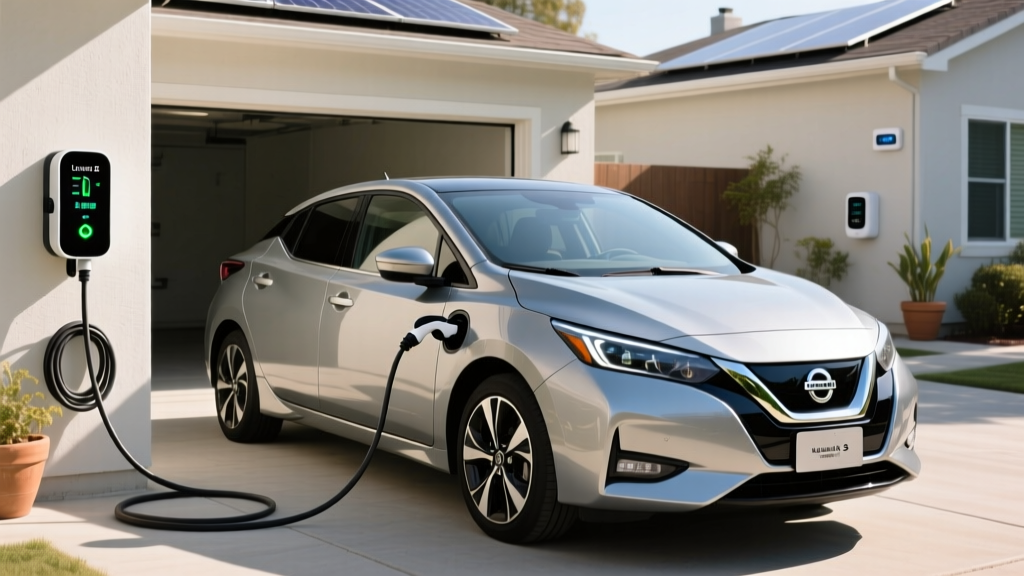
The 2023 Nissan Leaf S remains one of the most affordable new electric vehicles on the used market, but its smaller battery and CHAdeMO connector mean your charging setup requires more planning than newer NACS- or CCS-equipped EVs. If you're evaluating the Leaf S — or already own one — understanding the real-world range, home charging requirements, and public charging realities is essential before you spend a dollar on equipment or electrical work.
This guide breaks down everything you need to know about charging the 2023 Leaf S: from the exact 2023 Nissan Leaf S range you can expect in daily driving, to the electrical panel capacity required for a Level 2 home charger, to the long-term outlook for CHAdeMO public charging infrastructure in a market rapidly shifting to NACS.
2023 Nissan Leaf S: Range, Battery, and Efficiency at a Glance
The 2023 Leaf S comes equipped with a 40 kWh lithium-ion battery (usable capacity approximately 38 kWh) powering a 110 kW (147 horsepower) front-mounted electric motor. Here are the key specs from the EPA and Nissan:
| Spec | Value |
|---|---|
| EPA Range | 149 miles |
| Battery Capacity | 40 kWh total (~38 kWh usable) |
| Battery Chemistry | NMC (Nickel Manganese Cobalt) |
| Motor Output | 110 kW / 147 hp / 236 lb-ft torque |
| 0-60 mph | ~7.9 seconds |
| EPA Efficiency | 111 MPGe combined (30 kWh/100 mi) |
| Max DC Fast Charge Rate | 50 kW (CHAdeMO) |
| Onboard AC Charger | 6.6 kW (Level 2, J1772) |
| Battery Warranty | 8 years / 100,000 miles (capacity loss below 9 bars of 12) |
| Original MSRP (2023) | $28,140 (before incentives) |
The EPA rates the 2023 Leaf S at 149 miles. In real-world driving, expect approximately 120–140 miles on the highway at 70+ mph, and as low as 100–115 miles in cold weather (below 30°F) without relying on the seat/steering wheel heaters. The Leaf uses a resistive PTC heater, not a heat pump, which draws significant battery energy in winter. City driving with regenerative braking can sometimes exceed the EPA estimate, reaching 155+ miles in mild conditions.
Charging Levels Explained: How Fast Will Each Add Range?
Understanding the difference between charging levels — and the critical distinction between kW (power, the rate of charging) and kWh (energy, the battery capacity) — is the foundation of EV ownership. Think of kW as how fast water flows from a hose, and kWh as the size of the bucket you're filling.
| Level | Voltage / Power | Miles of Range Added per Hour | Full Charge Time (0–100%) | Typical Use Case |
|---|---|---|---|---|
| Level 1 (120V) | 120V / ~1.4 kW | ~4–5 miles/hour | ~35+ hours | Emergency / trickle top-off |
| Level 2 (240V) | 240V / 6.6 kW (Leaf's max) | ~22–25 miles/hour | ~6–7 hours | Daily home charging |
| DC Fast (CHAdeMO) | Up to 50 kW peak | ~100–140 miles/hour (at peak) | 10–80% in ~40–45 min | Road trips, rapid top-ups |
Key insight: The Leaf S's onboard charger caps Level 2 charging at 6.6 kW. Even if you install a 48-amp (11.5 kW) home charger, the Leaf will only draw 6.6 kW. That said, installing a higher-capacity charger future-proofs your garage for a next EV — and the cost difference is often minimal.
On DC fast charging, the Leaf S is limited to 50 kW via CHAdeMO. This is significantly slower than modern competitors: a Hyundai Ioniq 5 can accept up to 235 kW on CCS, and newer Tesla models exceed 250 kW on NACS. The 50 kW peak also tapers quickly — expect the charge rate to drop to 30–35 kW once the battery passes 60% state of charge (SoC). A 10–80% charge realistically takes 40–50 minutes depending on battery temperature and starting SoC.
Home Charging Installation: Electrical Requirements and Costs
For daily charging, a Level 2 home station is the practical minimum for any Leaf S owner. Level 1 (a standard 120V outlet) adds only ~4–5 miles per hour, meaning a depleted battery would take over a day and a half to fill — fine for low-mileage drivers who can top off nightly, but inadequate for anyone driving 30+ miles daily.
Electrical Requirements for a Level 2 Charger
A Level 2 charger for the Leaf S requires:
- 240V dedicated circuit — the same voltage as a clothes dryer or electric oven
- Minimum 30-amp breaker (for a 24-amp continuous draw charger, following the NEC 80% rule)
- Recommended: 40-amp or 50-amp breaker to support a 32-amp or 40-amp charger, which future-proofs for your next EV even though the Leaf S caps at 6.6 kW (~28 amps)
- NEMA 14-50 outlet (for plug-in chargers) or hardwired connection (often required for 48-amp+ units and preferred by many electricians for reliability)
Do You Need a Panel Upgrade?
This is the single biggest cost variable. Most homes built after 1990 have a 200-amp electrical panel, which usually supports a 40-amp EV circuit without issue. However:
- Older homes with 100-amp panels will likely need a panel upgrade ($1,500–$3,500) or a load-management device that throttles the charger when other large appliances run
- Homes with 150-amp panels that already have electric ranges, dryers, and central AC may need a load calculation by a licensed electrician to confirm capacity
- Some utilities offer secondary meter or dedicated EV panel programs that avoid a full upgrade — check with your local provider
| Component | Low Estimate | High Estimate |
|---|---|---|
| Level 2 Charger (equipment) | $250 | $700 |
| Electrician labor (basic install, panel nearby) | $400 | $1,200 |
| Electrical permit | $50 | $200 |
| Conduit/wiring (if run >30 ft from panel) | $200 | $800 |
| Panel upgrade (if needed — 100A → 200A) | $1,500 | $3,500 |
| Total (no panel upgrade) | $900 | $2,900 |
| Total (with panel upgrade) | $2,400 | $6,400 |
Note: The federal Alternative Fuel Vehicle Refueling Property Credit (IRS Form 8911) covers up to 30% of home charging equipment and installation costs, capped at $1,000, but is subject to census tract eligibility requirements. Check the IRS site for current rules.
CHAdeMO, CCS, and NACS: Connector Compatibility for the Leaf S
The 2023 Leaf S uses two connectors:
- J1772 for Level 1 and Level 2 AC charging (the universal North American AC standard)
- CHAdeMO for DC fast charging
This is a critical consideration in 2026. The North American charging landscape has shifted decisively toward NACS (the Tesla charging standard, now formally SAE J3400). Nearly every major automaker — Ford, GM, Rivian, Hyundai, Kia, Volvo, and others — has adopted NACS for new vehicles starting in 2025. CCS1 remains available at many public stations, but CHAdeMO has the smallest and most slowly growing network.
| Connector | Brands Using It | Public DC Network Availability |
|---|---|---|
| NACS (J3400) | Tesla, Ford, GM, Rivian, Hyundai, Kia, Volvo, Polestar | Tesla Supercharger (20,000+ stalls), growing third-party |
| CCS1 | VW, BMW, older Ford/GM models, Lucid, legacy models | Electrify America, EVgo, ChargePoint, Ionity (EU) |
| CHAdeMO | Nissan Leaf, Mitsubishi Outlander PHEV (legacy) | Declining; some Electrify America & EVgo stations |
| J1772 (AC) | All non-Tesla EVs (universal) | Universal Level 2 public charging |
Adapter options: There is currently no reliable CHAdeMO-to-NACS or CHAdeMO-to-CCS adapter for DC fast charging on the Leaf. The DC protocols are fundamentally different, and CHAdeMO communicates with the vehicle using a different signaling method. For Level 2 AC charging, a simple J1772-to-NACS adapter (~$150–$200) allows you to use Tesla Wall Connectors and Tesla Destination Chargers, but this does not help at DC fast-charging stations.
Practical impact: If you own a Leaf S and plan road trips, you must rely on CHAdeMO-equipped stations, which are increasingly sparse outside of metropolitan areas. Apps like PlugShare and the Nissan Energy app are essential for route planning. For daily commuting and home charging, the J1772 connector works everywhere and is not a limitation.
Cost to Charge: Leaf S Per-Mile Cost vs. Gasoline
One of the strongest arguments for the Leaf S is operating cost. With a 40 kWh battery and an efficiency rating of roughly 30 kWh per 100 miles (or 3.33 miles per kWh), here's what charging costs look like across different scenarios:
| Scenario | Rate ($/kWh) | Cost for Full 40 kWh Charge | Cost per Mile (149 mi range) |
|---|---|---|---|
| Home — Off-Peak Utility Rate | $0.08–$0.12 | $3.20–$4.80 | $0.021–$0.032 |
| Home — Standard Residential Rate | $0.14–$0.18 | $5.60–$7.20 | $0.038–$0.048 |
| Public Level 2 (ChargePoint, etc.) | $0.25–$0.49 | $10.00–$19.60 | $0.067–$0.131 |
| DC Fast Charging (EVgo, EA) | $0.35–$0.55 | $14.00–$22.00 | $0.094–$0.148 |
Gas comparison: A comparable gas car getting 30 MPG at $3.40/gallon costs roughly $0.113 per mile. Home-charging the Leaf S at off-peak rates saves 70–80% per mile. Even at public DC fast-charging prices, the Leaf S is roughly cost-competitive with gasoline — and far cheaper when charging at home, where most Leaf owners do 85–90% of their charging.
To maximize savings, enroll in your utility's time-of-use (TOU) plan and schedule charging for off-peak hours (typically 10 PM – 6 AM). Many Level 2 chargers, including the models recommended below, have built-in scheduling features.
Recommended Level 2 Chargers for the Nissan Leaf S
Since the Leaf S caps at 6.6 kW, you don't technically need a 48-amp charger — but buying one future-proofs your investment. Here are three proven options across price tiers, all using the J1772 connector that the Leaf S requires:
Budget Pick: Emporia Level 2 EV Charger
- Power Output: 48 amps / 11.5 kW (Leaf will draw 6.6 kW max)
- Connector: J1772
- Cable Length: 24 ft
- Smart Features: Wi-Fi, app scheduling, energy monitoring, solar integration
- Installation: Hardwired (requires electrician)
- Price: ~$350–$400
Best for: Cost-conscious buyers who want smart features and energy tracking. Excellent app and real-time power monitoring.
Best Overall: ChargePoint Home Flex
- Power Output: Up to 50 amps / 12 kW (configurable 16–50A)
- Connector: J1772
- Cable Length: 23 ft
- Smart Features: Wi-Fi, Alexa integration, app scheduling, flexible amperage settings
- Installation: NEMA 14-50 plug or hardwired
- Price: ~$550–$700
Best for: Most Leaf owners. Configurable amperage means you can set it to match your circuit, and the plug-in option simplifies installation.
Premium Pick: Grizzl-E Smart
- Power Output: 40 amps / 9.6 kW
- Connector: J1772
- Cable Length: 24 ft
- Smart Features: OCPP protocol, app control, works with utility demand-response programs
- Installation: NEMA 14-50 or hardwired; rated -40°F to +122°F (excellent for outdoor/cold climates)
- Price: ~$450–$550
Best for: Cold-climate and outdoor installs. Built in Canada, extremely durable enclosure, and utility-program compatible.
Why not a Tesla Wall Connector? The Tesla Wall Connector uses a NACS plug natively. You can use it with the Leaf S only by adding a J1772-to-NACS adapter (such as the Lectron or A2Z adapter, ~$150–$200). This works fine for Level 2 but adds cost and a connection point. If your household has both a Tesla and a Leaf, the Wall Connector + adapter is a reasonable solution. Otherwise, a native J1772 charger is simpler.
Safety, Electrical Code, and Permit Considerations
EV charging installation must comply with the National Electrical Code (NEC Article 625) and your local jurisdiction's amendments. Key requirements:
- Dedicated circuit: Your EV charger must be on its own dedicated breaker — it cannot share a circuit with other outlets or appliances
- GFCI protection: NEC 2020 and later require GFCI protection for all EV charging outlets (not required for hardwired installations in many jurisdictions — another reason hardwired is often preferred)
- Outdoor rating: If installing outdoors, the charger must carry a NEMA 4 or NEMA 4X rating for weather resistance. All three chargers recommended above meet this standard
- Permit required: Virtually all jurisdictions require an electrical permit for a new 240V circuit. Permit fees typically range from $50–$200. Your electrician usually pulls this on your behalf
- Inspection: After installation, a city or county inspector will verify the work. This is standard and protects you — never skip it, as unpermitted work can void homeowner's insurance claims
Pro tip: Get at least three quotes from licensed electricians. Pricing varies enormously — from $400 for a simple install where the panel is adjacent to the garage, to $2,000+ for a long conduit run through finished walls. Ask specifically whether the quote includes the permit and inspection coordination.
Public Charging Realities for the Leaf S in 2026
The CHAdeMO situation deserves honest discussion. As of 2026, CHAdeMO stations represent roughly 5–8% of public DC fast-charging locations in the United States. Electrify America has largely standardized on CCS1, and the rapidly expanding Tesla Supercharger network (open to non-Tesla vehicles via the Magic Dock adapter at select locations) uses NACS exclusively.
For Leaf S owners, this means:
- Daily commuting is unaffected — home Level 2 charging handles 90%+ of charging needs for most drivers
- Regional road trips require planning — use PlugShare or the Nissan Energy app to map CHAdeMO stations along your route before departing
- Rural charging deserts are a real limitation — if you frequently drive in areas with limited infrastructure, the Leaf S's 149-mile range combined with sparse CHAdeMO availability can create genuine range constraints
- 50 kW charging is slow by 2026 standards — plan for 40–50 minute stops for a meaningful charge, compared to 15–20 minutes for vehicles capable of 150+ kW
The Leaf S is best understood as a commuter and city vehicle that excels with home charging, rather than a road-trip EV. If long-distance travel is a regular need, a vehicle with CCS or NACS and a larger battery (e.g., Hyundai Ioniq 5, Tesla Model 3, Chevrolet Equinox EV) is a better fit.
Frequently Asked Questions
How much does it cost to install a home EV charger for the Leaf S?
Expect $900–$2,900 for a standard Level 2 installation (equipment, electrician labor, and permit) if your electrical panel has sufficient capacity. If you need a panel upgrade from 100A to 200A, add $1,500–$3,500, bringing the total to $2,400–$6,400. The federal Alternative Fuel Vehicle Refueling Property Credit may cover 30% of costs up to $1,000, subject to census tract eligibility — check IRS guidelines.
How fast will each charging level add range to the Leaf S?
Level 1 (120V) adds roughly 4–5 miles per hour. Level 2 (240V at 6.6 kW) adds approximately 22–25 miles per hour, filling the battery in 6–7 hours. DC fast charging (CHAdeMO at 50 kW peak) can add 100+ miles in about 40 minutes, though the charge rate tapers significantly above 60% SoC.
Which connector and charger is compatible with my Leaf S?
The Leaf S uses J1772 for AC charging (Level 1 and Level 2) and CHAdeMO for DC fast charging. Any J1772 Level 2 home charger will work. There is no practical adapter for CHAdeMO to NACS or CCS at DC stations. For home charging, the ChargePoint Home Flex, Emporia, or Grizzl-E Smart are all excellent J1772-native options.
How much does charging the Leaf S cost per mile vs. gas?
At home off-peak rates ($0.10/kWh), the Leaf S costs about $0.03 per mile — roughly 75% less than a 30 MPG gas car at $3.40/gallon ($0.113/mile). Even at public DC fast-charging rates ($0.45/kWh), the cost is approximately $0.135/mile, roughly comparable to gasoline. Most Leaf owners charge at home and save $800–$1,200 annually on fuel.
What electrical upgrades might I need?
If your home has a 200-amp panel with available breaker spaces, you likely need only a new 40- or 50-amp breaker and a wiring run to your garage or parking spot. Homes with 100-amp panels typically require a full panel upgrade ($1,500–$3,500). Homes with 150-amp panels may need a load calculation. An alternative is a smart load-management device (~$200–$400) that dynamically limits charger draw when other appliances are running, avoiding a panel upgrade in some cases. Always have a licensed electrician perform a load calculation before committing to equipment.
Is the 2023 Leaf S a good EV to buy in 2026?
The Leaf S is a strong value as a used commuter EV — with prices on the used market often in the $15,000–$20,000 range, it offers affordable entry into EV ownership with low operating costs. Its limitations are the CHAdeMO connector (declining infrastructure), 50 kW DC fast-charge ceiling, and 149-mile EPA range. If your daily commute is under 60 miles round-trip and you can charge at home, the Leaf S remains a practical and economical choice. For road trips or high-mileage drivers, consider a newer EV with NACS or CCS and a larger battery.
Sources: EPA Fuel Economy — 2023 Nissan Leaf, Nissan USA Leaf Specifications, IRS Alternative Fuel Vehicle Refueling Property Credit