The 2023 Nissan Leaf remains one of the most accessible used electric vehicles on the market, but its real-world utility hinges entirely on how you charge it. With two battery options — a 40 kWh pack in the S trim and a 62 kWh pack in the SV Plus — the Leaf delivers EPA-estimated ranges of 149 and 212 miles, respectively. But sticker range is only half the story. To get the most from a Leaf, you need a clear picture of its charging architecture, the home electrical work required, and what you'll actually pay per mile.
This guide breaks down everything a Leaf owner or buyer needs: real-world range expectations, charging speeds across all three levels, home installation costs with panel-upgrade realities, connector compatibility (including the CHAdeMO-to-NACS adapter question), and a cost-per-mile comparison against gasoline. All figures reflect 2026 ownership conditions, including the latest public-charging pricing and IRS §30D home-charger credit rules.
2023 Nissan Leaf Range: EPA vs. Real World
Before discussing charging, it's worth grounding what the Leaf's EPA numbers mean in daily driving. The EPA tests under controlled conditions that don't fully capture highway speeds, cold weather, or hilly terrain — all of which reduce range.
| Trim | Battery (kWh usable) | EPA Range | MPGe (combined) | Real-World Highway (~70 mph) | Cold-Weather Estimate (20°F) |
|---|---|---|---|---|---|
| S | 40 | 149 mi | 111 MPGe | ~115–125 mi | ~100–110 mi |
| SV Plus / SL Plus | 62 | 212 mi | 109 MPGe | ~170–185 mi | ~145–160 mi |
The Leaf uses an air-cooled battery thermal management system rather than liquid cooling. This means the pack can heat up during repeated DC fast charging sessions or hot-weather highway driving, which may trigger charge-rate throttling — a phenomenon known among owners as "Rapidgate." For daily Level 2 home charging and moderate use, this is rarely an issue, but it's a factor for road-trip planning.
Charging Levels Explained: How Fast Each Adds Range
EV charging happens at three distinct levels. The key distinction every owner must internalize: kW (kilowatts) measures power — the rate of charging, while kWh (kilowatt-hours) measures energy — the battery's total capacity. A 62 kWh battery charged at 6.6 kW takes roughly 9.4 hours from empty to full (62 ÷ 6.6).
| Level | Voltage / Amperage | Power (kW) | Miles of Range Added per Hour | Connector | Typical Use |
|---|---|---|---|---|---|
| Level 1 | 120V / 12A | ~1.4 kW | ~4–5 mi/hr | J1772 (standard) | Overnight trickle; emergency top-up |
| Level 2 | 240V / 30–40A | 6.6 kW (Leaf max) | ~22–25 mi/hr | J1772 | Home daily charging; workplace |
| DC Fast | 400V+ DC | Up to 100 kW (62 kWh) / 50 kW (40 kWh) | ~150–200 mi/hr (peak) | CHAdeMO | Road trips; rapid top-ups |
The 2023 Leaf's onboard charger maxes out at 6.6 kW on Level 2, meaning even if you install a 48-amp (11.5 kW) home charger, the Leaf will only draw 6.6 kW. This is a vehicle-side limitation, not a charger limitation — but installing a higher-capacity charger future-proofs your garage for your next EV.
Charging Time Examples: 10–80% and Full Charge
| Battery | Level 1 (1.4 kW) | Level 2 (6.6 kW) | DC Fast (CHAdeMO, 10–80%) |
|---|---|---|---|
| 40 kWh (S) | ~29 hours (0–100%) | ~6 hours (0–100%) | ~40 minutes (50 kW peak) |
| 62 kWh (SV Plus) | ~44 hours (0–100%) | ~9.5 hours (0–100%) | ~45 minutes (100 kW peak) |
DC fast charging speeds taper significantly above 80% state of charge. The 62 kWh Leaf can peak at roughly 100 kW at low state of charge, but drops to ~40 kW by 80% and slows further to protect the air-cooled battery. Plan road-trip stops around 10–80% windows rather than chasing a full charge.
Home Charger Installation: Electrical Requirements & Costs
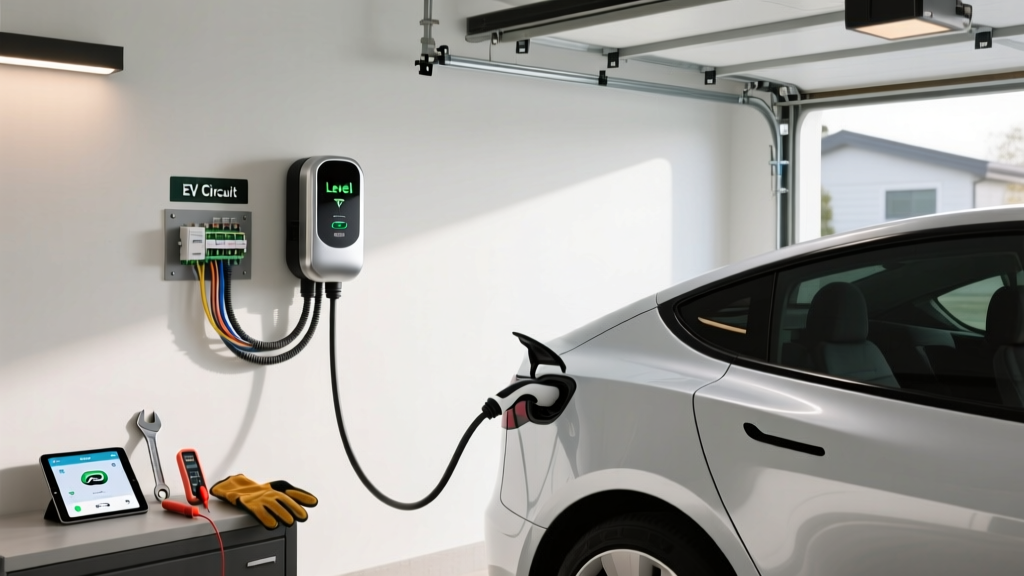
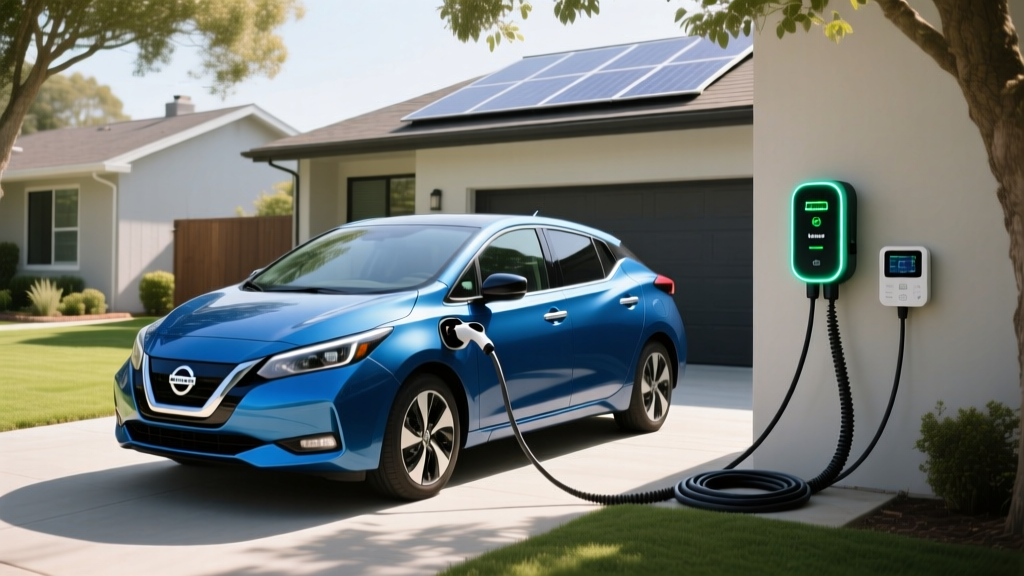
For daily driving, Level 2 home charging is the backbone of Leaf ownership. You'll need a 240-volt circuit, a hardwired or plug-in Level 2 EVSE (Electric Vehicle Supply Equipment), and a licensed electrician to ensure code compliance.
Electrical Requirements
The Leaf draws a maximum of 6.6 kW at 240V, which translates to roughly 27.5 amps. Electrical code requires circuits to be rated at 125% of the continuous load, so you need a minimum 40-amp breaker on a 240V dedicated circuit (NEMA 14-50 outlet or hardwired). A 50-amp circuit is the common standard install and provides headroom for future vehicles.
Key electrical considerations:
- Panel capacity: Your home's main electrical panel must have sufficient spare capacity. Most modern 200-amp panels can accommodate a 40–50A EV circuit. Older homes with 100-amp service will likely need a panel upgrade.
- Dedicated circuit: The EV charger must be on its own dedicated breaker — not shared with other appliances.
- GFCI protection: The 2020 NEC and later require GFCI protection for indoor and outdoor EV outlets in many jurisdictions. Hardwired EVSE units typically have built-in ground-fault protection.
- Outdoor rating: If installing outside, the EVSE must carry a NEMA 4 (weatherproof) rating.
- Permit: Most municipalities require an electrical permit ($50–$200) and a post-installation inspection.
How Much Does It Cost to Install a Home EV Charger?
Installation costs vary enormously based on your panel location, wiring distance, and whether an upgrade is needed. Here's a realistic breakdown:
| Component | Simple Install (panel nearby, no upgrade) | Complex Install (long run or panel upgrade) |
|---|---|---|
| Level 2 EVSE equipment (40A) | $350–$700 | $350–$700 |
| Electrician labor (2–4 hrs simple / 6–12 hrs complex) | $400–$800 | $1,200–$3,000 |
| Electrical permit | $50–$150 | $50–$200 |
| Panel upgrade (100A → 200A, if needed) | — | $1,500–$3,500 |
| Conduit, wiring, misc. materials | $100–$300 | $300–$800 |
| Total estimated cost | $900–$1,950 | $3,400–$8,200 |
As of 2026, the federal IRS Residential Clean Energy Credit (IRC §25C) covers 30% of home EV charger equipment and installation costs, up to $1,000 per year. This can offset $270–$585 on a simple install. Check irs.gov for current-year eligibility, as income and census-tract requirements apply.
Connector Compatibility: CHAdeMO, CCS, and the NACS Shift
The 2023 Nissan Leaf uses the CHAdeMO connector for DC fast charging and the standard J1772 connector for Level 1 and Level 2 AC charging. This is a critical compatibility point because the broader EV industry has shifted toward CCS1 and now NACS (the Tesla connector standard adopted by Ford, GM, Rivian, and most major automakers starting in 2024–2025).
| Connector | Used By | Leaf Compatible? | Adapter Needed? |
|---|---|---|---|
| J1772 (AC Level 1/2) | All non-Tesla EVs (2023 and earlier) | Yes — native | No |
| CHAdeMO (DC Fast) | Nissan Leaf, Mitsubishi Outlander PHEV | Yes — native | No |
| CCS1 (DC Fast) | Most non-Tesla EVs (Chevy, VW, Hyundai, BMW) | No | No reliable CHAdeMO-to-CCS adapter exists for consumer use |
| NACS / Tesla (DC Fast + AC) | Tesla (all); Ford, GM, Rivian (2025+) | No | CHAdeMO-to-NACS adapters are extremely limited and not widely available as of 2026 |
For Level 2 home and public AC charging, the J1772 connector on the Leaf works universally — no adapter needed. If you install a NACS-connector wall charger (like the Tesla Wall Connector), you would need a NACS-to-J1772 adapter (~$150–$250) for the Leaf, which adds a friction point. Most Leaf owners are better served by a J1772-native home charger.
Cost to Charge: Per-Mile Breakdown vs. Gasoline
One of the strongest ownership arguments for the Leaf is fuel-cost savings, but the math depends heavily on where and when you charge.
| Scenario | Rate | Cost per Full Charge (62 kWh) | Cost per Mile (212 mi EPA) |
|---|---|---|---|
| Home — off-peak utility rate | $0.09/kWh | $5.58 | $0.026/mi |
| Home — average U.S. residential | $0.17/kWh | $10.54 | $0.050/mi |
| Public Level 2 (ChargePoint, etc.) | $0.30/kWh | $18.60 | $0.088/mi |
| DC Fast Charging (Electrify America, EVgo) | $0.45/kWh | $27.90 | $0.132/mi |
| Gasoline car (30 MPG avg, $3.40/gal) | — | $23.80 per 210 mi | $0.113/mi |
At home on an off-peak rate, the Leaf costs roughly 2.6 cents per mile — less than a quarter of what a 30-MPG gas car spends. Even at average residential rates, it's under 5 cents per mile. However, exclusive reliance on DC fast charging at $0.45/kWh actually exceeds gasoline cost per mile. This is why home charging access is the single most important factor in EV economics.
The Leaf's efficiency rating of ~30 kWh/100 miles (combined) means every kWh matters. Preconditioning the battery — warming it before a DC fast charge using the car's climate timer — can improve charging speed and efficiency, though the Leaf's air-cooled system limits the benefit compared to liquid-cooled competitors.
Recommended Home Level 2 Chargers for the Nissan Leaf
Since the Leaf caps at 6.6 kW AC charging, you don't need the most powerful charger on the market. However, installing a 40–48 amp unit with a J1772 connector ensures compatibility and future-proofs for your next EV. Here are three proven options:
ChargePoint Home Flex (Best Overall for Leaf)
- Power output: Up to 12 kW (50A) — Leaf will draw 6.6 kW max
- Connector: J1772 (native Leaf compatibility)
- Cable length: 23 feet
- Smart features: Wi-Fi, app scheduling, Alexa integration, energy tracking
- Price: ~$550–$650
- Why it works: Adjustable amperage (16A–50A) lets you match your circuit. Excellent app for scheduling off-peak charges.
Emporia Level 2 EV Charger (Best Budget)
- Power output: Up to 11.5 kW (48A)
- Connector: J1772
- Cable length: 24 feet
- Smart features: Wi-Fi, app control, solar integration, energy monitoring
- Price: ~$350–$400
- Why it works: Lowest-cost smart charger with robust energy tracking. Hardwired install recommended for reliability.
Grizzl-E Smart (Best for Outdoor / Cold Climate)
- Power output: Up to 10 kW (40A)
- Connector: J1772
- Cable length: 24 feet
- Smart features: OCPP-compatible, app scheduling, extreme-weather rated (–40°F)
- Price: ~$450–$550
- Why it works: Canadian-built, NEMA 4 outdoor rated, and tested to –40°F. Ideal for unheated garages and driveway installs in northern states.
All three chargers deliver well beyond the Leaf's 6.6 kW AC ceiling, which is intentional: you're wiring the circuit once, and the next EV you own will likely accept 11.5 kW or more.
Safety, Code, and Panel-Upgrade Considerations
Level 2 charging is a continuous electrical load that runs for hours — it demands proper installation. Cutting corners here risks fire, voided insurance, and failed home inspections.
Non-Negotiable Safety Requirements
- Dedicated circuit: Your EVSE must be on its own breaker. Sharing a circuit with a dryer, oven, or HVAC system creates overload risk.
- Correct wire gauge: A 50A circuit requires 6 AWG copper wire (THHN in conduit or NM-B/Romex rated for the amperage). Your electrician will size this based on run length and local code.
- GFCI protection: Required by NEC 2020+ for 14-50 receptacles used for EV charging in many jurisdictions. Hardwired EVSEs with integrated GFI protection may satisfy this without a GFCI breaker.
- Permit and inspection: Skipping the permit may save $100 today but can void homeowner's insurance coverage if an electrical fire occurs. Most insurers require permitted work for claims.
- Outdoor installation: Use a NEMA 4-rated EVSE and a weatherproof in-use cover if installing a receptacle outdoors. The Grizzl-E and ChargePoint Home Flex both carry outdoor ratings.
When You Need a Panel Upgrade
Homes built before 1990 often have 100-amp electrical service. Adding a 40–50A EV circuit to a 100A panel that's already near capacity (electric range, dryer, central AC) will overload it. Signs you may need a panel upgrade:
- Your panel is 100A or less
- You have fewer than 2–4 open breaker slots
- Your electrician's load calculation shows the panel is above 80% capacity with the EV circuit added
- You already use high-draw appliances (electric heat, hot tub, workshop equipment)
A panel upgrade from 100A to 200A typically costs $1,500–$3,500, depending on your utility's requirements and whether a new meter base or service drop is needed. This is the single largest variable in home EV charging costs and the reason getting an electrician's load calculation before buying a charger is essential.
Frequently Asked Questions
How much does it cost to install a home EV charger for the Nissan Leaf?
A straightforward Level 2 installation with an existing 200A panel and short wiring run costs $900–$1,950 including equipment, labor, and permit. If your home needs a panel upgrade or has a long conduit run, expect $3,400–$8,200. The IRS §25C credit covers 30% up to $1,000 of equipment and installation.
How fast will each charging level add range to my Leaf?
Level 1 (120V standard outlet) adds about 4–5 miles per hour — sufficient only for very low daily mileage. Level 2 (240V, 6.6 kW) adds 22–25 miles per hour, fully replenishing the 62 kWh battery overnight in about 9.5 hours. DC fast charging on CHAdeMO can add 150+ miles in 40–45 minutes (10–80% SoC).
Which connector does the 2023 Nissan Leaf use?
The Leaf uses J1772 for AC charging (Level 1 and 2) and CHAdeMO for DC fast charging. It is not natively compatible with CCS1 or NACS (Tesla). No widely available consumer adapter converts CHAdeMO to CCS or NACS for DC fast charging, which limits public fast-charging options.
How much does charging the Leaf cost per mile vs. gas?
At a typical residential rate of $0.17/kWh, the Leaf SV Plus costs about $0.05 per mile — roughly half the cost of a 30-MPG gas car at $3.40/gallon ($0.11/mi). Off-peak home rates as low as $0.09/kWh bring it down to $0.026/mi. DC fast charging at $0.45/kWh is the one scenario where EV charging costs more than gasoline per mile.
What electrical upgrades might I need for a Level 2 charger?
At minimum, you need a dedicated 240V/40A circuit with a NEMA 14-50 outlet or hardwired connection. If your panel is 100A or near capacity, a 200A panel upgrade ($1,500–$3,500) will be necessary. An electrician's load calculation — typically $100–$200 as a standalone service — determines this before any work begins.
Does the 2023 Leaf qualify for any tax credits in 2026?
The 2023 Leaf is no longer eligible for the new-vehicle §30D federal tax credit (the Leaf was discontinued after 2024, and the credit applied at point of sale for qualifying new purchases). However, if purchased used from a dealer for $25,000 or less, it may qualify for the Used Clean Vehicle Credit of up to $4,000 (30% of sale price, capped). Income limits apply: $75,000 single / $150,000 married filing jointly. Consult a tax professional and verify on irs.gov.
Can I use a Tesla charger with my Nissan Leaf?
You can use Tesla Level 2 Wall Connectors with a NACS-to-J1772 adapter (~$150–$250), but you cannot use Tesla Superchargers. Tesla's Supercharger network uses NACS for DC fast charging, and no reliable CHAdeMO-to-NACS DC adapter exists for consumer use as of 2026. The Leaf is effectively locked out of the fastest-growing public charging network.