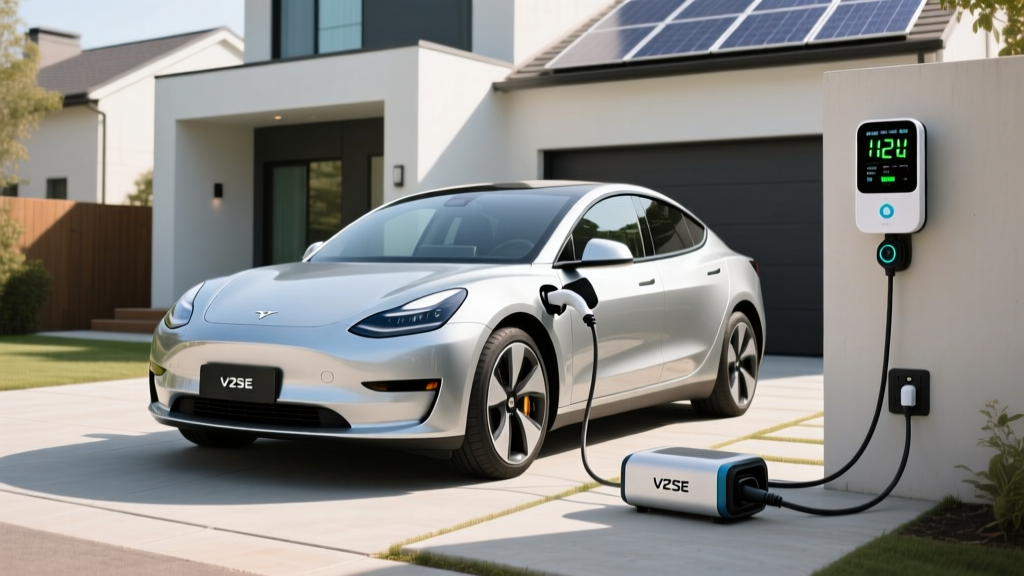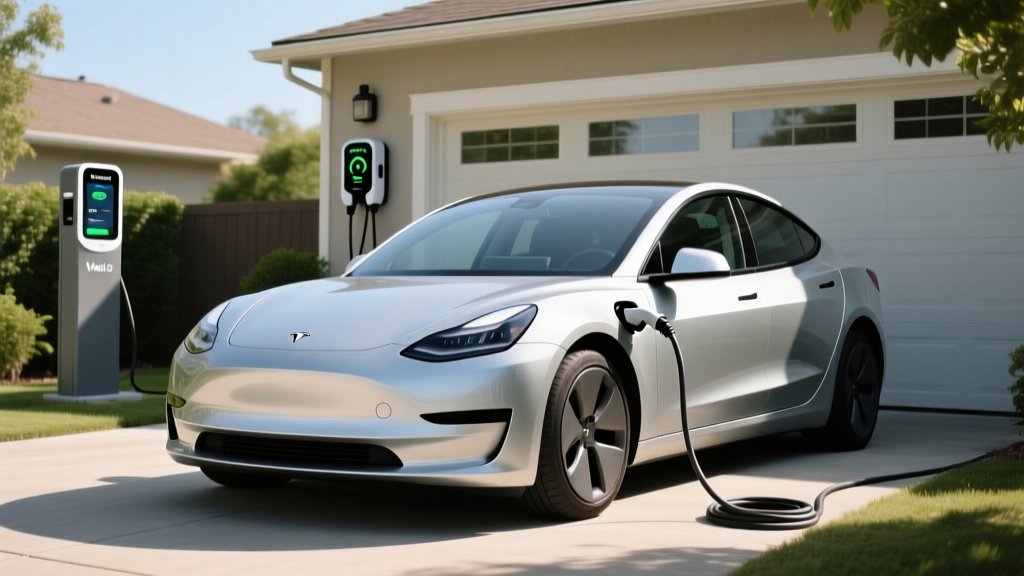
The 2023 Tesla Model 3 Standard Range (officially the Rear-Wheel Drive trim) pairs a 57.5 kWh usable LFP battery with EPA-rated 272 miles of range and one of the most efficient powertrains in the EV market at 132 MPGe combined. Whether you're taking delivery or optimizing ownership, understanding exactly how this car charges — at home, on the road, and at what cost — is essential. This guide covers every charging scenario with hard numbers, equipment picks, and installation realities.
2023 Model 3 Standard Range: Core Charging Specs
| Spec | Value |
|---|---|
| Battery (usable) | 57.5 kWh, LFP chemistry |
| EPA Range | 272 miles |
| Real-World Range (highway/cold) | ~220–250 mi (highway 70 mph); ~190–210 mi (freezing) |
| Efficiency | 132 MPGe / 25 kWh/100 mi |
| Max DC Fast Charge | 170 kW peak |
| 10–80% DC Fast Charge | ~25 minutes (preconditioned) |
| Level 2 Onboard Charger | 11.5 kW (48A) |
| Connector | NACS (Tesla proprietary) |
| Base MSRP (2023) | $38,990 (before incentives) |
Charging Levels Explained: Speeds and Range Added
Before we break down home and public options, let's clarify the three charging levels. kW (kilowatts) measures charging power — how fast energy flows into the battery. kWh (kilowatt-hours) measures energy capacity — the size of the battery. Think of kW as the flow rate of a hose and kWh as the size of the bucket.
| Level | Voltage / Amps | Power (kW) | Miles of Range Per Hour | Best For |
|---|---|---|---|---|
| Level 1 | 120V / 12–16A | 1.4–1.9 kW | 3–5 mi/hr | Overnight top-ups, emergencies |
| Level 2 | 240V / 32–48A | 7.7–11.5 kW | 25–44 mi/hr | Daily home charging |
| DC Fast | 400V+ DC | 50–250 kW | 150–800+ mi/hr | Road trips, quick stops |
For the 2023 Model 3 Standard Range, Level 1 charging adds roughly 4 miles per hour — enough to recover about 40–50 miles overnight if you drive less than 30 miles daily. Level 2 at the car's maximum 11.5 kW (48A) replenishes the full 57.5 kWh battery from 10% to 100% in about 5.5 hours. DC fast charging at 170 kW peak takes the battery from 10% to 80% in roughly 25 minutes when the battery is preconditioned.
Home Level 2 Charger Installation: Requirements and Costs
The 2023 Model 3's onboard charger accepts up to 11.5 kW (48 amps). To deliver that, you need a 240V circuit rated for at least 60 amps (EV chargers are continuous loads, so the circuit must be rated at 125% of the charger's max draw — 48A × 1.25 = 60A). If you opt for a 40A charger, a 50A circuit suffices.
Electrical Requirements
- Voltage: 240V (split-phase residential)
- Amperage: 60A dedicated circuit for full 48A charging; 50A circuit for 40A chargers
- Wiring: 6 AWG copper (60A) or 8 AWG copper (50A) in conduit
- Breaker: Dedicated double-pole breaker in main panel
- Panel capacity: Minimum 100A service; 200A strongly recommended for homes with electric HVAC, dryer, or stove
Do You Need a Panel Upgrade?
If your home has a 100A electrical panel and you already run electric heating, an electric dryer, and an electric stove, adding a 60A EV circuit may exceed your panel's capacity. A licensed electrician will perform a load calculation per NEC Article 220. If the math doesn't work, you'll either need to downgrade to a 32A (40A circuit) charger, install a smart load-management device like the Emporia Smart Load Center, or upgrade to a 200A panel.
| Item | Cost Range | Notes |
|---|---|---|
| Level 2 EV charger (hardware) | $350–$700 | 40A–48A smart charger, NACS |
| Electrician labor (simple run) | $500–$1,500 | Panel to garage, <30 ft run, drywall |
| Electrician labor (complex run) | $1,500–$3,000 | Long conduit runs, trenching, attic crawl |
| Permit and inspection | $50–$250 | Varies by municipality |
| Panel upgrade (if needed) | $1,500–$3,500 | 100A → 200A service upgrade |
| Total (no panel upgrade) | $900–$2,450 | Most homes with 200A service |
| Total (with panel upgrade) | $2,400–$5,950 | Older homes with 100A service |
Always hire a licensed electrician and pull a permit. Unpermitted EV charger installations can void home insurance claims and create fire hazards. The National Electrical Code (NEC) requires GFCI protection for outdoor receptacles and specific wire gauge for continuous loads. See NFPA NEC guidelines for code details.
Public Charging: Tesla Supercharger Network and Beyond
The 2023 Model 3 Standard Range uses the NACS (North American Charging Standard) connector — Tesla's proprietary plug. This gives you native access to the Tesla Supercharger network, which remains the most reliable public DC fast-charging network in the U.S. with over 99% uptime.
At a V3 Supercharger (250 kW capable), the Model 3 RWD peaks at approximately 170 kW. The charge curve is critical here: the car sustains near-peak power from roughly 10% to 50% State of Charge (SoC), then tapers progressively. From 80% to 100%, charging slows dramatically to protect the LFP battery — expect the last 20% to take nearly as long as the first 60%. This is why road-trip strategy focuses on 10–80% stops.
Charging Time Examples (2023 Model 3 RWD, 57.5 kWh Battery)
| Scenario | Charge Type | Time | Range Added |
|---|---|---|---|
| 10% → 80% | DC Fast (170 kW peak, V3 Supercharger) | ~25 min | ~190 mi |
| 10% → 80% | DC Fast (50 kW CHAdeMO/CCS w/ adapter) | ~55 min | ~190 mi |
| 0% → 100% | Level 2 at 11.5 kW (48A home charger) | ~5.5 hrs | 272 mi |
| 0% → 100% | Level 2 at 7.7 kW (32A charger) | ~8 hrs | 272 mi |
| Overnight (10 hrs) | Level 1 at 1.4 kW (120V outlet) | 10 hrs | ~40 mi |
Connector Compatibility
| Connector | Compatibility with 2023 Model 3 RWD | Adapter Needed? |
|---|---|---|
| NACS (Tesla) | Native — plug and charge | No |
| CCS1 | Compatible via Tesla CCS Adapter | Yes — Tesla CCS1 adapter (~$250) |
| CHAdeMO | Compatible via third-party adapter | Yes — limited availability, not recommended |
| J1772 (Level 2 public) | Compatible via Tesla J1772 adapter (included) | Yes — included with vehicle |
As of 2026, the Tesla Supercharger network has opened to non-Tesla EVs at select locations, but your 2023 Model 3 retains native access at all stations without adapters or app workarounds. For Electrify America, EVgo, or ChargePoint DC fast chargers, you'll need the Tesla CCS1 adapter. For destination Level 2 chargers at hotels and malls (J1772 plugs), use the included Tesla J1772 adapter.
Charging Cost Per Mile: Home vs. Public vs. Gas
One of the strongest ownership arguments for the Model 3 RWD is fuel cost. At 25 kWh per 100 miles (EPA combined), here's what charging actually costs across common scenarios:
| Scenario | Rate ($/kWh) | Cost per 100 mi | Cost per Mile | Cost to Fill 272 mi |
|---|---|---|---|---|
| Home (national avg residential) | $0.16 | $4.00 | $0.040 | $10.88 |
| Home (off-peak utility rate) | $0.09 | $2.25 | $0.023 | $6.12 |
| Tesla Supercharger (avg) | $0.32 | $8.00 | $0.080 | $21.76 |
| Electrify America / public DC | $0.42 | $10.50 | $0.105 | $28.56 |
| Gas car (28 MPG avg, $3.50/gal) | — | $12.50 | $0.125 | $34.00 |
Even at Supercharger rates, the Model 3 RWD costs roughly 36% less per mile than a 28 MPG gas car at $3.50/gallon. At home off-peak rates, the savings reach 82%. According to fueleconomy.gov, the 2023 Model 3 RWD's annual fuel cost is estimated at $600 (based on 15,000 miles and national electricity averages) versus $1,700+ for a comparable gas sedan.
LFP battery note: Tesla recommends charging the LFP battery to 100% at least once per week for accurate State of Charge calibration. Unlike NMC batteries, regular 100% charges do not significantly accelerate LFP degradation, so daily home charging to full is acceptable.
Recommended Home Level 2 Chargers for the Model 3 RWD
Since the 2023 Model 3's onboard charger maxes at 11.5 kW (48A), you want a charger that can deliver at least that. Here are top picks based on reliability, smart features, and value:
Tesla Wall Connector (Gen 3)
- Power Output: 11.5 kW (48A)
- Connector: NACS (native Tesla)
- Cable Length: 24 ft
- Smart Features: Wi-Fi, OTA updates, power-sharing with second unit, load management
- Price: ~$475
- Why: Best integration with Tesla vehicles. Automatic firmware updates. Power-sharing lets two Wall Connectors split a single 60A circuit.
ChargePoint Home Flex (NACS)
- Power Output: Up to 12 kW (50A), configurable down to 16A
- Connector: NACS (available as of 2025+ models)
- Cable Length: 23 ft
- Smart Features: Wi-Fi, app scheduling, Alexa integration, energy tracking
- Price: ~$550
- Why: Flexible amperage lets you match your circuit exactly. Excellent app for tracking cost per kWh and scheduling off-peak charging.
Emporia Vue Level 2 Charger
- Power Output: 11.5 kW (48A)
- Connector: NACS or J1772
- Cable Length: 24 ft
- Smart Features: Wi-Fi, integration with Emporia energy monitor, solar-aware scheduling
- Price: ~$400
- Why: Best budget smart charger. If you pair it with the Emporia Vue energy monitor, you can track whole-home energy and schedule EV charging when solar production peaks or utility rates dip.
All three chargers support hardwired installation (recommended for 48A+ operation) and carry NEMA 4 outdoor ratings for garage or exterior mounting. The Tesla Wall Connector remains the default choice for seamless plug-and-charge with no app authentication needed at home.
Safety, Electrical Code, and Best Practices
EV charging is a continuous high-draw load — it runs at full power for hours. This demands specific safety measures beyond typical household wiring:
- Dedicated circuit: Your EV charger must have its own dedicated double-pole breaker. Never share a circuit with other appliances.
- GFCI protection: NEC 2020 and later require GFCI protection for outdoor EV receptacles. Hardwired chargers do not require an external GFCI breaker (the charger has internal ground-fault protection).
- Outdoor rating: If mounting outside, ensure the charger carries a NEMA 4 or NEMA 4X rating for weather resistance.
- Wire gauge: 6 AWG copper for 60A circuits, 8 AWG for 50A. Aluminum wire requires larger gauge.
- Conduit: Required for exposed runs in garages and all outdoor segments per local code.
- Thermal monitoring: Quality chargers (Tesla, ChargePoint, Emporia) include internal temperature sensors that throttle power if the unit overheats.
Before installation, have your electrician verify the breaker panel's bus bar rating. Some older panels (particularly Federal Pacific and Zinsco brands) are known fire hazards and should be replaced regardless of EV charging needs. Budget an extra $500–$1,000 if your electrician flags a panel replacement during the load calculation.
Frequently Asked Questions
How much does it cost to install a home EV charger for the 2023 Model 3?
Expect $900–$2,450 total if your panel has sufficient capacity (most homes with 200A service). This includes $350–$700 for the charger, $500–$1,500 for electrician labor on a straightforward run, and $50–$250 for permits. If your home needs a panel upgrade from 100A to 200A, add $1,500–$3,500.
How fast will each charging level add range to the Model 3 Standard Range?
Level 1 (120V) adds about 3–5 miles per hour. Level 2 (240V at 48A) adds roughly 44 miles per hour. DC fast charging at a Tesla Supercharger adds up to 170 miles in about 15 minutes at peak rate, though the charge curve tapers significantly above 60% SoC.
Which connector and charger is compatible with my 2023 Model 3?
The 2023 Model 3 uses the NACS (Tesla) connector natively. At home, a Tesla Wall Connector is the simplest option. For non-Tesla public DC fast chargers (Electrify America, EVgo), you'll need the Tesla CCS1 adapter (~$250). For public Level 2 J1772 stations, the included Tesla J1772 adapter works.
How much does charging cost per mile compared to gas?
At home on the national average electricity rate ($0.16/kWh), the Model 3 RWD costs about $0.04 per mile. At off-peak rates ($0.09/kWh), that drops to $0.023/mile. A comparable 28 MPG gas car at $3.50/gallon costs $0.125/mile — roughly 3× more. Even Supercharging at $0.32/kWh costs $0.08/mile, still 36% cheaper than gas.
What electrical upgrades might I need for a Level 2 charger?
You need a 240V dedicated circuit with a double-pole breaker (50A or 60A depending on charger amperage). If your home has 100A electrical service and multiple large electric appliances, you may need a panel upgrade to 200A ($1,500–$3,500). A licensed electrician will perform a NEC Article 220 load calculation to determine if your existing panel can handle the additional draw. Smart load-management devices can sometimes avoid a panel upgrade by dynamically reducing charger power when other appliances are running.
Should I charge the LFP battery to 100% daily?
Tesla recommends charging the LFP battery in the Model 3 RWD to 100% at least once per week. Unlike NMC batteries, LFP chemistry tolerates regular full charges without significant degradation. Daily charging to 100% is acceptable and helps the battery management system maintain accurate range estimates. See Tesla's official battery care guidance for details.
For current federal EV tax credit eligibility under IRS §30D — including income caps, MSRP limits, and battery sourcing requirements — consult IRS.gov clean vehicle credit guidelines or a tax professional. The 2023 Model 3 RWD may qualify for up to $7,500 depending on your income, the vehicle's MSRP at purchase, and critical-mineral/battery-component sourcing rules that vary by build date.