If you own or are shopping for a 2023 Hyundai Ioniq 6 SEL, you already know it is one of the most aerodynamically efficient sedans on the market. The SEL trim with the Long Range RWD package carries an EPA-estimated 361 miles of range, thanks to its 77.4 kWh usable battery and a slippery 0.21 Cd drag coefficient. But that sticker number only matters if you can reliably replenish those electrons — at home, at work, and on the road.
This guide breaks down exactly how to charge an Ioniq 6 SEL at every level, what home installation really costs, which equipment to buy, and how your per-mile charging cost compares to gasoline. Every figure below uses the 2023 Ioniq 6 SEL Long Range RWD as the reference vehicle unless otherwise noted.
2023 Hyundai Ioniq 6 SEL Range and Battery Specs
Before planning your charging setup, anchor the numbers that define your daily and road-trip needs.
| EPA Range (Long Range RWD) | 361 miles |
| Battery Usable Capacity | 77.4 kWh (NMC chemistry) |
| DC Fast Charge Peak | ~240 kW (800V architecture) |
| DC 10–80% Time (ideal) | ~18 minutes |
| Level 2 AC Charge Rate | 10.9 kW (onboard charger) |
| EPA Combined MPGe | 140 MPGe (RWD LR) |
| Efficiency | 24 kWh / 100 miles |
| Connector (2023 model year) | CCS1 (J1772 AC inlet + DC pins) |
| Base MSRP (SEL) | ~$45,500 (before incentives) |
| Battery Warranty | 10 years / 100,000 miles |
Charging Levels Explained: Speeds in kW and Miles Per Hour
The single most important distinction in EV charging is between kW (kilowatts — the rate of power delivery, like water pressure from a hose) and kWh (kilowatt-hours — the total energy stored, like gallons in a tank). A 10 kW charger running for one hour delivers 10 kWh of energy. Your Ioniq 6 SEL's battery holds 77.4 kWh usable.
| Level | Power (kW) | Voltage / Amps | Miles of Range Added Per Hour | Full Charge Time (0–100%) |
|---|---|---|---|---|
| Level 1 (standard outlet) | 1.0–1.4 kW | 120V / 12A | ~4–5 miles/hr | ~60+ hours |
| Level 2 (home / workplace) | 7.2–10.9 kW | 240V / 32–48A | ~30–45 miles/hr | ~7–10 hours |
| DC Fast Charging | 50–240 kW peak | 400–800V DC | ~200–800+ miles/hr (peak) | 10–80% in ~18 min (ideal) |
Level 1 is emergency trickle charging — useful only if you drive under 30 miles per day and can leave the car plugged in overnight for 12+ hours. For Ioniq 6 owners, this is a backup, not a strategy.
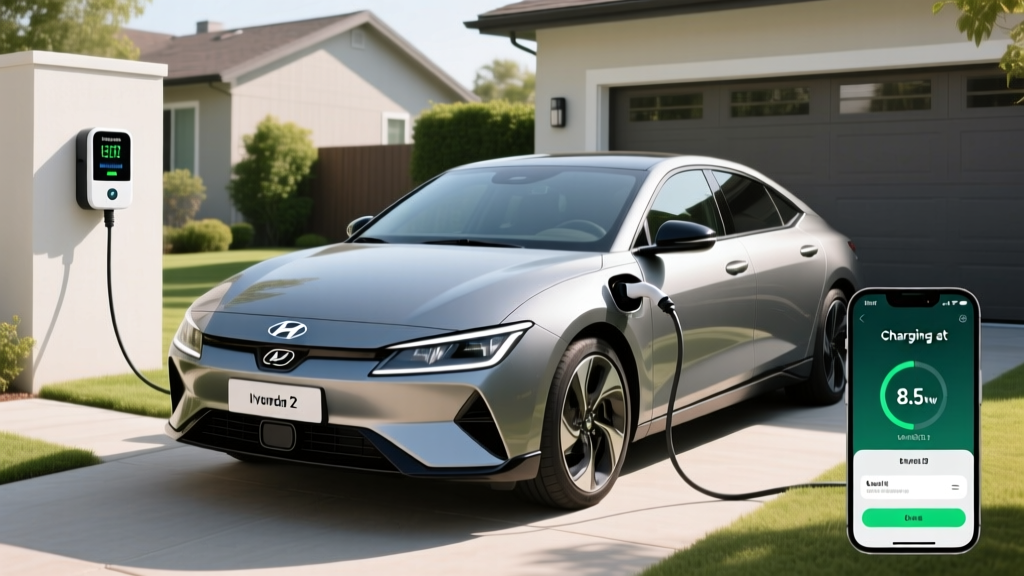
Level 2 is the daily workhorse. At 10.9 kW (the Ioniq 6's onboard charger maximum), you add roughly 45 miles of range per hour. An overnight session from 20% to 80% takes about 4.5 hours — easily covered while you sleep.
DC Fast Charging is for road trips. The Ioniq 6's 800V architecture lets it accept up to ~240 kW at compatible chargers, meaning a 10–80% session in roughly 18 minutes under ideal battery-temperature conditions. Note that charge speed tapers significantly above 80% State of Charge (SoC) to protect the battery — always plan road-trip stops to 80%, not 100%.
Home Level 2 Charger Installation: Electrical Requirements and Costs
Most Ioniq 6 owners will install a 240V Level 2 home charger. Here is what that involves electrically and financially.
Electrical Requirements
A Level 2 charger delivering the Ioniq 6's full 10.9 kW AC rate requires a 240V, 48-amp dedicated circuit. Per National Electrical Code (NEC), continuous loads (which EV charging qualifies as) must be on a circuit rated at 125% of the load — so a 48A charger needs a 60-amp breaker.
If your electrical panel has spare capacity (at least 60 amps of unused capacity on a 200A service panel), the installation is relatively straightforward: run conduit and wire from the panel to your garage or driveway, mount the charger, and connect. If your panel is older (100A service) or near capacity, you may need a panel upgrade to 200A — adding $1,500–$3,000 to the project.
Installation Cost Breakdown
| Component | Low Estimate | High Estimate | Notes |
|---|---|---|---|
| Level 2 Charger (hardware) | $350 | $700 | 32A–48A smart chargers |
| Electrician labor | $500 | $1,500 | Depends on run length, conduit |
| Permit and inspection | $50 | $200 | Required in most jurisdictions |
| Electrical panel upgrade (if needed) | $1,500 | $3,000 | 100A → 200A service upgrade |
| Total (no panel upgrade) | $900 | $2,400 | |
| Total (with panel upgrade) | $2,400 | $5,400 |
Always hire a licensed electrician and pull a permit. Unpermitted work can void homeowner's insurance and create fire risk. The Federal Energy Efficient Home Improvement Credit (§25C) may cover up to 30% of charger hardware and installation costs (capped at $1,000) — consult IRS guidelines and a tax professional for current-year eligibility.
Connector Compatibility: CCS1, NACS, and Adapter Options
The 2023 Hyundai Ioniq 6 left the factory with a CCS1 (Combined Charging System) connector — the J1772 AC inlet combined with two DC fast-charge pins below. However, the North American charging landscape is rapidly shifting toward NACS (North American Charging Standard, Tesla's connector).
| Network / Connector | Native Compatibility? | Adapter Needed? | Notes |
|---|---|---|---|
| CCS1 (Electrify America, EVgo, ChargePoint DC) | Yes — native | No | Direct plug-in at all CCS stations |
| NACS / Tesla Supercharger | No | Yes — CCS-to-NACS adapter | Hyundai offers an official adapter (~$200–$300); aftermarket options available from approved vendors |
| CHAdeMO | No | No adapter available | CHAdeMO is effectively retired in the US |
| J1772 (public Level 2) | Yes — native | No | Standard AC public charging |
For 2026, purchasing a CCS-to-NACS adapter is strongly recommended. It unlocks Tesla's Supercharger network — the largest and most reliable DC fast-charging network in the US — adding roughly 20,000+ stalls to your road-trip options. Hyundai's official adapter supports DC charging up to the vehicle's peak rate.
Cost to Charge: Home vs. Public vs. Gas Comparison
Charging economics vary enormously based on where and when you plug in. Here is a realistic breakdown using the Ioniq 6 SEL's 24 kWh/100mi efficiency.
| Scenario | Rate | Cost per kWh | Cost Per Mile |
|---|---|---|---|
| Home (off-peak utility rate) | $0.10/kWh | $0.10 | $0.024 |
| Home (average US residential) | $0.17/kWh | $0.17 | $0.041 |
| Public Level 2 (ChargePoint, etc.) | $0.25–$0.39/kWh | $0.32 avg | $0.077 |
| DC Fast (Electrify America, EA Pass+) | $0.36–$0.48/kWh | $0.42 avg | $0.101 |
| DC Fast (Tesla Supercharger w/ adapter) | $0.25–$0.35/kWh | $0.30 avg | $0.072 |
| Gasoline (30 MPG car at $3.50/gal) | — | — | $0.117 |
| Gasoline (25 MPG car at $3.50/gal) | — | — | $0.140 |
The takeaway: home charging at off-peak rates costs roughly $0.02–0.04 per mile — a fraction of gasoline. Even DC fast charging is competitive with or cheaper than gas on a per-mile basis. The Ioniq 6's exceptional efficiency (24 kWh/100mi, or 140 MPGe per fueleconomy.gov) amplifies these savings.
For a driver covering 12,000 miles per year charging primarily at home on an average $0.17/kWh rate, annual electricity cost is roughly $492 — compared to $1,404 for a 30 MPG gas car at $3.50/gallon. That is approximately $900 in annual fuel savings.
Recommended Level 2 Chargers for the Ioniq 6 SEL
These chargers match the Ioniq 6's 10.9 kW onboard charger capability and offer the reliability and smart features owners need.
ChargePoint Home Flex
- Power: Up to 12 kW (50A circuit) — configurable 16A–50A
- Connector: J1772 (NACS version now available)
- Cable length: 23 feet
- Smart features: Wi-Fi, app scheduling, Alexa, energy tracking
- Price: ~$550–$650
- Best for: Flexible amperage if your panel has limited capacity
Emporia Level 2 EV Charger
- Power: Up to 11.5 kW (48A)
- Connector: J1772
- Cable length: 24 feet
- Smart features: Wi-Fi, app, energy monitoring, solar integration
- Price: ~$350–$400
- Best for: Budget-conscious buyers who want smart scheduling
Wallbox Pulsar Plus
- Power: Up to 11.5 kW (48A)
- Connector: J1772
- Cable length: 25 feet
- Smart features: Wi-Fi + Bluetooth, app, Power Sharing for multi-charger setups
- Price: ~$550–$650
- Best for: Compact size and multi-EV households
Grizzl-E Smart
- Power: Up to 10 kW (40A)
- Connector: J1772
- Cable length: 24 feet
- Smart features: Wi-Fi, OCPP compatible, extreme cold rated (-40°C)
- Price: ~$450–$550
- Best for: Cold-climate durability and outdoor installs
All of these chargers deliver enough power to max out or nearly max out the Ioniq 6's 10.9 kW onboard charger. Choose based on your circuit capacity, cable length needs, and whether you want smart scheduling to take advantage of off-peak utility rates.
Safety, Code, and Preconditioning Best Practices
Electrical Safety and Code Requirements
- Dedicated circuit: Your Level 2 charger must be on its own dedicated breaker — never shared with other appliances.
- GFCI protection: NEC 2020 and later requires GFCI protection for EV charging outlets. Hardwired chargers with built-in GFCI may satisfy this; confirm with your electrician and local inspector.
- Outdoor rating: If installing outdoors, ensure the charger carries a NEMA 4 or IP65 rating for weather resistance.
- Wire gauge: A 60A circuit typically requires 6 AWG copper wire (THHN in conduit) or 4 AWG for longer runs — your electrician will calculate based on distance and voltage drop.
- Permit and inspection: Always required. Skipping this risks fire, insurance denial, and code violations that surface during a home sale.
Preconditioning for Faster DC Charging
The Ioniq 6's 800V battery architecture enables blazing 240 kW peak charge rates — but only when the battery is at optimal temperature (roughly 25–35°C / 77–95°F). Use the car's navigation to route to a DC fast charger; this triggers battery preconditioning, warming or cooling the pack ahead of arrival. Skipping preconditioning (e.g., driving to a charger without using nav routing) can add 5–10 minutes to your 10–80% session in cold weather, as the battery will limit charge rate until it self-heats.
DC Fast Charging on Road Trips: What to Expect
On a road trip, the Ioniq 6 SEL's 800V system is one of its biggest advantages. At a 350 kW-capable Electrify America or Tesla Supercharger V4 stall (with NACS adapter), expect:
- 10–80% in ~18 minutes under ideal conditions (moderate ambient temp, preconditioned battery)
- 10–80% in ~25–30 minutes in cold weather or at older 50–150 kW stations
- Peak rate of ~240 kW sustained from roughly 10–40% SoC, then tapering to ~150 kW at 60%, ~80 kW at 75%, and ~40 kW near 80%
This charge curve taper is normal and protects battery longevity. Plan road-trip legs around 10–80% charging windows rather than attempting full charges — the time from 80–100% can exceed the 10–80% time.
Frequently Asked Questions
How much does it cost to install a home EV charger for the Ioniq 6?
Expect $900–$2,400 for a standard installation (charger + electrician + permit) if your electrical panel has sufficient capacity. If a panel upgrade from 100A to 200A is needed, total costs rise to $2,400–$5,400. The §25C federal credit may offset up to $1,000 of hardware and installation costs.
How fast will each charging level add range to my Ioniq 6 SEL?
Level 1 (120V): ~4–5 miles per hour. Level 2 (240V at 10.9 kW): ~45 miles per hour. DC Fast Charging at peak 240 kW: roughly 200 miles in 15 minutes. These assume the Ioniq 6's efficiency of ~4.2 miles/kWh.
Which connector is compatible with my 2023 Ioniq 6?
The 2023 Ioniq 6 uses CCS1 natively for both AC Level 2 and DC fast charging. For Tesla Supercharger access, you need a CCS-to-NACS adapter (available from Hyundai or approved third parties). J1772 public Level 2 chargers are also natively compatible.
How much does charging cost per mile vs. gas?
At home on average US electricity ($0.17/kWh), the Ioniq 6 costs about $0.04 per mile. DC fast charging averages $0.07–$0.10 per mile. A comparable 30 MPG gas car at $3.50/gallon costs $0.12 per mile. Home charging saves roughly $900/year for a 12,000-mile driver.
What electrical upgrades might I need for a Level 2 charger?
You need a 240V dedicated circuit with a 60A breaker (for a 48A charger). If your home has a 100A service panel or the panel is near capacity, an upgrade to 200A service costs $1,500–$3,000. Your electrician will perform a load calculation to determine if an upgrade is necessary.
Does the Ioniq 6 SEL qualify for the federal EV tax credit?
Credit eligibility under IRS §30D depends on battery sourcing, critical minerals requirements, buyer income caps, and MSRP limits — all of which change periodically. The Ioniq 6 is assembled in South Korea, which may affect eligibility for the new-vehicle credit but could qualify under a lease structure. Consult a tax professional for your specific situation and current-year rules.
How long will the Ioniq 6 battery last?
Hyundai warranties the 77.4 kWh NMC battery for 10 years / 100,000 miles against capacity loss below 70%. Real-world data from Hyundai/Kia's E-GMP platform (shared with the Ioniq 5 and EV6) shows typical degradation of 5–8% over the first 100,000 miles with normal charging habits. Avoid routinely charging to 100% or leaving the battery at very low SoC for extended periods to maximize longevity.