The 2023 Chevrolet Bolt EUV remains one of the most affordable long-range electric crossovers on the used market, and understanding how to charge it efficiently is the key to unlocking its full potential. With an EPA-estimated 247 miles of range from its 65 kWh (usable) lithium-ion battery, the Bolt EUV can handle daily commuting and road trips alike — but only if you pair it with the right charging setup at home and know what to expect from public networks.
This guide breaks down exactly how fast each charging level replenishes the Bolt EUV's battery, what a home Level 2 installation actually costs (including panel upgrades), which connectors you need, and how charging costs compare to gasoline on a per-mile basis. Whether you just bought a 2023 Bolt EUV or are evaluating one, these numbers will shape your ownership experience.
Understanding the 2023 Chevy Bolt EUV Battery and Range
Before diving into charging hardware, let's establish the baseline specs. The 2023 Bolt EUV uses a 65 kWh usable NMC (nickel-manganese-cobalt) battery pack paired with a single front-mounted permanent-magnet motor producing 200 horsepower and 266 lb-ft of torque. EPA-estimated range is 247 miles, with a combined efficiency rating of 115 MPGe (29 kWh/100 miles).
| Spec | Value |
|---|---|
| Battery (usable) | 65 kWh, NMC chemistry |
| EPA Range | 247 miles |
| EPA Efficiency | 115 MPGe (29 kWh/100 mi) |
| Motor Output | 200 hp / 266 lb-ft |
| 0–60 mph | ~7.0 seconds |
| Max DC Fast Charge | 55 kW (CCS1) |
| Max Level 2 AC Charge | 11.5 kW |
| Connector (2023 model) | CCS1 (J1772 + DC pins) |
| Battery Warranty | 8 years / 100,000 miles |
A critical limitation to understand: the 2023 Bolt EUV's maximum DC fast charging rate is just 55 kW. This is slow by 2026 standards, where competitors routinely accept 150–350 kW. On a road trip, a 10–80% DC fast charge takes roughly 55–65 minutes — plan accordingly. This hardware constraint is the single biggest ownership trade-off for the Bolt EUV's otherwise attractive price.
Charging Levels Explained: Speeds, kW, and Miles Per Hour
EV charging is categorized into three levels. Here's a crucial distinction: kW (kilowatts) measures the power delivery rate — how fast energy flows into your battery. kWh (kilowatt-hours) measures energy capacity — the total amount stored. Think of kW as the width of a pipe and kWh as the size of the tank being filled.
| Level | Voltage / Power | Bolt EUV Max kW | Miles of Range Added Per Hour | 10–80% Time (Bolt EUV) |
|---|---|---|---|---|
| Level 1 (120V household) | 120V / 1.4 kW | 1.4 kW | ~4 miles/hr | ~55+ hours |
| Level 2 (240V home/public) | 240V / 7.2–11.5 kW | 11.5 kW | ~30–39 miles/hr | ~4.5–5.5 hours |
| DC Fast Charge | 400V+ / 50–350 kW | 55 kW (vehicle-limited) | ~140–160 miles/hr (peak) | ~55–65 minutes |
For Bolt EUV owners, Level 2 is the practical daily solution. At 11.5 kW, you'll add roughly 39 miles of range per hour of charging — more than enough to fully replenish the battery overnight. Level 1 (a standard 120V outlet) is best reserved for emergencies or low-mileage days, as adding a full charge takes over two full days.
On DC fast chargers, the Bolt EUV's 55 kW ceiling means that even plugging into a 150 kW or 350 kW Electrify America or EVgo station won't charge you any faster. The vehicle's onboard charge controller simply cannot accept more than 55 kW. Expect the charge curve to hold near peak rate from 10–50% SoC, then taper significantly above 70%. This is why manufacturers quote 10–80% times rather than 0–100%.
Home Level 2 Charger Installation: Costs, Electrical Requirements, and Upgrades
Installing a Level 2 home charger is the single highest-impact upgrade for EV ownership. For the Bolt EUV, a 240V / 48-amp circuit delivering up to 11.5 kW will max out the vehicle's onboard charger and provide a full overnight replenishment.
Electrical Requirements
A proper Bolt EUV home charging setup requires a 240V dedicated circuit rated for at least 50 amps (the National Electrical Code requires circuits to be rated at 125% of the continuous load, so a 40A continuous charger needs a 50A breaker; a 48A continuous charger needs a 60A breaker). The charger connects either via a NEMA 14-50 outlet or is hardwired directly to the panel.
Key considerations:
- Electrical panel capacity: Most modern homes have 200A service panels. Adding a 50–60A EV circuit is usually straightforward if you have spare breaker slots and sufficient remaining capacity. Older homes with 100A panels will likely need a panel upgrade ($1,500–$3,500).
- Wire gauge: A 50A circuit typically requires 6 AWG copper wire; a 60A circuit requires 4 AWG. Longer cable runs from the panel to the garage increase wire cost.
- Permit: Nearly all jurisdictions require an electrical permit for a new 240V circuit. Your licensed electrician will pull this. Inspections ensure the work meets NEC code.
- GFCI protection: The 2020 NEC update requires GFCI protection for outlets used for EV charging in garages. Hardwired chargers may bypass this requirement in some jurisdictions — ask your electrician.
- Outdoor rating: If your charger is mounted outside (carport, driveway), ensure the unit carries a NEMA 4 or IP65 weather rating.
How Much Does Home Charger Installation Cost?
| Item | Low Estimate | High Estimate | Notes |
|---|---|---|---|
| Level 2 Charger (hardware) | $350 | $700 | Smart Wi-Fi chargers, 40–48A |
| Electrician labor | $400 | $1,200 | Depends on panel distance, wall material |
| Electrical permit | $50 | $200 | Varies by municipality |
| Wire & conduit materials | $100 | $400 | Longer runs = higher cost |
| Panel upgrade (if needed) | $1,500 | $3,500 | 100A → 200A service; not always needed |
| Total (no panel upgrade) | $900 | $2,500 | Most common scenario |
| Total (with panel upgrade) | $2,400 | $6,000 | Older homes with 100A service |
Before hiring an electrician, request a load calculation to determine whether your panel can handle the added circuit. Many utility companies also offer rebates of $200–$500 for Level 2 charger installations — check with your local provider. The federal Alternative Fuel Vehicle Refueling Property Credit (IRS Form 8911) may cover up to 30% of home charging equipment and installation costs, capped at $1,000, though eligibility depends on census-tract requirements. Consult a tax professional for your specific situation.
Connector Compatibility: CCS1, NACS, and What the Bolt EUV Uses
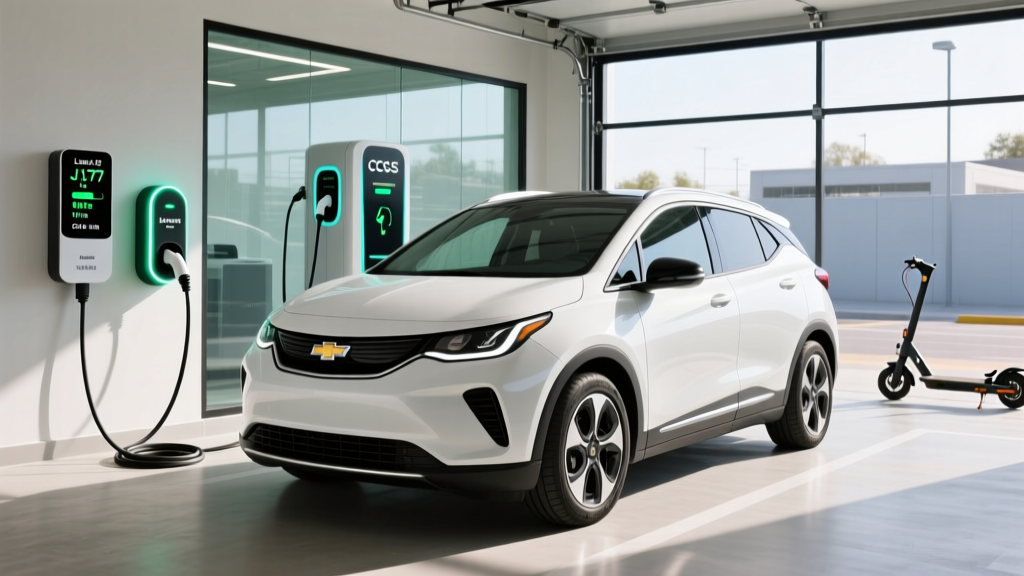
The 2023 Chevy Bolt EUV ships with a CCS1 (Combined Charging System) port — the J1772 connector for Level 1/Level 2 AC charging, plus two additional DC pins below for fast charging. This is the standard that GM, Ford, and most legacy automakers adopted before Tesla's North American Charging Standard (NACS) gained industry-wide traction beginning in 2024.
| Connector | Used By | Bolt EUV Compatible? | Adapter Needed? |
|---|---|---|---|
| J1772 (AC Level 1/2) | All EVs (pre-2025 non-Tesla) | Yes — native | No |
| CCS1 (DC fast) | GM, Ford, VW, Hyundai, Kia (pre-2025) | Yes — native | No |
| NACS (Tesla / new standard) | Tesla, 2025+ GM/Ford/Rivian/Hyundai | Via adapter | Yes — GM-approved CCS-to-NACS adapter (~$200–$300) |
| CHAdeMO (DC fast) | Nissan Leaf, Mitsubishi (legacy) | No | N/A — network is phasing out |
The NACS adapter question: As of 2025, GM began offering a CCS-to-NACS adapter that allows Bolt EUV and Bolt EV owners to access Tesla Supercharger stalls. This significantly expands your public DC fast-charging options, since the Tesla Supercharger network is the most reliable in North America. The adapter costs approximately $200–$300 and is available through GM dealerships or the myChevrolet app. Given that the Bolt EUV's 55 kW charge rate won't bottleneck even a V2 Supercharger (which delivers up to 150 kW), this adapter is a worthwhile investment for road-trip flexibility.
Charging Cost Per Mile: Bolt EUV vs. Gasoline
One of the strongest arguments for the Bolt EUV is operating cost. At 29 kWh per 100 miles, it's one of the most efficient EVs in its class. Here's how charging costs compare to a gasoline equivalent under various scenarios:
| Scenario | Rate | Bolt EUV $/Mile | Gas Vehicle $/Mile ($3.50/gal, 27 MPG) |
|---|---|---|---|
| Home charging (off-peak utility rate) | $0.10/kWh | $0.029 | $0.130 |
| Home charging (national avg. residential) | $0.17/kWh | $0.049 | $0.130 |
| Public Level 2 (ChargePoint, EVgo) | $0.30/kWh | $0.087 | $0.130 |
| DC Fast Charge (Electrify America, EVgo) | $0.48/kWh | $0.139 | $0.130 |
| Solar-charged at home (effective cost) | $0.04/kWh | $0.012 | $0.130 |
The data from the EPA's fueleconomy.gov listing for the 2023 Bolt EUV confirms its 29 kWh/100 mi efficiency. At home off-peak rates, you'll spend roughly 3 cents per mile — about one-quarter the cost of gasoline. Even at public DC fast-charging rates, costs are comparable to gas. The takeaway: home charging is where the economics work best. Relying exclusively on public DC fast charging erodes the cost advantage, though the Bolt EUV's 55 kW charge cap at least limits how much you'll spend per session.
Recommended Level 2 Chargers for the Bolt EUV
Since the Bolt EUV accepts up to 11.5 kW on Level 2 (48 amps), you'll want a charger rated for at least 48A to take full advantage. Here are three well-regarded options as of 2026:
ChargePoint Home Flex
- Power Output: Up to 50A (12 kW at 240V) — adjustable via DIP switch
- Connector: J1772 (compatible with Bolt EUV natively)
- Cable Length: 23 feet
- Smart Features: Wi-Fi, app scheduling, Alexa integration, energy tracking
- Price: ~$550–$650
- Best For: Flexible amperage adjustment to match your panel capacity
Emporia Level 2 EV Charger
- Power Output: 48A (11.5 kW at 240V)
- Connector: J1772
- Cable Length: 24 feet
- Smart Features: Wi-Fi, app control, solar integration, real-time energy monitoring
- Price: ~$350–$400
- Best For: Budget-conscious buyers who want smart features without the premium price
Wallbox Pulsar Plus (48A)
- Power Output: 48A (11.5 kW at 240V)
- Connector: J1772
- Cable Length: 25 feet
- Smart Features: Wi-Fi + Bluetooth, app scheduling, load balancing, Power Sharing for dual chargers
- Price: ~$500–$600
- Best For: Compact form factor and dual-charger garages
All three chargers will fully replenish the Bolt EUV's 65 kWh battery overnight (approximately 6–7 hours from near-empty). The Emporia stands out for value, while the ChargePoint offers the most amperage flexibility if your panel has limited headroom. Hardwired installation is recommended over a NEMA 14-50 outlet for reliability and to avoid GFCI nuisance trips that have been documented with some outlet-based setups.
Public Charging Tips for Bolt EUV Owners
The Bolt EUV's CCS1 port works natively at Electrify America, EVgo, ChargePoint DC stations, and most other public networks. With the GM-approved CCS-to-NACS adapter, you also gain access to Tesla Supercharger V2 and V3 stalls — a major advantage given the Supercharger network's superior uptime and reliability scores.
Practical tips for public DC fast charging:
- Precondition the battery: If your Bolt EUV has navigation-based battery preconditioning (available on models with the Super Cruise or navigation package), route through the onboard nav to a charger. The system will warm the battery to optimal temperature for faster charging. Without preconditioning, cold-soaked batteries charge significantly slower — a 55 kW peak may drop to 30–35 kW in freezing weather.
- Charge to 80%, then move on: The charge curve tapers sharply above 80% SoC. Charging from 80–100% can take nearly as long as 10–80%. For road trips, hop between chargers at 80% rather than waiting for a full charge.
- Check station status in-app: Use PlugShare or the specific network's app (EA, EVgo) to verify stall availability and operational status before driving to a station.
Frequently Asked Questions
How much does it cost to install a home EV charger for the Bolt EUV?
A typical Level 2 installation with a 240V/50A circuit costs between $900 and $2,500, including the charger hardware ($350–$700), electrician labor ($400–$1,200), permits ($50–$200), and wiring materials ($100–$400). If your home has a 100A electrical panel that needs upgrading to 200A, add $1,500–$3,500. Always get a licensed electrician to perform a load calculation before committing.
How fast will each charging level add range to the Bolt EUV?
Level 1 (120V) adds about 4 miles per hour. Level 2 (240V at 11.5 kW) adds approximately 39 miles per hour. DC fast charging at the Bolt EUV's 55 kW peak adds roughly 140–160 miles per hour, though the charge curve tapers above 50% SoC. A 10–80% DC fast charge takes approximately 55–65 minutes.
Which connector and charger is compatible with my 2023 Bolt EUV?
The 2023 Bolt EUV uses a CCS1 connector natively — this includes J1772 for AC charging and CCS DC pins for fast charging. Any J1772 Level 2 home charger is directly compatible. For DC fast charging, use CCS1 stations on Electrify America, EVgo, or similar networks. A GM-approved CCS-to-NACS adapter (~$200–$300) unlocks Tesla Supercharger access.
How much does charging the Bolt EUV cost per mile vs. gasoline?
At a national average residential electricity rate of $0.17/kWh, the Bolt EUV costs about $0.049 per mile to charge at home — roughly 62% cheaper than a 27 MPG gas vehicle at $3.50/gallon ($0.130/mile). Off-peak rates as low as $0.10/kWh bring the cost to under $0.03/mile. Public DC fast charging at $0.48/kWh is slightly more expensive than gas at $0.139/mile, which is why home charging is strongly recommended for daily use.
What electrical upgrades might I need for a home charger?
Homes with 200A electrical service and available breaker slots typically need no upgrades beyond the dedicated 50–60A circuit. Homes with 100A service, older wiring, or panels near capacity may require a panel upgrade ($1,500–$3,500), a service upgrade from the utility, or a smart panel device like the Span drive panel to manage loads dynamically. Your electrician's load calculation will determine this.
Does the 2023 Bolt EUV qualify for any tax credits on charging equipment?
The federal Alternative Fuel Vehicle Refueling Property Credit (IRS Form 8911) may cover 30% of home charging equipment and installation costs, up to $1,000. Eligibility depends on your property being in a qualifying census tract. Check current rules on irs.gov or consult a tax professional, as requirements can change.
Bottom Line: The 2023 Chevy Bolt EUV's 247-mile EPA range and 11.5 kW Level 2 acceptance rate make it an excellent home-charging EV. Budget roughly $1,000–$2,500 for a professional Level 2 installation, invest in a CCS-to-NACS adapter for road trips, and take advantage of off-peak utility rates to keep your per-mile cost under 5 cents. The 55 kW DC fast-charging limitation is the Bolt EUV's Achilles' heel on long trips — plan your stops accordingly and don't expect the 20-minute pit stops that 250+ kW vehicles enjoy.