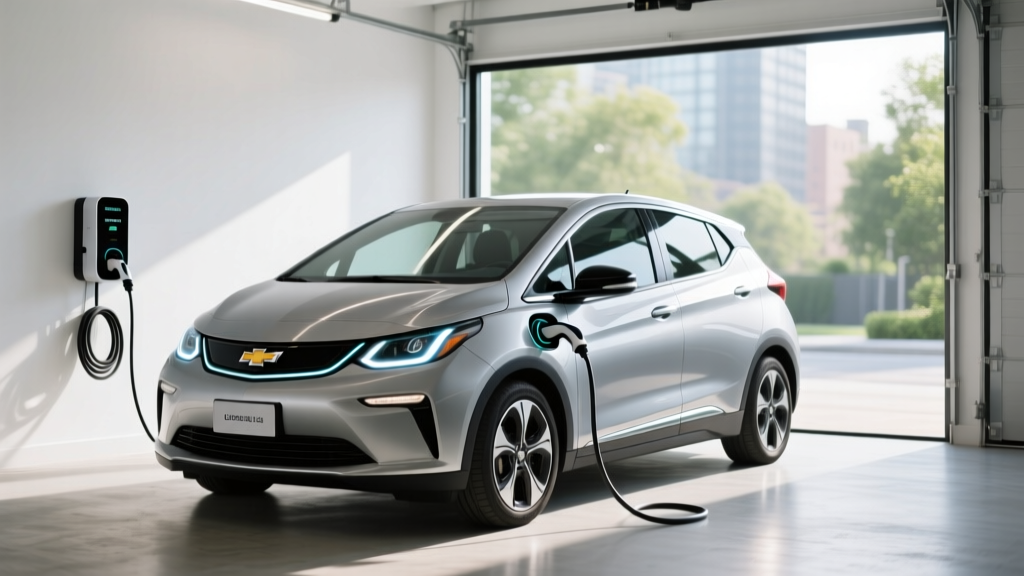
The 2023 Chevrolet Bolt EV and Bolt EUV remain two of the most affordable ways to get into a long-range electric vehicle. But owning one means understanding exactly how to keep its 65 kWh battery full — and the Bolt's charging profile has some quirks that every owner or prospective buyer should know. This guide breaks down 2023 Chevy Bolt charging speeds at every level, what you'll spend on a home setup, which connectors you need, and the real-world cost per mile compared to gas.
Before we get into specifics, a critical distinction: kW (kilowatts) measures power — how fast energy flows into your car, like water pressure from a hose. kWh (kilowatt-hours) measures energy capacity — how much the battery holds, like the size of a bucket. The 2023 Bolt EV has a 65 kWh battery; a 50 kW charger is one measure of how quickly that battery fills.
2023 Chevy Bolt EV and EUV: Battery and Range at a Glance
Both the Bolt EV and Bolt EUV share the same battery pack and powertrain for the 2023 model year. Here are the baseline specs that determine your charging experience:
| Spec | 2023 Bolt EV | 2023 Bolt EUV |
|---|---|---|
| Battery Capacity (usable) | 65 kWh | 65 kWh |
| Battery Chemistry | NMC (Nickel Manganese Cobalt) | NMC (Nickel Manganese Cobalt) |
| EPA Range | 259 miles | 247 miles |
| Real-World Highway Range | ~220–235 miles | ~210–225 miles |
| Cold-Weather Range (20°F) | ~180–200 miles | ~170–190 miles |
| EPA Efficiency | 120 MPGe (28 kWh/100mi) | 115 MPGe (29 kWh/100mi) |
| Max DC Fast Charge Rate | 55 kW (peak) | 55 kW (peak) |
| Max Level 2 AC Charge Rate | 11.5 kW | 11.5 kW |
| Onboard Charger | 48A / 11.5 kW | 48A / 11.5 kW |
| Connector (DC Fast) | CCS1 | CCS1 |
| Connector (AC Level 2) | J1772 | J1772 |
| 0–60 mph | 6.5 seconds | 6.8 seconds |
| Horsepower | 200 hp | 200 hp |
| Battery/Powertrain Warranty | 8 years / 100,000 miles | 8 years / 100,000 miles |
Charging Levels Explained: How Fast Each Level Adds Range
The 2023 Bolt supports three charging levels. Here's what each delivers in practical terms:
| Charging Level | Power Source | Max Power (kW) | Miles of Range Added per Hour | Full 0–100% Time (65 kWh) | Best Use Case |
|---|---|---|---|---|---|
| Level 1 | 120V household outlet | 1.2–1.4 kW | ~4 miles/hour | ~48–54 hours | Overnight top-ups, emergencies, low-mileage drivers |
| Level 2 (Home/Public AC) | 240V (NEMA 14-50 or hardwired) | 11.5 kW (Bolt's max) | ~39 miles/hour | ~6–7 hours | Daily home charging, workplace charging |
| DC Fast Charging | 480V+ public DC station | 55 kW (Bolt's peak) | ~150–180 miles/hour (at peak) | N/A (typically 10–80%) | Road trips, quick top-ups away from home |
Level 1: The Emergency Backup
Every 2023 Bolt ships with a dual-level charge cord that plugs into a standard 120V outlet. At roughly 1.2 kW, you'll gain about 4 miles of range per hour — or approximately 40–50 miles over a 10–12 hour overnight session. For drivers who travel under 30 miles daily and have reliable home parking, Level 1 can technically suffice. But for most owners, it's painfully slow and best reserved as a backup.
Level 2: The Daily Workhorse
The Bolt's 11.5 kW onboard charger is actually one of its strengths. Many competing EVs cap out at 7.2 kW or 9.6 kW on Level 2. With an 11.5 kW-capable home charger on a 48-amp circuit, the Bolt can add roughly 39 miles of range per hour, going from empty to full in about 6–7 hours. This means you can plug in at 11 PM and wake up to a full battery every morning.
DC Fast Charging: The Bolt's Known Weakness
Here's where the 2023 Bolt draws criticism. Its peak DC fast-charging rate of 55 kW is slow by modern standards — the Hyundai Ioniq 5 peaks at 240 kW, and even the older Tesla Model 3 hits 170 kW. At 55 kW peak, a 10–80% charge takes approximately 45–55 minutes under ideal conditions. And that peak rate isn't sustained: the Bolt's charge curve tapers significantly above 60% state of charge (SoC), dropping to the mid-30s kW range by 70% and into the low 20s by 80%.
Home Charger Installation: Requirements, Costs, and Gotchas
To unlock the Bolt's full 11.5 kW Level 2 charging capability at home, you need a 240V circuit with a 48-amp continuous draw, which electrical code requires be on a 60-amp breaker (continuous loads must not exceed 80% of breaker capacity).
Electrical Requirements for Full-Speed Bolt Charging
- Voltage: 240V (split-phase, standard US residential)
- Amperage: 48A continuous / 60A breaker
- Circuit: Dedicated — no sharing with other appliances
- Outlet options: NEMA 14-50 (50A receptacle, limits to 40A continuous / 9.6 kW) or hardwired (full 48A / 11.5 kW)
- GFCI protection: Required by NEC 2017+ for EV outlets in garages and outdoor locations
Important note on NEMA 14-50: A 14-50 outlet is rated for 50A, which means continuous draw is limited to 40A (9.6 kW). You'll lose about 2 kW of the Bolt's 11.5 kW capability. To get the full 48A, you need a hardwired charger on a 60A breaker. Many Bolt owners find 9.6 kW via 14-50 perfectly adequate — a full charge still completes overnight — but if you want maximum speed, hardwire is the way to go.
Installation Cost Breakdown
| Cost Component | Simple Install (Near Panel) | Complex Install (Far from Panel / Older Home) |
|---|---|---|
| Level 2 Charger (Equipment) | $350–$700 | $350–$700 |
| Electrician Labor (2–4 hrs simple / 6–12 hrs complex) | $500–$1,200 | $1,500–$3,500 |
| Electrical Permit | $50–$200 | $50–$200 |
| Panel Upgrade (100A → 200A, if needed) | $0 (not needed) | $1,500–$4,000 |
| Conduit/Wiring (long runs, trenching) | $0–$200 | $500–$2,500 |
| Total Estimated Cost | $900–$2,300 | $4,000–$10,900 |
The wide cost range is real, not padding. A homeowner with a 200A panel and a garage wall adjacent to the electrical box might spend under $1,500 all-in. A 1970s home with a 100A panel, a detached garage, and a 100-foot wire run could easily spend $8,000+. Always get 2–3 quotes from licensed electricians and confirm they have specific EV charger installation experience.
According to the IRS §30D guidelines, the federal Alternative Fuel Vehicle Refueling Property Credit (IRC §30C) may cover up to 30% of home charging equipment and installation costs, capped at $1,000, subject to income limits and census-tract eligibility. Check with a tax professional for your specific situation.
Connector Compatibility: What Plugs Into the 2023 Bolt?
The 2023 Bolt EV and EUV use the CCS1 (Combined Charging System) connector for DC fast charging and the J1772 connector for Level 1 and Level 2 AC charging. The CCS1 port on the Bolt integrates the J1772 inlet with two additional DC pins below it — it's a single port on the vehicle.
| Connector Type | Used For | 2023 Bolt Compatible? | Notes |
|---|---|---|---|
| J1772 | Level 1 & Level 2 AC charging | Yes (native) | Standard on all non-Tesla EVs sold in North America |
| CCS1 | DC Fast Charging | Yes (native) | Standard DC fast connector for GM, Ford, VW, Hyundai, most others |
| NACS (Tesla) | Tesla Superchargers & Level 2 | With adapter (for Supercharger access) | GM began providing NACS adapters to Bolt owners in mid-2025; Tesla Supercharger access for CCS vehicles requires an approved adapter |
| CHAdeMO | DC Fast Charging (legacy) | No | Used by older Nissan Leaf; essentially obsolete for new vehicles |
Tesla Supercharger Access for the Bolt
As of 2025, GM EV owners — including Bolt EV/EUV drivers — gained access to Tesla's Supercharger network using a GM-approved NACS adapter. This significantly expands the Bolt's road-trip usability, since the Supercharger network is the most reliable and widespread DC fast-charging network in North America. The adapter typically costs around $200–$250 if not provided complimentary by GM. Confirm adapter compatibility with GM's official guidance before purchasing a third-party adapter, as not all adapters safely handle all vehicles' charging protocols.
Charging Cost per Mile: Bolt EV vs. Gas Equivalent
One of the strongest arguments for the Bolt is its low operating cost. At 28 kWh per 100 miles (Bolt EV EPA combined), here's what charging costs in different scenarios:
| Charging Scenario | Typical $/kWh | Cost per 100 Miles | Cost per Mile | Equivalent Gas Price (at 30 MPG) |
|---|---|---|---|---|
| Home (off-peak utility rate) | $0.08–$0.12 | $2.24–$3.36 | $0.02–$0.03 | $0.67–$1.01/gallon |
| Home (standard rate) | $0.13–$0.18 | $3.64–$5.04 | $0.04–$0.05 | $1.09–$1.51/gallon |
| Public Level 2 (ChargePoint, EVgo) | $0.20–$0.35 | $5.60–$9.80 | $0.06–$0.10 | $1.68–$2.94/gallon |
| DC Fast Charging (Electrify America, EVgo) | $0.30–$0.55 | $8.40–$15.40 | $0.08–$0.15 | $2.52–$4.62/gallon |
For context, a comparable gas-powered subcompact like the Chevy Equinox at 30 MPG combined with gas at $3.50/gallon costs about $0.12 per mile. A Bolt owner charging primarily at home on off-peak rates spends roughly $0.03 per mile — a 75% reduction in fuel cost.
Even on DC fast charging at $0.45/kWh (a common Electrify America rate), the Bolt costs about $0.13/mile — roughly equivalent to gas. The savings are maximized when you charge at home. This is why home charging access is the single biggest factor in EV satisfaction.
Best Home Chargers for the 2023 Chevy Bolt
To maximize the Bolt's 11.5 kW onboard charger, you want a Level 2 station that delivers at least 48 amps. Here are top options, selected for reliability, safety certifications, and real-world performance:
Emporia Vue Smart Charger
- Power Output: 48A / 11.5 kW (hardwired) or 40A / 9.6 kW (14-50 plug)
- Connector: J1772 (compatible with Bolt natively)
- Cable Length: 24 feet
- Smart Features: Wi-Fi, energy monitoring, scheduling, solar integration, load management
- Price: ~$399
- Best For: Budget-conscious Bolt owners who want smart scheduling and solar-aware charging
ChargePoint Home Flex
- Power Output: Up to 50A / 12 kW (hardwired, adjustable via DIP switches)
- Connector: J1772
- Cable Length: 23 feet
- Smart Features: Wi-Fi, app scheduling, Alexa integration, amperage configurable to match your circuit
- Price: ~$549–$699
- Best For: Flexibility — set to 48A for the Bolt now, reconfigure for a future EV with a larger onboard charger
Grizzl-E Smart
- Power Output: 40A / 9.6 kW (14-50) or 48A / 11.5 kW (hardwired)
- Connector: J1772
- Cable Length: 24 feet
- Smart Features: Wi-Fi, OCPP support, firmware updates, works with ev.energy app
- Price: ~$449–$549
- Best For: Cold-climate and outdoor installations — rated to -40°F, rugged aluminum case
Tesla Wall Connector (with J1772 adapter)
- Power Output: 48A / 11.5 kW (hardwired)
- Connector: NACS native — requires a NACS-to-J1772 adapter for Bolt (~$100–$150)
- Cable Length: 24 feet
- Smart Features: Wi-Fi, OTA updates, power sharing between multiple units
- Price: ~$450 (charger) + ~$120 (adapter)
- Best For: Multi-EV households with both Tesla and non-Tesla vehicles
Our pick for Bolt-only households: The Emporia Vue Smart Charger at $399 hardwired gives you the full 11.5 kW the Bolt can accept, plus energy monitoring that helps you optimize for off-peak utility rates. It's UL-listed and backed by a 3-year warranty.
Safety and Electrical Code Considerations
EV charging draws sustained high current for hours — this is fundamentally different from most household loads. Key safety requirements:
- Dedicated circuit: Your Level 2 charger must have its own breaker — no shared circuits with dryers, HVAC, or other appliances.
- Continuous load derating: NEC requires that continuous loads (3+ hours) use no more than 80% of the breaker rating. A 48A charger needs a 60A breaker. A 40A charger needs a 50A breaker.
- GFCI protection: The 2017 NEC and later require GFCI protection for EV charging outlets. Hardwired installations may be exempt in some jurisdictions — confirm with your local inspector.
- Outdoor rating: If your charger is outdoors, it must be rated for wet locations (NEMA 4 or IP65 minimum). All chargers listed above meet this standard.
- Wire gauge: A 60A circuit typically requires 6 AWG copper wire (THHN in conduit) or 4 AWG NM-B cable. Your electrician will size this correctly based on run length and local code.
- Permit and inspection: Most jurisdictions require an electrical permit for a new 240V circuit. The inspection ensures the work meets NEC and local amendments. Budget $50–$200 for the permit and schedule the inspection before closing up any walls.
Never use extension cords or outlet adapters (like dryer-to-EV splitters) for sustained Level 2 charging. These introduce resistance, heat, and fire risk at currents the connectors weren't designed to handle continuously.
DC Fast Charging on Road Trips: What to Expect
The Bolt's 55 kW peak DC charge rate is its most-cited limitation, and it's the primary reason this otherwise excellent EV isn't ideal for frequent long-distance travel. Here's a realistic road-trip charging scenario:
Scenario: 300-mile trip, starting at 100% SoC, driving at 70–75 mph in moderate weather.
- Drive ~210 miles (real-world highway range at that speed). SoC arrives at approximately 10–15%.
- Plug into a 50+ kW DC fast charger. Charge from 15% to 60%: approximately 30–35 minutes.
- Drive another ~130 miles to your destination, arriving at ~20% SoC.
Total charging time: ~30–35 minutes for a 300-mile trip. That's workable but noticeably slower than EVs with 150+ kW charge rates, which can do 10–80% in 18–25 minutes.
Tips for Bolt road-trip charging:
- Use the Bolt's built-in navigation to precondition the battery — it warms the pack for faster charging when it detects you're navigating to a charger.
- Charge to 60% and go rather than waiting for 80%+. The taper above 60% makes the last 20% disproportionately slow.
- Plan stops using PlugShare or A Better Routeplanner, filtering for CCS1 stations with 50+ kW chargers.
- If you have the GM-approved NACS adapter, Tesla Supercharger stalls (typically 150–250 kW, though the Bolt will still cap at 55 kW) tend to be more reliable than third-party networks.
Frequently Asked Questions
How much does it cost to install a home charger for the 2023 Chevy Bolt?
A straightforward installation near your electrical panel typically costs $900–$2,300 all-in (charger + electrician + permit). Older homes needing a panel upgrade or long wire runs can cost $4,000–$10,900. Get multiple quotes from licensed electricians experienced with EV installations.
Can I charge the Bolt on a regular 120V outlet?
Yes, but slowly. Level 1 charging adds about 4 miles of range per hour. A full charge from empty takes roughly 48–54 hours. It works for low-mileage drivers who can charge nightly, but most Bolt owners install Level 2 for practical daily use.
How long does it take to charge the 2023 Bolt from 10% to 80% on a DC fast charger?
Approximately 45–55 minutes under ideal conditions at a 50+ kW charger. The Bolt's charge curve tapers significantly above 60% SoC. For road trips, charging 15–60% in about 30 minutes is more time-efficient than pushing to 80%.
Does the 2023 Bolt qualify for the federal EV tax credit?
For 2023 purchases, the Bolt EV and EUV were eligible for up to $7,500 under the revised §30D rules, subject to buyer income caps ($150K single / $300K joint), MSRP limits ($55K for SUVs like the EUV, $55K for the EV sedan classification), and battery sourcing requirements that phased in during 2023. Check the IRS clean vehicle credit page and consult a tax professional for your specific eligibility. The Bolt was discontinued after the 2023 model year, so this applies only to vehicles purchased new during that period.
Can the 2023 Bolt use Tesla Superchargers?
Yes, with a GM-approved NACS adapter. GM began distributing adapters to eligible Bolt owners in 2025. The adapter allows the Bolt's CCS1 port to connect to Tesla's NACS Supercharger connectors. The Bolt will still be limited to its 55 kW peak charge rate even at higher-capacity Supercharger stalls.
What electrical upgrades might I need for a Bolt home charger?
The most common upgrades are: (1) a panel upgrade from 100A to 200A service if your existing panel lacks capacity for a 60A breaker, (2) a new dedicated 240V circuit run from the panel to your garage or parking spot, and (3) GFCI breaker installation if required by your local code. Homes built after 2000 with 200A panels usually need only the circuit run. Older homes should budget for potential panel upgrades.
Is the Bolt's battery warranty adequate?
Chevrolet covers the Bolt's battery and powertrain for 8 years or 100,000 miles, whichever comes first. The warranty guarantees the battery will retain at least 60% of its original capacity during that period. Real-world data from earlier Bolt model years suggests NMC degradation is modest — most Bolts retain 90%+ capacity after 3–4 years and 50,000+ miles. Full battery replacement outside of warranty currently costs approximately $14,000–$16,000 including labor, though this is rarely needed within the vehicle's practical lifespan.
Sources: EPA Fueleconomy.gov — 2023 Chevrolet Bolt EV, Chevrolet Bolt EV Official Specifications, IRS Clean Vehicle Credits