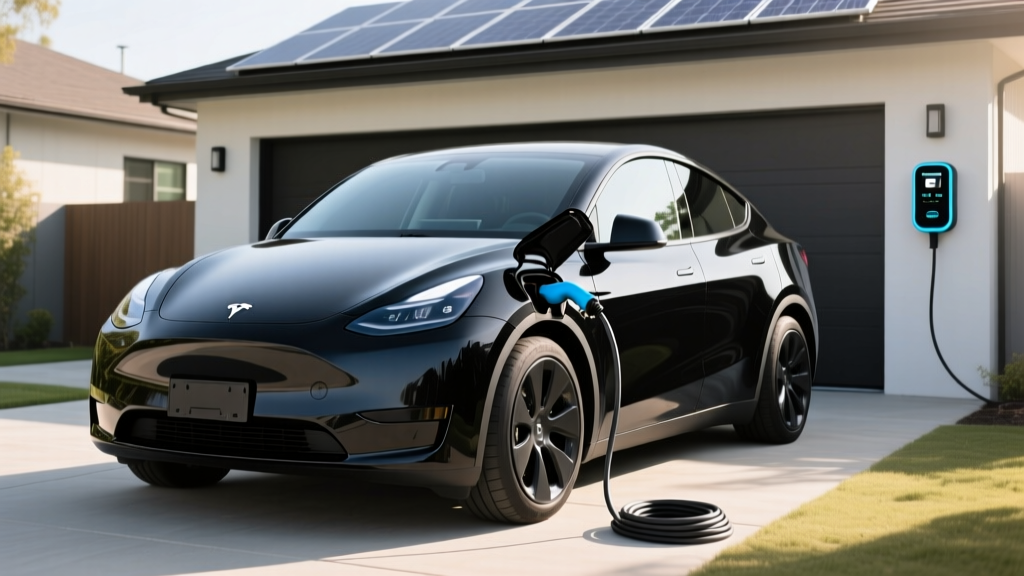
The 2022 Tesla Model Y remains one of the most popular electric vehicles on the road, and for good reason: practical SUV packaging, access to the Supercharger network, and strong efficiency. But owners and prospective buyers consistently ask the same question — what's the real-world 2022 Tesla Model Y range, and what does it take to keep one charged at home and on the road?
This guide breaks down the EPA range versus what you'll actually see, maps every charging scenario from a standard wall outlet to a 250 kW DC fast charger, and provides a detailed home charger installation cost breakdown. If you're evaluating a used 2022 Model Y or optimizing your current ownership, these are the numbers that matter.
2022 Tesla Model Y Range: EPA Sticker vs. Real-World Miles
Tesla sold the 2022 Model Y in two primary trims with distinct EPA range ratings:
| Trim | EPA Range | Battery (usable) | Chemistry | MPGe (combined) | 0-60 mph |
|---|---|---|---|---|---|
| Long Range AWD | 330 miles | ~82 kWh | NMC | 117 MPGe | 4.8 sec |
| Performance | 303 miles | ~82 kWh | NMC | 111 MPGe | 3.5 sec |
The 330-mile EPA figure for the Long Range assumes a mix of city and moderate-speed driving at moderate temperatures. In practice:
- Highway (75 mph sustained): Expect ~270–290 miles in warm weather, ~240–260 miles in cold (below 35°F).
- City/suburban mixed: 300–320 miles is achievable with regenerative braking doing heavy lifting.
- Cold weather (below 20°F): Range can drop 20–30%, bringing the Long Range down to ~230–265 miles depending on cabin heat usage and whether you precondition.
The Model Y uses an NMC (nickel manganese cobalt) lithium-ion pack. NMC offers higher energy density than LFP chemistry, which is why the Long Range achieves 330 miles from a ~82 kWh usable pack. The trade-off: Tesla recommends daily charging to 80–90% for NMC batteries to preserve long-term health, reserving 100% for road trips. That means your practical daily range is closer to 265–297 miles depending on trim.
Charging Levels Explained: How Fast Will Each Level Add Range?
Understanding EV charging requires distinguishing between kW (kilowatts), which measures charging power — how fast energy flows — and kWh (kilowatt-hours), which measures energy capacity — how much the battery holds. Think of kW as the flow rate of a hose and kWh as the size of the bucket.
The 2022 Model Y accepts up to 250 kW on DC fast charging and up to 11.5 kW (48A) on Level 2 AC charging via its onboard charger. Here's how each level translates to real charging speed:
| Level | Power (kW) | Voltage / Amps | Miles of Range Added per Hour | Typical Use Case |
|---|---|---|---|---|
| Level 1 | 1.4–1.9 kW | 120V / 12–16A | 3–5 miles/hr | Emergency / overnight trickle |
| Level 2 (standard) | 7.7 kW | 240V / 32A | ~25 miles/hr | Common home charger (NEMA 14-50) |
| Level 2 (max) | 11.5 kW | 240V / 48A | ~37 miles/hr | Wall Connector on 60A circuit |
| DC Fast (peak) | 250 kW | 400V+ DC | ~1,000+ miles/hr (peak) | Supercharger V3 / CCS stations |
At Level 1 (a standard 120V household outlet), you'll add roughly 4 miles of range per hour. That's ~40 miles over a 10-hour night — enough for short commutes but inadequate as a primary strategy. Level 2 at home is where most Model Y owners do 90%+ of their charging.
Charging Time Examples: 10–80% SoC
Here's how long a 10–80% charge takes at various power levels for the Model Y's ~82 kWh pack (roughly 57 kWh needed for that window):
- Level 1 (1.9 kW): ~30 hours — impractical for a full replenishment.
- Level 2, 7.7 kW (32A): ~7.4 hours — overnight fill.
- Level 2, 11.5 kW (48A): ~5 hours — fast overnight, ideal for heavy daily use.
- DC Fast (Supercharger V3, 250 kW peak): ~20–25 minutes (10–80%). The Model Y peaks at 250 kW briefly, then tapers: ~150 kW average from 10–50%, slowing to ~60 kW above 70%. Preconditioning the battery via navigation to a Supercharger is essential to hit peak rates.
Home Charger Installation: Requirements, Costs & Electrical Upgrades
Installing a Level 2 home charger for your Model Y involves three cost components: the charger equipment, the electrician's labor, and any electrical panel upgrades. Many buyers underestimate the last one.
Electrical Requirements for Level 2 Charging
A Level 2 charger requires a 240V dedicated circuit. The two most common configurations:
- NEMA 14-50 outlet (50A circuit): Delivers up to 40A continuous (9.6 kW). The Tesla Mobile Connector with a 14-50 adapter pulls up to 32A (7.7 kW). This is the most flexible option — you can unplug the charger and use the outlet for other appliances.
- Hardwired Wall Connector (60A circuit): Delivers up to 48A continuous (11.5 kW). Requires a dedicated 60A double-pole breaker. This is the fastest home charging the Model Y supports.
Your home's electrical panel must have enough spare capacity. A 60A circuit requires roughly 20% of a 200A panel's total capacity. If your panel is already loaded (electric stove, dryer, HVAC, water heater), you may need a panel upgrade from 100A to 200A, which adds $1,500–$3,500 to the project.
| Component | Low-End Cost | High-End Cost | Notes |
|---|---|---|---|
| Level 2 Charger (Equipment) | $250 | $650 | Tesla Wall Connector: ~$475; third-party smart chargers: $400–$650 |
| Electrician Labor | $500 | $2,000 | Depends on run length from panel, wall type, conduit |
| Permit & Inspection | $50 | $300 | Varies by municipality; some jurisdictions waive for EV |
| Electrical Panel Upgrade (if needed) | $1,500 | $3,500 | 100A → 200A service upgrade; not always required |
| Total (No Panel Upgrade) | $800 | $2,950 | Most homes with 200A panels fall in this range |
| Total (With Panel Upgrade) | $2,300 | $6,450 | Older homes with 100A service |
The federal Residential Clean Energy Credit does not cover EV chargers installed after 2022. However, some utilities and states offer rebates for Level 2 equipment and installation — check your local utility's EV program page for current offers. The §30D credit applies to the vehicle purchase, not the charger, and for used Model Y purchases, the Used Clean Vehicle Credit (up to $4,000) may apply if income and price thresholds are met.
Connector Compatibility: NACS, CCS1, and Adapters
The 2022 Model Y was built with Tesla's proprietary connector (now standardized as NACS — North American Charging Standard). This gives you native access to the entire Tesla Supercharger network — over 50,000 stalls in North America as of 2026.
| Connector | Native? | Adapter Needed? | Network Access |
|---|---|---|---|
| NACS (Tesla) | Yes | No | Tesla Supercharger, Tesla Destination Charging |
| CCS1 | No | Yes — Tesla CCS Adapter (~$175) | Electrify America, EVgo, ChargePoint DC stations |
| CHAdeMO | No | Yes — third-party adapter (~$300–$400) | Limited legacy stations; network is being phased out |
| J1772 (Level 2 AC) | No | Yes — included with Tesla Mobile Connector | Public Level 2 stations, workplace chargers |
For most 2022 Model Y owners, the native NACS plug is sufficient — Tesla's Supercharger network remains the most reliable DC fast-charging ecosystem in the US. However, if you frequently travel in areas where CCS-only stations dominate (some Electrify America corridors, for example), the Tesla CCS adapter is a worthwhile $175 investment. It enables charging at up to 150 kW on CCS stations, though not the full 250 kW you'd get at a V3 Supercharger.
Cost to Charge: Model Y Cost Per Mile vs. Gas
One of the strongest ownership arguments for the Model Y is fuel cost savings. Here's how charging costs break down across scenarios, using the Model Y Long Range's real-world efficiency of approximately 28 kWh/100 miles (slightly higher than the EPA's 29 kWh/100mi rating when accounting for charging losses):
| Charging Scenario | $/kWh | Cost per 100 Miles | Cost per Mile | Annual Cost (12,000 mi) |
|---|---|---|---|---|
| Home (off-peak utility rate) | $0.09 | $2.52 | $0.025 | $302 |
| Home (national avg. residential) | $0.16 | $4.48 | $0.045 | $538 |
| Public Level 2 (network pricing) | $0.25 | $7.00 | $0.070 | $840 |
| DC Fast — Supercharger (avg.) | $0.32 | $8.96 | $0.090 | $1,075 |
| DC Fast — Electrify America | $0.43 | $12.04 | $0.120 | $1,445 |
| Gas Equivalent (25 MPG, $3.40/gal) | — | $13.60 | $0.136 | $1,632 |
Even using DC fast charging exclusively — the most expensive way to charge — the Model Y still costs less per mile than a comparable gas SUV getting 25 MPG. But the real savings come from home charging at off-peak rates. A Model Y owner charging primarily at home on a time-of-use plan can spend as little as $300/year on "fuel" — a fraction of the $1,600+ a gas car would cost.
For context, a full 0–100% charge of the Model Y's ~82 kWh battery at home ($0.16/kWh national average) costs roughly $13.12 — equivalent to about 3.9 gallons of gas at $3.40/gallon, but delivering 330 miles instead of the ~97 miles a 25 MPG vehicle would get from that fuel.
Recommended Home Chargers for the 2022 Tesla Model Y
Here are three Level 2 chargers well-suited to the Model Y, covering budget, first-party, and premium smart-charger options:
Tesla Wall Connector (Gen 3)
- Power Output: Up to 11.5 kW (48A) on a 60A circuit
- Connector: NACS (native Tesla)
- Cable Length: 24 feet
- Smart Features: Wi-Fi for OTA updates, load sharing (pair two units on one circuit), power sharing
- Price: ~$475
- Best For: Tesla-only households wanting maximum charge speed and clean integration
ChargePoint Home Flex
- Power Output: Up to 12 kW (50A) on a 60A circuit; adjustable down to 16A
- Connector: J1772 (NACS adapter included with Tesla's J1772 adapter) or NACS version now available
- Cable Length: 23 feet
- Smart Features: App-based scheduling, Alexa integration, detailed energy tracking, flexible amperage configuration
- Price: ~$550–$650
- Best For: Multi-EV households or renters who may move and want a flexible, UL-listed unit
Emporia Level 2 EV Charger
- Power Output: Up to 11.5 kW (48A) on a 60A circuit
- Connector: J1772 (use with Tesla J1772 adapter) or NACS version
- Cable Length: 24 feet
- Smart Features: App scheduling, solar integration (pairs with Emporia Vue energy monitor), time-of-use optimization
- Price: ~$350–$400
- Best For: Budget-conscious buyers who want smart scheduling and solar-aware charging
For a 2022 Model Y, the Tesla Wall Connector is the default recommendation. It delivers the Model Y's maximum 11.5 kW AC charge rate, requires no adapter, and the 24-foot cable reaches most garage configurations. If you own or plan to own a non-Tesla EV alongside the Model Y, the ChargePoint Home Flex offers more flexibility.
Safety, Electrical Code & Installation Considerations
EV charger installation is electrical work that must comply with the National Electrical Code (NEC) and your local jurisdiction's amendments. Key requirements:
- Dedicated circuit: Your Level 2 charger must be on its own dedicated breaker — it cannot share a circuit with other appliances. A 50A circuit for a NEMA 14-50 or a 60A circuit for a hardwired Wall Connector.
- GFCI protection: NEC 2020 and later require GFCI protection for 14-50 receptacles used for EV charging in garages. Hardwired installations are exempt from this requirement, which is one reason many electricians recommend hardwiring.
- Outdoor rating: If your charger is installed outside, ensure the unit carries a NEMA 4 or NEMA 4X rating (weatherproof). The Tesla Wall Connector and ChargePoint Home Flex are both rated for outdoor use.
- Wire gauge: A 60A circuit requires 6 AWG copper wire (or 4 AWG aluminum) for runs up to ~100 feet. Longer runs may require thicker wire to prevent voltage drop. Your electrician will calculate this.
- Permit and inspection: Most jurisdictions require a permit for new 240V circuits. The inspection ensures proper wire sizing, breaker rating, grounding, and GFCI compliance. Do not skip this — unpermitted work can void homeowner's insurance coverage.
Before purchasing any charger, have an electrician perform a load calculation on your panel. A 200A panel with existing high-draw appliances (electric range, dryer, heat pump) may not have enough spare capacity for a 60A EV circuit without an upgrade. The load calculation is a NEC requirement — a reputable electrician will do this before quoting the job.
Frequently Asked Questions
How much does it cost to install a home EV charger for a 2022 Tesla Model Y?
Expect $800–$2,950 for a standard installation (equipment, electrician, permit) if your panel has sufficient capacity. If you need a 100A-to-200A panel upgrade, total costs can reach $2,300–$6,450. The Tesla Wall Connector ($475) plus a straightforward 60A hardwired install is the most common setup, typically landing around $1,200–$1,800 total.
How fast will each charging level add range to my Model Y?
Level 1 (120V): ~3–5 miles per hour. Level 2 at 7.7 kW (32A): ~25 miles per hour. Level 2 at 11.5 kW (48A): ~37 miles per hour. DC fast charging at a V3 Supercharger (250 kW peak): over 1,000 miles per hour at peak, but the charge curve tapers significantly above 50% SoC — a 10–80% session takes about 20–25 minutes.
Which connector does the 2022 Model Y use, and do I need adapters?
The 2022 Model Y has a native NACS (Tesla) connector. You need no adapter for Tesla Superchargers or Tesla Destination chargers. For CCS1 public DC fast stations (Electrify America, EVgo), you'll need the Tesla CCS Adapter (~$175). The Tesla Mobile Connector includes a J1772 adapter for public Level 2 AC stations.
How much does charging a Model Y cost per mile compared to gas?
Home charging at the national average ($0.16/kWh) costs about $0.045/mile. Off-peak home rates can drop that to $0.025/mile. DC fast charging averages $0.09–$0.12/mile. A comparable gas SUV at 25 MPG and $3.40/gallon costs $0.136/mile. Over 12,000 miles/year, home-charged Model Y owners save $1,000–$1,300 annually on fuel.
What electrical upgrades might my home need for a Level 2 charger?
The most common upgrade is a panel replacement from 100A to 200A service ($1,500–$3,500). You may also need a new conduit run from the panel to the garage or carport if the distance is significant. Homes with 200A panels and moderate existing loads typically need only the new 60A breaker and wiring — no panel upgrade required.
Is the 2022 Model Y's real-world range significantly less than the EPA estimate?
It depends on conditions. In warm weather with mixed city/highway driving, you can achieve 90–97% of the 330-mile EPA rating. Sustained highway driving at 75+ mph reduces range to ~270–290 miles. In freezing temperatures, expect 230–265 miles from the Long Range trim. Preconditioning via the Tesla app before driving helps recover some cold-weather range by warming the battery.