The 2022 Tesla Model Y Long Range remains one of the most popular used EVs on the market in 2026, and for good reason: its EPA-rated 330 miles of range, 75 kWh usable battery (NMC chemistry), and 250 kW peak DC fast-charging capability make it a practical daily driver and road-tripper alike. But owning one means setting up a charging strategy that actually fits your life — and that starts with understanding exactly what plugs into your garage, what it costs, and how fast you'll get back on the road.
This guide walks through every charging scenario for the 2022 Model Y Long Range, from a standard 120V outlet to a hardwired Level 2 station to Tesla's Supercharger network. We'll break down electrical requirements, real installation costs, connector compatibility, and the per-mile economics compared to a gas crossover.
Charging Levels Explained: How Fast Will Each Add Range?
EV charging is measured in kilowatts (kW), which represents the rate of power delivery. The battery itself stores energy measured in kilowatt-hours (kWh). Think of kW as how fast water flows through a hose and kWh as the size of the bucket you're filling. For the 2022 Model Y Long Range, that bucket holds roughly 75 kWh of usable energy.
| Level | Voltage / Amperage | Power (kW) | Miles of Range Added per Hour | Typical Use Case |
|---|---|---|---|---|
| Level 1 (120V) | 120V / 12A | ~1.4 kW | ~3–5 mi/hr | Overnight trickle, emergency top-ups |
| Level 2 (240V) | 240V / 32–48A | 7.7–11.5 kW | ~30–44 mi/hr | Daily home charging, workplace |
| DC Fast Charge | 400V+ DC | Up to 250 kW peak | ~1,000+ mi/hr (at peak) | Road trips, rapid top-ups |
Home Charger Installation: Electrical Requirements and Costs
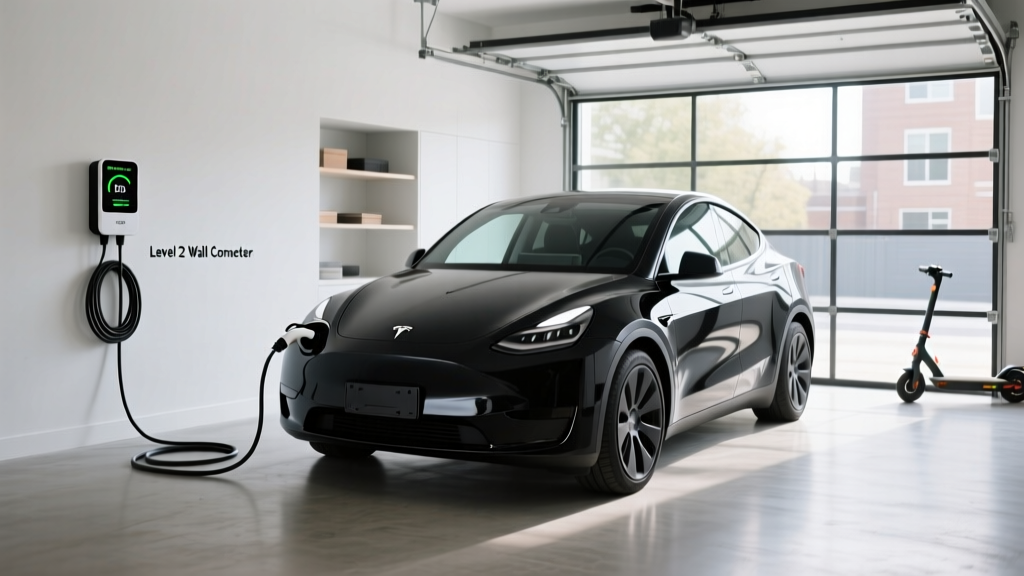
Most 2022 Model Y Long Range owners will want a Level 2 home charger. Tesla's onboard charger accepts up to 11.5 kW (48A on a 60A circuit), which is among the fastest in its class. To unlock that speed, you need the right electrical infrastructure.
Electrical Specifications
- Circuit: Dedicated 60-amp breaker for a 48A continuous charge (NEC requires circuits rated at 125% of continuous load)
- Wire gauge: 6 AWG copper (THHN in conduit) or 4 AWG aluminum for longer runs
- Outlet option: NEMA 14-50 receptacle (50A circuit, delivers up to 40A / 9.6 kW) — allows charger portability
- Hardwired option: Direct wire connection to a 60A circuit — delivers full 48A / 11.5 kW, no plug to maintain
- GFCI: NEC 2020+ requires GFCI protection for outdoor receptacles; hardwired units typically have built-in ground-fault protection
Panel Upgrade Considerations
Before installing any Level 2 charger, have a licensed electrician perform a load calculation on your electrical panel. A 200-amp service panel can typically accommodate a 60A EV circuit alongside normal household loads. However, older homes with 100A or 150A panels may require a service upgrade — especially if you also run electric heat, an electric dryer, and an electric oven simultaneously.
A panel upgrade from 100A to 200A typically costs $1,500–$3,000 including permits and utility coordination. This is the single biggest variable in home charging installation and the one most online guides undercount.
Installation Cost Breakdown
| Component | Low End | High End | Notes |
|---|---|---|---|
| Level 2 charger equipment | $350 | $700 | 32A–48A smart chargers |
| Electrician labor (standard install) | $500 | $1,500 | Short run from panel, same wall |
| Electrician labor (complex run) | $1,500 | $3,500 | Long conduit run, attic/crawlspace, trenching |
| Electrical permit | $50 | $250 | Varies by municipality |
| Panel upgrade (if needed) | $1,500 | $3,000 | 100A → 200A service |
| Total (no panel upgrade) | $900 | $2,450 | Most homes with 200A service |
| Total (with panel upgrade) | $2,400 | $5,450 | Older homes with 100A service |
Connector Compatibility: NACS, CCS, and Adapters
The 2022 Tesla Model Y Long Range was built with Tesla's proprietary connector, which has since been standardized as the North American Charging Standard (NACS). This is a significant advantage in 2026: NACS is now the dominant connector in North America, adopted by Ford, GM, Rivian, Hyundai, and most major automakers for their 2025+ models.
| Connector | Native Support? | Adapter Needed? | Network Access |
|---|---|---|---|
| NACS (Tesla) | Yes — built in | None | Tesla Superchargers, most new public stations |
| J1772 (Level 2 public) | Via included adapter | Tesla-to-J1772 adapter (included with vehicle) | ChargePoint, Blink, public Level 2 stations |
| CCS1 (DC fast) | Via optional adapter | Tesla CCS Adapter (~$175–$250) | Electrify America, EVgo, non-Tesla DC chargers |
| CHAdeMO | No | Not available (legacy standard) | Essentially obsolete in 2026 |
For daily home charging, you'll use either the Tesla Wall Connector (NACS native) or a third-party J1772 charger with the included adapter. For road trips, the Supercharger network is your primary option — and it remains the most reliable DC fast-charging network in the US, with over 20,000 V3/V4 stalls nationwide.
Charging Cost: Per-Mile Economics vs. Gas
The 2022 Model Y Long Range achieves an EPA-rated 122 MPGe combined, translating to roughly 28 kWh per 100 miles of driving. That efficiency figure is the key to calculating real charging costs.
| Scenario | Rate | Cost per 100 Miles | Cost per Mile |
|---|---|---|---|
| Home charging (national avg electricity) | $0.16/kWh | $4.48 | $0.045 |
| Home charging (off-peak TOU rate) | $0.09/kWh | $2.52 | $0.025 |
| Public Level 2 (ChargePoint, etc.) | $0.30/kWh | $8.40 | $0.084 |
| Tesla Supercharger V3 (avg) | $0.32/kWh | $8.96 | $0.090 |
| Non-Tesla DC fast (EA, EVgo) | $0.42/kWh | $11.76 | $0.118 |
| Gas crossover (25 MPG combined) | $3.40/gallon | $13.60 | $0.136 |
Even at public DC fast-charging rates, the Model Y Long Range costs less per mile than a comparable gas-powered compact SUV. Home charging on an off-peak time-of-use plan delivers the steepest savings — roughly $0.025 per mile, or about 80% less than gasoline. According to fueleconomy.gov, the estimated annual fuel cost for the 2022 Model Y Long Range is $600, compared to $1,800+ for a gas equivalent.
Recommended Level 2 Chargers for the Model Y Long Range
The 2022 Model Y's 11.5 kW onboard charger means you can benefit from higher-amperage Level 2 units. Here are three proven options that pair well with this vehicle:
Tesla Wall Connector (Gen 3)
- Power output: Up to 11.5 kW (48A)
- Connector: NACS native — no adapter needed
- Cable length: 24 feet
- Smart features: Wi-Fi, OTA updates, load sharing between multiple units, Power Sharing
- Price: ~$475
- Best for: Tesla-only households seeking maximum charge speed and seamless integration
ChargePoint Home Flex
- Power output: Up to 12 kW (50A, adjustable down to 16A)
- Connector: J1772 (NACS adapter included or use Tesla's J1772 adapter)
- Cable length: 23 feet
- Smart features: Wi-Fi, Alexa integration, scheduling, energy tracking, flexible amperage
- Price: ~$550–$650
- Best for: Multi-EV households with mixed Tesla and non-Tesla vehicles
Emporia Level 2 EV Charger
- Power output: Up to 11.5 kW (48A)
- Connector: J1772 (use Tesla adapter) or NACS version available
- Cable length: 24 feet
- Smart features: Wi-Fi, energy monitoring, solar integration, scheduling
- Price: ~$350–$400
- Best for: Budget-conscious buyers wanting smart features and solar-home integration
Charging Time Examples for the Model Y's 75 kWh Battery
Here's how long common charging sessions take with the 2022 Model Y Long Range's 75 kWh battery pack:
- Level 1 (1.4 kW, 120V): 0–100% in ~54 hours. Practical only for overnight trickle adding ~40 miles in 10 hours.
- Level 2 at 11.5 kW (48A, hardwired): 0–100% in ~7 hours. A full overnight charge from near-empty.
- Level 2 at 7.7 kW (32A, NEMA 14-50): 0–100% in ~10 hours. Still sufficient for overnight replenishment.
- DC Fast Charge (250 kW V3 Supercharger): 10–80% in ~25–30 minutes. Adds approximately 200 miles of range in 15 minutes at peak rate.
- DC Fast Charge above 80%: 80–100% adds another 20–25 minutes due to taper. Avoid charging past 80% on road trips unless necessary.
Safety, Code, and Best Practices
EV charging involves sustained high-current draw — similar to running an electric oven for 8 hours straight. Proper installation is non-negotiable.
- Dedicated circuit: Your Level 2 charger must be on its own dedicated breaker. Sharing a circuit with other appliances risks tripping or overheating.
- Outdoor rating: If your charger is installed outside, ensure the unit is rated NEMA 4 (weatherproof). The Tesla Wall Connector and ChargePoint Home Flex both carry NEMA 4 ratings.
- Permitting: Most jurisdictions require an electrical permit for new 240V circuits. Your electrician should pull this — unpermitted work can void homeowner's insurance coverage.
- Inspection: After installation, a city/county inspector will verify the work meets NEC code. This is standard and protects you.
- Cable management: Use a wall-mounted cable organizer to prevent tripping hazards and protect the connector from ground moisture and debris.
- Preconditioning: The Model Y can precondition its battery before a Supercharger session when you navigate to a Supercharger in the Tesla app or navigation. This warms the battery to optimal temperature, enabling faster DC charging — especially critical in cold weather.
Frequently Asked Questions
How much does it cost to install a home EV charger for a 2022 Tesla Model Y?
A typical Level 2 installation (48A hardwired or NEMA 14-50 outlet) costs between $900 and $2,450 including equipment, electrician labor, and permits — assuming your home already has a 200A electrical panel. If a panel upgrade from 100A to 200A is required, add $1,500–$3,000 to that total. The federal alternative fuel refueling property credit may offset up to $1,000 (30% of costs).
Can I charge the 2022 Model Y Long Range on a regular 120V outlet?
Yes, using the Tesla Mobile Connector with the included 120V adapter. You'll get roughly 3–5 miles of range per hour of charging (about 40 miles overnight). This works for low-mileage drivers or as a backup but is too slow for most daily needs if you drive more than 30–40 miles per day.
Do I need a CCS adapter for my 2022 Model Y?
Only if you plan to use non-Tesla DC fast chargers (Electrify America, EVgo, etc.). The Tesla CCS adapter costs around $175–$250 and unlocks access to the broader CCS network. However, Tesla's Supercharger network now has open access to non-Tesla EVs at many locations, and the NACS connector is becoming the universal standard, reducing the need for CCS adapters over time.
How much does charging cost per mile compared to gas?
Home charging on a national average electricity rate ($0.16/kWh) costs about $0.045 per mile — roughly one-third the cost of a 25 MPG gas SUV at $3.40/gallon ($0.136/mile). On off-peak time-of-use rates, it drops to around $0.025/mile. Even public DC fast charging at $0.32/kWh comes in at $0.09/mile, still cheaper than gasoline.
What electrical upgrades might I need for a Level 2 charger?
The most common upgrade is a panel replacement if your home has 100A service. A licensed electrician will perform a load calculation to determine if your existing panel can handle an additional 60A circuit. Other potential upgrades include running new conduit from the panel to the garage (especially for detached garages), upgrading the meter socket, or adding a sub-panel. Homes built after 2000 with 200A service rarely need panel upgrades.
Does cold weather affect charging speed on the Model Y Long Range?
Yes, significantly. In sub-freezing temperatures, DC fast charging can be 20–30% slower because the battery management system limits charge rate until the pack warms up. Always use the Tesla navigation to route to a Supercharger — this triggers automatic battery preconditioning, which mitigates cold-weather slowdowns. Expect real-world range to drop 15–30% in winter conditions (from 330 EPA miles down to roughly 230–280 miles depending on temperature and driving style).
Sources: EPA range and efficiency data from fueleconomy.gov; IRS alternative fuel refueling credit rules from IRS.gov; Tesla specifications from Tesla.com.