If you are shopping for a used 2022 Tesla Model 3 Long Range, the headline spec most buyers Google is 2022 Tesla Model 3 Long Range horsepower — a combined 346 hp from its dual-motor all-wheel-drive powertrain. But horsepower only tells you how quickly the car will hit 60 mph (4.2 seconds, per Tesla). The numbers that actually determine daily satisfaction are the 82 kWh battery pack, the EPA-rated 358 miles of range, and the 250 kW peak DC fast-charge rate.
This guide uses the 2022 Model 3 Long Range as the reference vehicle to walk through the complete charging ecosystem: Level 1, Level 2, and DC fast charging speeds; real home-installation costs; connector compatibility across brands; per-mile fueling cost versus gasoline; and the specific wall connectors worth buying in 2026.
2022 Tesla Model 3 Long Range: The Core Specs
| Spec | Value |
|---|---|
| Horsepower (combined) | 346 hp |
| Torque | 377 lb-ft |
| 0–60 mph | 4.2 seconds |
| Battery (usable) | ~79 kWh usable of 82 kWh gross, NMC chemistry |
| EPA range | 358 miles |
| EPA efficiency | 132 MPGe / 25 kWh/100 mi |
| Peak DC fast charge | 250 kW (CCS via adapter or NACS native on later builds) |
| 10–80% DCFC time | ~30 minutes (with preconditioning) |
| Level 2 onboard charger | 11.5 kW max (48A) |
| Battery warranty | 8 years / 120,000 miles, ≥70% retention |
| Original MSRP (2022) | ~$52,990 before incentives |
Charging Levels Explained: kW, Miles per Hour, and 10–80% Times
A quick terminology rule that separates informed EV owners from confused ones: kW (kilowatts) is the rate of power flow — how fast energy is moving into the battery. kWh (kilowatt-hours) is the amount of energy stored — the size of the tank. Think kW as "gallons per minute at the pump" and kWh as "gallons in the tank."
| Level | Voltage / Amps | Power (kW) | Miles of Range Added per Hour | 10–80% Time (79 kWh usable) | Best For |
|---|---|---|---|---|---|
| Level 1 | 120V / 12A | ~1.4 kW | ~4–5 mi/hr | ~40+ hours | Overnight top-offs, PHEVs, emergencies |
| Level 2 (home) | 240V / 40–48A | 9.6–11.5 kW | ~32–44 mi/hr | ~6–7 hours | Daily home charging, overnight full charges |
| Level 2 (public) | 208–240V / 30–80A | 7–19.2 kW | ~25–65 mi/hr | Varies | Workplaces, shopping, hotels |
| DC Fast Charge | 400–800V DC | 50–350 kW | ~180–1,000+ mi/hr (peak) | ~25–40 min | Road trips, quick top-ups |
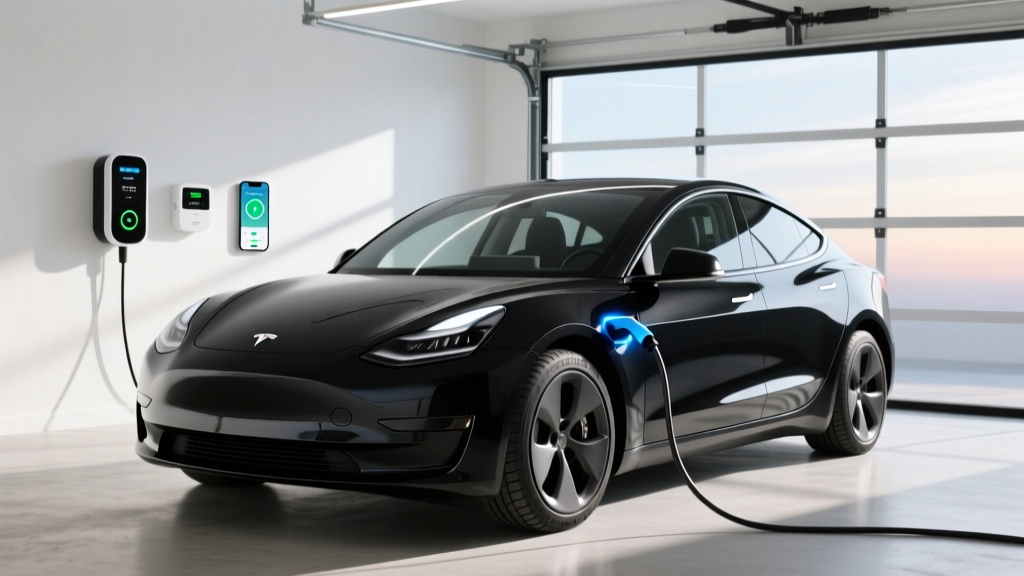
For the 2022 Model 3 Long Range, the onboard charger caps Level 2 intake at 11.5 kW (48A). Plugging into a 60A/14.4 kW public Level 2 station won't charge it faster — the car limits the draw. That's why matching your home charger to the car's onboard limit matters.
Home Charger Installation: Electrical Requirements and Real Costs
Installing a 240V Level 2 home charger is the single biggest quality-of-life upgrade an EV owner can make. But the cost varies enormously depending on your home's electrical panel, the distance from panel to garage, and local permitting.
What the electrical system actually needs
- Circuit: A dedicated 60A breaker (for a 48A continuous charger load — NEC requires 125% overhead, so 48A × 1.25 = 60A breaker).
- Wire: 6 AWG copper (or 4 AWG aluminum) THHN in conduit, or equivalent NM-B, for runs up to ~100 ft.
- Panel capacity: Your main panel must have two adjacent breaker slots and enough remaining amperage headroom. A 200A panel is standard in most post-2000 homes; older 100A or 150A panels may need an upgrade.
- GFCI: NEC 2020+ requires GFCI protection for EV receptacles (NEMA 14-50). Hardwired chargers typically have GFCI built in.
- Permit: Most jurisdictions require an electrical permit and final inspection — typically $75–$250.
| Item | Low End | High End | Notes |
|---|---|---|---|
| Level 2 charger hardware | $400 | $750 | Smart Wi-Fi chargers (ChargePoint, Wallbox, Tesla) |
| Electrician labor (simple install) | $500 | $1,200 | Short run, panel nearby, drywall |
| Electrician labor (complex install) | $1,200 | $3,500 | Long wire run, conduit, trenching, finished walls |
| Permit & inspection | $75 | $250 | Varies by municipality |
| Panel upgrade (if needed) | $1,500 | $4,500 | 100A→200A service upgrade; not always required |
| Total (no panel upgrade) | $975 | $4,200 | Most homes fall in $1,200–$2,200 |
| Total (with panel upgrade) | $2,475 | $8,700 | Older homes with 100A service |
The IRS Residential Clean Energy Credit (§25D) covers 30% of home charger hardware and installation costs (up to $1,000) through 2032 — confirm eligibility with a tax professional, as income and location rules apply.
Connector Compatibility: NACS, CCS, and CHAdeMO
The 2022 Model 3 Long Range was built with Tesla's proprietary connector (now standardized as NACS — North American Charging Standard). In 2026, NACS is the dominant connector in North America, adopted by Ford, GM, Rivian, Hyundai, Volvo, and most other automakers for new models.
| Connector | Brands (native) | DC Fast Charge Networks | Adapter Needed for Model 3? |
|---|---|---|---|
| NACS (Tesla) | Tesla, Ford, GM, Rivian, Hyundai (new), Volvo, Polestar | Tesla Supercharger, Electrify America (new stalls), EVgo, ChargePoint | No — native on 2022 Model 3 |
| CCS1 | Legacy VW ID.4, BMW i4, older Hyundai/Kia, Mercedes EQ | Electrify America, EVgo, ChargePoint | Yes — CCS-to-NACS adapter (~$150–$200) |
| CHAdeMO | Nissan Leaf (legacy) | Limited, shrinking network | Not recommended; no practical adapter |
For the 2022 Model 3, the biggest practical advantage in 2026 is access to the Tesla Supercharger network — over 25,000 stalls in North America, consistently the most reliable DC fast-charging network by uptime metrics. If you own a CCS-equipped EV from another brand, a NACS adapter is now widely available to access Superchargers.
Cost to Charge: Home vs. Public vs. Gasoline
Charging economics depend entirely on where and when you plug in. A 2022 Model 3 Long Range consumes roughly 25 kWh per 100 miles (EPA combined). Here's what that translates to in dollars:
| Scenario | Rate ($/kWh or $/gal) | Cost per 100 Miles | Cost per Mile |
|---|---|---|---|
| Home, off-peak utility rate | $0.10/kWh | $2.50 | $0.025 |
| Home, average US rate | $0.17/kWh | $4.25 | $0.043 |
| Public Level 2 (ChargePoint, etc.) | $0.30/kWh | $7.50 | $0.075 |
| DC fast charge (Tesla Supercharger avg) | $0.32/kWh | $8.00 | $0.080 |
| DC fast charge (peak pricing) | $0.50/kWh | $12.50 | $0.125 |
| Gas sedan (30 MPG, $3.40/gal) | $3.40/gal | $11.33 | $0.113 |
At home on an off-peak rate, the Model 3 Long Range costs roughly $0.025 per mile — about 4.5× cheaper than a 30-MPG gas sedan at $3.40/gallon. Even on public DC fast chargers at average rates, the EV is cheaper per mile. The crossover point where gasoline becomes cheaper only occurs at peak-rate DC chargers above ~$0.45/kWh, which is why home charging is the economic backbone of EV ownership.
Equipment Recommendations: Best Level 2 Chargers for a Model 3
These are the chargers that pair well with the Model 3 Long Range's 11.5 kW onboard limit, with real specs and 2026 pricing:
Tesla Wall Connector (Gen 3)
- Power: 11.5 kW (48A) — matches Model 3's max
- Connector: NACS native
- Cable: 24 ft
- Smart features: Wi-Fi, OTA updates, load sharing with 2nd unit, access control
- Price: ~$475
Best for: Tesla-only households. Cleanest integration, no adapter needed.
ChargePoint Home Flex
- Power: Up to 12 kW (50A), configurable down to 16A
- Connector: NACS (2025+ models) or J1772 with adapter
- Cable: 24 ft
- Smart features: Wi-Fi, app scheduling, utility demand-response, Alexa
- Price: ~$550–$650
Best for: Multi-EV households or renters who may move (flexible amperage).
Wallbox Pulsar Plus
- Power: 11.5 kW (48A)
- Connector: NACS or J1772
- Cable: 25 ft
- Smart features: Wi-Fi + Bluetooth, Eco-Smart (solar integration), Power Sharing
- Price: ~$500–$600
Best for: Homes with solar panels or tight panel capacity (smart load management).
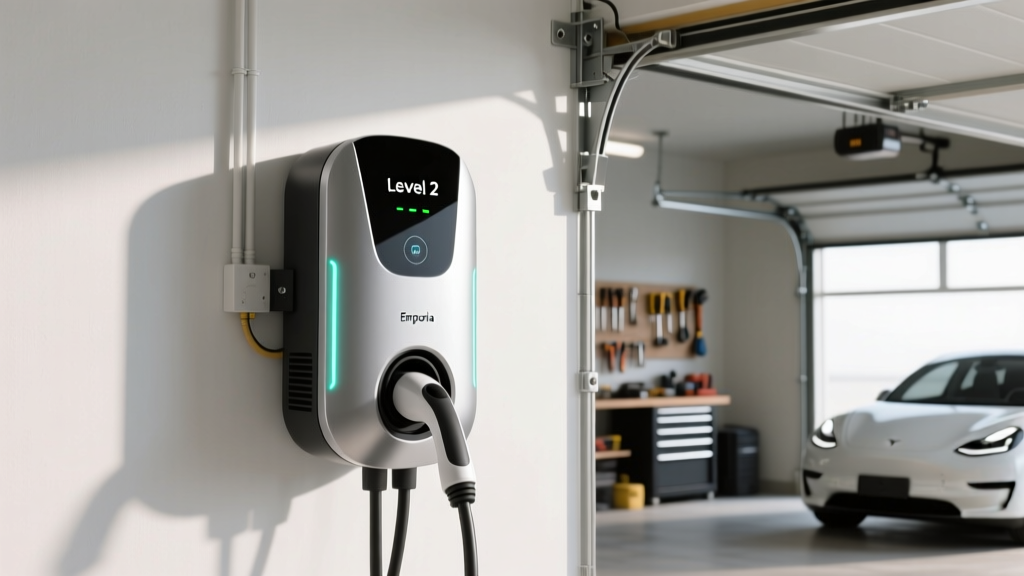
Emporia Vue 2 + EV Charger
- Power: 11.5 kW (48A)
- Connector: NACS or J1772
- Cable: 24 ft
- Smart features: Whole-home energy monitoring, solar-aware scheduling
- Price: ~$400–$500
Best for: Budget-conscious buyers who want energy monitoring bundled in.
Safety and Electrical Code Considerations
EV charging draws sustained high current for hours — more like a continuous-duty appliance than a typical household circuit. Key safety points:
- Dedicated circuit: Your Level 2 charger must be on its own dedicated breaker. Sharing a circuit with other loads is a code violation and a fire risk.
- Hardwired vs. plug-in: Hardwired installations avoid the GFCI breaker requirement (the charger has internal GFCI) and are generally more reliable. NEMA 14-50 receptacles are convenient for portability but require a GFCI breaker (~$100–$150 extra) under NEC 2020+.
- Outdoor rating: If your charger is mounted outside or in an unsealed garage, confirm it carries a NEMA 4 (weatherproof) rating. All major chargers listed above are rated for outdoor use.
- Load calculation: A licensed electrician will perform a NEC Article 220 load calculation to verify your panel can handle the added 48A draw alongside existing loads (HVAC, dryer, oven, water heater). If the calculation fails, a panel upgrade or a smart load-management device (e.g., Wallbox Power Sharing) is required.
- Permit and inspection: Skipping the permit saves $100–$250 but voids homeowner's insurance coverage for electrical fires originating from the unpermitted work. Always pull the permit.
Frequently Asked Questions
How much does it cost to install a home EV charger?
Most homes with a 200A panel and a short wire run spend $1,200–$2,200 total (charger + electrician + permit). Homes needing a panel upgrade or long conduit runs can spend $2,500–$5,000+. The IRS §25D credit covers 30% of costs up to $1,000 through 2032.
How fast will each charging level add range to the Model 3 Long Range?
Level 1 (120V): ~4–5 miles per hour. Level 2 (240V/48A): ~37–44 miles per hour. DC fast charge (250 kW peak): roughly 175 miles in 15 minutes under ideal conditions with battery preconditioning. Note that DC fast charging follows a charge curve — peak 250 kW is sustained only between ~10–30% SoC, then tapers progressively. A 10–80% session takes ~30 minutes; an 80–100% session can take an additional 30+ minutes at low power.
Which connector and charger is compatible with the 2022 Tesla Model 3 Long Range?
The 2022 Model 3 uses the NACS (Tesla) connector natively. It charges directly at all Tesla Superchargers and at any third-party station equipped with a NACS cable. For CCS1-equipped public chargers, a CCS-to-NACS adapter (sold by Tesla and third parties for ~$150–$200) is needed. The Tesla Wall Connector is the simplest home solution.
How much does charging cost per mile vs. gasoline?
At a typical home electricity rate of $0.17/kWh, the Model 3 Long Range costs ~$0.043 per mile. A comparable 30-MPG gas sedan at $3.40/gallon costs ~$0.113 per mile — roughly 2.6× more. Over 15,000 miles per year, that's ~$1,050 in annual fuel savings with home charging.
What electrical upgrades might I need for a Level 2 charger?
If your home has a 100A or 150A main panel, or if the panel is already near capacity (common with electric HVAC, dryer, oven, and water heater all running), you may need a panel upgrade to 200A ($1,500–$4,500) or a smart load-management system that throttles the charger when other loads spike. A licensed electrician's load calculation (NEC Article 220) is the definitive answer — get this done before buying hardware.
Does the 2022 Model 3 Long Range still qualify for a federal tax credit in 2026?
The 2022 Model 3 Long Range was eligible for up to $7,500 under the §30D credit when new, but as a used vehicle in 2026, it may qualify for the Used Clean Vehicle Credit (§25E): up to $4,000 or 30% of the sale price (whichever is lower), on vehicles sold for $25,000 or less, purchased from a dealer, with buyer income limits ($75K single / $150K joint). Confirm eligibility on IRS.gov or with a tax professional — rules are subject to change.
The 2022 Tesla Model 3 Long Range's 346 horsepower and 4.2-second 0–60 time make it genuinely quick, but its lasting value is the combination of a 358-mile EPA range, 250 kW DC fast-charging capability, and access to the Supercharger network. Pair it with a properly installed 48A Level 2 home charger, and daily fueling becomes a $2.50 overnight event — a fraction of what any gasoline sedan costs.