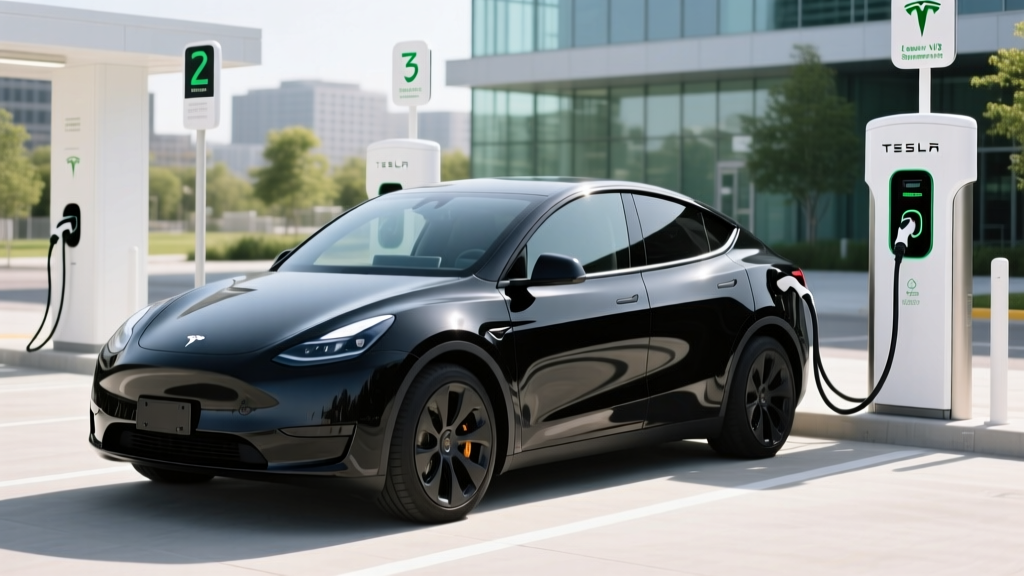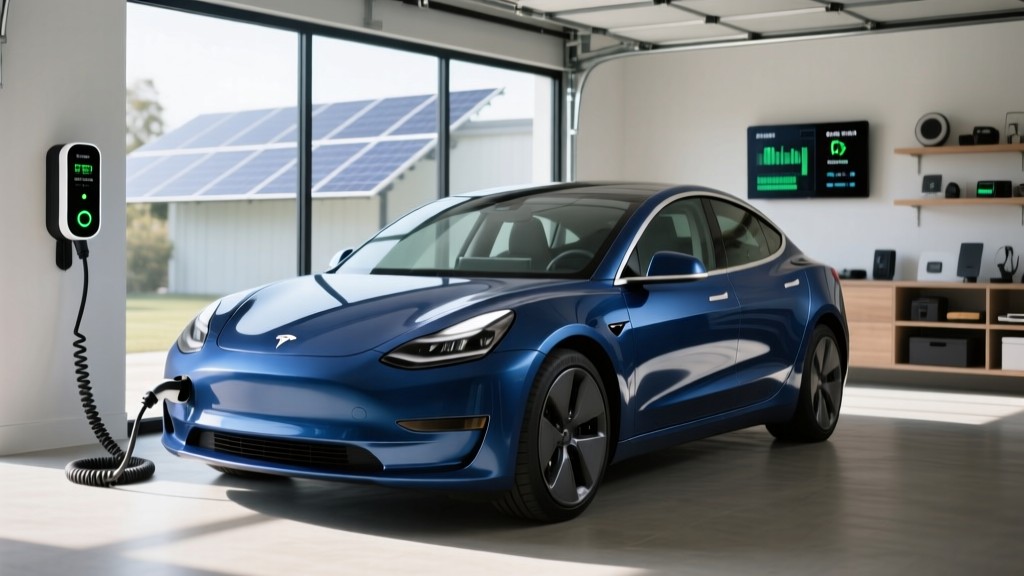
If you own or are considering a used 2022 Tesla Model 3 Long Range, understanding its real-world range and how to charge it efficiently is critical to getting the most out of the vehicle. The EPA rates this model at 358 miles of range on a full charge, but real-world results depend heavily on driving style, weather, and — most importantly — how you charge. This guide covers everything from the actual miles you can expect to home charger installation, public charging networks, and the equipment that makes ownership effortless.
2022 Tesla Model 3 Long Range: Real-World Range vs. EPA Estimate
The EPA's official rating for the 2022 Tesla Model 3 Long Range AWD is 358 miles, based on its 82 kWh battery pack (approximately 75 kWh usable) and NMC (nickel manganese cobalt) chemistry. The combined MPGe rating is 134 MPGe, with 139 city and 126 highway.
- City / mixed driving (mild weather): 320–345 miles — regenerative braking recovers energy in stop-and-go traffic.
- Highway (70–75 mph, mild weather): 275–310 miles — aerodynamic drag dominates at sustained speed.
- Cold weather (below 32°F / 0°C): 240–280 miles — battery resistance increases and cabin heating draws significant power.
- Cold weather highway: 210–250 miles — the worst-case scenario combining both factors.
These figures assume a 100% state of charge. For daily driving, Tesla recommends setting the charge limit to 80%, which yields roughly 286 EPA miles or ~220–260 real-world miles depending on conditions.
Charging Levels Explained: Speed, Power, and Miles Per Hour
Before diving into equipment, it's essential to understand the difference between kW (kilowatts — the rate of power delivery, like water pressure) and kWh (kilowatt-hours — the total energy stored or delivered, like gallons of water). Your Model 3 Long Range has an ~75 kWh usable battery. A 7.5 kW charger adds 7.5 kWh per hour.
| Level | Power (kW) | Miles of Range Per Hour | 0–80% Time | Best For |
|---|---|---|---|---|
| Level 1 (120V) | 1.0–1.4 kW | 3–5 mi/hr | ~60+ hours | Emergency / trickle |
| Level 2 (240V, 32A) | 7.7 kW | ~30 mi/hr | ~8 hours | Daily home charging |
| Level 2 (240V, 48A) | 11.5 kW | ~44 mi/hr | ~5.5 hours | Fast home charging |
| DC Fast (V3 Supercharger) | Up to 250 kW peak | ~1,000+ mi/hr (peak) | ~25–30 min (10–80%) | Road trips |
Charging curve reality: The Model 3 Long Range peaks at 250 kW only at a low state of charge (roughly 5–15%). By 50% SoC, the rate drops to ~120 kW, and above 80%, it tapers to under 50 kW. This is why the 10–80% metric (~25–30 minutes at a V3 Supercharger) is far more useful than peak kW claims. Charging from 80–100% can add another 30–40 minutes — avoid it on road trips unless absolutely necessary.
Home Charger Installation: Electrical Requirements and Costs
The 2022 Model 3 Long Range has an 11.5 kW onboard charger, meaning it can accept up to 48 amps at 240V. To unlock that speed at home, you need a hardwired Level 2 charger on a dedicated 60-amp circuit (the National Electrical Code requires circuits rated at 125% of continuous load, so 48A continuous requires a 60A breaker).
What Electrical Upgrades Might You Need?
Before installing, a licensed electrician will assess your panel's available capacity. Here's what you might encounter:
- 200A panel with spare capacity: Ideal — no upgrade needed. The electrician adds a 60A breaker and runs conduit to the charger location.
- 100A or 150A panel with limited headroom: You may need to downsize to a 32A charger (requiring only a 40A breaker) or invest in a panel upgrade to 200A, which costs $1,500–$3,000+.
- Older homes with 100A service and no spare slots: A panel upgrade is likely mandatory. Some homeowners opt for a load-management device (like the Emporia Smart Load Manager) that dynamically shares power between the charger and other circuits, avoiding a full panel upgrade.
| Component | Simple Install (Near Panel) | Complex Install (Long Run / Conduit) | With Panel Upgrade |
|---|---|---|---|
| Level 2 Charger (Equipment) | $350–$700 | $350–$700 | $350–$700 |
| Electrician Labor | $300–$600 | $800–$2,000 | $800–$2,000 |
| Permit & Inspection | $50–$200 | $100–$300 | $150–$400 |
| Panel Upgrade (if needed) | N/A | N/A | $1,500–$3,500 |
| Total Estimated Cost | $700–$1,500 | $1,250–$3,000 | $2,800–$6,600 |
Many utilities offer rebates of $200–$500 for home charger installation, and some states provide additional incentives. Check your local utility's EV programs before scheduling work.
Connector Compatibility: NACS, CCS, and Adapter Needs
The 2022 Tesla Model 3 Long Range was built with Tesla's proprietary connector (now standardized as NACS — North American Charging Standard). This is a significant advantage in 2026: Tesla's Supercharger network is the largest and most reliable DC fast-charging network in North America, with over 6,000 V3 and V4 stalls.
| Connector | Native Support? | Adapter Needed? | Notes |
|---|---|---|---|
| NACS (Tesla) | Yes — native | No | All Superchargers and Tesla Wall Connectors |
| CCS1 | No | Yes — Tesla CCS Adapter (~$175–$250) | Required for Electrify America, EVgo CCS stalls |
| CHAdeMO | No | Yes — Setec CHAdeMO adapter (~$300+) | Rarely needed; CHAdeMO network is shrinking |
| J1772 (Level 2 public) | No | Yes — included with vehicle | Tesla ships a J1772-to-NACS adapter in the glovebox |
Recommendation: Buy the Tesla CCS1 adapter and keep it in the frunk at all times. While Tesla's Supercharger network is dominant, having CCS access as a backup at Electrify America or ChargePoint stations adds route flexibility on long trips.
Charging Cost Per Mile: Home vs. Public vs. Gas
One of the strongest arguments for EV ownership is fuel cost savings — but the exact number depends on where and when you charge. Here's a realistic breakdown for the 2022 Model 3 Long Range, which averages about 25 kWh per 100 miles (4 mi/kWh) in mixed driving.
| Charging Scenario | Rate ($/kWh) | Cost per 100 mi | Cost per Mile |
|---|---|---|---|
| Home (off-peak utility rate) | $0.08–$0.12 | $2.00–$3.00 | $0.02–$0.03 |
| Home (standard rate, no TOU) | $0.13–$0.18 | $3.25–$4.50 | $0.03–$0.045 |
| Public Level 2 (ChargePoint, etc.) | $0.20–$0.35 | $5.00–$8.75 | $0.05–$0.09 |
| Tesla Supercharger (V3) | $0.25–$0.40 | $6.25–$10.00 | $0.06–$0.10 |
| Electrify America (DC Fast) | $0.35–$0.55 | $8.75–$13.75 | $0.09–$0.14 |
| Gas sedan (30 MPG, $3.50/gal) | — | $11.67 | $0.12 |
The bottom line: If you charge primarily at home on off-peak rates, the Model 3 Long Range costs roughly $0.02–$0.03 per mile — about 75–85% less than a comparable gas sedan. Even exclusive Supercharger use (~$0.06–$0.10/mi) undercuts gasoline in most markets. Over 15,000 miles/year, home charging saves roughly $1,200–$1,500 annually versus gas.
Recommended Home Chargers for the Model 3 Long Range
Since the 2022 Model 3 Long Range can accept up to 11.5 kW (48A), the chargers below are selected to maximize that capability. All use the native NACS connector.
Tesla Wall Connector
- Power: Up to 11.5 kW (48A)
- Connector: NACS (native)
- Cable length: 24 ft
- Smart features: Wi-Fi, OTA updates, power sharing between multiple units, load management
- Price: ~$475
- Verdict: The default choice for Tesla owners. Seamless integration, fast charging, and competitive price. Hardwired only.
ChargePoint Home Flex (NACS)
- Power: Up to 12 kW (50A) — adjustable down
- Connector: NACS (2025+ models)
- Cable length: 23 ft
- Smart features: Wi-Fi, app scheduling, Alexa integration, flexible amperage dip-switch
- Price: ~$550–$650
- Verdict: Excellent for multi-EV households or those wanting a non-Tesla ecosystem charger. The adjustable amperage is useful if your panel can't support a full 60A circuit.
Emporia Vue Level 2 Charger
- Power: Up to 11.5 kW (48A)
- Connector: NACS (2025+ models)
- Cable length: 24 ft
- Smart features: Energy monitoring, solar integration, load management with Emporia panel monitor
- Price: ~$400–$500
- Verdict: Best value pick with smart load management — ideal for older homes where a panel upgrade would otherwise be required.
Grizzl-E Smart (NACS)
- Power: Up to 10 kW (40A)
- Connector: NACS
- Cable length: 24 ft
- Smart features: OCPP-compatible, app control, adjustable amperage
- Price: ~$450–$550
- Verdict: Rugged, cold-weather tested (rated to -40°F), and Canadian-built. Slightly lower amperage but rock-solid reliability.
Safety, Code, and Best Practices for Home Charging
EV charging is a continuous high-load electrical draw — your charger will run at full power for 5–10 hours at a time. This makes proper installation non-negotiable.
- Dedicated circuit: Your Level 2 charger must be on its own dedicated breaker — never shared with other outlets or appliances.
- GFCI protection: The 2020 and 2023 NEC requires GFCI protection for EV charging outlets (not hardwired units). Hardwiring your charger avoids the nuisance tripping issues some owners experience with GFCI breakers and high-amperage plugs.
- Outdoor rating: If your charger is installed outdoors (driveway, carport), ensure the unit is NEMA 4 rated. The Tesla Wall Connector and Grizzl-E both carry this rating.
- Wire gauge: A 60A circuit requires 6 AWG copper wire (or 4 AWG aluminum). Your electrician will size this correctly, but verify it's not undersized — a common shortcut in budget installs.
- Permit and inspection: Most jurisdictions require an electrical permit for EV charger installation. Skipping this can void your homeowner's insurance coverage in the event of an electrical fire.
Frequently Asked Questions
How much does it cost to install a home EV charger for the 2022 Tesla Model 3 Long Range?
A straightforward install near your electrical panel typically runs $700–$1,500 (charger + electrician + permit). Longer wire runs, conduit through walls, or sub-panel additions push costs to $1,250–$3,000. If your home needs a panel upgrade from 100A to 200A service, total costs can reach $2,800–$6,600. Always get 2–3 quotes from licensed electricians.
How fast will each charging level add range to my Model 3 Long Range?
Level 1 (120V standard outlet) adds about 3–5 miles per hour — fine for overnight top-ups if you drive under 30 miles/day. Level 2 at 48A adds roughly 44 miles per hour, fully replenishing the battery in about 5.5 hours. DC fast charging at a Tesla V3 Supercharger adds up to 175 miles in 15 minutes under ideal conditions (low SoC, preconditioned battery).
Which charger connector is compatible with the 2022 Tesla Model 3?
The 2022 Model 3 uses the NACS (Tesla) connector natively. This works at all Tesla Superchargers and home Wall Connectors without adapters. For non-Tesla public Level 2 stations (J1772), Tesla includes a J1772 adapter in the vehicle. For CCS public DC fast chargers (Electrify America, etc.), you'll need to purchase the Tesla CCS adapter separately.
How much does charging cost per mile compared to gas?
At home on off-peak electricity ($0.10/kWh), the Model 3 Long Range costs about $0.025/mile. A comparable gas sedan at 30 MPG with $3.50/gallon fuel costs about $0.12/mile. Even exclusive Supercharger use ($0.06–$0.10/mile) is cheaper than gas. Over 15,000 miles/year, home charging saves $1,200–$1,500 annually.
What electrical upgrades might my home need for a Level 2 charger?
Homes with a 200A panel and spare breaker slots usually need no upgrade — just a new 60A breaker and wire run. Homes with 100A or 150A panels may need to downsize to a 32A charger (40A breaker) or upgrade the panel to 200A ($1,500–$3,500). A load-management device can sometimes avoid a panel upgrade by dynamically reducing charger power when other household loads are high.
Should I precondition my battery before Supercharging?
Yes. When you navigate to a Supercharger in the Tesla's built-in navigation, the car automatically begins preconditioning — warming the battery to its optimal charging temperature (roughly 95°F / 35°C). This can reduce 10–80% charge time by 5–10 minutes, especially in cold weather. If you drive to a Supercharger without using navigation, preconditioning won't activate, and your initial charge rate will be significantly slower.
Does the 2022 Model 3 Long Range battery degrade over time?
Tesla's NMC battery packs in the Model 3 Long Range typically lose about 5–8% capacity over the first 50,000 miles, then degradation slows significantly. Tesla warranties the battery for 8 years or 120,000 miles, whichever comes first, guaranteeing at least 70% capacity retention. Real-world data from high-mileage owners suggests most packs retain 85–90% capacity at 100,000 miles. To maximize longevity, Tesla recommends daily charging to 80% and only charging to 100% for long trips.