The 2022 Tesla Model 3 Long Range remains one of the most popular used EVs on the market in 2026, and for good reason. With an EPA-estimated 358 miles of range, a blistering 2022 Tesla Model 3 Long Range 0-60 time of 4.2 seconds, and access to the Supercharger network, it delivers a compelling ownership experience. But whether you're buying one used or already own one, understanding exactly how to charge it — at home, on road trips, and at what cost — is the difference between seamless EV ownership and frustration.
This guide breaks down every charging scenario for the 2022 Model 3 Long Range, including home Level 2 installation costs, real-world charging speeds, connector details, and per-mile cost comparisons versus gas.
2022 Model 3 Long Range: Key Specs at a Glance
Before we get into charging logistics, here are the numbers that define this car's energy and performance profile:
| Specification | Value |
|---|---|
| Usable Battery Capacity | ~75 kWh (NMC chemistry) |
| EPA Range | 358 miles |
| Real-World Highway Range | ~290–310 miles (70+ mph, moderate temps) |
| Real-World Cold-Weather Range | ~250–280 miles (below 32°F) |
| MPGe (Combined) | 134 MPGe |
| Efficiency | 25 kWh/100 mi |
| 0-60 mph | 4.2 seconds |
| Horsepower | 346 hp (dual motor AWD) |
| Peak DC Fast Charge Rate | 250 kW (V3 Supercharger) |
| 10–80% DC Fast Charge Time | ~27 minutes |
| Max Level 2 AC Charge Rate | 11.5 kW (48A) |
| Connector | NACS (Tesla proprietary) |
| Battery/Powertrain Warranty (orig.) | 8 years / 120,000 miles |
| Original MSRP (2022) | ~$52,990 (before incentives) |
Understanding Charging Levels: How Fast Does Each Add Range?
EV charging comes in three tiers. The distinction between kW (kilowatts — the rate of power delivery) and kWh (kilowatt-hours — the amount of energy stored in the battery) is fundamental. Think of kW as the speed of water flowing from a hose, and kWh as the size of the bucket you're filling.
| Charging Level | Voltage | Max Power (kW) | Miles of Range Added Per Hour | Best For |
|---|---|---|---|---|
| Level 1 (Standard Outlet) | 120V AC | ~1.4 kW | ~4–5 miles/hr | Overnight trickle; emergency top-ups |
| Level 2 (Home/Public AC) | 240V AC | 11.5 kW (Model 3 max) | ~38–44 miles/hr | Daily home charging; workplace |
| DC Fast Charging | 400V+ DC | Up to 250 kW | ~750+ miles/hr (peak) | Road trips; rapid top-ups |
Level 1: The Trickle Charge
Plugging the Model 3 into a standard 120V household outlet using Tesla's Mobile Connector delivers roughly 1.4 kW. That translates to about 4–5 miles of range per hour, or roughly 40–50 miles over a 10-hour overnight session. For a driver covering 30 miles daily, Level 1 can technically suffice — but it's painfully slow for replenishing a depleted battery. A full 10–100% charge would take over 50 hours.
Level 2: The Home Charging Sweet Spot
A 240V Level 2 setup is where the Model 3 Long Range shines daily. The car's onboard charger accepts up to 11.5 kW (48 amps), meaning you can add roughly 38–44 miles of range per hour of charging. A typical overnight session of 8 hours easily restores 300+ miles — more than most drivers use in a week.
At a 240V/48A circuit, a 10–80% charge takes roughly 5.5 to 6 hours. Since daily driving rarely depletes more than 20–40% of the battery, most owners plug in each evening and wake up fully topped off.
DC Fast Charging: Road Trip Speeds
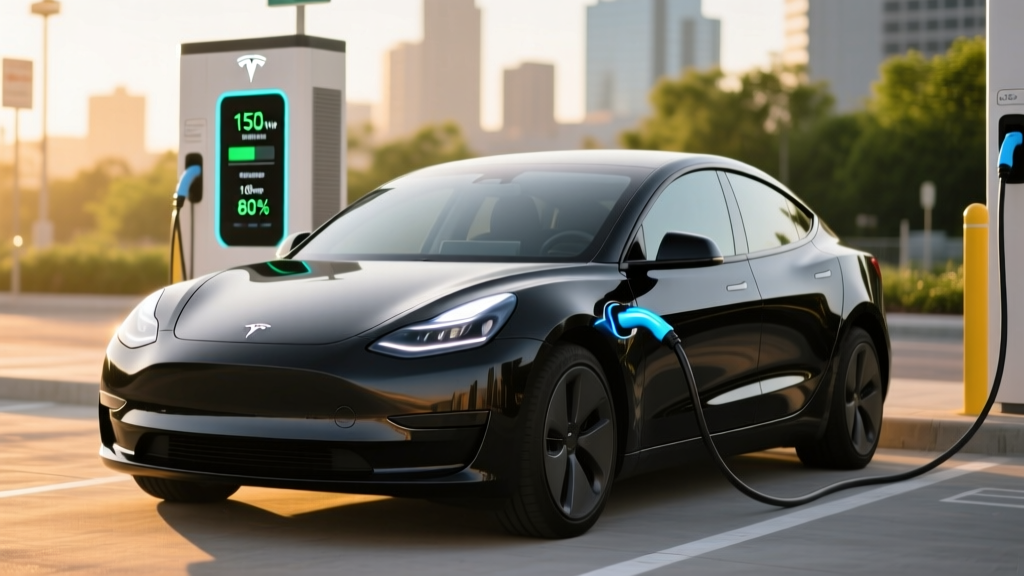
On a Tesla V3 Supercharger (250 kW peak), the 2022 Model 3 Long Range charges from 10–80% in approximately 27 minutes. However, that peak rate of 250 kW only sustains briefly at low states of charge (roughly 10–30% SoC). The charging curve then tapers: by 50% SoC, you'll see roughly 150 kW, and above 80%, it drops below 50 kW to protect battery health. This taper is normal for all lithium-ion EV batteries and is managed by the car's thermal management system.
On non-Tesla DC fast chargers (Electrify America, EVgo) using a NACS-to-CCS adapter or at NACS-equipped stations now opening across networks, expect peak speeds of 150–250 kW depending on the station's hardware. Tesla's Supercharger network remains the most reliable DC fast-charging ecosystem in the U.S.
Home Charger Installation: Requirements, Costs, and Gotchas
Installing a dedicated Level 2 home charger is the single most impactful upgrade for EV ownership. Here's what the 2022 Model 3 Long Range requires and what it will cost.
Electrical Requirements
To deliver the Model 3's maximum 11.5 kW AC charge rate, you need a 240V circuit rated at 60 amps (EVSE derated to 48A continuous draw per NEC code). If your home's electrical panel has spare capacity — typically 200A service with open breaker slots — the installation is straightforward.
If your panel is at capacity (common in homes built before 2000 with 100A or 150A service), you may need a panel upgrade to 200A, which adds significant cost. Some homeowners opt for a lower-amperage circuit (e.g., 240V/40A on a 50A breaker) delivering ~9.6 kW — still sufficient for overnight charging, just slightly slower at ~32 miles of range per hour.
Installation Cost Breakdown
| Cost Component | Low Estimate | High Estimate | Notes |
|---|---|---|---|
| Level 2 Charger (Hardware) | $350 | $700 | Tesla Wall Connector, ChargePoint, Emporia |
| Electrician Labor | $500 | $2,000 | Depends on run length, wall type, conduit |
| Electrical Permit | $50 | $300 | Varies by municipality |
| Panel Upgrade (if needed) | $1,500 | $4,000 | 100A→200A upgrade; not always required |
| Total (no panel upgrade) | $900 | $3,000 | Typical scenario for modern homes |
| Total (with panel upgrade) | $2,400 | $7,000 | Older homes with maxed-out panels |
Safety and Code Considerations
- Dedicated circuit: Your Level 2 charger must have its own dedicated breaker — never share a circuit with other appliances.
- GFCI protection: NEC 2020+ requires GFCI protection for outdoor receptacles. Hardwired EVSE units (like the Tesla Wall Connector) typically integrate ground-fault protection internally.
- Outdoor rating: If installing outside, ensure the charger carries a NEMA 4 or IP65 rating for weather resistance. The Tesla Wall Connector and ChargePoint Home Flex are both outdoor-rated.
- Wire gauge: A 60A circuit requires 6 AWG copper wire (or 4 AWG aluminum). Your electrician will handle this, but verify it's on the permit application.
- Utility rebates: Many utilities offer $250–$1,000 rebates for Level 2 installations, particularly if you agree to time-of-use rates. Check with your local provider.
Recommended Level 2 Chargers for the Model 3 Long Range
Since the 2022 Model 3 uses the NACS (Tesla) connector natively, you have two paths: buy a NACS-equipped charger, or use a CCS/J1772 charger with Tesla's included adapter. With the broader industry shift to NACS through 2025–2026, native NACS chargers are now widely available.
Tesla Wall Connector
- Power Output: Up to 11.5 kW (48A)
- Connector: NACS (native Tesla)
- Cable Length: 24 feet
- Smart Features: Wi-Fi, OTA updates, power-sharing with second unit, access control
- Price: ~$475
- Verdict: Best native option for Tesla owners. Seamless integration, fast firmware updates, and the longest proven track record.
ChargePoint Home Flex (NACS)
- Power Output: Up to 12 kW (50A, adjustable down to 16A)
- Connector: NACS (2025+ model) or J1772 (with adapter)
- Cable Length: 23 feet
- Smart Features: Wi-Fi, ChargePoint app scheduling, Alexa integration, amperage configurable
- Price: ~$550–$650
- Verdict: Excellent for mixed-EV households. Adjustable amperage means it works on circuits from 20A to 60A.
Emporia Vue Level 2 Charger
- Power Output: Up to 11.5 kW (48A)
- Connector: J1772 (use Tesla adapter) or NACS (newer model)
- Cable Length: 24 feet
- Smart Features: Energy monitoring, integration with Emporia home energy panel, scheduling
- Price: ~$350–$400
- Verdict: Best budget option with energy monitoring. Ideal if you already use Emporia's home energy system.
Connector Compatibility: NACS, CCS, and Adapters
The 2022 Model 3 Long Range was built with Tesla's proprietary connector, now formally designated NACS (North American Charging Standard). As of 2025–2026, most major automakers have adopted NACS, and public charging networks are rapidly adding NACS cables.
| Connector Type | Compatibility with 2022 Model 3 LR | Adapter Needed? |
|---|---|---|
| NACS (Tesla) | Native — direct plug at Superchargers and NACS public stations | No |
| CCS1 | Compatible via Tesla CCS adapter (sold separately, ~$175–$250) | Yes — Tesla CCS Adapter |
| CHAdeMO | Not natively compatible; limited adapter options | Yes — but CHAdeMO is being phased out |
| J1772 (Level 2 public) | Compatible via Tesla's included J1772 adapter | Yes — included with vehicle |
For most owners, the NACS connector handles 95%+ of charging needs — at home with a Tesla Wall Connector and on the road at Supercharger stations. The CCS adapter becomes relevant only when traveling through areas with sparse Supercharger coverage but available Electrify America or EVgo CCS stations.
Cost to Charge: Per-Mile Economics vs. Gas
One of the strongest arguments for the Model 3 Long Range is the fuel cost advantage. Here's how charging costs break down across scenarios, based on the car's efficiency of 25 kWh per 100 miles (per fueleconomy.gov):
| Charging Scenario | Cost per kWh | Cost per 100 Miles | Cost per Mile |
|---|---|---|---|
| Home — Off-Peak TOU Rate | $0.08–$0.12 | $2.00–$3.00 | $0.02–$0.03 |
| Home — Standard Residential Rate | $0.14–$0.18 | $3.50–$4.50 | $0.035–$0.045 |
| Public Level 2 (Workplace/Retail) | $0.20–$0.30 | $5.00–$7.50 | $0.05–$0.075 |
| Tesla Supercharger (DC Fast) | $0.28–$0.40 | $7.00–$10.00 | $0.07–$0.10 |
| Non-Tesla DC Fast (EA, EVgo) | $0.35–$0.55 | $8.75–$13.75 | $0.088–$0.138 |
Gas comparison: A comparable gas-powered sedan averaging 30 MPG at $3.40/gallon costs approximately $0.113 per mile in fuel alone. Even at Supercharger rates, the Model 3 Long Range is cheaper per mile. At home off-peak rates, you're paying roughly one-quarter to one-fifth the per-mile fuel cost of gasoline.
For a driver covering 12,000 miles annually, home charging at $0.15/kWh costs roughly $450/year versus $1,360/year for gasoline — a savings of ~$910 per year in fuel costs alone.
Charging Time Examples: 10–80% at Various Speeds
Here's how long it takes to charge the Model 3 Long Range's ~75 kWh battery from 10% to 80% (adding roughly 52.5 kWh of energy) across different charging scenarios:
- Level 1 (120V / 1.4 kW): ~37.5 hours — impractical for anything but emergency trickle
- Level 2 (240V / 40A / 9.6 kW): ~5.5 hours — a practical overnight charge
- Level 2 (240V / 48A / 11.5 kW): ~4.6 hours — maximizes the car's onboard charger
- DC Fast (150 kW CCS station): ~30 minutes (with taper curve)
- DC Fast (250 kW V3 Supercharger): ~27 minutes (with taper curve)
The charge curve matters: you'll hit 50% SoC faster than you might expect (roughly 15 minutes on a V3 Supercharger), but the final 30% (50–80%) takes nearly as long due to tapering. On road trips, plan stops around the 15–20 minute mark to 50–60% and resume driving rather than waiting for 80%.
Frequently Asked Questions
How much does it cost to install a home EV charger for the Model 3?
Expect $900–$3,000 for a standard installation (charger hardware, electrician labor, and permit) if your electrical panel has spare capacity. If a panel upgrade from 100A to 200A is needed, total costs can reach $2,400–$7,000. The Tesla Wall Connector costs ~$475, and labor typically runs $500–$2,000 depending on the wiring run length and complexity.
How fast will each charging level add range to the 2022 Model 3 Long Range?
Level 1 (120V) adds roughly 4–5 miles per hour. Level 2 (240V/48A) adds approximately 38–44 miles per hour. DC fast charging at a V3 Supercharger adds up to 750+ miles per hour at peak rates, though the charge curve tapers significantly above 50% SoC. For daily use, Level 2 is the optimal balance of speed and battery health.
Which connector and charger is compatible with my 2022 Model 3?
The 2022 Model 3 uses the NACS (Tesla) connector natively. The Tesla Wall Connector is the most seamless home option. For public Level 2 stations with J1772 connectors, use the J1772 adapter included with your car. For non-Tesla DC fast chargers with CCS1 cables, you'll need Tesla's CCS adapter (~$175–$250). CHAdeMO compatibility is limited and the standard is being phased out in the U.S.
How much does charging cost per mile compared to gas?
Charging at home on a standard residential rate (~$0.15/kWh) costs approximately $0.035–$0.045 per mile. Even at Tesla Supercharger rates ($0.28–$0.40/kWh), you're paying $0.07–$0.10 per mile. A comparable 30 MPG gas car at $3.40/gallon costs $0.113 per mile. Home charging saves most owners $700–$1,000 per year in fuel costs.
What electrical upgrades might I need for a Level 2 charger?
The most common upgrade is a panel capacity increase if your existing service is maxed out (100A or 150A panels in older homes). You'll need a dedicated 60A breaker slot for a full 48A charger, or a 50A breaker for a 40A charger. If your panel is full, a sub-panel or full service upgrade may be required. Some utilities offer load-management devices that avoid a panel upgrade by throttling charger amperage when other appliances are running.
Is the 2022 Model 3 Long Range's battery covered under warranty in 2026?
Tesla's battery and drive unit warranty for the 2022 Model 3 Long Range covers 8 years or 120,000 miles (whichever comes first), with a minimum 70% capacity retention threshold. If you purchased the car new in 2022, the warranty extends through 2030. For used purchases, verify the remaining warranty via the Tesla app using the VIN. Real-world degradation data from Tesla's impact reports and third-party fleet studies show most Model 3 batteries retain 90%+ capacity at 100,000 miles.