Understanding the 2022 Polestar 2 Long Range Single Motor's Battery and Charging System
The 2022 Polestar 2 Long Range Single Motor pairs a 78 kWh usable lithium-ion NMC battery pack with a 231 hp front-mounted electric motor. This front-wheel-drive configuration delivers an EPA-estimated 270 miles of range and 107 MPGe combined. In real-world highway driving at 70 mph, expect approximately 230–250 miles before needing a charge; in freezing temperatures, that figure can dip to 200–220 miles due to increased cabin heating demand and reduced battery chemistry efficiency.
Charging this 78 kWh pack efficiently requires understanding the three charging levels, your home's electrical capacity, and the Polestar 2's CCS1 connector standard. Whether you're installing a Level 2 wallbox at home or planning road trips on DC fast chargers, the numbers below will tell you exactly what to expect in time, cost, and equipment.
Charging Levels Explained: Speed, Power, and Range Added Per Hour
| Level | Voltage | Max Power (kW) | Miles of Range Added Per Hour | Typical Use Case |
|---|---|---|---|---|
| Level 1 (120V) | 120V AC | 1.4 kW | ~4–5 mi/hr | Emergency / overnight trickle |
| Level 2 (240V) | 240V AC | 11 kW (onboard limit) | ~35–40 mi/hr | Home daily charging |
| DC Fast Charging | 400V DC | 150 kW peak | ~180–220 mi/hr (at peak) | Road trips / public stations |
Level 1 uses a standard 120V household outlet and the included mobile charging cable. At roughly 1.4 kW, you'll add about 4–5 miles of range per hour. Fully replenishing a depleted 78 kWh battery would take approximately 55+ hours — impractical as a primary strategy but adequate for topping off a few dozen miles overnight if you drive less than 40 miles daily.
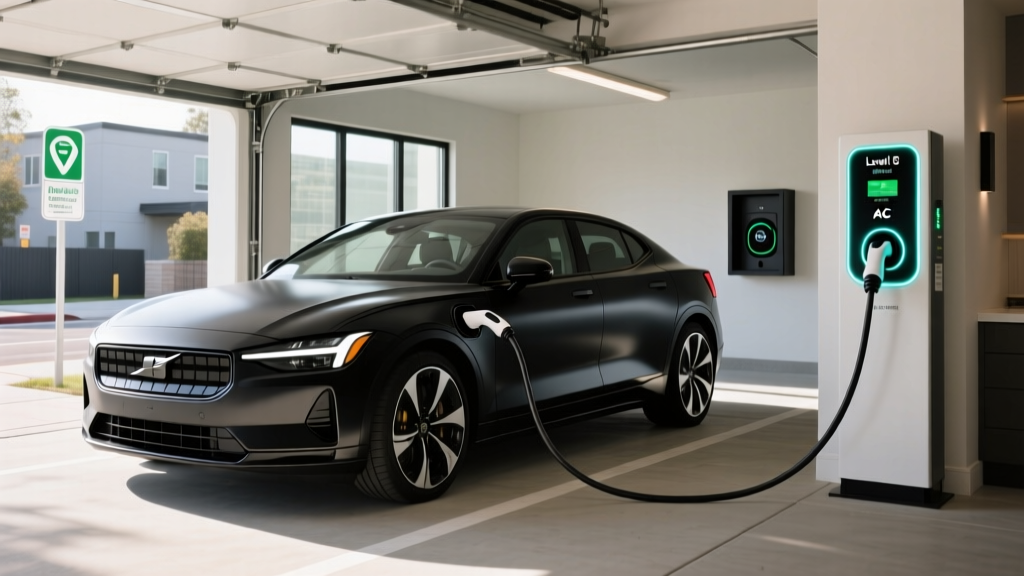
Level 2 is the backbone of practical EV ownership. The 2022 Polestar 2's onboard charger accepts up to 11 kW on AC power (three-phase capable, but on a typical US single-phase 240V/48A circuit, you'll see approximately 11.5 kW). At this rate, a full 10–100% charge takes roughly 7–8 hours — ideal for overnight replenishment. On a standard US 240V/40A circuit (the most common home install), you'll see about 9.6 kW, adding roughly 32 miles of range per hour and completing a 10–80% charge in about 5.5 hours.
DC Fast Charging bypasses the onboard charger entirely, sending DC current directly to the battery. The 2022 Polestar 2 Long Range Single Motor peaks at approximately 150 kW on a compatible CCS1 DC fast charger. Under ideal conditions (battery preconditioned, low state of charge), a 10–80% session takes roughly 32–35 minutes. However, the charge curve tapers significantly above 80% — expect 80–100% to take an additional 25–30 minutes. For road trips, plan to charge to 80% and move on; the time penalty for the final 20% is rarely worth it.
Home Level 2 Charger Installation: Electrical Requirements, Costs, and Panel Upgrades
Installing a Level 2 charger at home is the single most impactful upgrade for daily EV ownership. Here's exactly what the 2022 Polestar 2 Long Range Single Motor requires and what it will cost.
Electrical Requirements
To achieve the Polestar 2's full 11 kW AC charging capability, you need a 240V circuit rated for at least 48 amps (a 60-amp breaker, as electrical code requires circuits to be rated at 125% of continuous load). However, many homeowners install a 40-amp circuit (240V/40A), which delivers 9.6 kW — still sufficient to fully charge overnight and far more cost-effective in homes with limited panel capacity.
- 40A circuit (240V): 9.6 kW — ~7.5 hours for 10–100%, most common residential install
- 48A circuit (240V): 11.5 kW — ~6.5 hours for 10–100%, requires 60A breaker
- 60A circuit (240V): 14.4 kW — exceeds Polestar 2's 11 kW onboard limit; the car will still only draw 11 kW, so no benefit unless you plan to own a future EV with a larger onboard charger
Panel Upgrade Considerations
If your home has a 100-amp electrical panel — common in homes built before the 1990s — adding a 40A or 60A dedicated EV circuit may push your total load beyond the panel's capacity. A licensed electrician will perform a load calculation (NEC Article 220) to determine if an upgrade to a 200-amp panel is necessary. Panel upgrades are the single largest variable in home charging installation cost.
Installation Cost Breakdown
| Component | Typical Cost Range | Notes |
|---|---|---|
| Level 2 Charging Equipment (40A–48A) | $350–$700 | Hardwired or NEMA 14-50 plug |
| Electrician Labor (standard install, <50 ft run) | $500–$1,200 | Varies by region and run complexity |
| Permit & Inspection | $50–$250 | Required in most jurisdictions |
| Electrical Panel Upgrade (if needed) | $1,500–$3,500 | 100A → 200A service upgrade |
| Total (no panel upgrade) | $900–$2,150 | Most common scenario |
| Total (with panel upgrade) | $2,400–$5,650 | Older homes with 100A service |
Get at least three quotes from licensed electricians. Ask specifically about the circuit run distance (longer runs require thicker, more expensive wire), whether a subpanel is an option, and if your utility offers a separate EV meter or time-of-use rate that could reduce ongoing costs.
Connector Compatibility: CCS1, NACS Adapters, and Public Charging Networks
The 2022 Polestar 2 Long Range Single Motor was built with a CCS1 (Combined Charging System) connector for both AC Level 2 and DC fast charging in North America. This is the standard used by most non-Tesla charging networks including Electrify America, EVgo, and ChargePoint.
| Connector Type | Native Support? | Adapter Available? | Network Access |
|---|---|---|---|
| CCS1 | Yes (built-in) | Not needed | Electrify America, EVgo, ChargePoint, most public DCFC |
| NACS (Tesla) | No | Yes — CCS-to-NACS adapter ($200–$350) | Tesla Supercharger network (15,000+ stalls in US) |
| CHAdeMO | No | Rare / impractical | Largely deprecated in North America |
| J1772 (AC Level 1/2) | Yes (CCS1 includes J1772 upper coupler) | Not needed | All public Level 2 stations |
The Tesla Supercharger adapter question: As of 2025–2026, Tesla has opened its Supercharger network to non-Tesla EVs via the NACS standard. Polestar 2 owners can purchase a CCS1-to-NACS adapter (available from Polestar, Lectron, or A2Z) for approximately $200–$350. This unlocks access to Tesla's Supercharger network — widely regarded as the most reliable DC fast-charging infrastructure in North America. The adapter supports up to 150 kW, matching the Polestar 2's peak DC rate, so you won't sacrifice charging speed.
Charging Cost Per Mile: Home vs Public vs Gasoline Comparison
One of the strongest ownership arguments for the Polestar 2 is the per-mile energy cost. Here's how charging costs break down across scenarios, compared against a gasoline vehicle averaging 28 MPG combined.
| Charging Scenario | Rate ($/kWh) | Cost to Add 100 Miles | Cost Per Mile |
|---|---|---|---|
| Home Level 2 (off-peak utility rate) | $0.08–$0.12 | $2.40–$3.60 | $0.024–$0.036 |
| Home Level 2 (standard utility rate) | $0.13–$0.18 | $3.90–$5.40 | $0.039–$0.054 |
| Public Level 2 (ChargePoint, etc.) | $0.20–$0.35 | $6.00–$10.50 | $0.060–$0.105 |
| DC Fast Charger (Electrify America/EVgo) | $0.35–$0.55 | $10.50–$16.50 | $0.105–$0.165 |
| Tesla Supercharger (NACS adapter) | $0.28–$0.40 | $8.40–$12.00 | $0.084–$0.120 |
| Gasoline (28 MPG @ $3.40/gal) | — | $12.14 | $0.121 |
The Polestar 2 Long Range Single Motor achieves approximately 3.0–3.3 miles per kWh in mixed driving (consistent with its 107 MPGe EPA rating). At home off-peak rates, charging costs roughly one-quarter to one-third the per-mile cost of gasoline. Even at DC fast-charging rates, the Polestar 2 is generally cheaper per mile than a 28 MPG gas car — though the margin narrows significantly on expensive networks.
For a driver covering 12,000 miles annually and charging primarily at home on off-peak rates, annual fuel cost is approximately $360–$430. The equivalent gasoline cost at 28 MPG and $3.40/gallon is $1,457. That's a savings of roughly $1,000–$1,100 per year in energy costs alone.
Recommended Level 2 Home Chargers for the Polestar 2
Based on the Polestar 2's 11 kW onboard AC charger, CCS1 connector, and typical residential electrical capacity, here are three well-matched Level 2 charging stations:
ChargePoint Home Flex (up to 50A)
- Power Output: Up to 12 kW (50A/240V), adjustable via DIP switches
- Connector: J1772 (compatible with Polestar 2's CCS1 inlet upper coupler)
- Cable Length: 23 feet
- Smart Features: Wi-Fi, ChargePoint app scheduling, Alexa integration, energy tracking
- Installation: Hardwired or NEMA 14-50 plug
- Price: ~$550–$650
- Why it fits: Adjustable amperage lets you match your circuit capacity (set to 40A on a 50A breaker or 48A on a 60A breaker). UL-listed, ENERGY STAR certified, and widely recommended by electricians.
Emporia Vue Level 2 EV Charger (48A)
- Power Output: Up to 11.5 kW (48A/240V)
- Connector: J1772
- Cable Length: 24 feet
- Smart Features: Wi-Fi, Emporia app, solar integration, real-time energy monitoring, load management
- Installation: Hardwired or NEMA 14-50
- Price: ~$400–$500
- Why it fits: Best value in the 48A category. The load-management feature is valuable for homes with limited panel capacity — it can dynamically reduce charge rate if other high-draw appliances kick on.
Wallbox Pulsar Plus (40A or 48A)
- Power Output: Up to 11.5 kW (48A model) or 9.6 kW (40A model)
- Connector: J1772
- Cable Length: 25 feet (longest in this group)
- Smart Features: Wi-Fi + Bluetooth, Wallbox app, Power Sharing (two chargers on one circuit), Eco-Smart solar mode
- Installation: Hardwired only (no plug option on 48A model)
- Price: ~$550–$700
- Why it fits: The 25-foot cable accommodates deeper garages or driveway parking. Power Sharing is ideal if you plan to add a second EV and want two chargers on a single 60A circuit.
Safety, Electrical Code, and Best Practices
EV charging involves sustained high-current draw — often 8+ hours continuously. This places unique demands on your home's electrical system that differ from any other appliance.
- Dedicated circuit: Your Level 2 charger must be on a dedicated circuit with no other loads. Sharing a circuit with a dryer, HVAC, or other appliance is a code violation and a fire risk.
- GFCI protection: NEC 2020 and later requires GFCI (Ground Fault Circuit Interrupter) protection for EV charging outlets. Hardwired chargers may be exempt depending on jurisdiction — ask your electrician. Note: some EV owners report nuisance GFCI trips with certain charger-GFCI breaker combinations; using a hardwired connection avoids this issue.
- Outdoor rating: If your charger is installed outdoors (carport, driveway post), ensure the unit carries a NEMA 4 or IP55+ rating for weather resistance. All three chargers recommended above are rated for outdoor installation.
- Wire gauge: A 40A circuit requires minimum 8 AWG copper wire; a 48A circuit requires 6 AWG. Longer runs (>50 feet) may require upsizing to compensate for voltage drop. Your electrician will calculate this.
- Permit and inspection: Most jurisdictions require an electrical permit and post-installation inspection for EV charger circuits. This protects you legally and ensures the work meets NEC standards. Never skip this step — unpermitted work can void homeowner's insurance claims.
- Utility notification: Some utilities require notification before installing a Level 2 charger, particularly if your service is below 200A. Many utilities also offer EV-specific time-of-use rates that can cut your charging cost by 30–50%.
Frequently Asked Questions
How much does it cost to install a home EV charger for the Polestar 2?
A standard Level 2 installation (40A–48A circuit, under 50-foot wire run, no panel upgrade) typically costs between $900 and $2,150 including equipment, electrician labor, and permit fees. If your home requires a 100A-to-200A panel upgrade, add $1,500–$3,500. Get multiple quotes and ask about utility rebates — some utilities cover up to $500 of installation cost.
How fast will each charging level add range to the Polestar 2?
Level 1 (120V) adds approximately 4–5 miles per hour. Level 2 (240V/40A) adds about 32 miles per hour, while a 48A circuit adds roughly 38–40 miles per hour. DC fast charging at peak rate (150 kW) can add approximately 180–220 miles per hour, though the actual rate tapers significantly as the battery fills — plan around an average of 100 kW across a 10–80% session.
Can I use Tesla Superchargers with the 2022 Polestar 2?
Not natively — the Polestar 2 has a CCS1 connector, while Tesla Superchargers use NACS. However, you can purchase a CCS1-to-NACS adapter for $200–$350 from brands like Lectron or A2Z. With this adapter, you can access the full Tesla Supercharger network at up to 150 kW, which matches the Polestar 2's peak DC charging rate.
How much does charging cost per mile compared to gas?
Charging at home on off-peak utility rates ($0.08–$0.12/kWh), the Polestar 2 costs approximately $0.024–$0.036 per mile. A comparable 28 MPG gasoline car at $3.40/gallon costs $0.121 per mile. Even at DC fast-charging rates ($0.35–$0.55/kWh), the Polestar 2 at $0.105–$0.165 per mile is generally competitive with or cheaper than gasoline. Annual savings for a 12,000-mile driver charging primarily at home: approximately $1,000–$1,100.
What electrical upgrades might my home need for a Level 2 charger?
The most common upgrade is a panel capacity increase from 100A to 200A, needed in older homes where the existing panel cannot accommodate a new 40A–60A dedicated circuit. Your electrician will perform an NEC Article 220 load calculation. Other potential upgrades include replacing a Federal Pacific or Zinsco panel (known fire hazards), adding a subpanel near the garage, or upgrading the service drop from the utility. Homes built after 2000 with 200A service rarely need a panel upgrade.
Does the 2022 Polestar 2 qualify for any charging equipment tax credits?
The federal Alternative Fuel Infrastructure Tax Credit (§30C) expired for residential installations at the end of 2021, though it was partially revived under the Inflation Reduction Act for installations in qualified low-income or rural census tracts. Check IRS guidance on §30C for current eligibility. Many states and utilities offer separate rebates for charger equipment and installation — check your utility's EV programs page.
How long does a 10–80% DC fast charge take in the Polestar 2?
Under ideal conditions (battery preconditioned, ambient temperature 60–80°F, connected to a 150+ kW CCS1 charger), a 10–80% session takes approximately 32–35 minutes. In cold weather (below 32°F) without preconditioning, this can stretch to 40–50 minutes due to the battery management system limiting charge rate to protect the cells. Always enable navigation to a charger in the Polestar's Google-based infotainment system — this triggers automatic battery preconditioning.
Sources: EPA Fuel Economy — 2022 Polestar 2 Long Range Single Motor, Polestar US Specifications, IRS §30C Alternative Fuel Vehicle Refueling Property Credit.