The 2022 Nissan Leaf remains one of the most accessible used electric vehicles on the market, with EPA-estimated ranges of 149 miles (40 kWh battery) and 226 miles (62 kWh battery). But owning a Leaf — or any EV — hinges on understanding your charging options, real-world range expectations, and what it actually costs to keep the battery full. This guide breaks down every charging scenario for the 2022 Leaf, from a standard 120V wall outlet to DC fast charging, plus the exact costs and equipment you need.
2022 Nissan Leaf Range: EPA vs. Real World
| Trim/Battery | EPA Range | Real-World Highway (~70 mph) | Cold Weather (below 32°F) |
|---|---|---|---|
| S / SV (40 kWh) | 149 mi | ~120–130 mi | ~95–110 mi |
| SL / SV Plus (62 kWh) | 226 mi | ~180–195 mi | ~145–165 mi |
The Leaf's passively cooled battery means faster degradation in hot climates and slower charging in cold weather. Plan trips around the lower real-world numbers, not the EPA sticker. Source: fueleconomy.gov.
Range isn't just about battery size — it's about how you charge and drive. Highway speeds above 65 mph, aggressive acceleration, and cabin heating all reduce range significantly. The Leaf lacks a heat pump (standard on newer EVs like the Hyundai Ioniq 5), so winter range loss is more pronounced than in EVs with active thermal management.
Charging Levels Explained: kW, Speed, and What They Mean for Your Leaf
Before we get into equipment, let's clear up the single most common EV confusion: kW (kilowatts) measures power — how fast energy flows into your battery. kWh (kilowatt-hours) measures energy — the total capacity of your battery. Think of kW as the width of a hose and kWh as the size of the bucket.
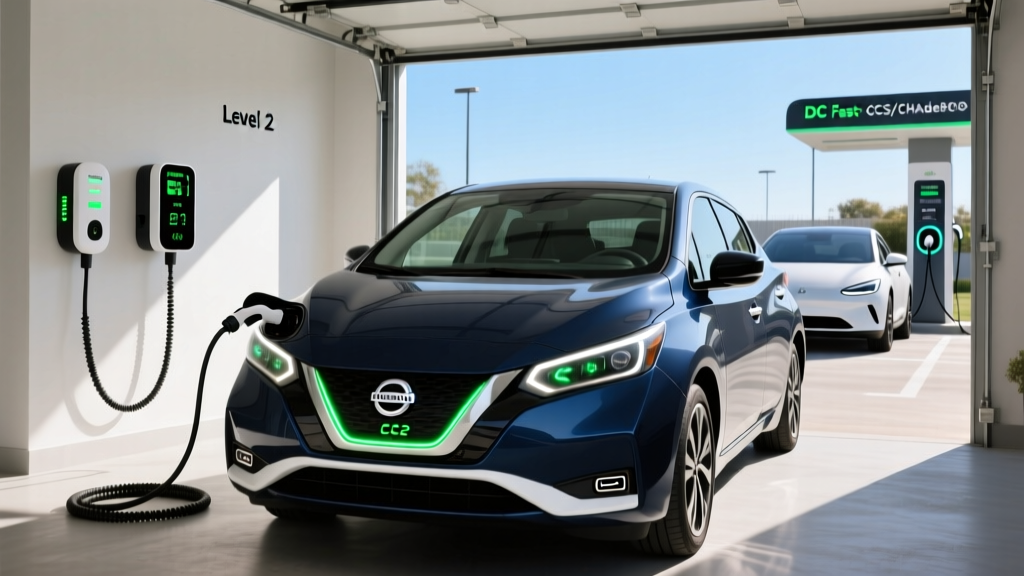
| Level | Voltage | Max Power (kW) | Miles of Range Added per Hour | Best For |
|---|---|---|---|---|
| Level 1 | 120V AC | 1.4 kW | ~4–5 mi/hr | Overnight top-ups, low daily mileage |
| Level 2 | 240V AC | 6.6 kW (Leaf onboard charger limit) | ~22–25 mi/hr | Daily home charging, full overnight refill |
| DC Fast (CHAdeMO) | 400V+ DC | ~50 kW (40 kWh) / ~100 kW (62 kWh) | ~120–180 mi/hr (peak) | Road trips, quick top-ups |
Critical Leaf limitation: The 2022 Leaf's onboard AC charger maxes out at 6.6 kW. Even if you install a 48-amp (11.5 kW) Level 2 home charger, the Leaf will only draw 6.6 kW. This means a full charge from empty takes roughly 7 hours (40 kWh) or 11 hours (62 kWh) on Level 2.
On DC fast charging, the 40 kWh Leaf peaks around 50 kW, while the 62 kWh Leaf Plus can reach approximately 100 kW — but only briefly. The Leaf's passive battery cooling causes charge speeds to taper aggressively above 60–70% State of Charge (SoC) to protect battery health. Expect a 10–80% charge in roughly 40–60 minutes depending on battery size and ambient temperature.
Home Charger Installation: Costs, Electrical Requirements, and Gotchas
How much does it cost to install a home EV charger? The answer depends heavily on your home's electrical panel and the distance from panel to charger location.
| Component | Simple Install (panel near garage) | Complex Install (long run, older panel) |
|---|---|---|
| Level 2 EVSE equipment | $300–$600 | $300–$700 |
| Electrician labor (2–4 hrs simple / 6–10 hrs complex) | $300–$600 | $900–$2,000 |
| Electrical permit | $50–$150 | $50–$200 |
| Panel upgrade (if needed: 100A → 200A) | N/A | $1,500–$3,500 |
| Total estimated cost | $650–$1,350 | $2,750–$6,400 |
Electrical requirements for Level 2: A Level 2 charger requires a dedicated 240V circuit. For a 32-amp charger, you need a 40-amp breaker (NEC code requires circuits rated at 125% of continuous load). For a 48-amp charger, you need a 60-amp breaker.
Panel upgrade reality: Homes built before the 1990s often have 100-amp main panels. Adding a 40-amp EV circuit may push total load beyond safe capacity, requiring a panel upgrade to 200 amps. This is the single biggest hidden cost in home EV charging. Have an electrician perform a load calculation before committing to equipment.
Safety and code considerations:
- Dedicated circuit: Your EV charger must have its own breaker — never share with appliances.
- GFCI protection: NEC 2020+ requires GFCI protection for EVSE in garages; many modern chargers include this built in.
- Outdoor rating: If mounting outside, choose a NEMA 4-rated unit and use an in-use cover for the receptacle (if hardwired, the unit itself must be outdoor-rated).
- Hardwired vs. plug: Hardwired chargers avoid the need for a 240V receptacle (NEMA 14-50 or 6-50) and are generally safer for high-amperage installs. A 14-50 outlet offers portability but must be installed correctly with proper torque specs.
What electrical upgrades might I need? Beyond the panel itself, older homes may need a new grounding rod, service drop upgrade from the utility, or conduit runs through finished walls. Budget 10–20% contingency for surprises uncovered during installation.
Connector Compatibility: CHAdeMO, CCS, and the NACS Shift
Which connector/charger is compatible with my EV? The 2022 Nissan Leaf uses two connectors:
- J1772 for Level 1 and Level 2 AC charging (universal across all non-Tesla EVs sold in North America).
- CHAdeMO for DC fast charging — a Japanese standard shared with the Mitsubishi Outlander PHEV.
| Connector | Vehicles Using It | Network Availability |
|---|---|---|
| CHAdeMO | Nissan Leaf, Mitsubishi Outlander PHEV | Declining — Electrify America has phased out; EVgo retains some; ChargePoint varies |
| CCS1 | Hyundai, Kia, VW, BMW, Ford, GM, most non-Tesla | Widely available — Electrify America, EVgo, ChargePoint |
| NACS (Tesla) | Tesla (all years); Ford, GM, Rivian, Volvo (2025+ with adapter or native) | Tesla Supercharger network (now open to some non-Tesla via Magic Dock) |
The CHAdeMO problem: The DC fast charging landscape has shifted decisively toward CCS1 and NACS. Electrify America no longer installs CHAdeMO connectors at new stations. EVgo still supports CHAdeMO at many legacy locations, but new builds favor CCS/NACS. This is a real ownership consideration for the Leaf: road trip charging options are narrowing.
Adapter options: As of 2026, no reliable CHAdeMO-to-CCS or CHAdeMO-to-NACS adapter exists for DC fast charging. Leaf owners are effectively locked into CHAdeMO-equipped stations. For Level 2 AC charging, a J1772-to-Tesla adapter (or vice versa) works fine, but this doesn't solve the DC fast charging gap.
Level 2 Charger Equipment Picks for the Nissan Leaf
Since the Leaf's onboard charger caps at 6.6 kW, you don't need the most powerful home charger on the market — but investing in a quality 32-amp or 40-amp unit future-proofs your install for your next EV. Here are three proven options:
Emporia Vue Level 2 EVSE
- Power output: Up to 48 amps (11.5 kW on 240V)
- Connector: J1772 (NACS adapter available)
- Cable length: 24 ft
- Smart features: Wi-Fi, scheduling, energy monitoring via Emporia app, solar integration
- Price: ~$350–$400
- Why for Leaf: Excellent value, smart scheduling lets you charge during off-peak utility rates. Overkill on power, but future-proof.
ChargePoint Home Flex
- Power output: Adjustable 16–50 amps (up to 12 kW)
- Connector: J1772 or NACS (select at purchase)
- Cable length: 23 ft
- Smart features: Wi-Fi, Alexa integration, ChargePoint app scheduling, amperage dip-switch adjustable
- Price: ~$550–$650
- Why for Leaf: Adjustable amperage means you can set it to 32 amps on a 40-amp circuit — matching older panels without upgrade.
Grizzl-E Smart
- Power output: Up to 40 amps (9.6 kW)
- Connector: J1772 (NACS version available)
- Cable length: 24 ft
- Smart features: OCPP-compatible, works with utility demand-response programs
- Price: ~$400–$500
- Why for Leaf: Built in Canada for extreme cold — NEMA 4 outdoor rated, robust build. Great for garage or driveway mounting.
For the Leaf specifically, any of these units will deliver a full overnight charge. The 6.6 kW onboard charger means a 40 kWh Leaf refills in ~6–7 hours and the 62 kWh Leaf in ~9–10 hours on Level 2.
Cost to Charge: Per-Mile Economics vs. Gasoline
How much does charging cost per mile vs gas? Let's run the numbers with real utility rates and the Leaf's efficiency.
The 2022 Nissan Leaf (62 kWh) achieves approximately 111 MPGe combined, or about 30 kWh per 100 miles (fueleconomy.gov). The 40 kWh model is slightly more efficient at roughly 27 kWh/100 mi.
| Scenario | Rate ($/kWh) | Cost per 100 mi | Cost per Mile |
|---|---|---|---|
| Home off-peak (utility time-of-use) | $0.08–$0.12 | $2.40–$3.60 | $0.024–$0.036 |
| Home standard rate (national avg.) | $0.16 | $4.80 | $0.048 |
| Public Level 2 (ChargePoint, etc.) | $0.25–$0.49 | $7.50–$14.70 | $0.075–$0.147 |
| DC Fast (EVgo, Electrify America) | $0.35–$0.55 | $10.50–$16.50 | $0.105–$0.165 |
| Gasoline comparison (30 MPG car, $3.40/gal) | — | $11.33 | $0.113 |
The takeaway: Home charging on an off-peak rate is roughly 3–4 cents per mile — about one-quarter the cost of gasoline. Even public DC fast charging at $0.45/kWh is competitive with a 30 MPG gas car at current fuel prices. But relying exclusively on public DC fast charging erases most of the cost advantage.
For a Leaf owner driving 12,000 miles/year with home charging at $0.16/kWh, annual fuel cost is approximately $576. The equivalent gas car at 30 MPG and $3.40/gal costs $1,360. That's a savings of ~$784/year, or roughly $3,920 over five years — before factoring in the Leaf's lower maintenance costs (no oil changes, reduced brake wear from regenerative braking).
Public Charging Networks: Where Can a Leaf Actually Charge?
The CHAdeMO situation requires practical planning. Here's where Leaf owners can reliably DC fast charge in 2026:
- EVgo: Retains CHAdeMO connectors at many existing stations, particularly in metro areas. New builds may omit CHAdeMO — check the EVgo app before relying on a specific station.
- ChargePoint: CHAdeMO availability varies by location. Many ChargePoint DC stations are CCS-only or CCS+NACS.
- Electrify America: No longer installs CHAdeMO. Existing CHAdeMO stalls at older locations may still function but are not maintained or expanded.
- Tesla Superchargers: Not accessible to Leaf owners — no CHAdeMO-to-NACS DC adapter exists.
For road trips, plan routes using apps like PlugShare or A Better Routeplanner, filtering specifically for CHAdeMO-compatible stations. In rural areas and along some interstate corridors, CHAdeMO availability is thin. This is the Leaf's most significant ownership limitation in 2026.
Charging Time Examples: What to Expect
How fast will each charging level add range? Here are concrete charging time scenarios for both Leaf battery sizes:
| Scenario | 40 kWh Leaf (0→100%) | 62 kWh Leaf (0→100%) |
|---|---|---|
| Level 1 (120V, 1.4 kW) | ~28 hours | ~44 hours |
| Level 2 (240V, 6.6 kW) | ~6–7 hours | ~9–10 hours |
| DC Fast 10–80% (CHAdeMO) | ~40 minutes (50 kW peak) | ~45–60 minutes (100 kW peak, taper after 60%) |
The charge curve taper on the Leaf is notable. The 62 kWh model may hit 100 kW at low SoC, but by 70% it drops to ~40 kW, and above 85% it slows to ~20 kW. For road trips, the optimal strategy is to charge from 10–70% and move on rather than waiting for a full battery.
Frequently Asked Questions
Can I charge the 2022 Nissan Leaf on a regular household outlet?
Yes. Level 1 charging on a standard 120V/15A outlet adds roughly 4–5 miles of range per hour. For the 40 kWh Leaf, a full charge takes about 28 hours — practical only for overnight top-ups if your daily driving is under 30 miles. Ensure the outlet is on a dedicated circuit and shows no signs of heat damage.
Is it worth installing a Level 2 charger if the Leaf only accepts 6.6 kW?
Absolutely. Level 2 at 6.6 kW adds ~22–25 miles per hour, meaning an overnight session fully replenishes either Leaf battery. Additionally, installing a higher-capacity circuit (e.g., 40-amp or 60-amp) and a capable EVSE prepares your home for your next EV, which will likely accept 11.5 kW or more on Level 2.
Will a CHAdeMO adapter let me use Tesla Superchargers or CCS stations?
No. As of 2026, no commercially available adapter converts CHAdeMO to CCS or NACS for DC fast charging. The Leaf is limited to CHAdeMO-equipped stations for DC fast charging. For Level 2 AC charging, J1772 is universal, so you can use any Level 2 station regardless of connector standard (with appropriate adapters for Tesla-connector stations).
Does the 2022 Leaf qualify for any federal tax credits?
The 2022 Leaf was eligible for the full $7,500 federal tax credit under the pre-2023 rules when purchased new. For used Leaf purchases in 2026, the IRS §25E used clean vehicle credit offers up to $4,000 (30% of sale price, capped at $4,000) on vehicles priced at $25,000 or less, purchased from a dealer, subject to buyer income limits ($75,000 single / $150,000 joint). Verify current eligibility at irs.gov.
How long will the Leaf battery last, and what does replacement cost?
Nissan warrants the Leaf battery for 8 years/100,000 miles against capacity loss below 66% (5 bars lost on the 12-bar gauge). Real-world data from Leaf owners shows the 40 kWh pack typically retains 85–90% capacity after 5 years/60,000 miles in moderate climates. Hot climates accelerate degradation due to the passive cooling system. A replacement 40 kWh pack costs approximately $6,500–$9,000; the 62 kWh pack runs $8,500–$12,000 including labor.
What's the best charging strategy to preserve Leaf battery health?
For daily use, charge to 80% using your EVSE's scheduling feature or the Leaf's built-in charge timer. Reserve 100% charges for road trips. Avoid frequent DC fast charging in hot weather — the passive cooling system stresses the battery during high-power sessions. If you live in a hot climate, park in shade and schedule charging for overnight when ambient temperatures are lower.
The 2022 Nissan Leaf is a practical, affordable EV — especially on the used market — but its CHAdeMO connector and passive battery cooling define its ownership experience. Home Level 2 charging is essential to making the Leaf work as a daily driver, and understanding your electrical panel's capacity before buying equipment will save you thousands in surprise costs. Plan your charging infrastructure around the Leaf's actual capabilities, and it will deliver reliable, low-cost electric miles for years.