The 2022 Model Y Long Range: A Charging Profile Overview
The 2022 Tesla Model Y Long Range remains one of the most popular electric vehicles on the road — and for good reason. With an EPA-estimated 330 miles of range, an 82 kWh battery pack (75 kWh usable, NMC chemistry), and peak DC fast-charging speeds of up to 250 kW on V3 Superchargers, it sets a high bar for real-world usability. But owning one means understanding exactly how, where, and how fast you can recharge it — and what that costs.
This guide walks through every charging scenario for the 2022 Model Y Long Range: Level 1 trickle charging, Level 2 home installation (including electrical requirements and costs), DC fast charging on Tesla Superchargers and third-party networks, and the true cost-per-mile compared to a gas crossover. Whether you've just taken delivery or are evaluating one on the used market, these are the numbers you need.
| Spec | Value |
|---|---|
| Battery Capacity (Usable) | ~75 kWh (NMC) |
| EPA Range | 330 miles |
| Max DC Fast Charge Rate | 250 kW (peak, V3 Supercharger) |
| 10–80% DC Fast Charge Time | ~27 minutes (preconditioned) |
| Level 2 Onboard Charger | 11.5 kW (48A max) |
| Connector | NACS (Tesla proprietary) |
| MPGe (Combined) | 122 MPGe |
| Efficiency | 28 kWh/100 mi |
Real-World Range Note: The EPA 330-mile sticker assumes mixed driving at moderate temperatures. Expect roughly 280–300 miles on sustained highway trips at 70+ mph, and as low as 230–250 miles in sub-freezing winter conditions. Cold weather increases battery internal resistance and cabin heating draw — preconditioning the battery before departure helps recover some of that loss.
Charging Levels Explained: Speeds in kW and Miles Per Hour
Before plugging in anywhere, it's critical to understand the difference between kW (kilowatts) and kWh (kilowatt-hours). kW measures the rate of energy delivery — think of it as how fast water flows through a hose. kWh measures the total energy stored or delivered — the size of the bucket. Your Model Y Long Range has a ~75 kWh battery (bucket). A 15 kW charger (flow rate) would take roughly 5 hours to fill it from empty.
| Level | Voltage / Amps | Power (kW) | Miles of Range Added Per Hour | Typical Use Case |
|---|---|---|---|---|
| Level 1 (120V) | 120V / 12A | ~1.4 kW | ~3–5 mi/hr | Overnight trickle; emergency top-up |
| Level 2 (240V) | 240V / 48A | 11.5 kW (max onboard) | ~37–44 mi/hr | Home daily charging; workplace |
| DC Fast (V3 Supercharger) | 400V+ DC | Up to 250 kW (peak) | ~1,000+ mi/hr (at peak) | Road trips; rapid top-ups |
A few things to notice: Level 1 charging is painfully slow for a 75 kWh battery — a full charge from near-empty would take over 50 hours. It's useful only for maintaining charge or adding 30–40 miles overnight. Level 2 at 48A is the sweet spot for daily home use: plug in when you get home, wake up to a full battery every morning. DC fast charging is for road trips, but the charge curve matters — peak 250 kW only holds at low states of charge and tapers significantly above 50–60% SoC.
Home Level 2 Installation: Electrical Requirements, Costs & Panel Upgrades
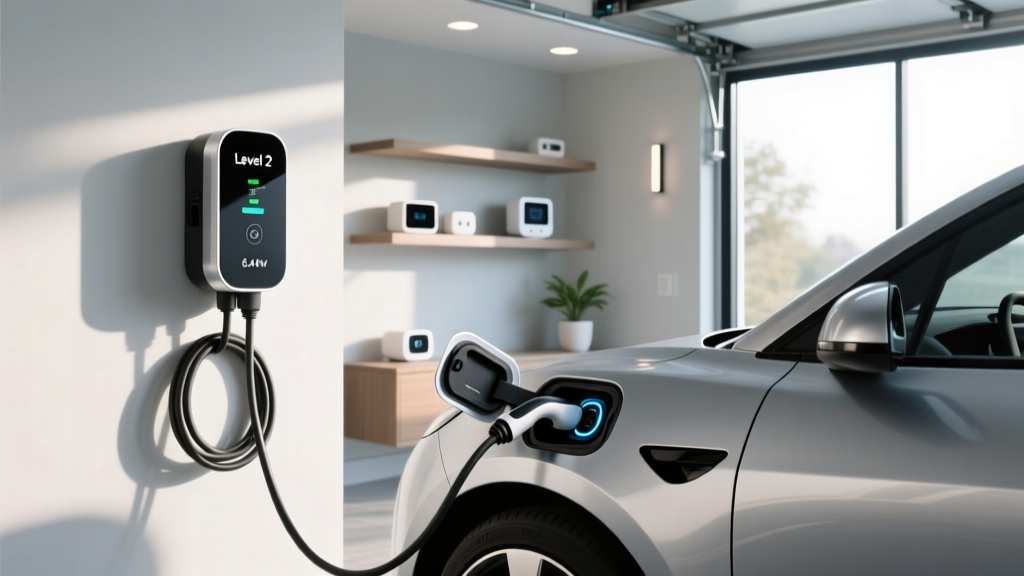
Installing a Level 2 home charger is the single most impactful upgrade for EV ownership. For the Model Y Long Range, you want a 240V circuit capable of delivering at least 48 amps to take full advantage of the 11.5 kW onboard charger. Here's what that entails electrically:
- Circuit requirement: 60-amp dedicated breaker (the National Electrical Code requires circuits to be rated at 125% of continuous load, so a 48A charger needs a 60A breaker)
- Wire gauge: Typically 4 AWG copper (varies by run length and local code)
- Connector: NEMA 14-50 receptacle or hardwired connection (hardwired is preferred for 48A+ circuits and avoids GFCI nuisance tripping)
- Permit: Required in most jurisdictions; typically $50–$200
Do You Need a Panel Upgrade?
This is the make-or-break cost question. Most modern homes have a 200-amp electrical panel, which can usually accommodate a 60A EV circuit alongside existing loads. However, older homes with 100A or 150A service, or homes with heavy existing loads (electric heat, hot tub, double oven), may need a panel upgrade to 200A or even a separate sub-panel. A panel upgrade adds $1,500–$4,000+ to the project.
Some homeowners opt for a lower-amperage circuit (e.g., 30A or 40A breaker delivering 24A or 32A to the car) to avoid a panel upgrade. At 32A, you'd get roughly 7.7 kW and ~25 miles of range per hour — enough to fully recharge overnight for most daily driving.
| Component | Cost Range | Notes |
|---|---|---|
| Level 2 Charger (Equipment) | $300–$700 | Tesla Wall Connector ~$425; third-party smart chargers $400–$700 |
| Electrician Labor (standard install) | $500–$1,500 | Depends on panel-to-outlet distance, wall type, conduit run |
| Electrical Permit | $50–$200 | Varies by municipality |
| Panel Upgrade (if needed) | $1,500–$4,000+ | 100A→200A upgrade; not required for most modern homes |
| Total (no panel upgrade) | $850–$2,400 | Typical for homes with adequate 200A service |
| Total (with panel upgrade) | $2,350–$6,400+ | Older homes or high-load scenarios |
Always get a quote from a licensed electrician before committing to a charger purchase. They can assess your panel capacity, recommend the right circuit size, and pull the required permits. According to Energy.gov's home charging guide, some utilities offer rebates of $250–$1,000 for Level 2 equipment and installation — check with your local provider.
Connector Compatibility: NACS, CCS1, and Adapters
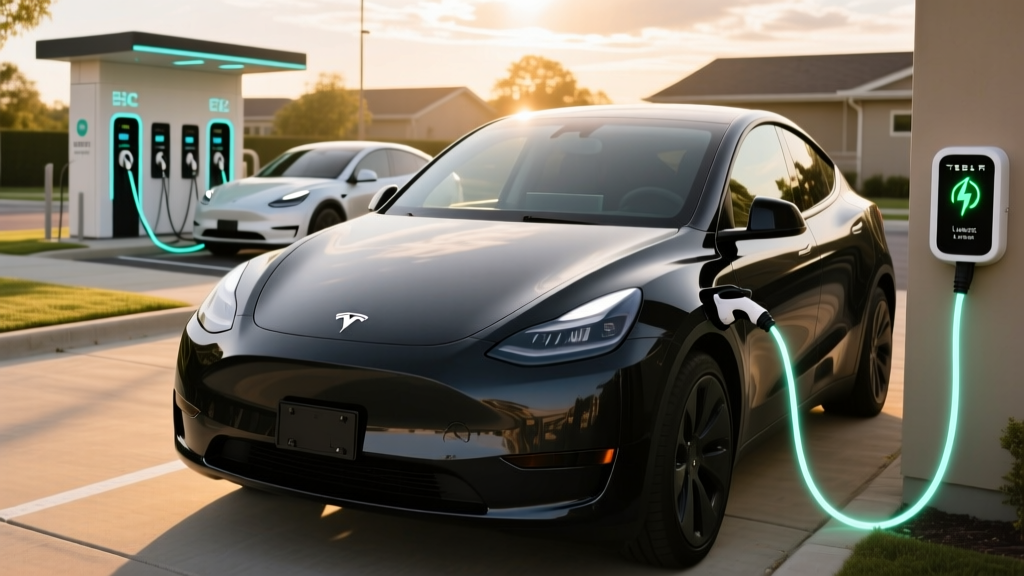
The 2022 Model Y Long Range comes equipped with Tesla's proprietary NACS (North American Charging Standard) connector. In 2022, this meant exclusive access to Tesla's Supercharger network — a major advantage. Since late 2024, the industry has broadly adopted NACS, and Tesla has opened its Supercharger network to non-Tesla EVs via the Magic Dock adapter at select stations.
For your Model Y, here's what you need to know about connector compatibility:
| Connector Type | Native Support? | Adapter Needed? | Network Access |
|---|---|---|---|
| NACS (Tesla) | Yes — native | None | Tesla Superchargers, Tesla Destination Chargers, home Wall Connector |
| CCS1 | No | Tesla CCS Adapter (~$175–$250) | Electrify America, EVgo, ChargePoint, and other CCS networks |
| CHAdeMO | No | Third-party adapter (limited availability, ~$300–$450) | Largely legacy; being phased out in the US |
| J1772 (Level 2 public) | No | Tesla Mobile Connector J1772 adapter (included with vehicle) | Public Level 2 stations, hotels, workplaces |
Practical recommendation: Buy Tesla's official CCS1 adapter if you plan to use non-Tesla DC fast-charging networks — it unlocks Electrify America, EVgo, and others. For Level 2 public charging (malls, workplaces, hotels), the J1772 adapter that came with your car works fine. CHAdeMO is effectively dead for new installations, so investing in an adapter is rarely worthwhile.
DC Fast Charging: Real-World Speeds, Charge Curves & 10–80% Times
Tesla rates the 2022 Model Y Long Range for up to 250 kW peak on V3 Superchargers. But peak kW is not sustained kW — understanding the charge curve is essential for realistic trip planning.
Here's what a typical DC fast-charging session looks like when the battery is preconditioned (the car heats the battery to optimal temperature before arrival, triggered automatically when you navigate to a Supercharger):
- 10–30% SoC: Sustains near 250 kW — this is the fastest phase
- 30–50% SoC: Tapers to ~170–200 kW
- 50–70% SoC: Drops to ~100–130 kW
- 70–80% SoC: Further tapers to ~60–80 kW
- 80–100% SoC: Very slow; avoid charging past 80% on road trips unless necessary
Real-world 10–80% time: approximately 27 minutes at a V3 Supercharger with a preconditioned battery. At a V2 Supercharger (capped at 150 kW), expect 35–40 minutes for the same session. At a non-Tesla 50 kW DC fast charger (with CCS adapter), a 10–80% session would take roughly 90 minutes — a stark reminder of why Supercharger access matters.
Charge Curve Tip: On road trips, plan shorter, more frequent stops that keep you in the 10–60% SoC range where charging speeds are fastest. Charging from 60–80% adds surprisingly few miles but takes disproportionately longer due to taper. Tesla's trip planner in the navigation system accounts for this automatically.
Cost to Charge: Home vs. Public vs. Gas — The Per-Mile Breakdown
One of the strongest arguments for the Model Y Long Range is the fuel-cost advantage. Let's break it down with real numbers, using the vehicle's EPA efficiency of 28 kWh per 100 miles.
| Scenario | Rate | Cost Per 100 Miles | Cost Per Mile |
|---|---|---|---|
| Home charging (off-peak, avg US rate) | $0.13/kWh | $3.64 | $0.036 |
| Home charging (California avg) | $0.27/kWh | $7.56 | $0.076 |
| Home charging with TOU off-peak (CA) | $0.12/kWh | $3.36 | $0.034 |
| Tesla Supercharger (avg US) | $0.32/kWh | $8.96 | $0.090 |
| Electrify America (CCS, avg) | $0.43/kWh | $12.04 | $0.120 |
| Gas crossover (25 MPG combined, $3.50/gal) | $3.50/gallon | $14.00 | $0.140 |
The math is clear: home charging on an off-peak rate is roughly 75% cheaper per mile than a gas vehicle averaging 25 MPG. Even at public DC fast-charger rates, the Model Y is typically less expensive to "fuel" than a comparable gas crossover. According to fueleconomy.gov, the 2022 Model Y Long Range AWD achieves 122 MPGe combined, which translates to the 28 kWh/100 mi figure used in these calculations.
For a driver covering 12,000 miles per year, the annual fuel cost difference is significant:
- Home charging (US avg): ~$437/year
- Gas crossover (25 MPG, $3.50/gal): ~$1,680/year
- Annual savings: ~$1,243/year on fuel alone
Recommended Home Charging Equipment
For the 2022 Model Y Long Range, you want a Level 2 charger that can deliver the full 48 amps (11.5 kW) your onboard charger supports. Here are three well-regarded options as of 2026:
Tesla Wall Connector (Gen 3)
- Power Output: Up to 11.5 kW (48A)
- Connector: NACS (native — no adapter needed)
- Cable Length: 24 feet
- Smart Features: Wi-Fi for OTA updates, power sharing between two units, load management
- Price: ~$425
- Best For: Tesla-only households; simplest setup, best integration
ChargePoint Home Flex
- Power Output: Up to 12 kW (50A, adjustable down to 16A)
- Connector: J1772 (use Tesla's included J1772 adapter) or NACS pigtail version available
- Cable Length: 23 feet
- Smart Features: App-based scheduling, Alexa integration, detailed energy tracking
- Price: ~$550–$650
- Best For: Multi-EV households (Tesla + non-Tesla); flexible amperage for panel-constrained homes
Emporia Vue Level 2 Charger
- Power Output: Up to 11.5 kW (48A)
- Connector: J1772 (NACS adapter version also available)
- Cable Length: 24 feet
- Smart Features: Real-time energy monitoring via Emporia Vue panel integration, solar-aware scheduling
- Price: ~$400–$500
- Best For: Homes with Emporia energy monitoring or solar panels; budget-conscious buyers
For a Tesla-only household, the Tesla Wall Connector is the obvious choice — native NACS means no adapter fumbling, and at $425, it's competitively priced. If you have (or plan to get) a non-Tesla EV, the ChargePoint Home Flex offers more versatility.
Safety, Code & Installation Best Practices
EV charging draws significant current for extended periods — this is classified as a continuous load under the National Electrical Code (NEC Article 625). That means specific safety requirements apply:
- Dedicated circuit: Your Level 2 charger must have its own dedicated breaker — no sharing with other outlets or appliances.
- 125% rule: A 48A continuous load requires a breaker rated at 60A minimum (48 × 1.25 = 60).
- Hardwired vs. receptacle: For 48A+ circuits, hardwired installation is strongly preferred. NEMA 14-50 receptacles are rated for 50A, which technically limits continuous draw to 40A. Some jurisdictions now require GFCI breakers on receptacle circuits, which can cause nuisance tripping with EV chargers — hardwiring avoids this entirely.
- Outdoor rating: If your charger is installed outside (garage-exterior wall, carport, driveway), ensure the unit carries a NEMA 4 or IP65 weather rating. The Tesla Wall Connector and ChargePoint Home Flex are both rated for outdoor use.
- Permit and inspection: Most jurisdictions require an electrical permit and post-installation inspection. Skipping this can void homeowner's insurance coverage for electrical fires and may cause issues at resale.
Always hire a licensed electrician experienced with EV charger installations. Ask for a load calculation on your panel before committing to a circuit size.
Frequently Asked Questions
How much does it cost to install a home EV charger for the 2022 Model Y Long Range?
For a standard installation on a 200A panel with no upgrade needed, expect $850–$2,400 total (charger + electrician + permit). If your home needs a panel upgrade from 100A to 200A, add $1,500–$4,000+. The Tesla Wall Connector itself costs ~$425.
How fast will each charging level add range to my Model Y?
Level 1 (120V) adds roughly 3–5 miles per hour — essentially unusable for daily charging of a 330-mile battery. Level 2 (240V/48A) adds 37–44 miles per hour, fully recharging overnight. DC fast charging at a V3 Supercharger can add up to 200 miles in about 15 minutes at peak rates (low SoC, preconditioned battery).
Which connector and charger is compatible with my 2022 Model Y?
Your Model Y uses the NACS connector natively. This works with all Tesla Superchargers, Tesla Destination Chargers, and the Tesla Wall Connector. For non-Tesla DC fast chargers (Electrify America, EVgo), you'll need a Tesla CCS1 adapter (~$175–$250). For public Level 2 J1772 stations, use the J1772 adapter included with your vehicle.
How much does charging cost per mile vs. gas?
At the US average residential electricity rate of ~$0.13/kWh, the Model Y Long Range costs about $0.036 per mile to charge at home — roughly 75% less than a 25 MPG gas crossover at $3.50/gallon ($0.14/mile). Even at Supercharger rates (~$0.32/kWh), you're paying about $0.09/mile, still well below gasoline.
What electrical upgrades might I need for a home charger?
If your home has a 200A electrical panel (standard in most homes built after ~2000), you likely need nothing beyond a new 60A breaker and wiring run. Homes with 100A or 150A service, or those with heavy existing electrical loads (electric heat, hot tub, workshop), may require a panel upgrade to 200A ($1,500–$4,000+) or a lower-amperage charger circuit (32A instead of 48A) to stay within capacity. An electrician's load calculation will determine this.
Should I charge to 100% every night?
No. The 2022 Model Y Long Range uses an NMC battery, which degrades faster when held at high states of charge. Tesla recommends setting the daily charge limit to 80–90% and only charging to 100% before long road trips. This practice significantly extends long-term battery health. According to Tesla's owner manual, regular 100% charging is unnecessary for daily driving and accelerates capacity loss.
Does the 2022 Model Y Long Range qualify for any tax credits in 2026?
The 2022 Model Y Long Range may qualify for the federal §30D Clean Vehicle Credit on the used EV market (up to $4,000 or 30% of the sale price, whichever is lower). The used-EV credit has income caps ($75,000 single / $150,000 joint), a $25,000 maximum sale price, and requires purchase from a licensed dealer. For new-vehicle credits, eligibility depends on battery sourcing and critical mineral requirements that have tightened significantly. Always verify current rules on IRS.gov and consult a tax professional.