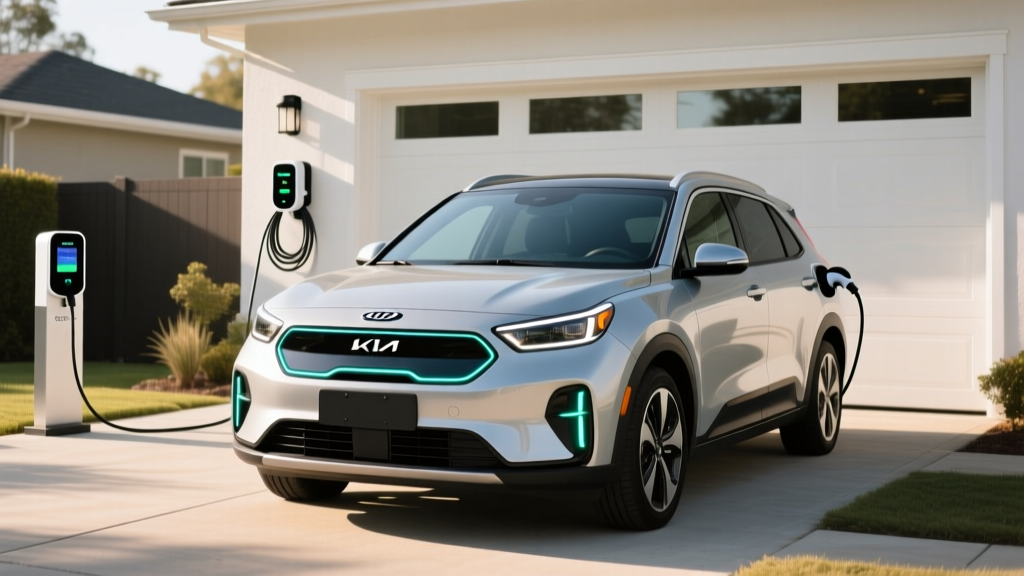
The 2022 Kia Niro EV remains a practical, efficiency-focused electric crossover that holds its own against newer competitors. But knowing its EPA range sticker is only half the picture — understanding how to charge it at home, what that range looks like in real driving, and what it costs per mile is what separates confident ownership from frustration. This guide covers the 2022 Kia Niro EV range in real-world terms, then walks you through every charging decision you'll face as an owner or prospective buyer.
2022 Kia Niro EV Range: EPA vs. Real-World Numbers
The 2022 Kia Niro EV is equipped with a 64 kWh lithium-ion polymer battery pack (NMC chemistry) and carries an official EPA-estimated range of 239 miles on a full charge. Its combined efficiency rating is 112 MPGe, or roughly 29 kWh per 100 miles driven.
- EPA Sticker: 239 miles
- Mixed suburban/city driving (65°F): ~230–245 miles (regen braking helps in stop-and-go)
- Sustained highway (70–75 mph): ~190–210 miles
- Cold weather (below 32°F, cabin heat): ~165–190 miles (expect 20–30% reduction)
- Hot weather (above 95°F, A/C): ~210–225 miles
The Niro EV lacks a heat pump (standard on the 2023+ redesign), so winter range loss is more pronounced than in competitors like the Hyundai Ioniq 5 or Tesla Model Y.
| Spec | Value |
|---|---|
| Battery Capacity | 64 kWh (usable), NMC chemistry |
| EPA Range | 239 miles |
| EPA Efficiency | 112 MPGe / 29 kWh/100 mi |
| Motor Output | 201 hp / 291 lb-ft torque |
| 0–60 mph | ~6.5 seconds |
| Max DC Fast Charge | ~77 kW (peak) |
| 10–80% DC Fast Charge | ~54 minutes |
| Level 2 Onboard Charger | 7.2 kW |
| Connector (DC) | CCS1 (Combo) |
| Connector (AC) | J1772 |
| Battery/Powertrain Warranty | 10 years / 100,000 miles |
Charging-curve reality check: The Niro EV peaks near 77 kW only between roughly 10–40% State of Charge. Above 60%, the rate tapers significantly — often dropping below 40 kW. That's why the 10–80% time stretches to roughly 54 minutes, which is slower than the 18–25 minute times you'll see from 800V architecture vehicles like the Ioniq 5 or EV6. On a road trip, plan accordingly: the Niro EV is best suited as a daily commuter with occasional longer trips, not a cross-country hauler.
Charging Levels Explained: How Fast Will Each Add Range?
Understanding charging speed requires distinguishing between kW (kilowatts) — the rate of power delivery, like water flow from a hose — and kWh (kilowatt-hours) — the total energy stored in the battery, like the size of the tank. Your 2022 Niro EV has a 64 kWh battery. How quickly you fill it depends on the kW rate of your charger.
| Level | Power (kW) | Voltage / Amps | Miles of Range per Hour | Full Charge Time (64 kWh) |
|---|---|---|---|---|
| Level 1 (standard outlet) | 1.0–1.4 kW | 120V / 12A | ~3–5 mi/hr | ~48–64 hours |
| Level 2 (home/public AC) | 3.3–7.2 kW | 240V / 16–40A | ~12–25 mi/hr | ~9–19 hours |
| DC Fast Charging | 50–77 kW* | DC direct, 200–500V | ~120–175 mi/hr (at peak) | 10–80% in ~54 min |
*The Niro EV's onboard charge controller caps DC input at ~77 kW. Plugging into a 150 kW or 350 kW station will not charge it faster.
Level 1 is the included portable cordset plugged into a standard 120V household outlet. For the Niro EV, this adds roughly 4 miles of range per hour — enough only for emergency top-ups or if you drive fewer than 30 miles per day and can charge overnight (12+ hours).
Level 2 is the standard home charging solution and the sweet spot for daily ownership. The Niro EV's onboard charger accepts up to 7.2 kW, meaning a 32-amp (7.7 kW capable) Level 2 unit will max out the car's acceptance rate. At 7.2 kW, you'll add roughly 25 miles of range per hour, or refill the entire 64 kWh battery in about 9 hours — ideal for overnight charging.
DC Fast Charging bypasses the onboard charger and feeds DC current directly to the battery. The Niro EV uses a CCS1 connector and peaks at roughly 77 kW. Expect 10–80% in approximately 54 minutes at a compatible station. The taper above 60% is significant — if you need to charge past 80%, plan for substantially more time.
Home Charger Installation: Costs, Electrical Requirements & Panel Upgrades
Installing a Level 2 home charger is the single most impactful upgrade for EV ownership. Here's what the 2022 Niro EV needs and what it will cost.
Electrical Requirements
To deliver the Niro EV's maximum 7.2 kW charge rate, you need a 240-volt circuit rated for at least 40 amps (a 40A circuit supports a continuous 32A charge, which is the NEC 80% rule for continuous loads). A 48A circuit (supporting 40A continuous) provides headroom for future vehicles or a charger upgrade.
The charger must be on a dedicated circuit — it cannot share a breaker with other appliances. Your electrician will run appropriately gauged wire (typically 6 AWG copper for 40A, 4 AWG for 48A) from your electrical panel to the charger location.
Panel Upgrade: The Cost Most Guides Ignore
Older homes with 100-amp electrical service may not have enough spare capacity for a 40A EV circuit. An electrician will perform a load calculation per NEC Article 220. If your panel is near capacity, you may need:
- Panel upgrade to 200A service: $1,500–$3,500 (common in homes built before 1990)
- Sub-panel installation: $500–$1,200 (if main panel is full but service is adequate)
- Smart load-management device: $300–$600 (alternatives like the Emporia Load Management Kit can avoid a full panel upgrade by dynamically reducing charger draw when other circuits are active)
| Component | Typical Range | Notes |
|---|---|---|
| Level 2 Charger (hardware) | $250–$650 | 32–40A, J1772 connector, 18–25 ft cable |
| Electrician labor & materials | $400–$1,500 | Depends on panel-to-charger distance, wall type, conduit run |
| Electrical permit | $50–$200 | Required in most jurisdictions; inspection included |
| Panel upgrade (if needed) | $1,500–$3,500 | 100A → 200A service upgrade |
| Total (no panel upgrade) | $700–$2,350 | Most common scenario for homes with 200A service |
| Total (with panel upgrade) | $2,200–$5,850 | Older homes or high-load panels |
Federal incentive: The Residential Clean Energy Credit (IRS §25D) was modified under current rules. Check current-year IRS guidance for whether EV charger hardware qualifies, as provisions have shifted. Some utilities also offer rebates of $200–$500 for Level 2 installation — contact your local provider.
Safety & Code Considerations
- Dedicated circuit: Required — never share a breaker with a dryer, HVAC, or kitchen circuit.
- GFCI protection: NEC 2020+ requires GFCI for outdoor receptacles. Hardwired chargers may be exempt in some jurisdictions, but many electricians include GFCI breakers as standard practice for safety.
- Outdoor rating: If mounting outside, the charger must carry a NEMA 4 (or IP65+) weather rating. All recommendations below meet this standard.
- Permit & inspection: Skipping the permit risks insurance denial in the event of an electrical fire. Always pull a permit.
Connector Compatibility: What Plugs Into the Niro EV?
The 2022 Kia Niro EV uses two connector standards:
- AC charging (Level 1 & Level 2): J1772 — the universal North American AC connector.
- DC fast charging: CCS1 (Combined Charging System, Combo 1) — the J1772 connector with two additional DC pins below.
With the industry-wide shift to NACS (Tesla's North American Charging Standard), many new EVs and chargers are adopting that plug. As a 2022 Niro EV owner, your CCS1 port is still widely supported at Electrify America, EVgo, and ChargePoint DC stations. However, as more stations add NACS-only cables, you may eventually need an adapter.
| Connector | Native Support? | Adapter Needed? | Adapter Cost (if applicable) |
|---|---|---|---|
| J1772 (AC Level 1 & 2) | ✅ Yes — native port | No | N/A |
| CCS1 (DC Fast) | ✅ Yes — native port | No | N/A |
| NACS / Tesla Supercharger (DC) | ❌ No | Yes — CCS1-to-NACS adapter | $200–$300 (e.g., Lectron, A2Z) |
| CHAdeMO (DC, legacy) | ❌ No | Rare/expensive adapter | Not recommended — CHAdeMO is being phased out |
Key takeaway: If you plan to use Tesla Superchargers (which are increasingly opening to non-Tesla EVs via NACS), budget $200–$300 for a quality CCS1-to-NACS adapter. Confirm the adapter is rated for the Niro EV's max 77 kW DC rate.
Cost to Charge: Per-Mile vs. Gasoline
One of the Niro EV's strongest ownership arguments is its low per-mile energy cost. Here's how it compares across charging scenarios, using its real-world efficiency of approximately 29 kWh per 100 miles (0.29 kWh/mile).
| Scenario | Rate ($/kWh) | Cost per Mile | Cost for 239 mi (full range) |
|---|---|---|---|
| Home (off-peak utility rate) | $0.09/kWh | $0.026/mi | $6.21 |
| Home (national avg. residential) | $0.16/kWh | $0.046/mi | $11.10 |
| Public Level 2 (ChargePoint, etc.) | $0.25/kWh | $0.073/mi | $17.34 |
| DC Fast Charging (Electrify America) | $0.43/kWh | $0.125/mi | $29.83 |
| Gas equivalent (30 MPG, $3.40/gal) | — | $0.113/mi | $27.09 |
The takeaway: Charging at home on off-peak rates makes the Niro EV roughly 4x cheaper per mile than a 30 MPG gas car. Even at residential average rates, you're saving more than half. However, frequent DC fast charging at public rates can actually exceed gas costs per mile — another reason home Level 2 charging is essential for EV economics.
Recommended Level 2 Chargers for the Niro EV
Since the Niro EV's onboard charger maxes out at 7.2 kW (32A at 240V), a 40A (9.6 kW capable) charger is the right match — it delivers the car's maximum rate while leaving headroom for a future EV that may accept more. Here are three proven options:
Emporia Vue Level 2 Charger
- Power Output: 48A / 11.5 kW max (Niro EV will draw 32A / 7.2 kW)
- Connector: J1772
- Cable Length: 24 ft
- Smart Features: Wi-Fi, app scheduling, energy monitoring, solar integration, load management
- Price: ~$399
- Best For: Budget-conscious buyers wanting smart features and energy tracking
ChargePoint Home Flex
- Power Output: Up to 50A / 12 kW (configurable via dip switches, 16–50A)
- Connector: J1772
- Cable Length: 23 ft
- Smart Features: Wi-Fi, app scheduling, Alexa integration, amperage adjustment
- Price: ~$549
- Best For: Flexibility — adjustable amperage fits any circuit size
Grizzl-E Smart
- Power Output: 40A / 9.6 kW max
- Connector: J1772
- Cable Length: 24 ft
- Smart Features: Wi-Fi, OCPP-compatible, app control, extreme cold rated (-40°F)
- Price: ~$499
- Best For: Cold-climate owners, durable aluminum enclosure, simple reliability
Any of these will fully charge the Niro EV's 64 kWh battery overnight in roughly 9 hours. All carry NEMA 4 outdoor ratings, so garage or exterior wall mounting is supported. Hardwired installation is recommended over plug-in (NEMA 14-50) for long-term reliability and code compliance in many jurisdictions.
Public Charging: Networks, Speeds & Trip Planning
For road trips or apartment dwellers without home charging, the Niro EV relies on public DC fast charging networks. Its CCS1 connector is compatible with:
- Electrify America: Largest US CCS network; stations typically offer 50–350 kW chargers. Niro EV will peak at ~77 kW. Pricing: $0.43–$0.48/kWh (Pay-as-you-go) or $0.36/kWh with a $4/month Pass+ subscription.
- EVgo: Growing network with CCS connectors; many stations in metro areas. Pricing: $0.33–$0.43/kWh depending on market.
- ChargePoint: Mix of Level 2 and DC fast stations; pricing set by site host, typically $0.25–$0.49/kWh for DC.
- Tesla Superchargers (with adapter): Tesla has opened select Supercharger locations to non-Tesla EVs. With a CCS1-to-NACS adapter, the Niro EV can access these — though at its own 77 kW cap, not Tesla's 250 kW capability.
Trip planning tip: Use apps like A Better Routeplanner (ABRP) or PlugShare to map CCS-compatible stations along your route. Given the Niro EV's ~190-mile real-world highway range and 54-minute 10–80% charge time, plan stops every 150–170 miles on long trips for a comfortable buffer. Each stop will take roughly 45–55 minutes.
Frequently Asked Questions
How much does it cost to install a home EV charger for the 2022 Kia Niro EV?
For most homes with existing 200A electrical service, expect to spend $700–$2,350 total (charger hardware + electrician labor + permit). If your home needs a panel upgrade from 100A to 200A service, add $1,500–$3,500, bringing the total to $2,200–$5,850. Always get 2–3 quotes from licensed electricians and verify they pull a permit.
How fast will each charging level add range to the Niro EV?
Level 1 (120V outlet): roughly 3–5 miles per hour. Level 2 (240V, 32A): roughly 25 miles per hour, or a full charge in ~9 hours. DC fast charging: peaks at ~77 kW, adding roughly 120–175 miles per hour at the steepest part of the charge curve, with a 10–80% time of about 54 minutes.
Which charger connector is compatible with my 2022 Niro EV?
The Niro EV uses J1772 for AC charging (Level 1 and Level 2) and CCS1 for DC fast charging. These are standard across nearly all non-Tesla public chargers. To use Tesla Superchargers (where available for non-Tesla vehicles), you'll need a CCS1-to-NACS adapter ($200–$300).
How much does charging the Niro EV cost per mile compared to gas?
At home off-peak rates ($0.09/kWh), the Niro EV costs about $0.026 per mile — roughly 4x cheaper than a 30 MPG gas car at $3.40/gallon ($0.113/mile). At the national residential average ($0.16/kWh), it's $0.046/mile — still less than half the cost of gas. DC fast charging at public rates ($0.43/kWh) costs roughly $0.125/mile, which is comparable to or slightly above gas.
What electrical upgrades might I need for a Level 2 charger?
You need a dedicated 240V circuit rated for at least 40 amps. If your electrical panel is already near capacity (common in older homes with 100A service), you may need a full panel upgrade to 200A ($1,500–$3,500) or a smart load-management device ($300–$600) that dynamically reduces charger draw when other circuits are in use. A licensed electrician can perform a load calculation to determine what's required.
Does the 2022 Niro EV qualify for the federal EV tax credit?
The 2022 Kia Niro EV was eligible for up to $7,500 under the pre-IRA rules at the time of purchase. Under current IRS §30D rules, eligibility for new purchases depends on MSRP caps, buyer income limits, battery critical-mineral sourcing, and North American assembly requirements. Since the Niro EV is assembled in South Korea, it does not currently qualify for the new-vehicle §30D credit if purchased new today. However, a used 2022 Niro EV may qualify for the Used Clean Vehicle Credit — up to $4,000 or 30% of the sale price (whichever is lower), subject to income caps and dealer requirements. Consult a tax professional for your specific situation.
Sources: EPA fueleconomy.gov, Kia Motors America specifications, IRS.gov tax credit guidance. All pricing and incentive information reflects conditions as of publication and is subject to change. Confirm current rates with your utility, electrician, and tax advisor.