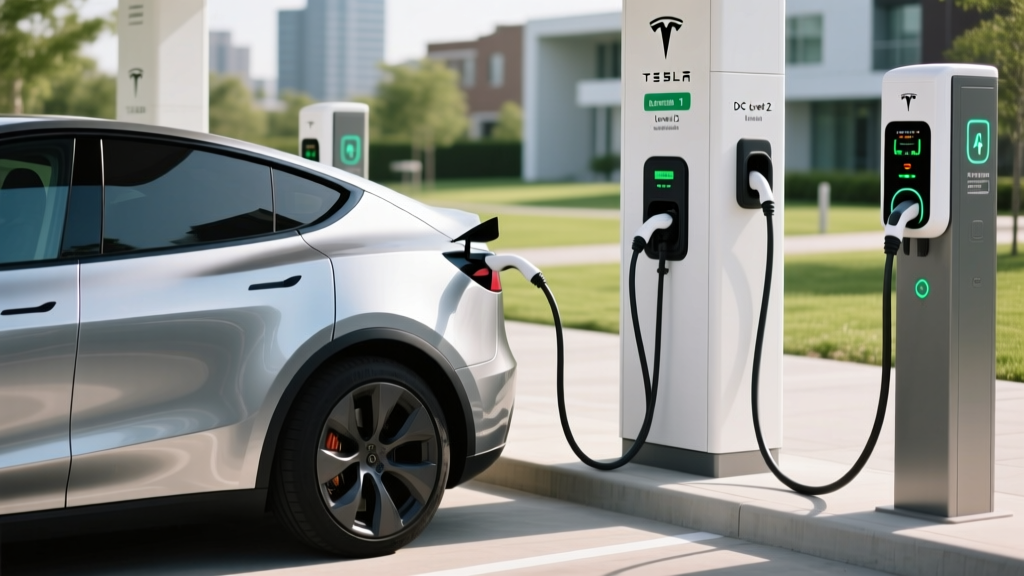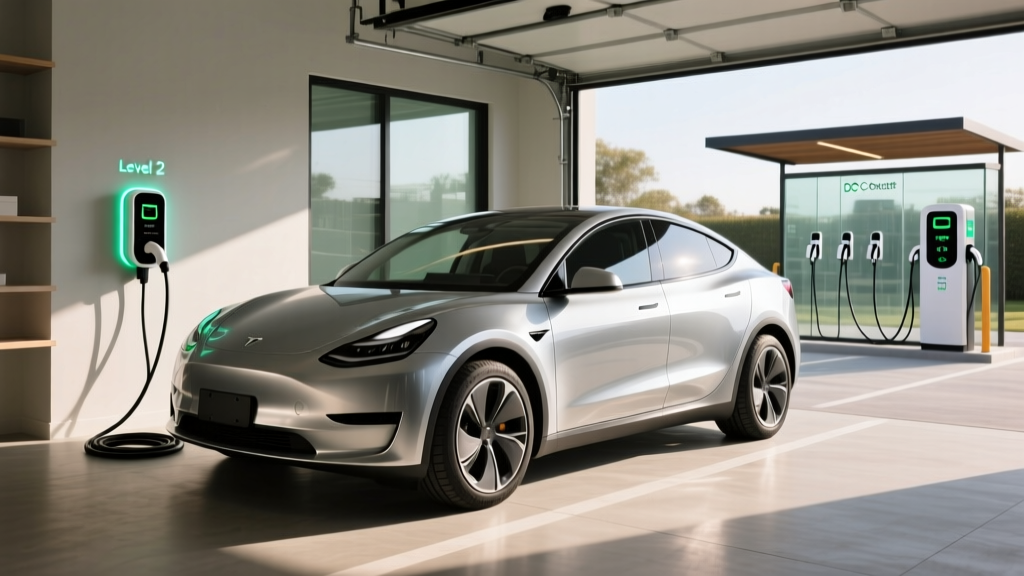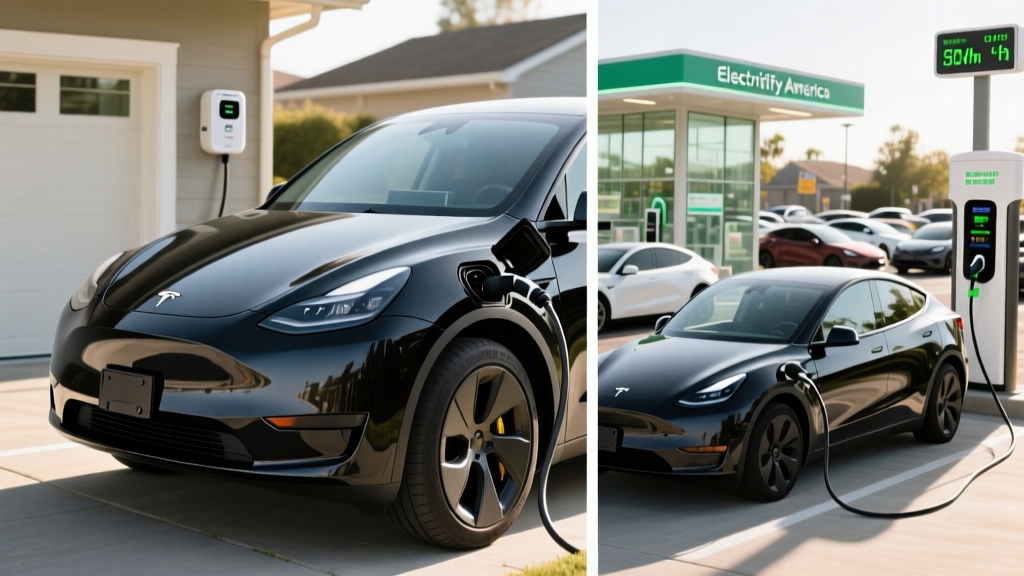
If you own or are shopping for a 2021 Tesla Model Y Long Range AWD, understanding your charging options is the single biggest factor in daily satisfaction. The Model Y Long Range AWD from 2021 ships with a 75 kWh (usable) NMC battery pack, an EPA-estimated 326 miles of range, and a peak DC fast-charge rate of 250 kW on V3 Superchargers. But those numbers only matter if you have the right charging setup at home and know what to expect on the road.
This guide breaks down every charging scenario for the 2021 Model Y Long Range AWD — from a standard 120V outlet to a hardwired Level 2 wall connector to Tesla's Supercharger network — with exact speeds, costs, and installation requirements.
Charging Levels Explained: How Fast Will Each Add Range?
EV charging is measured in kW (kilowatts), which represents the rate of power delivery. Your battery capacity is measured in kWh (kilowatt-hours), which represents total energy stored. Think of kW as the flow rate of a hose and kWh as the size of the bucket. Here's how each level performs with the 2021 Model Y Long Range AWD's 75 kWh pack:
| Level | Voltage / Amperage | Max Power (kW) | Miles of Range Added per Hour | 0–80% Time (approx.) |
|---|---|---|---|---|
| Level 1 (120V outlet) | 120V / 12A | ~1.4 kW | ~3–5 mi/hr | ~45–50 hours |
| Level 2 (240V home/public) | 240V / 48A | 11.5 kW | ~37–44 mi/hr | ~6–7 hours |
| DC Fast Charge (V3 Supercharger) | 400V+ DC | 250 kW (peak) | ~1,000+ mi/hr (peak) | 10–80% in ~27 min |
Real-world caveat: The 250 kW peak rate on a V3 Supercharger is sustained only between roughly 10–30% State of Charge (SoC). Above 50%, the charge curve tapers significantly — expect ~100 kW at 60% and ~40 kW above 85%. This is why the 10–80% time is ~27 minutes, not the 15 minutes marketing sometimes implies. Cold battery temperatures will also reduce peak charge rates; preconditioning via the Tesla app or navigation-routed Supercharger stops is essential in winter.
Home Charging Installation: Requirements, Costs & Panel Upgrades
For daily ownership, Level 2 home charging is the standard. The Tesla Gen 3 Wall Connector delivers up to 11.5 kW (48A) on a 60A dedicated circuit and is the natural pairing for a 2021 Model Y Long Range AWD. But installation involves more than hanging a unit on the wall.
Electrical Requirements
- Circuit: 60A dedicated breaker for a 48A continuous charge rate (National Electrical Code requires circuits rated at 125% of continuous load)
- Voltage: 240V (same as a dryer or oven outlet)
- Wire gauge: 6 AWG copper (THHN in conduit or NM-B depending on local code)
- Alternative: A 50A circuit / 40A charge rate (9.6 kW) is acceptable if panel capacity is limited — adds ~30 mi/hr, still adequate for overnight charging
Do You Need a Panel Upgrade?
If your home has a 100A electrical service panel that is already near capacity (common in homes built before 1990), adding a 60A EV circuit may require a panel upgrade to 200A. This is the single biggest variable in installation cost. Signs you may need an upgrade:
- Your panel is 100A or less
- You already run high-draw appliances (electric oven, dryer, HVAC, tankless water heater) simultaneously
- An electrician's load calculation shows you'd exceed 80% of panel capacity
Installation Cost Breakdown
| Component | Simple Install (panel nearby, no upgrade) | Complex Install (long wire run or panel upgrade) |
|---|---|---|
| EVSE equipment (Tesla Wall Connector) | $450 | $450 |
| Electrician labor (2–4 hrs simple; 6–12 hrs complex) | $400–$800 | $1,200–$2,500 |
| Materials (wire, conduit, breaker) | $100–$300 | $300–$600 |
| Permit & inspection | $50–$150 | $50–$200 |
| Panel upgrade to 200A (if needed) | N/A | $1,500–$3,500 |
| Total estimated cost | $1,000–$1,700 | $3,500–$7,250 |
The federal §30C Alternative Fuel Vehicle Refueling Property Credit covers up to 30% of home charger equipment and installation costs (capped at $1,000), subject to census-tract eligibility. Check IRS guidance and consult a tax professional for your specific situation.
Connector Compatibility: NACS, CCS, and Adapters for the 2021 Model Y
The 2021 Tesla Model Y Long Range AWD was built with Tesla's proprietary connector — now formally standardized as NACS (North American Charging Standard). This is a significant advantage in 2026, as NACS has become the dominant connector across nearly all new EVs sold in North America.
| Connector Type | Native Compatibility? | Adapter Needed? | Network Access |
|---|---|---|---|
| NACS (Tesla) | Yes — native port | None | Tesla Supercharger network, Destination Chargers |
| CCS1 | No | Tesla CCS Adapter (included with newer vehicles, ~$175 retrofit) | Electrify America, EVgo, ChargePoint DC stations |
| CHAdeMO | No | Aftermarket (Setec, ~$300–$400) | Limited; mostly legacy Nissan Leaf infrastructure |
| J1772 (Level 2 public) | No | Tesla J1772 Adapter (included with vehicle) | Public Level 2 stations, hotels, workplaces |
Practical advice: The Tesla Supercharger network remains the most reliable DC fast-charging option, with over 6,000 V3/V4 stalls across the US. The CCS adapter is worth carrying for redundancy on long trips through areas with sparse Supercharger coverage. Always verify adapter firmware compatibility with your 2021 Model Y's software version.
Cost to Charge: Home vs. Public vs. Gas Comparison
One of the strongest ownership arguments for the 2021 Model Y Long Range AWD is fuel cost. The EPA rates it at 122 MPGe combined, which translates to roughly 28 kWh per 100 miles in mixed driving. Here's what that costs in different scenarios:
| Scenario | Rate | Cost per 100 Miles | Cost per Mile |
|---|---|---|---|
| Home charging (off-peak utility rate) | $0.09/kWh | $2.52 | $0.025 |
| Home charging (national avg residential) | $0.16/kWh | $4.48 | $0.045 |
| Tesla Supercharger (avg 2026) | $0.32/kWh | $8.96 | $0.090 |
| Electrify America / public DCFC | $0.43/kWh | $12.04 | $0.120 |
| Gas SUV (25 MPG, $3.40/gal) | $3.40/gal | $13.60 | $0.136 |
At the national average residential electricity rate, charging the Model Y at home costs roughly one-third what a comparable gas SUV spends per mile. Even at Supercharger rates, the Model Y is cheaper per mile than a 25 MPG gas crossover. Over 15,000 miles per year, home charging saves approximately $1,200–$1,650 annually versus gasoline.
Pro tip: Many utilities offer time-of-use (TOU) plans with overnight rates as low as $0.06–$0.09/kWh. Scheduling your Model Y to charge between 12 AM and 5 AM via the Tesla app maximizes savings. According to fueleconomy.gov, the 2021 Model Y Long Range AWD's annual fuel cost is estimated at $600 based on 15,000 miles and national average electricity prices.
Recommended Home Charging Equipment for the Model Y
The 2021 Model Y Long Range AWD has an onboard charger rated at 11.5 kW (48A max). Any Level 2 EVSE delivering 48A or less will utilize the car's full AC charging capability. Here are top equipment options:
Tesla Gen 3 Wall Connector — Best Overall
- Power output: Up to 11.5 kW (48A)
- Connector: NACS (native Tesla)
- Cable length: 24 ft
- Smart features: Wi-Fi, OTA firmware updates, power sharing between two units, load management, Tesla app integration
- Price: ~$450
- Why it wins: Seamless integration with the Model Y, auto-authenticates on plug-in, and supports power sharing if you add a second EV later
ChargePoint Home Flex — Best Universal Option
- Power output: Up to 12 kW (50A), configurable down to 16A for limited panels
- Connector: J1772 (use included Tesla J1772 adapter) or NACS version available
- Cable length: 23 ft
- Smart features: Wi-Fi, ChargePoint app scheduling, Alexa integration, flexible amperage DIP-switch settings
- Price: ~$550–$650
- Why consider it: Adjustable amperage (16A–50A) is ideal if your panel can't support a full 60A circuit. Works with any EV via J1772 or NACS
Emporia Vue Level 2 Charger — Best Budget Smart Charger
- Power output: Up to 11.5 kW (48A)
- Connector: J1772 or NACS
- Cable length: 24 ft
- Smart features: Wi-Fi, Emporia app, energy monitoring integration with Emporia Vue home energy panel
- Price: ~$350–$400
- Why consider it: Lowest-cost smart charger with full 48A output; ideal if you already use Emporia's energy monitoring system
Safety, Electrical Code & Outdoor Installation Considerations
EV charging is a high-draw, continuous electrical load. Cutting corners on installation creates fire risk and may void your homeowner's insurance. Key safety requirements:
- Dedicated circuit: Your Level 2 charger must be on its own dedicated breaker — never share a circuit with other appliances
- GFCI protection: NEC 2020 and later require GFCI protection for all EVSE installations. Hardwired units like the Tesla Wall Connector have built-in GFCI; plug-in units require a GFCI breaker
- Outdoor rating: The Tesla Wall Connector is NEMA 3R rated (suitable for outdoor installation). Ensure the mounting location protects the cable from direct ground contact and standing water
- Permit & inspection: Most jurisdictions require an electrical permit for EVSE installation. Skipping the permit risks code violations and insurance claim denials. Budget $50–$200 for the permit and a final inspection
- Hardwired vs. plug-in: Hardwired installations (no plug) are preferred for 48A+ chargers because NEMA 14-50 receptacles are rated for intermittent, not continuous, use. If you use a 14-50 outlet, have the electrician install an industrial-grade receptacle (Hubbell or Bryant) and torque all connections to spec
DC Fast Charging on the Road: Supercharger Tips for the 2021 Model Y
The 2021 Model Y Long Range AWD supports up to 250 kW on Tesla V3 Superchargers and up to ~170 kW on CCS stations (with adapter). To maximize charging speed on road trips:
- Precondition the battery: Navigate to a Supercharger via the car's built-in navigation. The Model Y will automatically begin warming the battery 15–30 minutes before arrival, enabling peak charge rates even in cold weather. Without preconditioning, a cold battery may peak at only 80–120 kW
- Charge between 10–80%: The charge curve tapers sharply above 80%. Charging from 80–100% can take as long as 10–80%. Plan stops around the 10–80% window for the fastest trip times
- V3 vs. V2 Superchargers: V3 stalls deliver up to 250 kW per stall with no power sharing. V2 stalls deliver up to 150 kW and share power between paired stalls (labeled A/B). Always choose an unpaired stall at V2 sites
- Real-world 10–80% time: Expect ~27 minutes at a V3 Supercharger with a preconditioned battery in moderate temperatures. In winter without preconditioning, expect 35–45 minutes
Frequently Asked Questions
How much does it cost to install a home EV charger for a 2021 Tesla Model Y?
A straightforward installation with a Tesla Wall Connector on an existing 200A panel typically costs $1,000–$1,700 (equipment + electrician + permit). If your home needs a panel upgrade to 200A, total costs can range from $3,500 to $7,250. Always get a load calculation from a licensed electrician before committing.
How fast will Level 2 charging add range to my Model Y Long Range AWD?
At the maximum 11.5 kW (48A), you'll add approximately 37–44 miles of range per hour. An overnight charge of 8 hours easily replenishes 250+ miles — more than enough for any daily commute. Level 1 (120V) adds only 3–5 miles per hour and is suitable only for emergency top-ups or very low-mileage drivers.
Which connector is compatible with the 2021 Model Y Long Range AWD?
The 2021 Model Y uses the NACS (Tesla) connector natively. It is directly compatible with all Tesla Superchargers and Destination Chargers. For CCS public charging networks (Electrify America, EVgo), you'll need the Tesla CCS adapter. A J1772 adapter (included with the vehicle) enables use of standard public Level 2 stations.
How much does charging cost per mile compared to gas?
At the national average residential electricity rate of ~$0.16/kWh, the 2021 Model Y Long Range AWD costs roughly $0.045 per mile to charge at home — about one-third the cost of a 25 MPG gas SUV at $3.40/gallon ($0.136/mile). Even at Supercharger rates (~$0.32/kWh), the Model Y costs ~$0.09/mile, still 34% cheaper than gasoline.
What electrical upgrades might I need for a home charger?
The most common upgrade is a panel capacity increase from 100A to 200A, needed when your existing panel can't accommodate a new 60A circuit alongside existing loads. Other potential upgrades include adding a sub-panel in the garage, upgrading service entrance wiring, or replacing an outdated fuse box with a modern breaker panel. A licensed electrician's load calculation (typically $100–$200) will determine your exact needs.
Is the 2021 Model Y Long Range AWD eligible for any federal tax credits?
The 2021 Model Y Long Range AWD is no longer eligible for the §30D new-vehicle tax credit as a new purchase (production has moved to refreshed model years). However, as a used EV, it may qualify for the Used Clean Vehicle Credit of up to $4,000 (30% of sale price, capped at $4,000) if purchased from a dealer for $25,000 or less, subject to buyer income limits ($75,000 single / $150,000 joint). Always verify current IRS rules and consult a tax professional.