The 2021 Tesla Model 3 Standard Range Plus remains one of the most popular used EVs on the market in 2026. With an EPA-rated 263 miles of range, a 50 kWh usable battery (LFP in later 2021 builds, NMC in earlier ones), and access to the Supercharger network, it's a practical daily driver. But owning one means understanding exactly how to charge it efficiently — at home, at work, and on road trips — without overpaying for equipment or electrical work you don't need.
This guide breaks down every charging scenario for the 2021 Model 3 SR+ with exact numbers: charge speeds in kW, real-world range added per hour, home installation costs with panel-upgrade realities, and what you'll actually spend per mile compared to a gas car.
The 2021 Model 3 SR+ Battery and Charging Specs at a Glance
Before plugging in anywhere, you need the baseline specs. The 2021 Standard Range Plus uses a ~50 kWh usable battery pack. Tesla's onboard AC charger accepts up to 11.5 kW (48A) on Level 2, and the car can peak at roughly 170 kW on a DC fast charger under ideal conditions.
| Spec | Value |
|---|---|
| Battery (usable) | ~50 kWh |
| Chemistry | NMC (early 2021) / LFP (late 2021 Fremont builds) |
| EPA Range | 263 miles |
| Real-World Range (highway, 70 mph) | ~220–240 miles |
| Cold-Weather Range (20°F) | ~185–210 miles |
| Max AC Charge (Level 2) | 11.5 kW (48A onboard) |
| Max DC Fast Charge | ~170 kW peak |
| DC 10–80% Time (ideal) | ~28–32 minutes |
| Connector | NACS (Tesla proprietary) |
| EPA Efficiency | 142 MPGe / 24 kWh/100mi |
Charging Levels Explained: How Fast Will Each Level Add Range?
There are three charging levels available to your Model 3 SR+. The key distinction is between kW (kilowatts — the rate of power delivery, like water pressure) and kWh (kilowatt-hours — the total energy delivered, like gallons of water). Your battery holds ~50 kWh of energy. A charger delivering 10 kW will take roughly 5 hours to fill it from empty.
| Level | Voltage | Max Power (kW) | Miles of Range Per Hour | Full Charge Time (0–100%) | Best For |
|---|---|---|---|---|---|
| Level 1 (120V outlet) | 120V | ~1.4 kW | ~5–6 mi/hr | ~35–40 hours | Emergency / overnight trickle |
| Level 2 (240V home/public) | 240V | 11.5 kW (car-limited) | ~44 mi/hr | ~4.5–5 hours | Daily home charging |
| DC Fast Charging | 400V+ | ~170 kW peak | ~200+ mi/hr (peak) | 10–80% in ~28 min | Road trips |
Level 1 uses a standard household 120V outlet with Tesla's Mobile Connector. At ~1.4 kW, you'll add about 5–6 miles of range per hour. If your daily commute is under 30 miles round-trip and you can plug in for 10+ hours overnight, Level 1 technically works — but it's painfully slow for anything beyond minimal use.
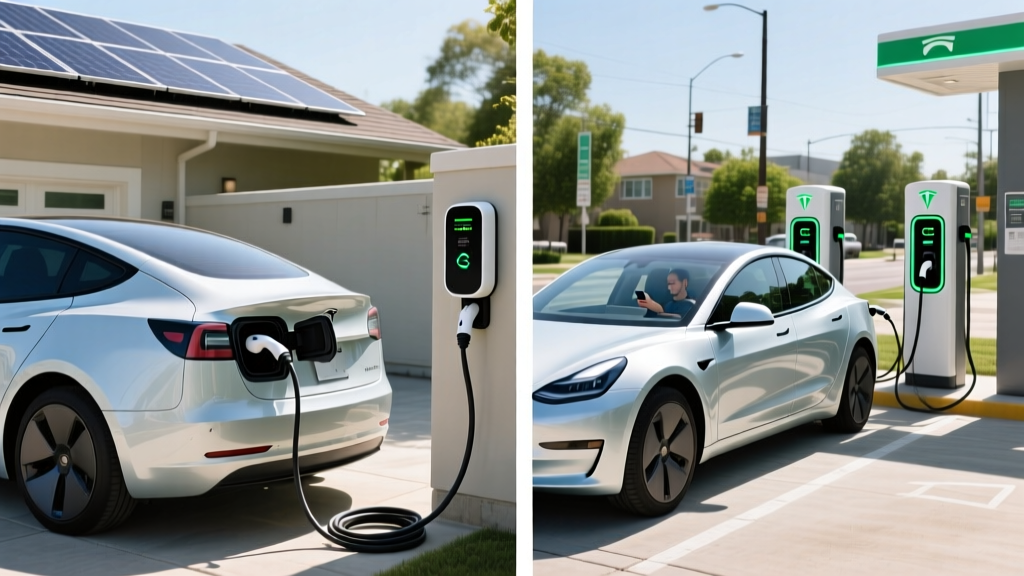
Level 2 is the standard for home charging. A 240V circuit (like a dryer outlet) delivers up to 11.5 kW into the Model 3 SR+, adding roughly 44 miles of range per hour. A full charge from near-empty takes about 4.5 to 5 hours. Most owners charge overnight and wake up to a full battery every morning.
DC Fast Charging bypasses the car's onboard charger and sends DC power directly to the battery. On a Tesla V3 Supercharger (250 kW capable), the Model 3 SR+ will peak around 170 kW — but that peak doesn't last. The charge curve tapers significantly above 50–60% state of charge (SoC). Expect the 10–80% session to take roughly 28–32 minutes at a V3 Supercharger. At a V2 Supercharger (150 kW), plan on 35–40 minutes for the same range.
Home Charger Installation: Electrical Requirements and Real Costs
Installing a Level 2 home charger for your 2021 Model 3 SR+ requires a dedicated 240V circuit. The most common setup is a 60-amp breaker feeding a 48-amp continuous load (the National Electrical Code requires circuits to be rated at 125% of continuous load). This delivers the car's maximum 11.5 kW AC charge rate.
Electrical requirements:
- 240V dedicated circuit
- 60-amp breaker (for 48A continuous charging)
- 6-gauge copper wire (or 4-gauge aluminum) for runs up to ~100 feet
- NACS (Tesla) connector — or a J1772 charger with a Tesla adapter
- GFCI protection required by NEC 2020+ for outdoor receptacles
Alternatively, a 50-amp breaker (40A continuous) delivers ~9.6 kW — still plenty for overnight charging, and may save on wire costs for longer runs.
Do You Need a Panel Upgrade?
This is where costs can jump significantly. If your home has a 100-amp main electrical panel (common in homes built before the 1990s), adding a 60-amp EV circuit may exceed your panel's capacity. A licensed electrician will perform a load calculation to determine available headroom. If you need a panel upgrade to 200 amps, expect to pay $1,500–$3,500 additional.
Homes with modern 200-amp panels usually have enough spare capacity for a 60-amp EV circuit without upgrades — but this depends on existing loads (electric range, dryer, HVAC, water heater).
| Component | Low Estimate | High Estimate | Notes |
|---|---|---|---|
| Level 2 Charger (hardware) | $350 | $700 | Tesla Wall Connector, ChargePoint, Emporia |
| Electrician labor (install) | $400 | $1,200 | Depends on run length, wall type, conduit |
| Electrical materials (wire, conduit, breaker) | $150 | $500 | Longer runs = more wire cost |
| Permit and inspection | $50 | $250 | Varies by municipality |
| Panel upgrade (if needed) | $1,500 | $3,500 | 100A → 200A service upgrade |
| Total (no panel upgrade) | $950 | $2,650 | Typical scenario for modern homes |
| Total (with panel upgrade) | $2,450 | $6,150 | Older homes with 100A panels |
The federal Residential Clean Energy Credit (IRC §25D) covers 30% of home EV charger equipment and installation costs (up to $1,000) through 2032. Some states and utilities offer additional rebates — check your local utility's EV program for specifics, as these vary by jurisdiction.
Connector Compatibility: NACS, CCS, and Adapter Options
The 2021 Tesla Model 3 Standard Range Plus was built with Tesla's proprietary connector, now formally designated as NACS (North American Charging Standard). In 2026, NACS has become the dominant connector in North America, adopted by Ford, GM, Rivian, Hyundai, and most other automakers.
| Connector Type | Native Support? | Adapter Needed? | Where You'll Find It |
|---|---|---|---|
| NACS (Tesla) | Yes — native | No | Tesla Superchargers, Destination Chargers, most new public stations |
| CCS1 | No | Tesla CCS Adapter (~$175) | Electrify America, EVgo, ChargePoint DC stations |
| CHAdeMO | No | Third-party adapter (~$300+) | Legacy Nissan Leaf stations — increasingly rare |
| J1772 (Level 2 public) | No | Tesla J1772 Adapter (included with car) | Public Level 2 stations, hotels, workplaces |
The CCS adapter matters for road trips. While Tesla's Supercharger network is extensive, Electrify America and other CCS-based networks fill coverage gaps — particularly in rural corridors and some urban areas. Tesla sells an official CCS adapter that enables charging at any CCS1-equipped DC fast station. At $175, it's a worthwhile glovebox addition for any Model 3 owner who road-trips regularly.
The J1772 adapter (for public Level 2 stations) ships with the car. If you bought your 2021 Model 3 SR+ used, verify it's included — replacements cost about $95 from Tesla.
Level 2 Home Charger Recommendations for the Model 3 SR+
Since the Model 3 SR+ accepts up to 11.5 kW (48A) on AC, you want a charger that can deliver at least 48A to take full advantage. Here are three proven options in 2026:
Tesla Wall Connector
- Power: Up to 11.5 kW (48A)
- Connector: NACS native — no adapter
- Cable length: 24 ft
- Smart features: Wi-Fi, OTA updates, power-sharing with 2nd unit, load management
- Price: ~$475
- Best for: Tesla-only households; cleanest integration
Emporia Vue Level 2 Charger
- Power: Up to 11.5 kW (48A)
- Connector: J1772 (Tesla adapter needed) or NACS version available
- Cable length: 24 ft
- Smart features: Energy monitoring, solar integration, scheduling, load management
- Price: ~$399
- Best for: Solar owners, mixed-EV households, budget-conscious buyers
ChargePoint Home Flex
- Power: Up to 12 kW (50A) — car limits to 11.5 kW
- Connector: J1772 (Tesla adapter needed) or NACS version
- Cable length: 23 ft
- Smart features: App scheduling, Alexa, amperage configurable via DIP switch
- Price: ~$699
- Best for: Multi-EV garages, future-proofing for non-Tesla vehicles
For a Tesla-only household, the Tesla Wall Connector is the obvious pick — native NACS, no adapter fumbling, and power-sharing lets you install two units on a single 60A circuit. If you have solar panels or want detailed energy tracking, the Emporia Vue is hard to beat at $399.
Cost to Charge: Per-Mile Economics vs. Gasoline
One of the strongest ownership arguments for the 2021 Model 3 SR+ is fuel cost. At 24 kWh per 100 miles (per EPA data on fueleconomy.gov), here's what charging actually costs in common scenarios:
| Scenario | $/kWh | Cost per 100 Miles | Cost per Mile |
|---|---|---|---|
| Home (off-peak utility rate) | $0.12 | $2.88 | $0.029 |
| Home (average US rate) | $0.17 | $4.08 | $0.041 |
| Home (high-cost state, e.g. CA) | $0.30 | $7.20 | $0.072 |
| Tesla Supercharger (average) | $0.32 | $7.68 | $0.077 |
| Electrify America / public DC | $0.43 | $10.32 | $0.103 |
| Gas equivalent (30 MPG, $3.40/gal) | — | $11.33 | $0.113 |
Bottom line: If you charge primarily at home on an average utility rate, the Model 3 SR+ costs roughly $0.03–$0.04 per mile — about one-third the cost of a 30-MPG gas car at $3.40/gallon. Even on Tesla Superchargers at $0.32/kWh, you're still saving versus gasoline. The only scenario where EV charging approaches gas costs is frequent use of expensive public DC fast chargers at $0.43+/kWh.
For the average driver covering 12,000 miles per year with 80% home charging at $0.15/kWh and 20% Supercharging at $0.32/kWh, annual "fuel" cost comes to approximately $538 — versus $1,360 for the equivalent gas car. That's roughly $822 in annual fuel savings.
Safety, Code Compliance, and Installation Best Practices
Home EV charging involves sustained high-current draw for hours at a time — more demanding than most household appliances. Cutting corners on installation creates fire risk. Here's what to insist on:
- Dedicated circuit: Your Level 2 charger must have its own dedicated breaker — never share a circuit with other appliances.
- Correct wire gauge: 6 AWG copper for 60A circuits. Undersized wire causes overheating.
- GFCI protection: NEC 2020 and later require GFCI protection for outdoor EV receptacles. Hardwired units (like the Tesla Wall Connector) may be exempt depending on local code — ask your electrician.
- Outdoor rating: If installing outside, the charger must carry a NEMA 4 or NEMA 4X rating for weather resistance. The Tesla Wall Connector and ChargePoint Home Flex both carry NEMA 4 ratings.
- Permit and inspection: Most jurisdictions require an electrical permit for a new 240V circuit. The inspection ensures the work meets code — don't skip this step. Unpermitted work can void homeowner's insurance claims.
- Load calculation: A licensed electrician should verify your panel can handle the added load before installation. This is non-negotiable for 100-amp panels.
Always hire a licensed electrician for the installation. Tesla's home charging page provides a certified installer finder, and many utilities maintain lists of EV-experienced electricians.
Frequently Asked Questions
How much does it cost to install a home charger for the 2021 Model 3 SR+?
Expect $950–$2,650 for a standard installation in a home with a modern 200-amp panel. This includes the charger ($350–$700), electrician labor ($400–$1,200), materials ($150–$500), and permit ($50–$250). If your home needs a panel upgrade from 100A to 200A, add $1,500–$3,500. The federal §25D credit covers 30% of the cost, up to $1,000.
Can I charge the 2021 Model 3 SR+ on a regular 120V outlet?
Yes, using Tesla's Mobile Connector with the 120V adapter. You'll get roughly 5–6 miles of range per hour at ~1.4 kW. This works for very short commutes (under 30 miles round-trip) if you can plug in for 10+ hours, but it's impractical as a primary charging method. A full charge from empty would take 35–40 hours.
Do I need the Tesla CCS adapter?
If you road-trip outside major corridors, yes. While the Supercharger network covers most interstate routes, CCS stations from Electrify America and EVgo fill important gaps. The Tesla CCS adapter costs ~$175 and fits in the glovebox. It enables charging at any CCS1 DC fast station at up to the car's ~170 kW peak rate.
How long does it take to charge from 10% to 80% on a Supercharger?
At a V3 Supercharger (250 kW capable), expect 28–32 minutes for a 10–80% session. The car peaks around 170 kW at low SoC, then tapers as the battery fills. At a V2 Supercharger (150 kW), plan on 35–40 minutes. Preconditioning the battery (navigating to the Supercharger in the car's nav system triggers this automatically) is critical for reaching peak charge speed — without it, your first several minutes of charging will be noticeably slower.
Should I charge my Model 3 SR+ to 100% every day?
It depends on your battery chemistry. The early 2021 Standard Range Plus uses NMC cells — Tesla recommends setting the daily charge limit to 80–90% and only charging to 100% when needed for a long trip. Late-2021 builds with LFP (lithium iron phosphate) batteries can and should be charged to 100% regularly — LFP chemistry benefits from periodic full charges for accurate battery management system calibration. Check your vehicle's charge settings screen to identify your battery type.
Is the 2021 Model 3 SR+ eligible for any tax credits in 2026?
The federal §30D new-vehicle credit no longer applies (it was for original purchasers when new). However, if you're buying this car used in 2026, the Used Clean Vehicle Credit (§25E) offers up to $4,000 (30% of sale price, capped at $4,000) if the sale price is $25,000 or less, your income falls below IRS thresholds ($75,000 single / $150,000 joint), and you purchase from a licensed dealer. The credit can be transferred to the dealer at point of sale for an immediate price reduction. Verify current eligibility on irs.gov and consult a tax professional for your specific situation.