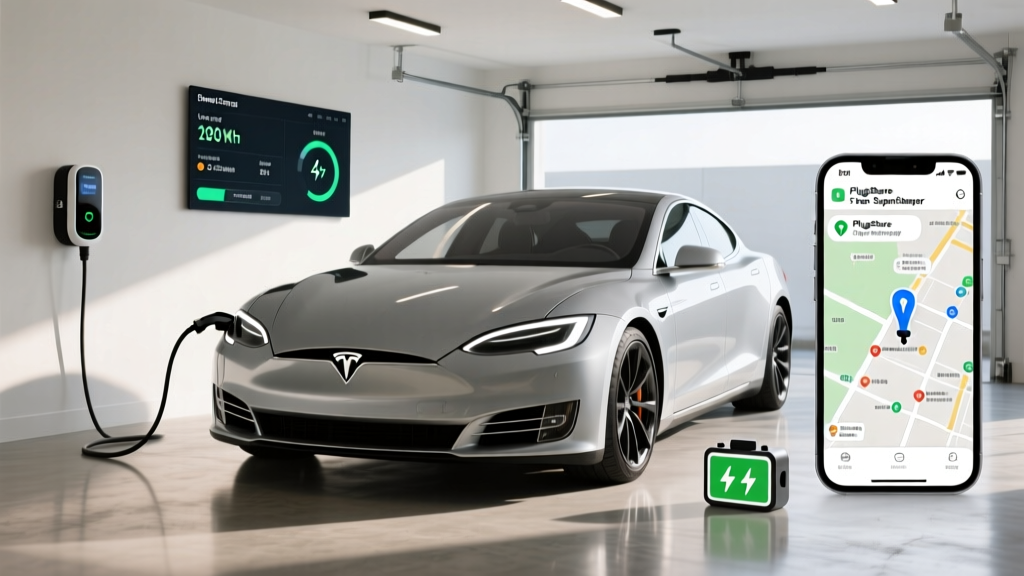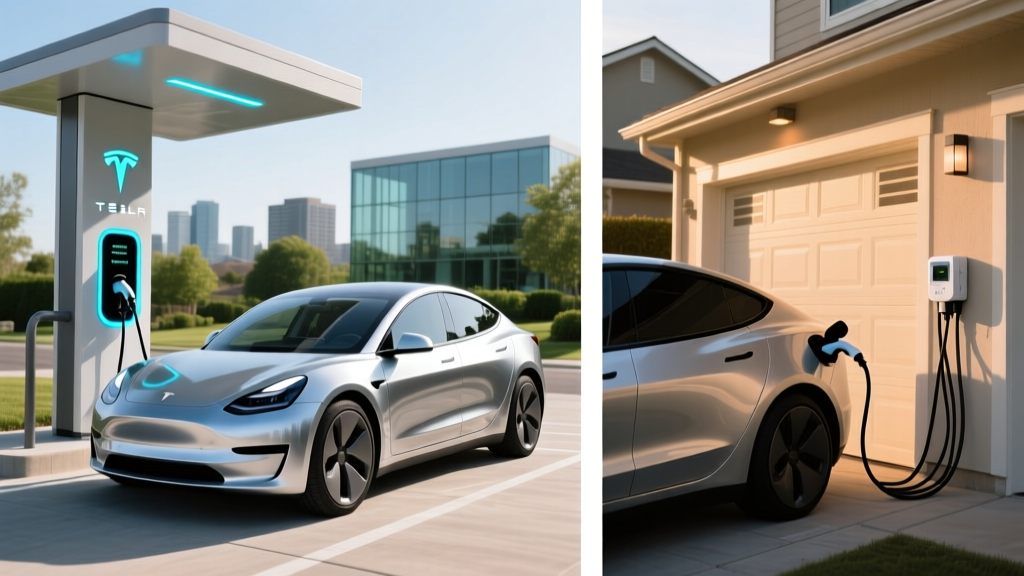
Charging Your 2021 Tesla Model 3 Standard Range Plus: What You Need to Know
The 2021 Tesla Model 3 Standard Range Plus (SR+) remains one of the most popular used EVs on the market in 2026, and for good reason: it delivers an EPA-estimated 263 miles of range from a ~50 kWh usable LFP (lithium iron phosphate) battery, paired with access to Tesla's Supercharger network. But whether you just bought one or are optimizing your daily charging routine, understanding exactly how fast it charges, what home installation costs, and how much you'll spend per mile is critical to ownership satisfaction.
This guide covers every charging scenario for the 2021 Model 3 SR+ — from Level 1 trickle charging to DC fast charging — with exact kW figures, installation costs, connector details, and real-world cost comparisons. We'll also clarify the single most common EV confusion: kW (kilowatts) measures power — the rate at which energy flows — while kWh (kilowatt-hours) measures energy — the total capacity of your battery. Think of kW as the width of a hose and kWh as the size of the bucket.
Charging Levels Explained: Speeds in kW and Miles Per Hour
The 2021 Model 3 SR+ supports three charging levels, each with vastly different speeds. Here's what to expect from each:
| Charging Level | Power (kW) | Voltage / Amperage | Miles of Range Added Per Hour | Typical Use Case |
|---|---|---|---|---|
| Level 1 (120V AC) | ~1.4 kW | 120V / 12A | ~5 miles/hr | Overnight top-up, emergency |
| Level 2 (240V AC) | 7.2 – 11.5 kW | 240V / 32–48A | ~30–44 miles/hr | Daily home charging |
| DC Fast Charging | Up to 170 kW (peak) | 400V DC | ~500+ miles/hr (peak) | Road trips, Superchargers |
A few real-world notes on these figures:
- Level 1 is painfully slow for the SR+. A full charge from 10% takes over 30 hours. It works only if you drive under 30 miles daily and can plug in every night.
- Level 2 at home is where most owners live. The 2021 Model 3 SR+ has an onboard charger rated for 32 amps (7.6 kW max on a 40A circuit). Tesla's Wall Connector on a 60A circuit can push 48A, but the SR+ will cap at its 32A onboard limit — so you'll see ~30–32 miles of range per hour of charging.
- DC fast charging on a V3 Supercharger peaks at 170 kW for the SR+ (the Long Range peaks higher at ~250 kW). Expect a 10–80% charge in approximately 25–30 minutes. Note that charging speed tapers significantly above 80% SoC — the battery management system reduces current to protect cell health. Charging from 80–100% can add another 20+ minutes.
Home Charger Installation: Electrical Requirements and Costs
Installing a Level 2 home charger for your 2021 Model 3 SR+ requires a dedicated 240V circuit. Here are the electrical specifics:
- Circuit requirement: 40A or 60A dedicated breaker (a 60A breaker supports the Tesla Wall Connector at its full 48A output; a 40A breaker limits you to 32A continuous, which matches the SR+'s onboard charger maximum anyway)
- Wire gauge: 6 AWG copper for 60A; 8 AWG for 40A
- Panel capacity: Your electrical panel must have room for the new double-pole breaker and sufficient total capacity (typically 200A service for modern homes)
- GFCI protection: Required by NEC 2020/2023 for EV charging circuits in most jurisdictions — the Tesla Wall Connector has built-in GFCI, which simplifies compliance
- Permit: Required in nearly all US jurisdictions; costs vary by locality
How Much Does It Cost to Install a Home EV Charger?
Installation costs vary enormously based on your home's electrical setup. Here's a realistic breakdown:
| Cost Component | Simple Install (panel nearby, no upgrade) | Complex Install (long wire run, subpanel) | Panel Upgrade Needed (100A → 200A) |
|---|---|---|---|
| Charger equipment (Tesla Wall Connector) | $475 | $475 | $475 |
| Electrician labor | $400–$800 | $1,000–$2,500 | $1,500–$3,000 |
| Electrical materials (wire, conduit, breaker) | $100–$300 | $300–$800 | $300–$800 |
| Permit and inspection | $50–$200 | $50–$200 | $50–$200 |
| Panel upgrade (if needed) | — | — | $2,000–$4,000 |
| Total estimated cost | $1,025–$1,775 | $1,825–$3,975 | $4,325–$8,475 |
Panel upgrade reality check: If your home has a 100A main panel — common in houses built before 2000 — you'll likely need a service upgrade to 200A to safely add a 40A or 60A EV circuit alongside existing loads. This is the single biggest cost surprise for new EV owners. Get a licensed electrician to do a load calculation before committing to a charger purchase.
The IRS residential clean energy credit (IRC §25C) may cover up to 30% of charger equipment and installation costs (up to $1,000) through 2032, though eligibility depends on your tax situation — consult a tax professional. Note this is different from the §30D vehicle purchase credit.
Connector Compatibility: NACS, CCS, and Adapter Needs
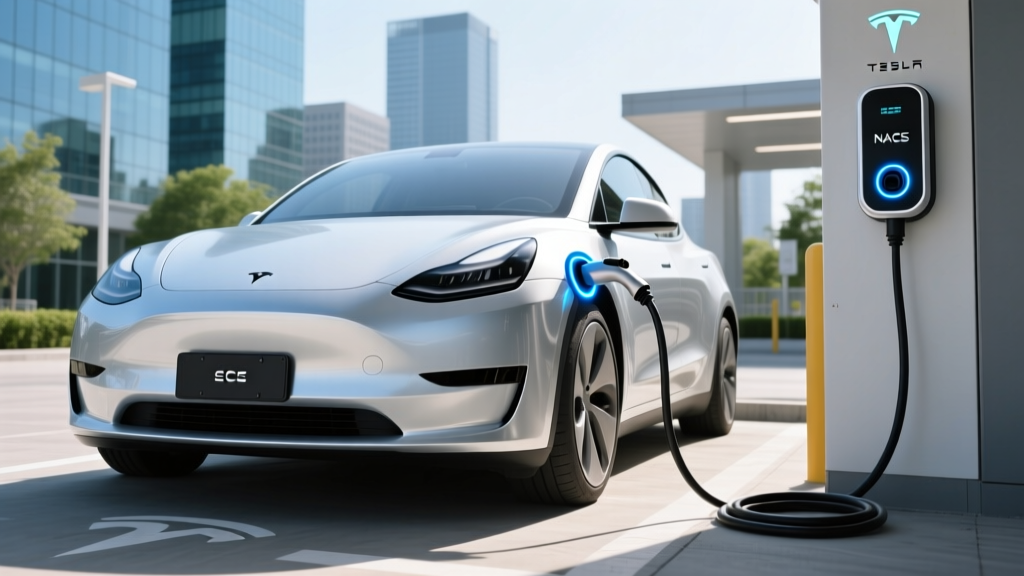
The 2021 Tesla Model 3 SR+ was built with Tesla's proprietary connector, which as of 2024 has been formally adopted as the NACS (North American Charging Standard). Here's what this means for charging compatibility:
| Connector Type | Native Compatibility | Adapter Required? | Notes for 2021 Model 3 SR+ |
|---|---|---|---|
| NACS (Tesla) | Yes — native | No | Used for all Supercharging and Tesla Wall Connector home charging |
| CCS1 | No | Yes — Tesla CCS Adapter (~$175–$250) | Required for Electrify America, EVgo, and most non-Tesla DC fast chargers |
| CHAdeMO | No | Yes — but adapters are rare/discontinued | CHAdeMO infrastructure is declining; not worth investing in |
| J1772 (Level 2 public) | Yes — Tesla includes a J1772 adapter | Included with vehicle | Works at ChargePoint, public Level 2 stations, workplaces |
Practical advice: Your 2021 Model 3 SR+ should have come with a Tesla Mobile Connector and a J1772 adapter. For road trips beyond the Supercharger network, purchase the official Tesla CCS adapter. As of 2026, most non-Tesla DC fast chargers in the US use CCS1 connectors, and the Tesla Supercharger network has opened to non-Tesla EVs — but your Tesla still needs the CCS adapter to use non-Tesla chargers.
Charging Cost Per Mile: Home vs. Public vs. Gas
One of the strongest ownership arguments for the Model 3 SR+ is fuel cost savings. Here's how charging costs break down across scenarios, using the SR+'s EPA efficiency of approximately 26 kWh/100 miles (or ~3.85 miles/kWh):
| Charging Scenario | Typical $/kWh | Cost Per Mile | Cost for 263-Mile Full "Tank" |
|---|---|---|---|
| Home (off-peak utility rate) | $0.08–$0.14 | $0.02–$0.04 | $5.28–$9.52 |
| Home (national avg. residential) | $0.17 | $0.04 | $11.48 |
| Tesla Supercharger V3 (avg.) | $0.25–$0.35 | $0.07–$0.09 | $17.10–$23.70 |
| Non-Tesla DC fast charger | $0.30–$0.48 | $0.08–$0.12 | $20.50–$32.50 |
| Gas car (28 MPG, $3.40/gal) | — | $0.12 | $31.94 |
Key takeaway: Charging at home on off-peak rates, the 2021 Model 3 SR+ costs roughly 2–4 cents per mile — about one-third to one-quarter the cost of a comparable gas vehicle. Even at Supercharger rates, you're typically saving versus gas. However, relying exclusively on expensive public DC fast chargers ($0.40+/kWh) can erode those savings to near parity with gasoline. Home charging access is the economic linchpin of EV ownership.
For time-of-use (TOU) utility plans, schedule charging between 10 PM and 6 AM to capture the lowest rates. The Tesla app lets you set scheduled charging natively.
DC Fast Charging Times: 10–80% and the Charge Curve Reality
The 2021 Model 3 SR+ with its LFP battery can accept up to 170 kW peak on a V3 Supercharger. But peak rate is not sustained rate — understanding the charge curve is essential for trip planning.
- 10–80% on V3 Supercharger (250 kW stall): ~25–30 minutes (vehicle caps at 170 kW)
- 10–80% on V2 Supercharger (150 kW stall): ~35–40 minutes
- 10–80% on 50 kW CHAdeMO/CCS (with adapter): ~55–65 minutes
- Full Level 2 charge (10–100%, 7.6 kW): ~6.5 hours
Note: LFP batteries can be charged to 100% regularly without the degradation concerns of NMC chemistries. Tesla recommends periodic 100% charges for LFP to allow accurate battery calibration.
The charge curve tapers are significant: the SR+ will pull close to 170 kW from roughly 10–30% SoC, then step down to ~120 kW through 50%, ~80 kW through 70%, and ~40 kW from 80–90%. This is why DC fast charging to 100% at a road-trip stop rarely makes sense — the last 20% can take as long as the first 60%. Plan to charge to 80% and drive.
In cold weather (below 32°F / 0°C), expect charge rates to be 20–40% slower unless the battery is preconditioned. Navigate to a Supercharger using the car's built-in navigation and it will automatically precondition the battery — warming it to optimal temperature for faster charging. Always use this feature in winter.
Recommended Home Charging Equipment for the Model 3 SR+
Given the SR+'s 32A onboard charger limit, you don't need the most powerful charger on the market — but investing in quality equipment pays off in reliability and safety. Here are three recommended options:
Tesla Wall Connector (Best Overall)
- Power output: Up to 11.5 kW (48A on 60A circuit) — SR+ will use 7.6 kW (32A)
- Connector: NACS native — no adapter needed
- Cable length: 18 ft or 24 ft options
- Smart features: Wi-Fi connected, OTA updates, power sharing between two units, Tesla app integration, built-in GFCI
- Price: ~$475
- Why it's our pick: Seamless integration, no adapter friction, future-proof for a higher-power EV later
ChargePoint Home Flex (Best Universal)
- Power output: Up to 12 kW (50A on 60A circuit) — configurable from 16A to 50A
- Connector: J1772 native; use Tesla's included J1772 adapter
- Cable length: 23 ft
- Smart features: Wi-Fi, ChargePoint app scheduling, Alexa integration, amperage adjustable via app, NEMA 14-50 plug option (portable)
- Price: ~$550–$650
- Why consider it: Works with any EV (not just Tesla), excellent app, flexible amperage for older panels
Emporia Vue Level 2 Charger (Budget Smart Pick)
- Power output: Up to 11.5 kW (48A on 60A circuit)
- Connector: J1772; Tesla adapter required
- Cable length: 24 ft
- Smart features: Wi-Fi, Emporia app, energy monitoring, solar integration, scheduling
- Price: ~$350–$400
- Why consider it: Lowest-cost smart charger with energy monitoring; great if you have solar panels
Safety note: Whichever charger you choose, ensure it is UL-listed (or ETL-listed to UL standards). Hardwired installations are preferred over NEMA 14-50 receptacle plugs for daily charging — a hardwired connection eliminates the receptacle as a potential point of heat buildup and failure. If you use a 14-50 receptacle, have your electrician install an industrial-grade outlet (Hubbell or Bryant) rather than a residential-grade one from a big-box store.
Safety and Electrical Code Considerations
EV charging draws sustained high current for hours — unlike any other household appliance. This makes proper installation non-negotiable:
- Dedicated circuit: Your EV charger must be on its own dedicated breaker — never shared with other appliances.
- Continuous load rule: The NEC requires EV chargers to be sized at 125% of continuous draw. A 32A charger needs a 40A breaker; a 48A charger needs a 60A breaker.
- GFCI protection: NEC 2020 and later requires GFCI for EV charging outlets. Hardwired chargers with built-in GFCI (like the Tesla Wall Connector) satisfy this without a separate GFCI breaker.
- Outdoor rating: If installing outdoors, ensure the charger carries a NEMA 4 (watertight) or IP65+ rating. The Tesla Wall Connector is rated for outdoor use.
- Permit and inspection: Always pull a permit. An uninspected EV charging install may void your homeowner's insurance in the event of an electrical fire.
- Load calculation: A licensed electrician should perform a NEC Article 220 load calculation to confirm your panel can handle the added circuit — especially critical in homes with electric ranges, dryers, or HVAC on the same panel.
Frequently Asked Questions
Can I charge my 2021 Model 3 Standard Range Plus to 100% every day?
Yes. Unlike NMC batteries (used in the Long Range and Performance trims), the SR+ uses an LFP battery that Tesla explicitly recommends charging to 100% at least once per week for accurate state-of-charge calibration. Daily 100% charging does not significantly accelerate LFP degradation. According to fueleconomy.gov, LFP batteries generally exhibit slower long-term degradation than NMC at high states of charge.
How much range does the 2021 Model 3 SR+ actually get in the real world?
The EPA rates it at 263 miles. In mixed real-world driving at moderate temperatures (60–80°F), expect 240–260 miles. On sustained highway driving at 75+ mph, expect 210–230 miles. In cold weather (below 30°F), range can drop to 180–210 miles due to cabin heating demands and reduced battery efficiency. Using seat heaters and preconditioning while plugged in mitigates cold-weather losses.
Is a 40A circuit enough, or do I need 60A for the SR+?
A 40A circuit (delivering 32A continuous) is perfectly matched to the 2021 SR+'s 32A onboard charger. You won't gain any charging speed from a 60A circuit with this specific vehicle. However, if you plan to own a future EV with a 48A or higher onboard charger, installing a 60A circuit now avoids a costly re-wire later — the incremental cost during initial installation is typically $100–$300 in wire and breaker upgrades.
Does the 2021 Model 3 SR+ qualify for any tax credits in 2026?
The IRS §30D clean vehicle credit applies only to new vehicle purchases, so it does not apply to a 2021 Model 3 bought used in 2026. However, the previously owned clean vehicle credit (§25E) may provide up to $4,000 or 30% of the sale price (whichever is less) if the used sale price is $25,000 or below, your income falls under the caps ($75K single / $150K joint), and you purchase from a licensed dealer. The home charger installation may qualify for the §25C energy efficient home improvement credit (30% of cost, up to $1,000). Always verify current rules with a tax professional.
What happens if my electrical panel doesn't have enough capacity?
If your electrician's load calculation shows insufficient capacity, you have three options: (1) upgrade your main panel from 100A to 200A ($2,000–$4,000), (2) install a lower-amperage charger (e.g., 16A/3.8 kW on a 20A circuit) that fits within existing capacity, or (3) use a smart panel load-management device like the Emporia VUE or Span smart panel that dynamically reduces charger draw when other household loads spike. Option 3 can avoid a full panel upgrade but adds $300–$500 in equipment cost.
For official efficiency and range data, refer to the EPA's fuel economy listing for the 2021 Tesla Model 3 Standard Range Plus. For current safety ratings, check NHTSA's crash test results, where the Model 3 earned a 5-star overall rating.