The 2021 Tesla Model 3 remains one of the most popular used EVs on the road, but its real-world usability hinges on how well you understand its charging ecosystem. Whether you own the Standard Range Plus (SR+), Long Range, or Performance variant, knowing exactly how many miles you can expect — and how quickly you can replenish the battery at home or on the road — is the difference between effortless daily driving and frustrating range compromises.
This guide breaks down the 2021 Tesla Model 3 range by trim, maps out every charging level with exact kW speeds and miles-per-hour gains, details home installation costs down to the permit fee, and compares charging cost per mile against gasoline. We'll also cover the NACS connector standard, recommend specific Level 2 chargers, and flag electrical panel upgrades that catch many buyers off guard.
2021 Tesla Model 3 Range: EPA vs. Real-World Expectations
The 2021 Model 3 was offered in three main configurations, each with a different battery size and EPA-rated range. Here's the official data from fueleconomy.gov, paired with what you should actually plan for in daily and highway driving:
| Trim | Battery (Usable kWh) | Chemistry | EPA Range | Real-World Highway | Cold Weather (20°F) | MPGe (Combined) |
|---|---|---|---|---|---|---|
| Standard Range Plus (RWD) | ~50 kWh | LFP (CATL) / NMC | 263 mi | 220–240 mi | 185–210 mi | 142 MPGe |
| Long Range (AWD) | ~75 kWh | NMC (Panasonic) | 353 mi | 290–320 mi | 240–270 mi | 134 MPGe |
| Performance (AWD) | ~75 kWh | NMC (Panasonic) | 315 mi | 260–290 mi | 215–245 mi | 123 MPGe |
Charging Levels Explained: Speeds in kW and Miles Per Hour
Before we get into equipment, let's nail down the single most important distinction in EV charging: kW (kilowatts) measures power — how fast energy flows. kWh (kilowatt-hours) measures energy — how much the battery holds. Think of kW as the width of a pipe and kWh as the size of the tank you're filling. Confusing them is the most common EV literacy mistake.
Here's how each charging level translates to real range added on a 2021 Model 3:
| Level | Voltage / Amperage | Max Power (kW) | Miles of Range Added Per Hour | Typical Use Case |
|---|---|---|---|---|
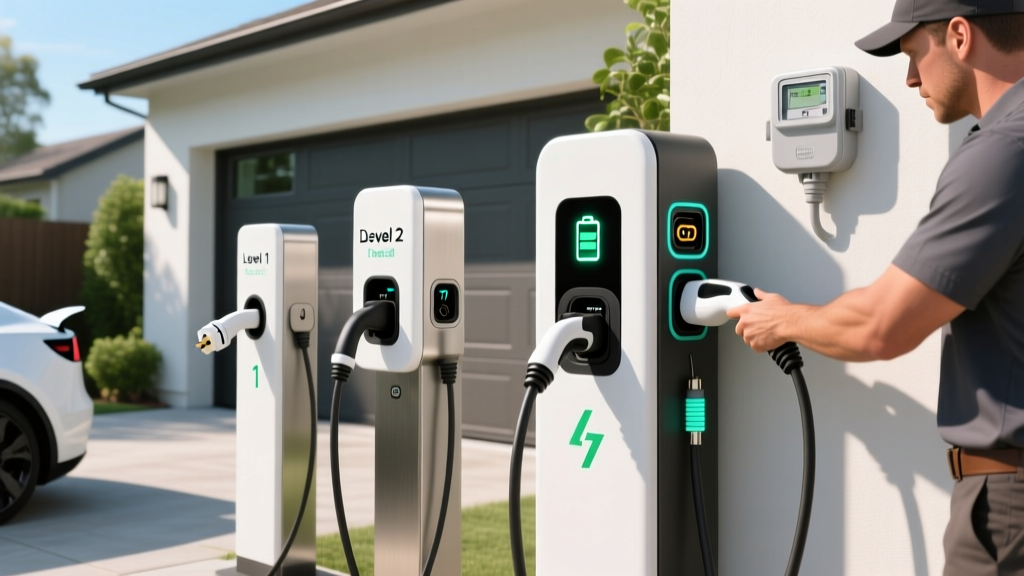
| Level 1 (120V) | 120V / 12A | ~1.4 kW | 3–5 mi/hr | Overnight trickle, emergency top-up |
| Level 2 (240V) | 240V / 32–48A | 7.7–11.5 kW | 25–44 mi/hr | Home daily charging, workplace |
| DC Fast Charging | 400V+ DC | Up to 250 kW (V3 Supercharger) | Up to ~1,000 mi/hr (peak) | Road trips, rapid replenishment |
The 2021 Model 3's onboard charger accepts up to 11.5 kW on Level 2 (48A at 240V). That means a full charge from 10% to 100% on a 48A home charger takes roughly 7–8 hours for the Long Range's 75 kWh battery — ideal for overnight charging. On DC fast charging, the Long Range and Performance can peak at 250 kW on Tesla V3 Superchargers, though that peak only holds for the first few minutes of the charge curve.
DC Fast Charging Times: 10–80% for the 2021 Model 3
Peak kW numbers grab headlines, but what matters on a road trip is the sustained charge rate and total 10–80% time. The Model 3's charge curve tapers significantly above 50% State of Charge (SoC) to protect battery health. Here are realistic numbers based on V3 Supercharger sessions:
| Trim | Battery Size | 10–50% Time | 10–80% Time | Avg. Sustained Rate (10–80%) |
|---|---|---|---|---|
| Standard Range Plus | ~50 kWh | ~12 min | ~25–28 min | ~95 kW |
| Long Range / Performance | ~75 kWh | ~15 min | ~28–32 min | ~110 kW |
Home Charger Installation: Electrical Requirements & Cost Breakdown
Installing a Level 2 home charger is the single biggest quality-of-life upgrade for any Model 3 owner. But costs vary wildly depending on your home's electrical panel, the distance from panel to charger location, and local permit requirements. Here's what you're actually looking at:
Electrical Requirements for Level 2 Charging
The 2021 Model 3 can accept up to 48A on Level 2, which requires a 60A dedicated circuit (EVSE must be rated at 80% of circuit capacity per NEC code — so 48A continuous draw needs a 60A breaker). If you opt for a 32A or 40A charger, you'll need a 40A or 50A circuit respectively.
- Voltage: 240V (same as a dryer or oven outlet)
- Amperage: 40A or 60A dedicated circuit recommended
- Wire gauge: 6 AWG copper for 48A; 8 AWG for 32A
- Circuit type: Dedicated — no sharing with other appliances
- GFCI protection: Required by NEC 2020+ for EV outlets in garages (some chargers have built-in GFCI)
Do You Need a Panel Upgrade?
Most homes built after 1990 have a 200A main panel, which usually has enough spare capacity for a 60A EV circuit. However, if your home has a 100A panel (common in pre-1980 construction), or if your panel is already near capacity with HVAC, electric range, dryer, and water heater loads, you may need a panel upgrade to 200A — or a smart load-management system that throttles the charger when other high-draw appliances run.
A licensed electrician should perform a load calculation (NEC Article 220) before installation. Don't skip this step — an overloaded panel is a fire hazard.
Installation Cost Breakdown
| Component | Simple Install (Panel nearby, no upgrade) | Complex Install (Long run, panel upgrade) |
|---|---|---|
| Level 2 EVSE Equipment | $400–$700 | $400–$700 |
| Electrician Labor (2–4 hrs simple / 6–10 hrs complex) | $300–$600 | $900–$2,000 |
| Electrical Permit | $50–$150 | $50–$200 |
| Panel Upgrade (100A → 200A, if needed) | N/A | $1,500–$3,500 |
| Conduit & Wiring Materials | $50–$150 | $200–$500 |
| Total Estimated Cost | $800–$1,600 | $3,050–$6,900 |
Federal tax credit note: The IRS §30C Alternative Fuel Vehicle Refueling Property Credit covers up to 30% of home charger equipment and installation costs (capped at $1,000), but only if you live in an eligible census tract. Check IRS guidance for current-year qualifying areas. This is separate from the §30D vehicle purchase credit.
Connector Compatibility: NACS, CCS, and Adapter Needs
The 2021 Tesla Model 3 uses Tesla's proprietary connector — which as of 2024 has been formally adopted as the North American Charging Standard (NACS) by SAE. This means the Model 3's native plug is now the industry standard in North America, and non-Tesla EVs are increasingly shipping with NACS ports.
Here's how connector compatibility breaks down for a 2021 Model 3 owner:
| Connector Type | Native on Model 3? | Where You'll Find It | Adapter Needed? |
|---|---|---|---|
| NACS (Tesla) | Yes — native | Tesla Superchargers, Tesla Destination Chargers, growing number of third-party stations | None |
| CCS1 | No | Electrify America, EVgo, most non-Tesla DC fast networks | Tesla CCS Adapter (~$175 from Tesla) |
| CHAdeMO | No | Legacy stations, mostly phased out | Third-party adapter (rare, expensive, not recommended) |
| J1772 (Level 2) | No | Public Level 2 stations (ChargePoint, Blink, etc.) | Tesla J1772 Adapter (included with Model 3) |
Cost to Charge: Home vs. Public vs. Gas Comparison
One of the strongest ownership arguments for the Model 3 is fuel cost savings. But the actual per-mile cost depends heavily on where and when you charge. Here's a realistic breakdown using national average electricity rates and the 2021 Model 3 Long Range's efficiency of approximately 26 kWh/100 miles (from EPA data):
| Scenario | Rate ($/kWh) | Cost for 100 Miles | Cost Per Mile |
|---|---|---|---|
| Home — Off-Peak TOU (e.g., overnight) | $0.08–$0.12 | $2.08–$3.12 | $0.02–$0.03 |
| Home — Standard Rate (no TOU plan) | $0.14–$0.18 | $3.64–$4.68 | $0.04–$0.05 |
| Public Level 2 (ChargePoint, etc.) | $0.20–$0.35 | $5.20–$9.10 | $0.05–$0.09 |
| Tesla Supercharger (V3) | $0.28–$0.40 | $7.28–$10.40 | $0.07–$0.10 |
| Electrify America (CCS adapter) | $0.35–$0.48 | $9.10–$12.48 | $0.09–$0.12 |
| Gas Car (28 MPG avg, $3.40/gal) | — | $12.14 | $0.12 |
The bottom line: Charging at home on a time-of-use (TOU) plan is dramatically cheaper than gasoline — roughly one-quarter to one-third the per-mile cost. Even DC fast charging at Superchargers is typically cheaper than gas, though the gap narrows on routes with high Supercharger pricing (California and Northeast corridors tend to be at the upper end). If you rely exclusively on public DC fast charging, your savings over gas shrink significantly — home charging access is the key economic advantage of EV ownership.
Recommended Level 2 Home Chargers for the Model 3
Since the 2021 Model 3 can accept up to 11.5 kW (48A), you'll want a charger that can deliver at least 40A to take meaningful advantage of the car's onboard charger. Here are three proven options across different price points:
Tesla Wall Connector
- Power Output: Up to 11.5 kW (48A)
- Connector: NACS (native Tesla)
- Cable Length: 24 ft
- Smart Features: Wi-Fi, OTA updates, power sharing between multiple units, load management
- Price: ~$475
- Best For: Tesla-only households wanting seamless integration
ChargePoint Home Flex
- Power Output: Up to 12 kW (50A, configurable down to 16A)
- Connector: J1772 (use Tesla's included J1772 adapter) or NACS plug option
- Cable Length: 23 ft
- Smart Features: Wi-Fi, app scheduling, Alexa integration, flexible amperage settings
- Price: ~$550–$650
- Best For: Multi-EV households (Tesla + non-Tesla)
Emporia Vue Level 2 Charger
- Power Output: Up to 11.5 kW (48A)
- Connector: J1772 (use Tesla adapter) or NACS option
- Cable Length: 24 ft
- Smart Features: Wi-Fi, app control, energy monitoring, solar integration, TOU scheduling
- Price: ~$350–$400
- Best For: Budget-conscious buyers wanting smart features and energy tracking
For a Tesla-only household, the Tesla Wall Connector is the obvious pick — native NACS plug means no adapter fumbling, and power sharing lets you install two units on a single 60A circuit if you add a second EV later. If you anticipate owning a non-Tesla EV (or already do), the ChargePoint Home Flex offers the most flexibility with its configurable amperage and universal connector options.
Safety, Code Compliance, and Installation Best Practices
EV charger installation is electrical work governed by the National Electrical Code (NEC) and local building codes. Cutting corners here risks fire, voided insurance, and failed home inspections. Key requirements:
- Dedicated circuit: Your Level 2 charger must have its own breaker — no shared circuits with laundry, HVAC, or kitchen appliances.
- GFCI protection: NEC 2020 and later requires ground-fault circuit interrupter protection for EV outlets in garages and outdoor locations. Many modern EVSEs (including the Tesla Wall Connector) have built-in GFCI, which may satisfy this requirement without a separate GFCI breaker.
- Outdoor rating: If installing outside, the EVSE must carry a NEMA 4 or NEMA 4X rating for weather resistance. All three chargers recommended above are outdoor-rated.
- Permit required: Virtually all jurisdictions require an electrical permit for EV charger installation. Your electrician should pull this — the fee is typically $50–$200 and includes a post-install inspection.
- Hardwired vs. plug: Chargers above 40A should be hardwired (no plug/receptacle) per NEC guidelines. The Tesla Wall Connector at 48A is hardwired. If you want a plug-in unit for portability, limit to 40A (NEMA 14-50 receptacle) or 32A (NEMA 14-30).
Frequently Asked Questions
How much does it cost to install a home EV charger for a 2021 Tesla Model 3?
A straightforward installation with a nearby 200A panel and short wire run typically costs $800–$1,600 total (equipment + electrician + permit). Complex installs requiring long conduit runs, subpanels, or a full panel upgrade from 100A to 200A can range from $3,000–$6,900. Always get a load calculation from a licensed electrician before committing.
How fast will each charging level add range to my Model 3?
Level 1 (120V) adds roughly 3–5 miles per hour — enough for overnight replenishment if your daily commute is under 30 miles. Level 2 (240V at 48A) adds approximately 44 miles per hour on the Long Range, fully recharging overnight. DC fast charging at a V3 Supercharger adds up to 175 miles in 15 minutes at peak rate, though the curve tapers significantly after 50% SoC.
Which connector and charger is compatible with my 2021 Model 3?
The 2021 Model 3 uses the NACS (Tesla) connector natively. This works directly at all Tesla Superchargers and Destination Chargers. For non-Tesla DC fast chargers (Electrify America, EVgo), you'll need Tesla's CCS adapter (~$175). For public Level 2 J1772 stations, the J1772-to-Tesla adapter is included with your car.
How much does charging cost per mile compared to gas?
Home charging on an off-peak rate costs roughly $0.02–$0.03 per mile, compared to $0.12 per mile for a 28 MPG gas car at $3.40/gallon — a savings of about 75%. Even at Supercharger rates ($0.07–$0.10/mile), you're still paying less than gas. The savings are largest when you charge at home and smallest when you rely exclusively on public DC fast charging.
What electrical upgrades might I need for a home charger?
If your home has a 200A main panel with available capacity, you likely need nothing beyond a new 60A breaker and wiring. If you have a 100A panel or your load calculation shows insufficient headroom, options include a panel upgrade to 200A ($1,500–$3,500), installing a lower-amperage charger (32A on a 40A circuit), or adding a smart load-management device like the Emporia Smart EV Charger or Tesla Wall Connector's built-in load sharing, which dynamically reduces charging power when other appliances draw heavily.