The 2021 Tesla Model 3 Performance: Range Reality Check
The 2021 Tesla Model 3 Performance carries an EPA-estimated 315 miles of range from its 82 kWh (usable ~79 kWh) NMC lithium-ion battery pack. That sticker number, however, doesn't tell the full story for owners planning road trips or daily commutes in 2026.
- EPA Combined: 315 miles
- Highway (70-75 mph, moderate weather): ~260–280 miles
- Cold Weather (below 32°F, highway): ~210–240 miles
- City / Stop-and-Go with Regen: ~295–310 miles
Source: fueleconomy.gov and owner-reported data.
The Model 3 Performance's dual-motor all-wheel-drive system produces 456 horsepower and hits 0-60 mph in approximately 3.1 seconds. Its efficiency rating sits around 113 MPGe combined (roughly 30 kWh/100mi). Those performance motors trade a small amount of efficiency versus the Long Range trim, which is why understanding your charging setup becomes critical to enjoying the car without compromise.
Whether you bought this car used in 2026 or have owned it since new, optimizing your home and public charging strategy is what separates a stress-free EV experience from one plagued by range management headaches. This guide walks through every charging level, the real costs of home installation, and the exact equipment that pairs best with the Model 3 Performance's onboard charger and DC fast-charging capabilities.
Charging Levels Explained: Speeds That Actually Matter
Before choosing equipment, you need to understand the three charging tiers and what they mean for your Model 3 Performance's 82 kWh pack. The critical distinction: kW (kilowatts) measures charging power — how fast energy flows. kWh (kilowatt-hours) measures energy capacity — the size of your battery. Think of kW as the flow rate of a hose and kWh as the size of the bucket.
| Level | Voltage / Amperage | Power (kW) | Miles of Range per Hour | 10–80% Time (82 kWh Pack) | Best Use Case |
|---|---|---|---|---|---|
| Level 1 (120V) | 120V / 12A | ~1.4 kW | 3–5 mi/hr | ~35–40 hours | Emergency top-ups, overnight trickle |
| Level 2 (240V) | 240V / 32–48A | 7.7–11.5 kW | 25–44 mi/hr | ~5.5–8 hours | Daily home charging, overnight full charge |
| DC Fast Charging | 400V+ DC | Up to 250 kW peak | ~200+ mi in 15 min | ~18–25 minutes | Road trips, rapid top-ups |
The 2021 Model 3 Performance has an 11.5 kW onboard charger for Level 2 AC charging, meaning even if you install a 48-amp (11.5 kW) wall connector, you'll max out at that rate. For DC fast charging, the car can peak at 250 kW on a V3 Tesla Supercharger, though the charge curve tapers significantly above 60% state of charge (SoC). Expect the 10–80% sprint to take roughly 18–22 minutes at a V3 stall, and closer to 25–30 minutes at older V2 (150 kW) Superchargers.
One ownership nuance: the Model 3 Performance's battery management system will precondition the pack when you navigate to a Supercharger, warming or cooling it to the optimal temperature for maximum charge acceptance. Skipping preconditioning — say, by driving to a charger without using the car's navigation — can add 5–10 minutes to your session, especially in cold weather.
Home Charger Installation: Costs, Electrical Requirements, and Gotchas
Most Model 3 Performance owners will want a Level 2 home charger. Here's what that actually requires and costs in 2026.
Electrical Requirements
The Tesla Wall Connector or any quality Level 2 EVSE (Electric Vehicle Supply Equipment) for the Model 3 Performance typically needs:
- Voltage: 240V dedicated circuit
- Amperage: 40A or 48A circuit (requires a 50A or 60A breaker, respectively, per NEC 80% continuous-load rule)
- Wire gauge: 6 AWG copper (for 50A) or 4 AWG copper (for 60A)
- Circuit: Dedicated — no sharing with other appliances
If your home's electrical panel is at or near capacity — common in homes built before 2000 with 100A or 150A main service — you may need a panel upgrade to 200A, which is a significant added cost. Some homeowners opt for a lower-amperage circuit (e.g., 32A / 40A breaker) to avoid a panel upgrade, which still delivers roughly 25–30 miles of range per hour — adequate for most overnight charging.
Installation Cost Breakdown
| Component | Typical Cost Range | Notes |
|---|---|---|
| Level 2 EVSE (charger hardware) | $400–$750 | Tesla Wall Connector ~$475; aftermarket options vary |
| Electrician labor (standard install) | $500–$1,500 | Depends on run length, wall type, conduit needs |
| Permit & inspection | $50–$250 | Required by most jurisdictions; varies by locality |
| Electrical panel upgrade (if needed) | $1,500–$3,500 | 200A service upgrade; not required in most newer homes |
| Total (no panel upgrade) | $950–$2,500 | Most common scenario |
| Total (with panel upgrade) | $2,450–$6,000 | Older homes with insufficient service |
Always hire a licensed electrician familiar with EVSE installations. The NEC (National Electrical Code) requires GFCI protection for outdoor outlets and specific breaker sizing for continuous loads. A proper install includes a dedicated breaker, correctly sized wiring, and a NEMA 14-50 outlet (if using a mobile connector) or hardwired connection (for the Tesla Wall Connector).
Federal Incentive for Home Charging Equipment
The IRS §30D-related Alternative Fuel Vehicle Refueling Property Credit (Form 8911) can cover up to 30% of home charger hardware and installation costs, capped at $1,000. Eligibility depends on your census tract meeting certain income or rural criteria. Consult a tax professional and see the latest guidance at irs.gov.
Connector Compatibility: NACS, CCS, and Adapters
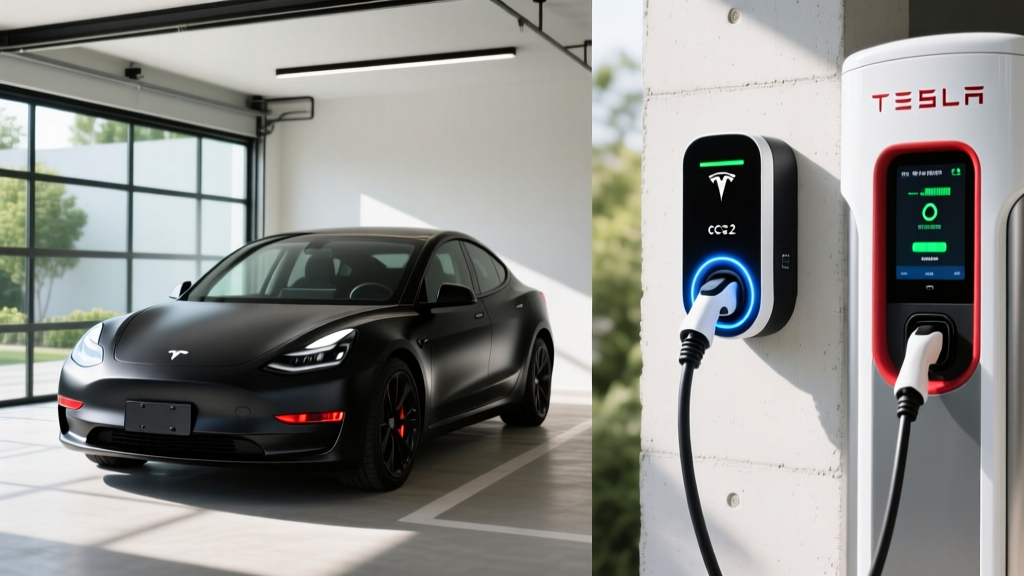
The 2021 Tesla Model 3 Performance was built with a proprietary Tesla connector (now standardized as NACS — North American Charging Standard). Here's what that means for your charging options in 2026:
| Connector Type | Native Compatibility | Adapter Required? | Where You'll Find It |
|---|---|---|---|
| NACS (Tesla) | Yes — native port | No | Tesla Superchargers, Tesla Destination Chargers, growing number of third-party stations |
| CCS1 | No | Yes — Tesla sells a CCS adapter (~$250) | Electrify America, EVgo, ChargePoint DC fast stations |
| CHAdeMO | No | Yes — third-party adapters (limited availability) | Legacy Nissan Leaf infrastructure; increasingly rare |
| J1772 (Level 2 AC) | No | Yes — Tesla includes a J1772 adapter with the car | Public Level 2 stations, hotels, workplaces |
In 2026, the charging landscape has shifted heavily toward NACS. Ford, GM, Rivian, Hyundai, and most other automakers have adopted the standard, meaning Tesla Supercharger stalls are increasingly shared. However, Tesla has opened its network, and you may encounter non-Tesla EVs at Superchargers. The CCS adapter remains valuable as a backup for Electrify America or other CCS-only DC fast chargers along certain highway corridors.
Charging Cost Per Mile: Home vs. Public vs. Gas
One of the strongest ownership arguments for the Model 3 Performance is fuel cost savings. Here's how the numbers break down in 2026:
| Charging Scenario | Typical $/kWh | Cost to Add 200 Miles | Cost Per Mile |
|---|---|---|---|
| Home (off-peak utility rate) | $0.08–$0.14 | $4.80–$8.40 | $0.024–$0.042 |
| Home (standard rate, no TOU plan) | $0.14–$0.20 | $8.40–$12.00 | $0.042–$0.060 |
| Tesla Supercharger (V3) | $0.28–$0.40 | $16.80–$24.00 | $0.084–$0.120 |
| Electrify America / third-party DC | $0.35–$0.55 | $21.00–$33.00 | $0.105–$0.165 |
| Gas Car (25 MPG, $3.50/gal) | — | $28.00 | $0.140 |
At the Model 3 Performance's efficiency of roughly 30 kWh per 100 miles (0.30 kWh/mi), home charging on an off-peak utility plan delivers fuel costs at about one-quarter to one-third the cost of a comparable gasoline sports sedan. Even regular Supercharging undercuts premium gasoline on a per-mile basis in most states.
Pro tip: many utilities offer Time-of-Use (TOU) plans with deeply discounted overnight rates (sometimes $0.05–$0.08/kWh between midnight and 6 AM). Scheduling your Model 3 to charge during these windows — easily done through the car's built-in charge scheduling feature — maximizes savings and often aligns with grid conditions where renewable energy penetration is highest.
Best Level 2 Chargers for the 2021 Model 3 Performance
Given the car's 11.5 kW onboard charger, you want a Level 2 EVSE that can deliver the full 48 amps to minimize overnight charge time. Here are top picks in 2026:
Tesla Wall Connector (Gen 3)
- Power Output: Up to 11.5 kW (48A)
- Connector: NACS (native Tesla)
- Cable Length: 24 ft
- Smart Features: Wi-Fi, OTA firmware updates, power sharing between multiple units, access control
- Price: ~$475
- Verdict: Best overall integration. No adapter needed, sleek design, and Tesla's load-sharing feature is ideal for homes with two EVs on a single circuit.
ChargePoint Home Flex (NACS version)
- Power Output: Up to 12 kW (50A, adjustable)
- Connector: NACS (available) or J1772 with adapter
- Cable Length: 23 ft
- Smart Features: Wi-Fi, app-based scheduling, Alexa integration, detailed energy reporting
- Price: ~$650–$700
- Verdict: Excellent app experience and flexible amperage settings. Good choice if you want granular energy tracking or plan to use the charger with a future non-Tesla EV.
Emporia Level 2 EV Charger
- Power Output: Up to 11.5 kW (48A)
- Connector: J1772 (use Tesla's included adapter) or NACS version
- Cable Length: 24 ft
- Smart Features: Wi-Fi, app scheduling, integrates with Emporia Vue energy monitor for solar-aware charging
- Price: ~$400–$500
- Verdict: Best value pick. If you have solar panels and an Emporia energy monitor, the solar-match charging feature is a genuine differentiator.
For hardwired installations (recommended for 48A+ circuits), all three chargers above support direct wiring. If you prefer a NEMA 14-50 outlet for portability, note that the NEC limits continuous draw on a 50A breaker to 40A (9.6 kW) — you'll lose roughly 2 kW of potential charge speed versus hardwiring.
Safety, Code, and Installation Best Practices
EV charging involves sustained high-current draw — more similar to running an electric furnace than plugging in a phone charger. Here's what your installation must address:
- Dedicated Circuit: Your EVSE must have its own breaker. Sharing a circuit with a dryer, oven, or HVAC system is a code violation and fire risk.
- GFCI Protection: Required for all outdoor receptacles and recommended for garage installations per NEC 2023 updates. Hardwired EVSEs typically include internal ground-fault protection.
- Outdoor Rating: If your charger mounts outside, it must carry a NEMA 4 or IP65 weatherproof rating. The Tesla Wall Connector and ChargePoint Home Flex both qualify.
- Wire Sizing: Undersized wiring causes voltage drop, overheating, and potential fire. A licensed electrician will calculate the correct gauge based on circuit length and amperage.
- Permit and Inspection: Most jurisdictions require an electrical permit for EVSE installation. Skipping this can void homeowner's insurance coverage in the event of an electrical fire.
- Cable Management: A 24-foot cable dragging on a garage floor degrades over time. Wall-mounted cable organizers or retractors extend cord life.
Frequently Asked Questions
How much does it cost to install a home EV charger for a 2021 Tesla Model 3 Performance?
Expect $950–$2,500 for a standard Level 2 installation (equipment, electrician labor, and permit) if your electrical panel has sufficient capacity. If you need a 200A panel upgrade — common in pre-2000 homes — total costs can reach $2,450–$6,000. The Tesla Wall Connector hardware itself costs ~$475.
How fast will each charging level add range to my Model 3 Performance?
Level 1 (120V) adds 3–5 miles per hour — impractical for daily use. Level 2 (240V, 48A) adds 38–44 miles per hour, fully replenishing the 82 kWh pack overnight in ~7–8 hours. DC fast charging at a V3 Supercharger (250 kW peak) can add 175+ miles in 15 minutes, with a 10–80% session taking roughly 18–22 minutes.
Which connector and charger is compatible with my 2021 Tesla Model 3 Performance?
Your car uses the NACS (Tesla) connector natively. It works directly with Tesla Wall Connectors, Superchargers, and Destination Chargers. For CCS-based public DC fast chargers (Electrify America, EVgo), you'll need Tesla's CCS adapter (~$250). The J1772 adapter for public Level 2 AC charging is included with the vehicle.
How much does charging cost per mile compared to gas?
Home charging on an off-peak utility plan costs roughly $0.024–$0.042 per mile. Supercharging runs $0.084–$0.12 per mile. A comparable 25 MPG gasoline sports sedan at $3.50/gallon costs $0.14 per mile. Even the most expensive public DC charging scenarios typically match or beat gasoline on a per-mile basis.
What electrical upgrades might I need for a home Level 2 charger?
You'll need a dedicated 240V circuit with a 50A or 60A breaker. If your home has a 100A or 150A main panel that's already near capacity, a 200A panel upgrade ($1,500–$3,500) may be necessary. Alternatively, you can install a lower-amperage circuit (32A / 40A breaker) that still provides ~25–30 miles of range per hour — sufficient for most overnight charging needs — while avoiding a panel upgrade.
Does the 2021 Model 3 Performance qualify for any EV tax credits in 2026?
The §30D federal tax credit applies to new EV purchases and has specific MSRP, buyer income, and battery-sourcing requirements. Since the 2021 Model 3 is no longer sold new, the credit doesn't apply to its original purchase. However, if you're buying one used in 2026, the Used Clean Vehicle Credit (§25E) offers up to $4,000 (30% of sale price, capped) for qualifying pre-owned EVs purchased from a dealer, subject to income limits ($75K single / $150K married filing jointly) and a $25,000 maximum sale price. Verify current rules at irs.gov.
How does cold weather affect the Model 3 Performance's range and charging speed?
In temperatures below 32°F, expect 20–30% range reduction (down to ~210–240 real-world highway miles from the 315-mile EPA figure). DC fast charging also slows in cold weather — a battery at 20°F may accept only 50–80 kW initially until the thermal management system warms it. Always precondition by navigating to a Supercharger through the car's built-in navigation, which activates battery heating 15–30 minutes before arrival.