The 2021 Porsche Taycan was the first production EV built on an 800-volt architecture, a decision that still defines its charging performance years later. But prospective owners and current drivers alike often search for the real story behind the 2021 Porsche Taycan range — how far it actually goes, how fast it charges at home and on the road, and what it takes to set up a proper Level 2 charging station in your garage. This guide covers all of it with exact numbers, real-world caveats, and installation cost breakdowns.
2021 Porsche Taycan Range and Efficiency by Trim
Porsche offered the 2021 Taycan in four main configurations, each with a different battery pack and EPA range rating. The Taycan uses an NMC (nickel manganese cobalt) lithium-ion battery with a gross capacity of either 79.2 kWh (Performance Battery) or 93.4 kWh (Performance Battery Plus). Usable capacity is approximately 71.0 kWh and 83.7 kWh respectively, as Porsche reserves a larger-than-average buffer to protect long-term battery health.
| Trim | Battery (Gross/Usable kWh) | EPA Range | MPGe (Combined) | 0-60 mph | HP (Overboost) |
|---|---|---|---|---|---|
| Taycan (RWD, 79.2 kWh) | 79.2 / 71.0 | 200 mi | 79 MPGe | 5.1 sec | 402 hp |
| Taycan (RWD, 93.4 kWh) | 93.4 / 83.7 | 225 mi | 84 MPGe | 5.1 sec | 469 hp |
| Taycan 4S | 93.4 / 83.7 | 227 mi | 84 MPGe | 3.8 sec | 562 hp |
| Taycan Turbo | 93.4 / 83.7 | 212 mi | 79 MPGe | 3.0 sec | 670 hp |
| Taycan Turbo S | 93.4 / 83.7 | 201 mi | 75 MPGe | 2.6 sec | 750 hp |
Source: fueleconomy.gov (EPA). Real-world range varies significantly based on driving style, temperature, and terrain.
Understanding EV Charging Levels: kW, kWh, and What They Mean
Before discussing Taycan charging specifics, it is essential to separate two terms that are constantly confused:
- kW (kilowatts) = power, or the rate at which energy flows. Think of it as the width of a hose. A 250 kW DC fast charger delivers energy much faster than a 7.2 kW Level 2 home unit.
- kWh (kilowatt-hours) = energy, or the total amount of electricity stored or delivered. The Taycan 4S has an 83.7 kWh usable battery — that's the "tank size."
Charging speed is measured in kW. Battery capacity is measured in kWh. They are never interchangeable.
| Level | Voltage | Max Power (kW) | Miles of Range Added per Hour | Typical Use Case |
|---|---|---|---|---|
| Level 1 | 120V AC | 1.0-1.4 kW | 3-5 mi/hr | Emergency/overnight trickle |
| Level 2 | 240V AC | 3.3-19.2 kW | 12-65 mi/hr | Home, workplace, public AC |
| DC Fast Charging | 400-800V DC | 50-350 kW | 150-800+ mi/hr (peak) | Highway travel, rapid top-ups |
2021 Taycan DC Fast Charging: The 800V Advantage
The Taycan's 800-volt architecture allows it to accept up to 270 kW peak DC fast charging at compatible stations — significantly higher than the 150 kW typical of 400V EVs from the same era. Here is what that translates to in real charging times:
| Charger Rating | Peak Power Accepted | 10-80% SoC Time | Range Added in 5 Minutes (Peak) |
|---|---|---|---|
| 350 kW station (800V) | ~270 kW | ~22 minutes | ~62 miles |
| 150 kW station (CCS) | ~130-150 kW | ~35-40 minutes | ~35 miles |
| 50 kW station (CCS) | 50 kW | ~80-90 minutes | ~12 miles |
The Taycan uses a CCS1 (Combined Charging System) connector for DC fast charging in North America. In 2026, the charging landscape has shifted heavily toward NACS (Tesla's connector standard), and many Electrify America and third-party networks now offer NACS cables alongside CCS. If you're buying a used 2021 Taycan today, you may need a CCS-to-NACS adapter to access Tesla Superchargers — Porsche has confirmed compatibility with approved adapters for DC charging.
Home Level 2 Charging Setup: What the Taycan Needs
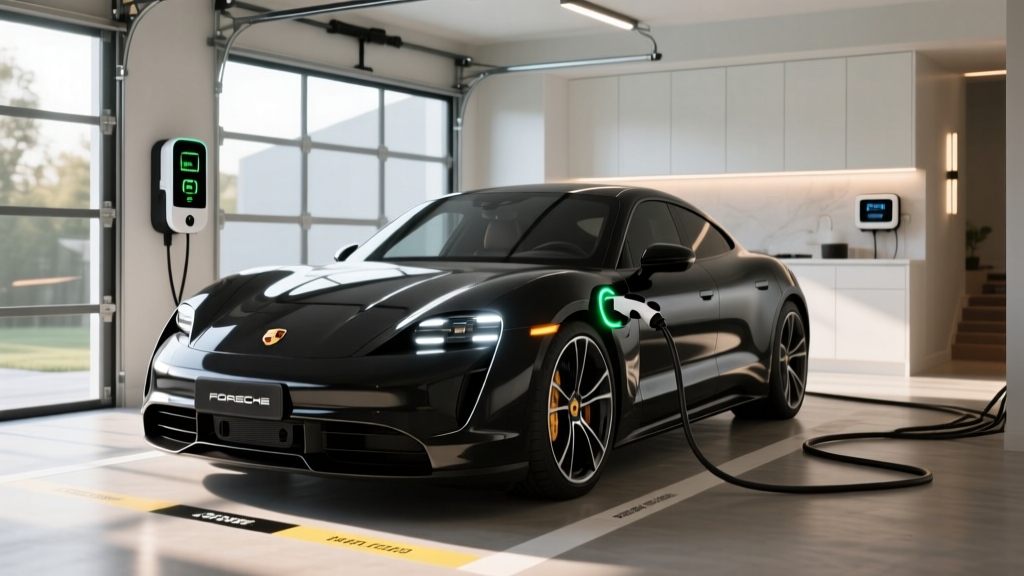
The 2021 Taycan's onboard AC charger accepts up to 9.6 kW on Level 2 (240V, 40 amps). An optional onboard charger upgrade to 19.2 kW / 80 amps was available from Porsche but is rare on used examples. For most owners, a 9.6 kW Level 2 home charger is the practical sweet spot.
At 9.6 kW, a fully depleted 93.4 kWh Taycan battery (83.7 kWh usable) will charge from 0-100% in approximately 9-10 hours. In practice, most owners plug in at 20-30% and wake up to a full battery every morning — roughly 6-7 hours of charging.
Electrical Requirements for a Taycan Home Charger
- Circuit: Dedicated 50-amp, 240V circuit (for a 40A continuous charger load; NEC requires circuits rated at 125% of continuous load)
- Wire gauge: 6 AWG copper (for runs up to ~50 feet; 4 AWG for longer runs)
- Breaker: 50-amp double-pole breaker in your main panel
- Panel capacity: Your electrical panel must have spare capacity. A 200-amp panel is standard for modern homes, but older homes with 100-amp service will likely need a panel upgrade
- Permit: Most jurisdictions require an electrical permit for new 240V circuit installation — your electrician pulls this
Home Charger Installation Cost Breakdown
| Item | Low Estimate | High Estimate | Notes |
|---|---|---|---|
| Level 2 Charger (Equipment) | $400 | $750 | Quality 40-48A smart charger |
| Electrician Labor (standard install) | $500 | $1,500 | Depends on panel-to-garage distance, wall type |
| Electrical Permit | $50 | $200 | Varies by municipality |
| Panel Upgrade (if needed) | $1,500 | $4,000 | 100A → 200A service upgrade; not always required |
| Total (no panel upgrade) | $950 | $2,450 | Most homes with 200A panels fall here |
| Total (with panel upgrade) | $2,450 | $6,450 | Older homes with 100A service |
Which Charger Should You Buy? Equipment Recommendations
The Taycan's CCS1 inlet (or NACS with adapter) and 9.6 kW onboard AC limit narrow the field. Here are proven Level 2 chargers suited to Taycan owners:
| Charger Model | Power Output | Connector | Cable Length | Smart Features | Approx. Price |
|---|---|---|---|---|---|
| ChargePoint Home Flex | Up to 12 kW (50A) | J1772 (CCS-compatible) | 23 ft | Wi-Fi, app scheduling, Alexa | $550-$650 |
| Emporia Vue Level 2 | Up to 11.5 kW (48A) | J1772 | 24 ft | Energy monitoring, app, solar integration | $400-$500 |
| Wallbox Pulsar Plus | Up to 11.5 kW (48A) | J1772 | 25 ft | Wi-Fi/Bluetooth, load balancing, compact | $450-$550 |
| Grizzl-E Smart | Up to 10 kW (40A) | J1772 | 24 ft | Smart app, adjustable amperage, rugged outdoor | $450-$550 |
| Porsche Mobile Charger Connect | Up to 9.6 kW (40A) | J1772 | 23 ft | OEM integration, touchscreen, NEMA 14-50 plug | $700-$900 (used/OEM) |
All of these chargers use the J1772 AC connector, which plugs directly into the Taycan's AC charging port. For DC fast charging on the road, the Taycan uses CCS1 — no home equipment is needed for DC.
Connector Compatibility Quick Reference
| Connector Type | Use | Taycan Compatible? | Notes |
|---|---|---|---|
| J1772 | Level 1 & 2 AC charging | Yes (native) | All home and public AC stations |
| CCS1 | DC fast charging | Yes (native) | Electrify America, EVgo, most public DC |
| NACS (Tesla) | DC fast charging / AC | With adapter | Required for Supercharger access; check Porsche adapter compatibility |
| CHAdeMO | DC fast charging | No | Largely discontinued in North America |
Charging Cost: Taycan vs. Gas per Mile
One of the strongest ownership arguments for the Taycan is fuel cost savings, though the exact number depends heavily on where and how you charge. The Taycan 4S averages roughly 30 kWh per 100 miles in real-world mixed driving (the EPA combined rating is approximately 35 kWh/100mi for the Turbo S, with the 4S slightly better).
| Scenario | Cost per kWh | Cost per 100 Miles | Cost per Mile |
|---|---|---|---|
| Home charging (off-peak utility rate) | $0.12/kWh | $3.60 | $0.036 |
| Home charging (average US rate) | $0.17/kWh | $5.10 | $0.051 |
| Public Level 2 (ChargePoint, etc.) | $0.25-$0.40/kWh | $7.50-$12.00 | $0.075-$0.12 |
| DC Fast Charging (Electrify America) | $0.35-$0.55/kWh | $10.50-$16.50 | $0.105-$0.165 |
| Gas equivalent (Porsche Panamera, 21 MPG, $3.50/gal) | — | $16.67 | $0.167 |
At home off-peak rates, the Taycan costs roughly one-fifth what a comparable gas Porsche costs per mile. Even at expensive DC fast charging rates, you're typically breaking even or slightly ahead of premium fuel costs. The key insight: home charging is where the economics win decisively. If you rely entirely on public DC fast charging, the cost advantage shrinks considerably.
Safety, Code, and Installation Best Practices
Installing a Level 2 charger is electrical work that must meet National Electrical Code (NEC) standards. Here is what matters for Taycan owners planning a home setup:
- Dedicated circuit: Your Level 2 charger must be on its own dedicated breaker — never shared with other appliances. A 50-amp breaker feeding a 40A charger is standard.
- GFCI protection: NEC 2020 and later requires GFCI (Ground Fault Circuit Interrupter) protection for EV charging outlets in garages. Hardwired chargers may have GFCI built into the unit; plug-in units via NEMA 14-50 outlets require a GFCI breaker.
- Outdoor rating: If your charger is mounted outside or in an exposed carport, ensure it carries an outdoor/NEMA 4 rating. The ChargePoint Home Flex, Wallbox Pulsar Plus, and Grizzl-E are all rated for outdoor use.
- NEMA 14-50 vs. hardwired: A NEMA 14-50 outlet gives you portability (take the charger when you move), but hardwired installations eliminate the GFCI breaker requirement at the panel (the charger's internal GFCI handles it) and can support higher amperage. Discuss with your electrician.
- Load calculation: A licensed electrician will perform a load calculation on your panel to ensure adding a 40-50A circuit doesn't exceed 80% of your panel's rated capacity. This is not optional — it's code and it prevents panel overloads.
2021 Taycan Battery Health and Long-Term Ownership
Porsche warrants the Taycan's high-voltage battery for 8 years or 100,000 miles, guaranteeing a minimum of 70% capacity retention over that period. Real-world degradation data from early 2020-2021 Taycan owners (as tracked by community databases and EV testing organizations) shows typical degradation of approximately 5-8% after 60,000 miles — well within warranty thresholds.
The Taycan's large buffer (roughly 8-10 kWh of the gross capacity is software-locked and inaccessible to the user) is a key reason degradation appears modest. Porsche engineered conservative charge limits to prioritize longevity over maximum range.
For long-term battery health:
- Set daily charging limit to 80-85% via the Porsche Communication Management (PCM) system or Mobile Charger Connect app
- Use the preconditioning feature before DC fast charging — the Taycan will warm the battery to optimal temperature, improving charge speed and reducing cell stress
- Avoid leaving the car at 100% SoC for extended periods (days); charge to 100% only when you need the full range for a trip
Frequently Asked Questions
How much does it cost to install a home EV charger for a Taycan?
Expect $950-$2,450 for a standard installation (charger + electrician + permit) if your home already has a 200-amp electrical panel with spare capacity. If you need a panel upgrade from 100A to 200A service, total costs can reach $2,450-$6,450. Always get an in-person quote from a licensed electrician.
How fast will each charging level add range to the Taycan?
Level 1 (120V): roughly 3-4 miles per hour — essentially useless for a Taycan's large battery except as emergency trickle. Level 2 (240V at 9.6 kW): approximately 30-35 miles of range per hour — fully recharges overnight. DC Fast Charging (at a 270 kW-capable station): up to 62 miles in 5 minutes at peak, with a 10-80% charge in about 22 minutes.
Which connector and charger is compatible with my 2021 Taycan?
For AC home and public Level 2 charging, the Taycan uses the J1772 connector (native). For DC fast charging, it uses CCS1 (native). To access Tesla Superchargers, you will need a CCS-to-NACS adapter — verify compatibility with Porsche's latest guidance. CHAdeMO is not supported.
How much does charging a Taycan cost per mile vs. gas?
Charging at home on off-peak electricity ($0.12/kWh) costs roughly $0.036 per mile. A comparable gas sports sedan like the Porsche Panamera at 21 MPG with $3.50/gallon premium costs about $0.167 per mile. Home charging is roughly 4-5x cheaper per mile. Public DC fast charging at $0.45/kWh brings the cost to roughly $0.135/mile — still a modest savings over gas.
What electrical upgrades might I need for a Taycan home charger?
The most common upgrade is a panel capacity increase. If your home has a 100-amp electrical panel, adding a 50-amp dedicated circuit for EV charging will likely exceed safe capacity, requiring a $1,500-$4,000 upgrade to 200-amp service. Homes with existing 200-amp panels usually have sufficient headroom. Other potential upgrades include running new conduit for long wire runs (garage far from the panel) or adding a sub-panel.
Does the 2021 Taycan qualify for any EV tax credits in 2026?
The federal §30D new EV tax credit does not apply to used vehicle purchases, but the used EV credit (up to $4,000 or 30% of the sale price, whichever is less) may apply if you buy a 2021 Taycan from a dealer in 2026. Income caps apply ($75,000 single / $150,000 joint filers), and the vehicle sale price must be $25,000 or less — which effectively excludes the Taycan given its used market pricing. Consult a tax professional and review current IRS used EV credit rules for your specific situation.