Quick Verdict: What 2021 Model 3 Long Range Owners Need to Know About Charging
The 2021 Tesla Model 3 Long Range remains one of the most efficient and capable electric sedans on the road. With an EPA-estimated 353 miles of range, an 82 kWh (usable ~79 kWh) NMC lithium-ion battery, and a peak DC fast-charge rate of 250 kW, it sets a high bar. But owning one means understanding exactly how to charge it — at home, on road trips, and at public stations — without overpaying or underperforming.
This guide covers every charging scenario a 2021 Model 3 Long Range owner will face: home Level 2 installation costs and electrical requirements, public DC fast-charging realities (including the charge-curve taper above 80%), connector compatibility now that NACS has become the industry standard, and the real cost-per-mile compared to gasoline. We'll also recommend specific Level 2 chargers that pair well with this car's 11.5 kW onboard charger.
The 2021 Model 3 Long Range carries an EPA range of 353 miles. In real-world highway driving at 70 mph, expect roughly 290–310 miles. In cold weather (below 30°F), range can drop to 250–280 miles due to battery resistance and cabin heating demands. Plan road-trip charging stops accordingly.
Charging Levels Explained: Speeds, kW, and Miles Per Hour
Before plugging in, it's critical to understand the difference between kW (kilowatts) and kWh (kilowatt-hours). kW measures power — how fast energy flows into the battery. kWh measures energy — how much the battery stores. The 2021 Model 3 Long Range's battery holds roughly 79 kWh of usable energy. A charger delivering 11 kW adds 11 kWh per hour, or about 44 miles of range per hour given the car's efficiency of roughly 4 miles per kWh.
| Level | Voltage / Amps | Power (kW) | Miles of Range / Hour | 0–100% Time |
|---|---|---|---|---|
| Level 1 (120V outlet) | 120V / 12A | ~1.4 kW | ~5 mi/hr | ~56 hours |
| Level 2 (240V home/public) | 240V / 48A | 11.5 kW (max onboard) | ~44 mi/hr | ~7 hours |
| DC Fast Charge | 400V architecture | Peak 250 kW | ~170 mi in 15 min | 10–80% in ~28 min |
Key detail on DC fast charging: The 250 kW peak rate only sustains from roughly 10% to 30% State of Charge (SoC). Above 50%, the charge curve tapers significantly — you'll see 100 kW or less. Above 80%, the car restricts charging to protect the NMC battery, dropping below 40 kW. This is why Tesla's navigation system routes you to arrive at Superchargers at low SoC and recommends charging only to 80% on road trips.
Home Level 2 Charger Installation: Electrical Requirements and Costs
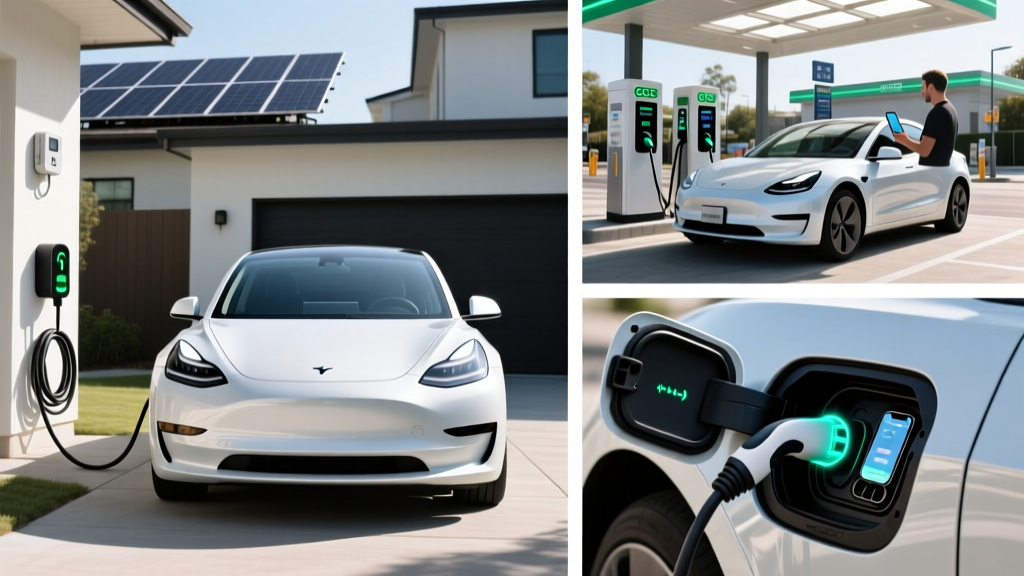
Most 2021 Model 3 Long Range owners will want a Level 2 home charger — it's the only practical way to fully recharge the 79 kWh battery overnight. The Model 3's onboard charger accepts up to 11.5 kW (48 amps at 240V), so you'll want a 60-amp dedicated circuit (the National Electrical Code requires circuits to be rated at 125% of the continuous load, meaning a 48A charger needs a 60A breaker).
What Your Electrical Panel Needs
A 60-amp 240V circuit requires two adjacent breaker slots in your panel and sufficient remaining capacity. Most modern 200-amp panels can accommodate this. However, homes with 100-amp service or panels already near capacity (common in pre-1990 construction) may require a panel upgrade to 200 amps — a significant added cost.
A licensed electrician will perform a load calculation per NEC Article 220 to determine if your panel can handle the additional 60A draw. Don't skip this step — overloading a panel is a fire hazard.
| Component | Typical Cost Range | Notes |
|---|---|---|
| Level 2 charger (hardware) | $400 – $750 | 48A smart charger, NACS connector |
| Electrician labor (standard install) | $500 – $1,500 | Depends on run length from panel to garage |
| Permit and inspection | $50 – $250 | Required in most jurisdictions |
| Electrical panel upgrade (if needed) | $1,500 – $3,500 | Only if upgrading from 100A to 200A service |
| Total (no panel upgrade) | $950 – $2,500 | Most homes with 200A service |
| Total (with panel upgrade) | $2,450 – $6,000 | Older homes needing service upgrade |
Federal incentive: The IRS §30D alternative fuel vehicle refueling property credit covers 30% of home charging equipment and installation costs, up to $1,000, for equipment placed in service. Eligibility depends on census-tract requirements and current-year tax rules. Check IRS.gov and consult a tax professional before claiming.
Connector Compatibility: NACS, CCS1, and What 2021 Model 3 Owners Need
The 2021 Tesla Model 3 Long Range uses Tesla's proprietary connector, which in late 2022 was renamed the North American Charging Standard (NACS). Since then, nearly every major automaker — Ford, GM, Rivian, Hyundai, Kia, BMW, and others — has adopted NACS for their North American EVs starting in the 2025–2026 model years. This means the 2021 Model 3's connector is now the de facto standard, not an outlier.
| Connector Type | Native to Model 3? | Adapter Needed? | Where You'll Find It |
|---|---|---|---|
| NACS (Tesla) | Yes — native | None | Tesla Superchargers, Tesla Wall Connector, new NACS public stations |
| CCS1 | No | Tesla CCS Adapter (~$175) | Electrify America, EVgo, ChargePoint DC stations |
| CHAdeMO | No | Third-party adapter (~$400+) | Legacy stations (being phased out) |
| J1772 (Level 2) | No | Tesla J1772 adapter (included with car) | Public Level 2 stations, non-Tesla home chargers |
Practical advice: Tesla now allows non-Tesla EVs at many Supercharger locations via the Magic Dock (built-in CCS adapter). For your 2021 Model 3, the native NACS connector means you can use any Supercharger without adapters. However, purchasing the Tesla CCS Adapter (~$175 from Tesla's shop) is strongly recommended — it unlocks Electrify America and other CCS networks as backup on road trips through charging deserts.
Cost to Charge: Home, Public, and DC Fast Charging Compared to Gas
One of the strongest ownership arguments for the 2021 Model 3 Long Range is fuel-cost savings. The car achieves an EPA-rated 134 MPGe combined (26 kWh/100 mi), making it one of the most efficient EVs in its class. Let's break down what that means in dollars.
| Scenario | Rate | Cost / kWh | Cost Per Mile |
|---|---|---|---|
| Home charging (off-peak utility rate) | $0.09/kWh | $0.09 | $0.023/mi |
| Home charging (national avg residential) | $0.16/kWh | $0.16 | $0.042/mi |
| Tesla Supercharger (avg 2026) | $0.30/kWh | $0.30 | $0.078/mi |
| Public DC fast (Electrify America, etc.) | $0.38/kWh | $0.38 | $0.099/mi |
| Gas car (30 MPG avg, $3.50/gal) | — | — | $0.117/mi |
| Gas car (30 MPG, $4.00/gal) | — | — | $0.133/mi |
At national average residential electricity rates, home-charging a 2021 Model 3 Long Range costs roughly $0.04 per mile — about one-third the cost of a 30 MPG gasoline car at $3.50/gallon. Over 15,000 miles per year, that's roughly $1,125 in annual fuel savings versus gasoline.
Even on Tesla Superchargers at $0.30/kWh, the Model 3 undercuts most gas cars per mile. The cost advantage narrows at expensive public DC fast chargers ($0.38+/kWh), which is why home charging is the economic backbone of EV ownership. Per fueleconomy.gov, the Model 3 Long Range's efficiency is among the top-rated EVs, amplifying these savings.
Recommended Level 2 Home Chargers for the 2021 Model 3 Long Range
Since the Model 3 Long Range can accept up to 11.5 kW (48A) on Level 2, you want a charger that can deliver at least that much. Here are three top picks — all with native NACS connectors or configuration options, smart scheduling features, and UL certification.
Tesla Wall Connector
Power: Up to 11.5 kW (48A)
Connector: Native NACS
Cable length: 24 ft
Smart features: Wi-Fi updates, load sharing (pair two units on one circuit), access control
Price: ~$475
Best for: Tesla-only households wanting seamless integration
ChargePoint Home Flex (NACS)
Power: Up to 12 kW (50A) configurable
Connector: NACS (2025+ model) or J1772 with adapter
Cable length: 23 ft
Smart features: App scheduling, utility demand-response, Alexa integration, energy tracking
Price: ~$699
Best for: Multi-EV households or utility time-of-use optimization
Grizzl-E Smart (NACS)
Power: Up to 11.5 kW (48A) adjustable
Connector: NACS available
Cable length: 24 ft
Smart features: OCPP-compatible, app control, adjustable amperage for panel-limited installs
Price: ~$549
Best for: Budget-conscious buyers, outdoor installs (rated -40°F to 122°F)
Pro tip: If your electrical panel can't support a 60A circuit, the Grizzl-E and ChargePoint both allow you to dial down the amperage to 40A (50A breaker) or even 32A (40A breaker) via DIP switches or app settings. You'll sacrifice some charging speed — roughly 35 mi/hr at 40A vs. 44 mi/hr at 48A — but you avoid a costly panel upgrade.
Safety, Electrical Code, and Installation Best Practices
EV charging is a continuous high-amperage load — it runs at near-maximum draw for hours. This places demands on your wiring that ordinary household circuits don't face. Follow these non-negotiable safety guidelines:
- Dedicated circuit: Your Level 2 charger must be on its own dedicated circuit. Do not share it with a dryer, HVAC, or other large appliance.
- Breaker sizing: NEC 210.20 requires the breaker to be rated at 125% of the continuous load. A 48A charger requires a 60A breaker. A 40A charger requires a 50A breaker.
- GFCI protection: NEC 2020 and later require GFCI protection for EV charging outlets (NEMA 14-50 receptacles). Hardwired installations may be exempt depending on jurisdiction — ask your electrician.
- Wire gauge: A 60A circuit requires 6 AWG copper wire (THHN in conduit) or 4 AWG if using NM-B (Romex). Longer runs may require upsizing to account for voltage drop.
- Outdoor rating: If installing outside, ensure the charger carries a NEMA 4 or IP65 rating. All three chargers recommended above are outdoor-rated.
- Permit and inspection: Most municipalities require an electrical permit for EV charger installation. Skipping the permit can void home insurance coverage in the event of an electrical fire.
According to NHTSA and the National Fire Protection Association, properly installed EV chargers carry extremely low fire risk. The hazard comes from DIY installations, undersized wiring, and skipped permits — not from the chargers themselves.
DC Fast Charging on Road Trips: Superchargers, Charge Curves, and Trip Planning
The 2021 Model 3 Long Range shines on road trips thanks to Tesla's Supercharger network and the car's excellent charging curve. Here's what to expect in practice:
- 10–80% at a V3 Supercharger (250 kW): ~28 minutes. You'll add roughly 170 miles in the first 15 minutes.
- 10–80% at a V2 Supercharger (150 kW): ~38 minutes.
- 10–80% at Electrify America (350 kW station, using CCS adapter): ~30 minutes. The car caps at 250 kW regardless of station capability.
Preconditioning matters: When you navigate to a Supercharger using the car's built-in navigation, the battery management system automatically preconditions the battery — warming it to the optimal temperature for fast charging. If you arrive at a Supercharger without preconditioning (for example, navigating via a third-party app or pulling in cold), your initial charge rate may be significantly lower, sometimes below 100 kW for the first several minutes.
For long road trips, plan charging stops using the car's native trip planner or A Better Route Planner (ABRP). Aim to arrive at each charger at 10–15% SoC and depart at 70–80%. Charging from 80% to 100% on DC fast charging is painfully slow and unnecessary for most stops.
Frequently Asked Questions
How much does it cost to install a home EV charger for my 2021 Model 3?
Expect to pay $950–$2,500 for a standard installation (equipment + electrician + permit) if your home has a 200-amp panel with available capacity. If you need a panel upgrade from 100A to 200A, total costs can reach $2,450–$6,000. Always get a load calculation from a licensed electrician before committing.
How fast will each charging level add range to the Model 3 Long Range?
Level 1 (120V) adds roughly 5 miles per hour — adequate only for emergencies or very low daily mileage. Level 2 (240V, 48A) adds roughly 44 miles per hour, fully recharging the battery in about 7 hours. DC fast charging at a V3 Supercharger can add 170 miles in 15 minutes at peak rates.
Which connector does my 2021 Model 3 Long Range use?
Your car uses the NACS (Tesla) connector natively. This gives you direct access to all Tesla Superchargers and the growing number of NACS-equipped public stations. For CCS-based networks like Electrify America, you'll need the Tesla CCS Adapter (~$175). The car also came with a J1772 adapter for public Level 2 stations.
How much does charging the Model 3 Long Range cost per mile vs. gas?
At national average residential electricity rates ($0.16/kWh), home charging costs roughly $0.04/mile. A comparable 30 MPG gas car at $3.50/gallon costs $0.12/mile. That's roughly $1,125 in annual savings over 15,000 miles. Even Supercharging at $0.30/kWh ($0.078/mile) undercuts gasoline.
What electrical upgrades might I need for a home charger?
The most common upgrade is a panel upgrade from 100A to 200A service ($1,500–$3,500), needed in older homes with limited panel capacity. You may also need conduit runs if the charger is far from the panel (adding $200–$800 in materials and labor). Some utilities offer rebates that offset these costs — check with your local provider.
Should I charge my Model 3 Long Range to 100% daily?
No. The 2021 Model 3 Long Range uses an NMC (nickel manganese cobalt) battery, which degrades faster when held at 100% SoC for extended periods. Tesla recommends setting the daily charge limit to 80% and charging to 100% only when needed for long trips. This practice significantly extends long-term battery health and capacity retention.
Does the 2021 Model 3 Long Range qualify for any charging tax credits?
The federal §30D alternative fuel vehicle refueling property credit covers 30% of home charger equipment and installation, up to $1,000, subject to census-tract eligibility requirements. The vehicle itself no longer qualifies for the new-vehicle §30D credit since it's a used purchase, but the used EV credit (§25E) may apply — up to $4,000 or 30% of the sale price (whichever is lower) for qualified used EVs purchased from a dealer, subject to income caps. Consult a tax professional and review current rules at IRS.gov.
Final Take: Optimizing Your 2021 Model 3 Long Range Charging Setup
The 2021 Model 3 Long Range is an outstanding daily driver and road-trip EV, but its efficiency and range advantages only fully materialize with the right charging setup. Install a 48A Level 2 home charger on a dedicated 60A circuit, keep daily charges to 80%, use preconditioning for DC fast charging, and buy a CCS adapter for network redundancy. Do this, and your cost per mile stays below $0.05 while your battery retains maximum capacity for years to come.