If you own or are shopping for a 2021 Audi e-tron, understanding its real-world range and charging behavior is the single biggest factor in daily satisfaction. The EPA rates the 2021 e-tron at 222 miles of range (226 miles for the Sportback variant), but how you charge at home, what equipment you install, and how you manage the 95 kWh battery pack will determine whether you actually see those miles on a Monday morning commute.
This guide breaks down exactly what the 2021 Audi e-tron needs from your electrical panel, which Level 2 chargers pair best with its 9.6 kW onboard charger, how fast DC charging really is on a road trip, and what you'll spend per mile compared to gas. Every figure below is grounded in EPA data, Audi specifications, and real-world ownership patterns.
2021 Audi e-tron Range: EPA Sticker vs. Real-World Miles
Battery: 95 kWh gross, ~86.5 kWh usable (NMC chemistry)
Real-World Highway (70 mph, 65°F): ~185–200 miles
Cold Weather (30°F, highway): ~155–175 miles
Efficiency: 78 MPGe combined (SUV) — roughly 2.0–2.2 kWh/mile
The 2021 e-tron's 95 kWh battery uses nickel-manganese-cobalt (NMC) chemistry, which offers strong energy density but is more sensitive to sustained high states of charge than LFP packs. Audi buffers the pack with roughly 8.5 kWh of unusable capacity at the top and bottom to protect long-term health. In practice, that means charging from 10% to 80% — the sweet spot for daily use — gives you about 60 kWh of usable energy, or roughly 150–170 real-world miles depending on temperature and driving style.
According to fueleconomy.gov, the e-tron SUV achieves 78 MPGe combined. In colder climates, expect a 15–25% range reduction on highway trips due to battery heating demands and cabin climate load. The e-tron's heat pump (standard on 2021 models) helps mitigate this compared to resistive heating, but physics still wins in deep winter.
Charging Levels Explained: Speeds and Miles Per Hour
The 2021 Audi e-tron uses a CCS1 (Combined Charging System) connector for both Level 2 AC and DC fast charging. Understanding the three charging levels is essential because the difference between "overnight top-up" and "road-trip pit stop" comes down to kilowatts (kW) — the rate of power delivery — not kilowatt-hours (kWh), which measure total energy stored.
| Level | Power Source | Max Power (kW) | Miles of Range Per Hour | Best Use Case |
|---|---|---|---|---|
| Level 1 | 120V household outlet | 1.2–1.4 kW | ~3–4 mi/hr | Emergency / overnight trickle |
| Level 2 | 240V dedicated circuit | Up to 9.6 kW (e-tron's onboard limit) | ~22–28 mi/hr | Daily home / workplace charging |
| DC Fast | 480V+ public station | Peak 150 kW (CCS) | ~180–250 mi/hr (at peak) | Road trips, rapid top-ups |
The 2021 e-tron's onboard AC charger maxes out at 9.6 kW. Even if you install an 11.5 kW or 19.2 kW wallbox, the car will only draw 9.6 kW. This is a critical specification: spending extra on a charger that exceeds the car's acceptance rate won't speed up home charging, though it does future-proof for a next EV.
Home Charger Installation: Electrical Requirements and Costs
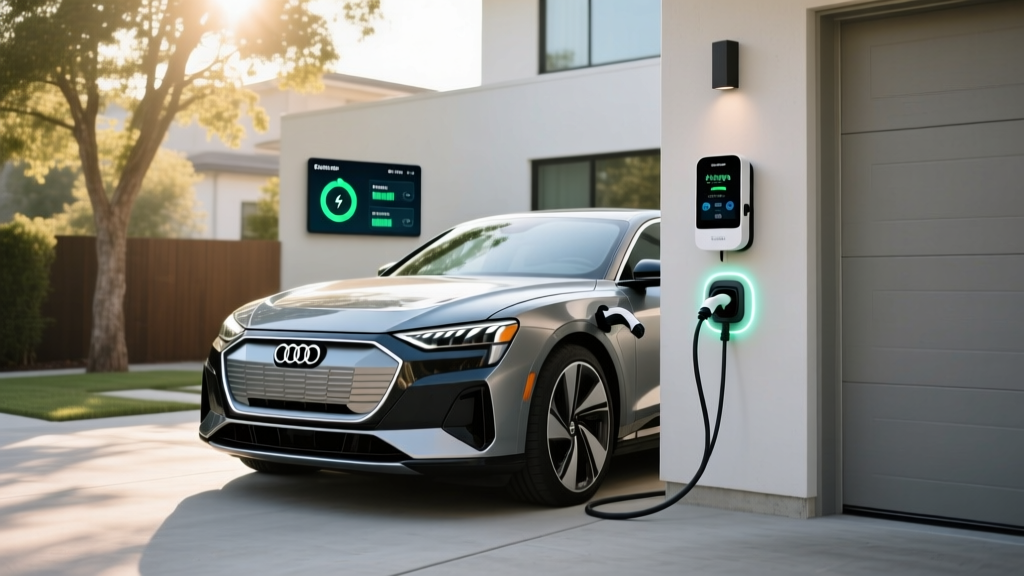
To unlock Level 2 charging at the e-tron's full 9.6 kW, you need a 240V circuit rated at 50 amps (which delivers 40 amps continuous, per the 80% NEC rule for continuous loads). Here's what that involves and what it costs.
| Component | Typical Cost Range | Notes |
|---|---|---|
| Level 2 EVSE (charger unit) | $350–$750 | 40A–48A models; smart vs. basic |
| Electrician labor (50A circuit install) | $600–$1,800 | Varies by run length, conduit, drywall work |
| Electrical permit | $50–$200 | Required in most jurisdictions |
| Panel upgrade (if needed) | $1,500–$3,500 | 200A service upgrade for older 100A panels |
| Total (no panel upgrade) | $1,000–$2,750 | Most homes with 200A service |
| Total (with panel upgrade) | $2,500–$6,250 | Older homes with 100A panels |
Do You Need a Panel Upgrade?
Homes built before the 1990s often have 100-amp electrical service. Adding a 50A dedicated circuit for EV charging can push total household demand beyond the panel's capacity, especially if you run central AC, an electric oven, and an electric dryer simultaneously. A licensed electrician will perform a load calculation (NEC Article 220) to determine whether your existing panel can handle the new circuit. If not, a 200A service upgrade runs $1,500–$3,500 depending on your utility's requirements and local labor rates.
An alternative for panel-constrained homes: a smart load-management device like the Emporia VUE with smart breaker, which monitors total household draw and throttles the EV charger when other loads spike. This can avoid a panel upgrade entirely.
Connector Compatibility: CCS1, NACS, and Adapter Options
The 2021 Audi e-tron came from the factory with a CCS1 (Combined Charging System Combo 1) port. This is the standard connector used by virtually every non-Tesla EV sold in the US through 2024. However, the industry has shifted toward NACS (North American Charging Standard, the Tesla connector) as the dominant standard, and Audi's newer models now ship with NACS.
| Connector | Your 2021 e-tron | Adapter Available? | Notes |
|---|---|---|---|
| CCS1 | Native — built-in | N/A | Works at Electrify America, EVgo, ChargePoint DC stations |
| NACS (Tesla) | Requires adapter | Yes — Audi-approved CCS-to-NACS adapters (~$200–$250) | Unlocks Tesla Supercharger network access |
| CHAdeMO | Not compatible | No practical adapter | Nissan Leaf standard; nearly obsolete in the US |
| J1772 (Level 2 AC) | Native (top portion of CCS) | N/A | All Level 2 public and home chargers use this |
As of 2026, Tesla Supercharger stations are open to non-Tesla CCS vehicles at many locations through the Magic Dock adapter built into the stall, or you can carry your own Audi-approved CCS-to-NACS adapter for Supercharger access. This significantly expands your road-trip charging network beyond Electrify America and EVgo.
Charging Times: 10%–80% at Every Level
Here's what to expect when charging the e-tron's ~86.5 kWh usable battery from 10% to 80% (roughly 60 kWh of energy added):
| Charging Method | Power (kW) | 10%–80% Time | Range Added |
|---|---|---|---|
| Level 1 (120V outlet) | 1.2 kW | ~50 hours | ~150 miles |
| Level 2 (240V, 40A/9.6 kW) | 9.6 kW | ~6.5 hours | ~150 miles |
| DC Fast (150 kW peak) | Peak 150 kW / avg ~95 kW | ~30–34 minutes | ~150 miles |
| DC Fast (50 kW station) | 50 kW | ~75–80 minutes | ~150 miles |
The e-tron's thermal management system is one of the best in its class. It preconditioning the battery when you navigate to a DC fast charger, which means even in 40°F weather, you'll see near-peak charge rates within minutes of plugging in — provided you've driven at least 20–30 minutes or set preconditioning via the myAudi app.
Level 2 Charger Recommendations for the e-tron
Since the 2021 e-tron caps AC charging at 9.6 kW, a 40-amp or 48-amp charger is the sweet spot. Here are three proven options:
ChargePoint Home Flex (Best Overall)
- Power: Up to 12 kW (50A) — configurable via DIP switches; set to 40A for the e-tron's 9.6 kW limit
- Connector: J1772 (CCS AC compatible)
- Cable Length: 23 feet
- Smart Features: Wi-Fi, ChargePoint app scheduling, Alexa integration, energy tracking
- Price: ~$550–$650
- Why for e-tron: Reliable, UL-listed, adjustable amperage means you can dial it to your circuit capacity
Emporia Level 2 EV Charger (Best Value)
- Power: Up to 11.5 kW (48A)
- Connector: J1772
- Cable Length: 24 feet
- Smart Features: Wi-Fi, Emporia app, solar integration, load management with Emporia VUE panel monitor
- Price: ~$350–$400
- Why for e-tron: Budget-friendly, smart load management can avoid panel upgrades
Tesla Wall Connector + CCS Adapter (Best for Supercharger Users)
- Power: Up to 11.5 kW (48A)
- Connector: NACS (requires CCS-to-NACS adapter for e-tron)
- Cable Length: 24 feet
- Smart Features: Wi-Fi, Tesla app, power sharing between two units
- Price: ~$425 (charger) + ~$200–$250 (adapter) = ~$625–$675 total
- Why for e-tron: If you plan to use Tesla Superchargers on road trips and want one connector ecosystem at home
Cost to Charge: Per-Mile Economics vs. Gas
The 2021 e-tron averages about 2.1 kWh per mile driven. Here's what that translates to in real dollars across common charging scenarios:
| Scenario | Cost per kWh | Cost per Mile | Cost for 15,000 mi/yr |
|---|---|---|---|
| Home (national avg. $0.16/kWh) | $0.16 | $0.034 | $510 |
| Home (off-peak TOU rate $0.09/kWh) | $0.09 | $0.019 | $285 |
| Public Level 2 (avg. $0.30/kWh) | $0.30 | $0.063 | $945 |
| DC Fast Charging (avg. $0.48/kWh) | $0.48 | $0.101 | $1,515 |
| Gas SUV (22 MPG, $3.40/gal) | — | $0.155 | $2,325 |
Even at DC fast-charging rates, the e-tron costs less per mile than a comparable gas SUV (like the Audi Q5 at 22 MPG combined). But the economics are dramatically better when you charge at home, especially on a time-of-use (TOU) rate plan that offers off-peak electricity between 10 PM and 6 AM. Many utilities offer EV-specific rate plans that can bring your effective rate below $0.10/kWh.
Safety, Electrical Code, and Installation Best Practices
EV charging draws significant current for extended periods — the NEC classifies it as a "continuous load" requiring specific protections:
- Dedicated Circuit: Your Level 2 charger must be on its own dedicated 50A breaker. Sharing a circuit with other appliances is a code violation and a fire risk.
- GFCI Protection: NEC 2020 and later require GFCI (ground-fault circuit interrupter) protection for all EV outlets. Most quality EVSEs have built-in ground-fault detection, but your breaker may also need to be GFCI-type depending on your jurisdiction.
- Outdoor Rating: If your charger is installed outdoors (garage exterior, carport, driveway), the EVSE must carry a NEMA 4 or NEMA 4X rating for weather resistance. All three chargers recommended above are outdoor-rated.
- Hardwired vs. Plug: Chargers above 40A (like a 48A unit) must be hardwired — there is no standard plug/receptacle rated for 48A continuous. A 40A charger can use a NEMA 14-50 plug, which offers portability if you move homes.
- Permit and Inspection: Most municipalities require an electrical permit for new 240V circuits. The inspection ensures proper wire gauge (6 AWG copper for 50A), correct breaker sizing, and adequate grounding. Do not skip this — unpermitted work can void homeowners insurance.
Always hire a licensed electrician familiar with EV charger installations. Ask whether they've installed EVSEs before and whether they'll pull the permit (they should). Get at least two quotes, as labor costs vary widely by market.
Frequently Asked Questions
How much does it cost to install a home EV charger for my 2021 Audi e-tron?
Expect $1,000–$2,750 total for a standard installation (charger + electrician + permit) if your home has a 200A electrical panel. If a panel upgrade from 100A to 200A is needed, total costs rise to $2,500–$6,250. The charger unit itself costs $350–$650; electrician labor for running a 50A circuit is typically $600–$1,800.
How fast will each charging level add range to the e-tron?
Level 1 (120V) adds about 3–4 miles per hour — essentially useless for daily needs but fine for emergencies. Level 2 (240V at 9.6 kW) adds roughly 22–28 miles per hour, fully replenishing a daily commute overnight. DC fast charging at peak 150 kW can add up to 150 miles in about 30 minutes, though the charge curve tapers significantly above 80% state of charge.
Which connector and charger is compatible with my 2021 Audi e-tron?
Your e-tron has a CCS1 port, which includes J1772 for Level 2 AC charging and two DC pins below for fast charging. Any J1772 Level 2 home charger works natively. For Tesla Supercharger access, you'll need a CCS-to-NACS adapter (~$200–$250). CHAdeMO stations are not compatible and no adapter exists.
How much does charging the e-tron cost per mile versus a gas car?
At the national average home electricity rate of $0.16/kWh, the e-tron costs about $0.034 per mile. A comparable gas SUV at 22 MPG and $3.40/gallon costs $0.155 per mile — roughly 4.5× more. Even at public DC fast-charging rates ($0.48/kWh), the e-tron costs $0.101 per mile, still 35% cheaper than gas.
What electrical upgrades might I need before installing a Level 2 charger?
The most common upgrade is a panel capacity increase from 100A to 200A service, required if your home's total calculated load (existing appliances + new 50A EV circuit) exceeds your panel rating. Other possible upgrades include adding a sub-panel in the garage if the main panel is far away, upgrading the service drop from the utility, or installing a smart load-management system to avoid a panel upgrade entirely. A licensed electrician will perform a NEC Article 220 load calculation to determine what's needed.
Should I charge my e-tron to 100% every night?
No. NMC chemistry degrades faster when held at high states of charge for extended periods. Set your charge limit to 80% for daily driving via the myAudi app or your charger's scheduling feature. Only charge to 100% before long road trips. This practice, combined with the e-tron's built-in buffer, should keep battery degradation under 10% over 8–10 years of ownership.
Does the 2021 Audi e-tron qualify for any tax credits in 2026?
The 2021 e-tron is no longer eligible for the new-vehicle §30D federal tax credit (that applies only to new purchases of qualifying current-year models). However, if you're buying a used 2021 e-tron from a dealer in 2026, you may qualify for the Used Clean Vehicle Credit under IRS §25E — up to $4,000 or 30% of the sale price (whichever is less), subject to income caps ($75,000 single / $150,000 joint) and a vehicle sale price cap of $25,000. Verify current rules at irs.gov and consult a tax professional.