Quick Charging Profile: 2020 Tesla Model 3 Standard Range Plus
The 2020 Tesla Model 3 Standard Range Plus (SR+) remains one of the most popular used EVs on the road. With its 50 kWh usable battery (LFP chemistry in later 2020 production runs, NMC in earlier ones), EPA-rated 250-mile range, and native NACS (North American Charging Standard) connector, it's a practical daily driver — but only if you understand how to charge it efficiently.
This guide covers everything a current or prospective SR+ owner needs: home Level 2 installation, DC fast charging reality, connector compatibility, and what you'll actually spend per mile. All figures reflect real-world ownership data as of 2026.
Charging Levels Explained: Speeds, kW, and Miles Per Hour
EV charging happens at three levels. The critical distinction: kW (kilowatts) measures power — how fast energy flows into the battery. kWh (kilowatt-hours) measures energy capacity — the size of the battery itself. The 2020 Model 3 SR+ has a ~50 kWh usable battery and can accept up to 170 kW peak DC fast charge rate (though sustained rates are lower, as we'll cover).
| Level | Voltage / Amps | Power (kW) | Miles Added Per Hour | Best Use Case |
|---|---|---|---|---|
| Level 1 (120V) | 120V / 12A | ~1.4 kW | ~3–5 mi/hr | Emergency / overnight trickle |
| Level 2 (240V) | 240V / 32–48A | 7.7–11.5 kW | ~30–44 mi/hr | Daily home charging |
| DC Fast Charge | 400V+ DC | Up to 170 kW (peak) | ~180–300 mi/hr (peak) | Road trips, quick top-ups |
Level 1 uses a standard household outlet. The included Tesla Mobile Connector delivers about 1.4 kW, adding roughly 3–5 miles of range per hour. A full 10–80% charge (about 35 kWh) takes roughly 25 hours — impractical for daily use but adequate if you drive under 30 miles per day and can plug in overnight.
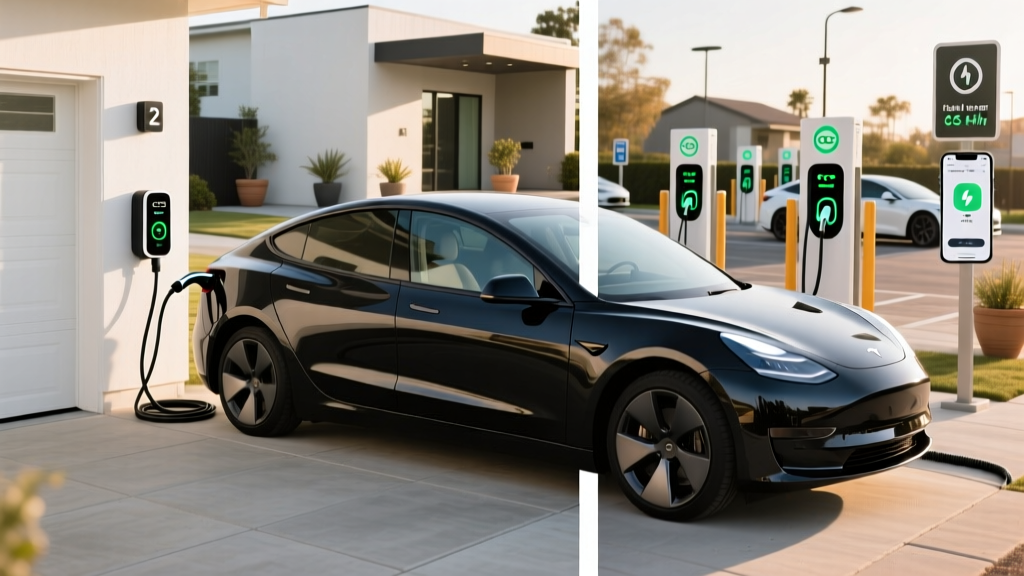
Level 2 is the standard for home charging. On a 240V/48A circuit (Tesla Wall Connector), the Model 3 SR+ can accept up to 11.5 kW via its onboard charger. A 10–80% charge takes approximately 3.5–4 hours. Most owners plug in each evening and wake up to a full battery.
DC Fast Charging bypasses the onboard charger entirely, sending direct current straight to the battery. At a Tesla Supercharger V3 (250 kW capable), the SR+ peaks around 170 kW but sustains that rate only briefly. Expect a 10–80% charge in about 25–30 minutes. Above 80% State of Charge (SoC), the charge curve tapers sharply — going from 80–100% can take as long as 10–80% due to cell-balancing and thermal protection.
Home Level 2 Installation: Electrical Requirements and Costs
Installing a Level 2 home charger is the single biggest upgrade most EV owners make. For the 2020 Model 3 SR+, here's what's required:
Electrical Specifications
- Circuit: Dedicated 60A breaker (for a 48A continuous load charger like the Tesla Wall Connector)
- Wire: 6 AWG copper (or 4 AWG aluminum) for a 60A circuit; run in conduit if exposed
- Panel capacity: Your main electrical panel must have sufficient spare capacity. Most homes with 200A service can accommodate a 60A EV circuit without an upgrade. Homes with 100A service or heavily loaded panels may need a panel upgrade ($1,500–$3,500).
- Permit: Nearly all jurisdictions require an electrical permit and inspection for a new 240V circuit. Permit fees range from $50–$250 depending on locality.
- GFCI protection: NEC 2020 and later require GFCI protection for EV charging outlets in garages. Hardwired chargers (like a wall-mounted Wall Connector) typically do not require a GFCI breaker, which saves cost and avoids nuisance tripping.
Installation Cost Breakdown
| Item | Low Estimate | High Estimate | Notes |
|---|---|---|---|
| Level 2 Charger (Equipment) | $250 | $600 | Tesla Wall Connector ~$475; third-party options vary |
| Electrician Labor (240V circuit run) | $500 | $2,000 | Depends on panel-to-charger distance, wall/attic routing |
| Electrical Permit & Inspection | $50 | $250 | Varies by municipality |
| Panel Upgrade (if needed) | $1,500 | $3,500 | Only if 100A service or no spare breaker slots |
| Total (no panel upgrade) | $800 | $2,850 | Typical range for most 200A-panel homes |
| Total (with panel upgrade) | $2,300 | $6,350 | Older homes, 100A service |
Get at least two quotes from licensed electricians. Ask specifically whether the quote includes permit, conduit, wire, and the charger unit — some quotes are labor-only. Check your utility for rebates: many offer $200–$500 toward Level 2 installation or provide time-of-use (TOU) rate plans that slash off-peak charging costs.
Connector Compatibility: NACS, CCS, and Adapter Options
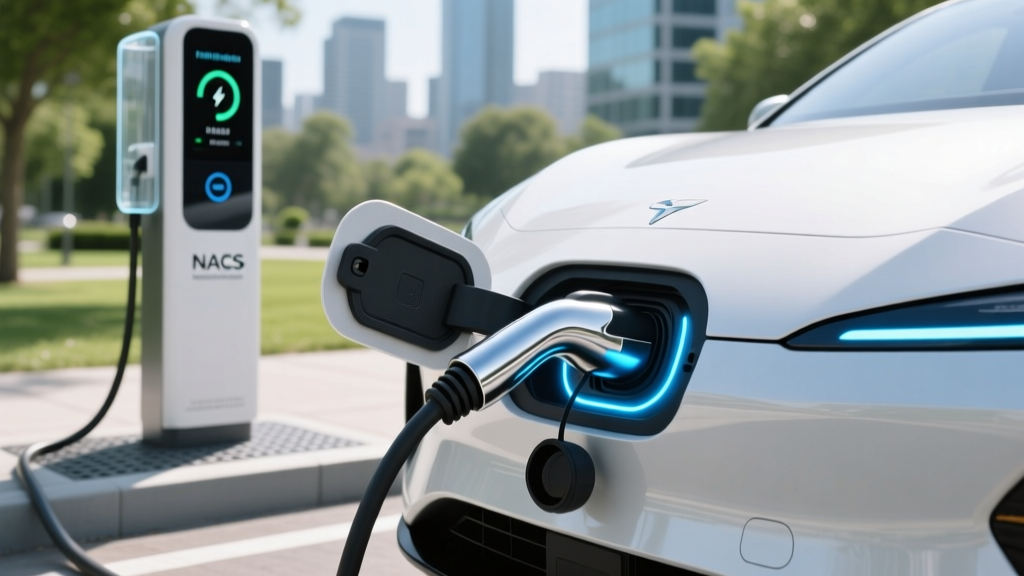
The 2020 Model 3 SR+ uses Tesla's proprietary connector, which was formally standardized as NACS (North American Charging Standard, SAE J3400) in late 2022. This is a significant advantage in 2026: NACS is now the dominant light-duty EV connector in North America, adopted by Ford, GM, Rivian, Hyundai, and most other major automakers.
| Connector | Compatible with 2020 Model 3 SR+? | Notes |
|---|---|---|
| NACS (Tesla native) | ✅ Yes — native port | All Tesla Superchargers; growing third-party NACS stations |
| CCS1 | ⚠️ With adapter | Tesla CCS Adapter (~$175) enables Electrify America, EVgo CCS stalls |
| CHAdeMO | ❌ No practical adapter | Legacy standard; increasingly rare. Skip. |
| J1772 (Level 2 public) | ✅ With included adapter | Tesla ships a J1772-to-NACS adapter in-box with the Mobile Connector |
Key takeaway: You'll primarily use Tesla Superchargers for DC fast charging and the Tesla Wall Connector or a NACS-equipped Level 2 charger at home. The CCS adapter is worth buying ($175 from Tesla) to access Electrify America and other non-Tesla DC networks as backup on road trips. The included J1772 adapter handles public Level 2 stations at malls, workplaces, and hotels.
Charging Time Examples: 10–80% for the Model 3 SR+
Charging times depend on the power source and the battery's State of Charge (SoC). The 2020 SR+ has approximately 50 kWh of usable capacity. Here's how long common scenarios take:
| Charger Type | Peak Power (kW) | 10–80% Time (est.) | Miles Added in 30 Min |
|---|---|---|---|
| 120V Level 1 (Mobile Connector) | 1.4 kW | ~25 hours | ~2 miles |
| 240V / 32A Level 2 (Mobile Connector w/ NEMA 14-50) | 7.7 kW | ~4.5 hours | ~16 miles |
| 240V / 48A Level 2 (Tesla Wall Connector) | 11.5 kW | ~3.5 hours | ~22 miles |
| Tesla Supercharger V2 | 150 kW | ~35 minutes | ~120 miles |
| Tesla Supercharger V3/V4 | 170 kW (SR+ peak) | ~25–30 minutes | ~150 miles |
Cost to Charge: Per kWh and Per Mile vs. Gas
One of the strongest ownership arguments for the Model 3 SR+ is fuel cost savings. Here's how charging costs compare to gasoline in 2026:
| Scenario | Cost per kWh | Cost for 10–80% (~35 kWh) | Cost per Mile |
|---|---|---|---|
| Home off-peak (TOU rate, overnight) | $0.08–$0.12 | $2.80–$4.20 | $0.014–$0.021 |
| Home standard rate (national avg.) | $0.16–$0.18 | $5.60–$6.30 | $0.028–$0.032 |
| Tesla Supercharger (avg. 2026) | $0.28–$0.36 | $9.80–$12.60 | $0.049–$0.063 |
| Electrify America / 3rd-party DC | $0.32–$0.48 | $11.20–$16.80 | $0.056–$0.084 |
| Gasoline equivalent (30 MPG @ $3.40/gal) | — | — | $0.113 |
Bottom line: Home charging at off-peak rates costs roughly 5–6× less per mile than gasoline. Even exclusive Supercharger use is about half the per-mile cost of a 30 MPG gas car. Over 15,000 miles/year, home charging saves $1,200–$1,500 annually versus gas. The EPA rates the 2020 SR+ at 141 MPGe combined, making it one of the most efficient EVs ever produced.
The Model 3 SR+ achieves approximately 4.0–4.5 miles per kWh in mixed driving (24–26 kWh/100mi), which is exceptional efficiency. Highway driving at 75 mph pushes consumption closer to 3.5 mi/kWh; city driving with regenerative braking can exceed 5.0 mi/kWh.
Recommended Level 2 Home Chargers for the Model 3 SR+
Not all Level 2 chargers are equal. Here are three proven options for NACS-equipped Teslas, evaluated on power output, cable length, smart features, and build quality:
Tesla Wall Connector (Gen 3)
- Power: Up to 11.5 kW (48A on a 60A circuit)
- Connector: Native NACS — no adapter needed
- Cable: 24 ft standard
- Smart features: Wi-Fi for OTA updates, load sharing (pair two units on one circuit), power management for limited panels
- Price: ~$475
- Verdict: Best overall for Tesla owners. Seamless integration, highest output the SR+ can accept, and load-sharing capability is ideal for two-EV households.
Emporia Vue Level 2 EV Charger
- Power: Up to 11.5 kW (48A)
- Connector: NACS (native, as of 2025 model)
- Cable: 24 ft
- Smart features: Energy monitoring, solar integration, scheduling via app, works with Emporia home energy monitor
- Price: ~$399
- Verdict: Best value for solar-equipped homes. Real-time energy tracking and solar-aware scheduling are genuinely useful.
ChargePoint Home Flex (NACS version)
- Power: Up to 12 kW (50A, adjustable down to 16A)
- Connector: NACS (2025+ models; earlier units are J1772 — use included adapter)
- Cable: 23 ft
- Smart features: Alexa integration, detailed app scheduling, flexible amperage dip-switch settings
- Price: ~$599
- Verdict: Most flexible amperage settings — ideal if your panel can't support a full 60A circuit. Set it to 32A (40A breaker) and still get 7.7 kW.
Public Charging and Road-Trip Strategy
The 2020 Model 3 SR+ has a built-in advantage for road trips: native access to the Tesla Supercharger network, which in 2026 remains the most reliable and widespread DC fast-charging network in North America, with over 6,500 stations and 65,000+ stalls. Superchargers are integrated into the car's navigation — the vehicle preconditions the battery automatically when a Supercharger is set as your destination, warming the pack to optimize charge speed.
Preconditioning matters. Without it, a cold battery arriving at a Supercharger may charge at 50–80 kW instead of 170 kW, doubling your stop time. Always navigate to the charger via the car's built-in nav, even if you know the route, to trigger preconditioning.
For non-Tesla DC charging (Electrify America, EVgo), you'll need the Tesla CCS Adapter. Reliability on third-party networks has improved since 2023 but still lags behind Superchargers. Check PlugShare or the station's app for recent user check-in status before relying on a non-Tesla DC stall in a rural area.
Safety, Code, and Installation Best Practices
EV charging involves sustained high-current draw — far more demanding on your home's electrical system than an oven or dryer. Follow these guidelines:
- Dedicated circuit: Your Level 2 charger must be on its own dedicated breaker. Never share a circuit with other major appliances.
- Hardwired vs. outlet: Hardwired installations (no plug) are preferred for reliability and avoid NEC GFCI requirements for receptacles. If you use a NEMA 14-50 outlet for the Mobile Connector, ensure it's an industrial-grade receptacle (Hubbell or Bryant) — cheap 14-50 outlets can overheat under sustained EV charging loads.
- Outdoor rating: If installing outside, ensure the charger is NEMA 4 rated (weatherproof). The Tesla Wall Connector is NEMA 3R rated (suitable for outdoor use in most climates).
- Wire gauge: Undersized wire is a fire hazard. For a 48A continuous load on a 60A breaker, 6 AWG copper is the minimum. For runs over 50 feet, consider upsizing to 4 AWG to reduce voltage drop.
- Utility notification: Some utilities require notification before installing a Level 2 charger, especially if your transformer serves multiple homes. Check with your provider.
2020 Model 3 SR+ Battery Health and Charging Best Practices
The SR+ battery is designed for longevity, but charging habits affect degradation over time. Tesla's battery warranty covers 8 years / 100,000 miles with a minimum 70% capacity retention threshold.
Daily charging limit: If your SR+ has an LFP battery (check in Settings → Software → Additional Vehicle Information), Tesla recommends charging to 100% regularly — LFP chemistry tolerates full charges better and needs periodic 100% charges for accurate SoC calibration. If your SR+ has NMC chemistry, set the daily charge limit to 80–90% and save 100% for road trips.
Avoid frequent DC fast charging if possible. While the battery management system actively protects against thermal damage, consistent daily DC fast charging accelerates degradation slightly. Home Level 2 charging at 7.7–11.5 kW is gentler on the cells and far cheaper.
Cold weather charging: In freezing temperatures, always precondition before DC fast charging. At home, schedule charging to complete just before departure — the car will keep the battery warm using grid power rather than battery energy, preserving range.
Frequently Asked Questions
How much does it cost to install a home EV charger for the 2020 Model 3 SR+?
Expect $800–$2,850 for a typical installation with a 200A panel (equipment + electrician + permit). If your home has 100A service or needs a panel upgrade, total costs can reach $2,300–$6,350. The Tesla Wall Connector itself costs ~$475.
How fast will each charging level add range to the Model 3 SR+?
Level 1 (120V): about 3–5 miles per hour. Level 2 (240V/48A): about 30–44 miles per hour. DC fast charging at a Tesla Supercharger V3: up to ~150 miles in 30 minutes during peak charge rate (10–40% SoC).
Which connector is compatible with my 2020 Model 3 SR+?
Your car has a native NACS (Tesla) connector. It works directly with all Tesla Superchargers and NACS-equipped Level 2 chargers. For CCS1 public DC stations, purchase the Tesla CCS Adapter (~$175). A J1772-to-NACS adapter is included with the Mobile Connector for public Level 2 stations.
How much does charging cost per mile vs. gas?
Home off-peak charging costs about $0.014–$0.021 per mile. Even Supercharger use averages $0.05–$0.06 per mile. A comparable 30 MPG gas car at $3.40/gallon costs $0.113 per mile. Home charging saves $1,200–$1,500 per year over gasoline at 15,000 miles driven annually.
What electrical upgrades might I need for a Level 2 charger?
You need a dedicated 60A breaker with 6 AWG copper wire (for a 48A charger). If your panel is 100A or has no spare slots, a panel upgrade to 200A may be required ($1,500–$3,500). Homes built after 2000 with 200A service usually accommodate a Level 2 circuit without upgrades.
Can I use a NEMA 14-50 outlet instead of hardwiring?
Yes, but use an industrial-grade Hubbell or Bryant 14-50 receptacle, not a residential-grade one. Sustained 40A draw can overheat cheap outlets. A hardwired Tesla Wall Connector avoids this risk entirely and eliminates the NEC GFCI breaker requirement.
Does the 2020 Model 3 SR+ qualify for any tax credits in 2026?
The federal §30D new clean vehicle credit applies only to new vehicle purchases — the 2020 SR+ is no longer eligible as new. However, the used clean vehicle credit (up to $4,000 or 30% of sale price, whichever is less) may apply if you purchase this model from a dealer for $25,000 or less, subject to income caps ($75,000 single / $150,000 joint) and other IRS requirements. Consult a tax professional for eligibility.