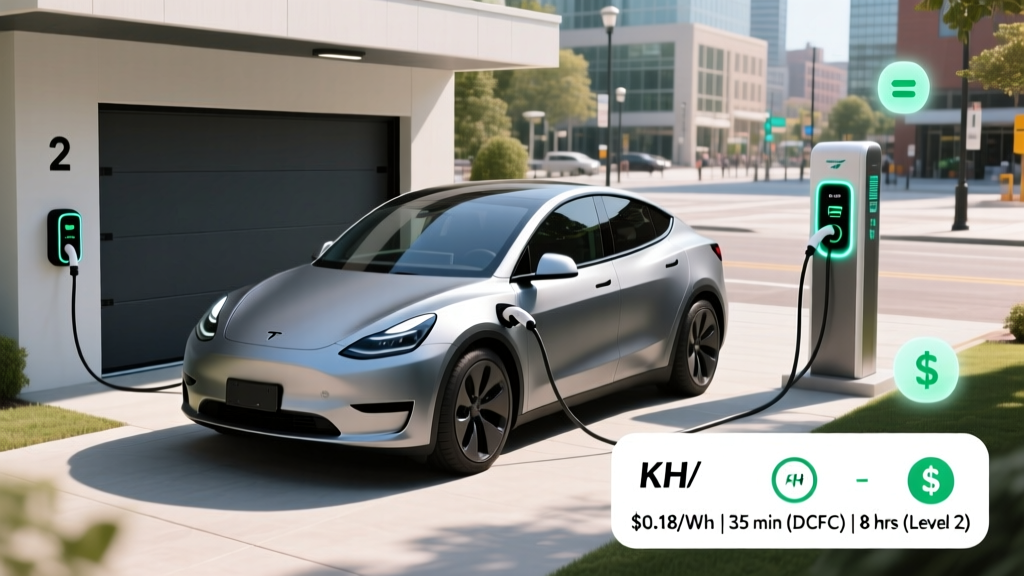
If you own or are shopping for a 2020 Tesla Model Y Long Range, understanding its charging behavior isn't optional—it's the single biggest factor in daily satisfaction. The 2020 Model Y Long Range ships with a 75 kWh (usable) NMC battery pack, an EPA-rated 315 miles of range, and a proprietary Tesla connector that gives it access to the industry's most reliable fast-charging network. But plug it into the wrong setup at home, and you'll leave performance on the table.
This guide covers exactly how fast each charging level replenishes the Model Y's battery, what a home Level 2 installation actually costs in 2026, which adapters you might need, and how charging expenses compare to gasoline mile-for-mile.
Charging Levels Explained: How Fast Does Each Add Range?
EV charging is measured in kW (kilowatts), which represents power—the rate at which energy flows into the battery. The battery itself stores energy measured in kWh (kilowatt-hours). Think of kW as the flow rate of a hose and kWh as the size of the bucket. Confusing these two is the most common EV mistake—never treat them as interchangeable.
The 2020 Model Y Long Range's onboard charger accepts up to 11.5 kW on Level 2 AC (48 amps at 240V) and peaks at roughly 250 kW on DC fast charging via V3 Superchargers. Here's how each level translates to real-world range recovery:
| Charging Level | Voltage / Amperage | Power (kW) | Miles of Range per Hour | 0–100% Time (75 kWh) |
|---|---|---|---|---|
| Level 1 (120V household) | 120V / 12A | ~1.4 kW | ~3–5 mi/hr | ~50+ hours |
| Level 2 (240V home/public) | 240V / 48A | 11.5 kW | ~37–44 mi/hr | ~7–8 hours |
| DC Fast (Tesla V3 Supercharger) | 400V+ DC | Up to 250 kW | ~1,000+ mi/hr (peak) | 10–80% in ~27 min |
| DC Fast (Tesla V2 Supercharger) | 400V DC | Up to 150 kW | ~600+ mi/hr (peak) | 10–80% in ~38 min |
Real-world caveat: Those DC fast-charge times assume battery preconditioning (the car warms the pack before you arrive). Without preconditioning—say, on a cold morning with no navigation to the charger—the 10–80% time can stretch to 40+ minutes. The Model Y's charge curve also tapers sharply above 80% state of charge; charging from 80–100% on DC can take as long as 10–80%.
Home Level 2 Installation: Electrical Requirements and Real Costs
Most 2020 Model Y Long Range owners install a 240V Level 2 charger at home. The Model Y's onboard charger maxes out at 48 amps / 11.5 kW, so you need a circuit rated for at least 60 amps (EV chargers are continuous loads, meaning the circuit must be rated at 125% of the charger's max draw—48A × 1.25 = 60A).
What Your Electrical Panel Needs
Before any installation, check your main panel's amperage. A 200-amp service panel is standard in most homes built after the 1990s and typically supports a 60A EV circuit without an upgrade. However, if your home has a 100A or 150A panel—common in older construction—you may need a panel upgrade or a smart load-management device like the Emporia Smart Load Center to avoid overloading the service.
A licensed electrician will perform a load calculation per NEC Article 220 to determine if your panel can handle the additional draw. Skipping this step risks tripped main breakers or, worse, fire hazards.
Installation Cost Breakdown
Here's what a typical Level 2 home installation costs in 2026, based on national averages. Your actual cost depends heavily on the run length from panel to garage and whether a panel upgrade is needed:
| Cost Component | Simple Install (short run, 200A panel) | Complex Install (long run or panel upgrade) |
|---|---|---|
| Level 2 charger (hardware) | $400–$700 | $400–$700 |
| Electrical permit | $50–$200 | $50–$300 |
| Electrician labor (2–4 hrs simple, 6–12 hrs complex) | $500–$1,200 | $1,500–$3,500 |
| Wiring, conduit, breaker (60A) | $200–$500 | $500–$1,500 |
| Panel upgrade (if needed) | $0 | $2,000–$5,000 |
| Total estimated cost | $1,150–$2,600 | $4,450–$11,000 |
As of 2026, the federal Alternative Fuel Vehicle Refueling Property Credit (IRS Form 8911) covers up to 30% of home charging equipment and installation costs, capped at $1,000, provided the installation is in an eligible census tract. Check the IRS guidelines or consult a tax professional to confirm eligibility.
Connector Compatibility: NACS, CCS, and Adapters
The 2020 Model Y Long Range was built with a Tesla proprietary connector (now retroactively referred to as NACS—North American Charging Standard). This gives it native access to all Tesla Superchargers and Destination Chargers without an adapter.
However, non-Tesla public Level 2 and DC fast chargers predominantly use CCS1 (Combined Charging System) or the older CHAdeMO connector. Here's what you need to know:
| Connector Type | Native on 2020 Model Y? | Adapter Required? | Where You'll Find It |
|---|---|---|---|
| NACS (Tesla) | Yes | No | Tesla Superchargers, Destination Chargers, some newer public stations |
| J1772 (Level 2 AC public) | No | Yes (Tesla Mobile Connector includes J1772 adapter; or Tesla J1772 Wall Connector adapter) | Public Level 2 stations, workplaces, hotels |
| CCS1 (DC fast) | No | Yes (Tesla CCS Adapter, ~$175–$250 aftermarket) | Electrify America, EVgo, ChargePoint DC stations |
| CHAdeMO (DC fast) | No | Yes (third-party adapters available but rare/expensive) | Older Nissan Leaf-era stations; phasing out |
Practical recommendation: The Tesla-included J1772 adapter handles virtually all public Level 2 stations. For DC fast charging outside the Supercharger network, purchase the official Tesla CCS1 adapter. CHAdeMO stations are increasingly rare, and investing in an adapter for that standard is rarely worthwhile in 2026.
Cost to Charge: Home, Public, and DC Fast Charging Compared
One of the strongest ownership arguments for the 2020 Model Y Long Range is fuel cost. The EPA rates the Model Y Long Range AWD at 121 MPGe combined, consuming roughly 28 kWh per 100 miles (per fueleconomy.gov). Here's what that translates to in dollars:
| Charging Scenario | Cost per kWh | Cost per 100 Miles | Cost per Mile |
|---|---|---|---|
| Home (off-peak utility rate) | $0.08–$0.14 | $2.24–$3.92 | $0.022–$0.039 |
| Home (average US rate, ~$0.17/kWh) | $0.17 | $4.76 | $0.048 |
| Public Level 2 (ChargePoint, EVgo) | $0.25–$0.49 | $7.00–$13.72 | $0.07–$0.14 |
| Tesla Supercharger V3 (avg ~$0.30/kWh) | $0.25–$0.40 | $7.00–$11.20 | $0.07–$0.11 |
| Gasoline equivalent (25 MPG, $3.50/gal) | — | $14.00 | $0.14 |
The bottom line: Home charging at off-peak rates costs roughly one-quarter to one-third what gasoline costs per mile. Even exclusive Supercharger use is typically 20–30% cheaper than gas. A 2020 Model Y Long Range owner driving 12,000 miles/year and charging primarily at home spends approximately $350–$575 annually on electricity, versus $1,680 on gasoline for a comparable 25 MPG crossover.
To minimize public charging costs, check whether your utility offers time-of-use (TOU) plans. Scheduling the Model Y to charge between 10 PM and 6 AM via the Tesla app can cut your per-kWh rate in half in many regions.
Recommended Home Chargers for the 2020 Model Y Long Range
Since the Model Y accepts up to 48A / 11.5 kW on Level 2, pairing it with a charger that delivers the full 48A maximizes overnight recovery. Here are three proven options in 2026:
Tesla Wall Connector (Gen 3)
- Power output: Up to 48A / 11.5 kW (240V)
- Connector: NACS native (no adapter needed)
- Cable length: 24 feet
- Smart features: Wi-Fi, OTA updates, power sharing with multiple units, load management
- Price: ~$475
- Best for: Tesla-only households wanting seamless integration and maximum charge rate
ChargePoint Home Flex
- Power output: Up to 50A / 12 kW (configurable 16A–50A)
- Connector: J1772 (use Tesla's included J1772 adapter)
- Cable length: 23 feet
- Smart features: Wi-Fi, Alexa integration, scheduling, energy tracking via app
- Price: ~$550–$700
- Best for: Multi-EV households (charges Teslas and non-Teslas natively)
Emporia Vue Level 2 Charger
- Power output: Up to 48A / 11.5 kW (240V)
- Connector: J1772 (Tesla adapter required)
- Cable length: 24 feet
- Smart features: Solar integration, real-time energy monitoring, TOU scheduling, whole-home energy panel compatibility
- Price: ~$400–$500
- Best for: Solar-equipped homes or budget-conscious buyers wanting smart features
Editor's pick for 2020 Model Y Long Range: The Tesla Wall Connector is the most frictionless choice—native NACS plug, full 48A throughput, and no adapter fumbling in the dark. If you also own (or plan to own) a non-Tesla EV, the ChargePoint Home Flex is the more versatile investment.
Safety and Electrical Code Considerations
Level 2 EV charging draws sustained high current for hours, making proper installation non-negotiable. Key requirements under the 2023/2026 National Electrical Code (NEC):
- Dedicated circuit: The charger must be on its own dedicated breaker—no sharing with other appliances.
- GFCI protection: NEC 2023 (Article 625.54) requires GFCI protection for all receptacles used for EV charging. Hardwired installations (which most Level 2 chargers use) may be exempt depending on local AHJ interpretation, but many jurisdictions now require GFCI breakers for hardwired EV circuits as well.
- Outdoor rating: If your charger is mounted outside or in an exposed carport, ensure it carries a NEMA 4 or NEMA 4X rating (weatherproof). The Tesla Wall Connector and ChargePoint Home Flex both carry NEMA 4 ratings.
- Wire gauge: A 60A circuit requires minimum 6 AWG copper wire (THHN in conduit) or 4 AWG if using NM-B (Romex) cable, depending on local code and run length.
- Permit and inspection: Virtually all jurisdictions require an electrical permit and post-installation inspection. Skipping this can void homeowner's insurance coverage in the event of a fire.
Always hire a licensed electrician. The savings from a DIY install are never worth the risk of an improperly torqued connection or undersized wire on a continuous 48A load.
Real-World Charging Tips for 2020 Model Y Long Range Owners
Beyond the hardware, these practices maximize battery longevity and charging convenience:
- Daily charge limit: Tesla recommends setting the charge limit to 80% for daily use on the NMC battery. Reserve 100% charges for road trips. This practice significantly slows long-term degradation.
- Preconditioning: Always navigate to a Supercharger via the car's built-in navigation, even if you know the route. This triggers battery preconditioning, warming the pack to optimal temperature and enabling peak charge rates on arrival. Skipping preconditioning in cold weather can double your DC fast-charge time.
- Cold-weather range loss: The 2020 Model Y Long Range's 315-mile EPA range can drop to 220–260 miles in sustained sub-freezing temperatures due to cabin heating and increased battery resistance. Plan accordingly on winter road trips.
- Charge curve awareness: On V3 Superchargers, the Model Y peaks near 250 kW only between roughly 10–30% SoC. Above 50%, the rate tapers to ~100 kW; above 80%, it drops below 50 kW. For road trips, charge to 80% and move on—waiting for 100% wastes time.
Frequently Asked Questions
How much does it cost to install a home EV charger for a 2020 Model Y?
A straightforward Level 2 installation on an existing 200A panel typically costs $1,150–$2,600 including the charger, wiring, breaker, permit, and electrician labor. If your home needs a panel upgrade (100A or 150A service), total costs can reach $4,500–$11,000. The federal Alternative Fuel Vehicle Refueling Property Credit can offset up to $1,000 (30% of costs) if you're in an eligible census tract.
How fast will each charging level add range to the Model Y Long Range?
Level 1 (120V) adds roughly 3–5 miles per hour—suitable only for emergency trickle charging. Level 2 (240V, 48A) adds approximately 37–44 miles per hour, fully recharging the 75 kWh battery overnight in 7–8 hours. DC fast charging at a V3 Supercharger adds up to ~175 miles in 15 minutes under ideal conditions, with a 10–80% charge taking approximately 27 minutes.
Which connector does the 2020 Model Y Long Range use?
The 2020 Model Y uses Tesla's proprietary connector (now designated NACS). It plugs directly into all Tesla Superchargers and Destination Chargers. For public J1772 Level 2 stations, use the J1772 adapter included with the Tesla Mobile Connector. For CCS1 DC fast chargers (Electrify America, EVgo), you'll need a separate Tesla CCS adapter (~$175–$250).
How much does charging a Model Y cost per mile compared to gas?
Home charging at the US average rate of ~$0.17/kWh costs roughly $0.05 per mile. Off-peak utility rates can drop this to $0.02–$0.04 per mile. Even exclusive Supercharger use averages $0.07–$0.11 per mile. A comparable 25 MPG gasoline crossover at $3.50/gallon costs $0.14 per mile. Over 12,000 annual miles, home charging saves roughly $1,100–$1,300 versus gasoline.
What electrical upgrades might I need for a Level 2 charger?
If your home has a 200A main service panel with available capacity, you likely need only a new 60A double-pole breaker and a wiring run to the charger location. Homes with 100A or 150A panels may require a full panel upgrade ($2,000–$5,000) or a smart load-management system that dynamically reduces charger amperage when other large loads (oven, dryer, HVAC) are running. A licensed electrician's load calculation is the definitive answer.
Should I charge my Model Y to 100% every night?
No. The 2020 Model Y Long Range uses an NMC (nickel manganese cobalt) battery, which degrades faster when held at high states of charge. Tesla recommends an 80% daily charge limit and reserving 100% for long trips. This practice can meaningfully extend the battery's usable life over the vehicle's ownership period.