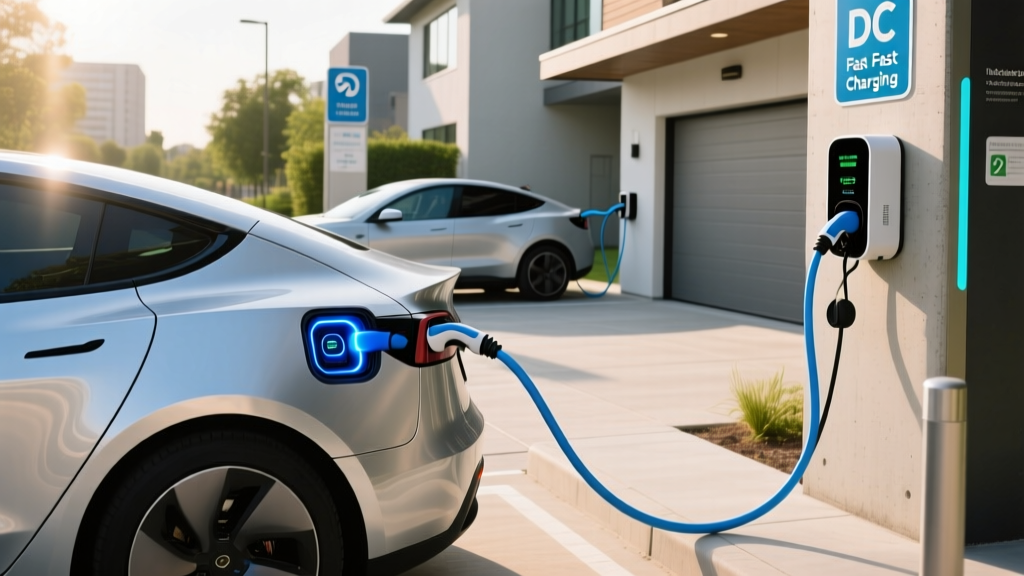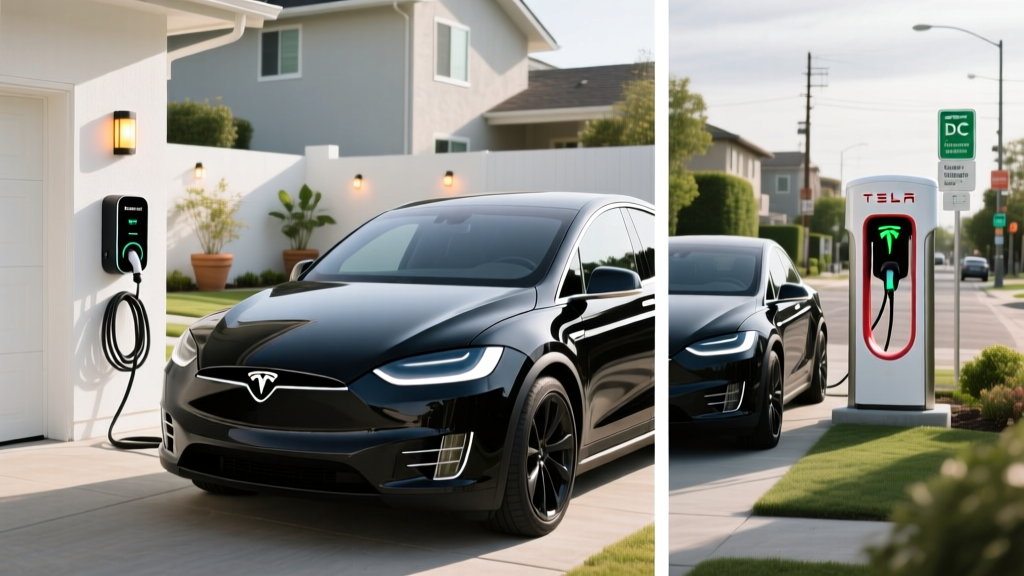
The 2020 Tesla Model X Long Range Plus remains one of the most capable electric SUVs on the used market, with an EPA-rated 371 miles of range and a 100 kWh battery pack. But extracting the best ownership experience from this vehicle depends heavily on how you charge it. A 100 kWh battery is large — charging it from empty on a standard 120V household outlet would take nearly four days. That makes a proper home charging setup and a clear understanding of public DC fast-charging essential for any Model X Long Range Plus owner or prospective buyer in 2026.
This guide covers every charging scenario you will encounter, from Level 1 trickle charging to 250 kW Supercharger sessions, with exact speeds, costs, equipment recommendations, and the electrical work required to support them.
2020 Model X Long Range Plus: Charging Specs at a Glance
Before diving into charging levels, here are the core specifications that determine how this vehicle accepts energy. The Model X Long Range Plus uses a 100 kWh battery pack (approximately 95 kWh usable) and is equipped with Tesla's proprietary NACS (North American Charging Standard) connector. It supports up to 48 amps of AC Level 2 charging via its onboard charger and up to 250 kW on DC fast chargers.
| Specification | Value |
|---|---|
| Battery Capacity (Usable) | ~95 kWh (100 kWh gross) |
| EPA Range | 371 miles |
| Real-World Highway Range | ~290–320 miles (70–80°F); ~240–270 miles (below 32°F) |
| Onboard AC Charger | 11.5 kW (48A at 240V) |
| Max DC Fast Charge Rate | 250 kW (peak) |
| 10–80% DC Fast Charge Time | ~35–40 minutes at a V3 Supercharger (250 kW) |
| Connector (AC & DC) | NACS (Tesla proprietary) |
| EPA Efficiency | 101 MPGe combined (33 kWh/100mi) |
| 0–60 mph | 4.4 seconds |
| Horsepower | 518 hp (dual motor AWD) |
Understanding Charging Levels: kW, Speed, and What Each Adds
EV charging falls into three categories, each defined by power delivery (measured in kilowatts, or kW). Power is the rate at which energy flows — think of it like the width of a hose. Energy (measured in kilowatt-hours, or kWh) is the total amount delivered — the bucket being filled. The Model X's 95 kWh usable battery is the bucket. The kW rating of your charger determines how fast that bucket fills.
| Level | Voltage / Amperage | Max Power (kW) | Miles of Range Added Per Hour | Full Charge Time (10–100%) | Best Use Case |
|---|---|---|---|---|---|
| Level 1 (120V) | 120V / 12A | ~1.4 kW | ~3–4 miles/hr | ~65–70 hours | Emergency/top-off only |
| Level 2 (240V) | 240V / 48A | 11.5 kW | ~34–38 miles/hr | ~8.5–9 hours | Daily home charging |
| DC Fast Charge (V3 Supercharger) | 400V DC | 250 kW (peak) | ~170 miles in 15 min | ~35–40 min (10–80%) | Road trips |
| DC Fast Charge (older V2 Supercharger) | 400V DC | 150 kW (peak) | ~120 miles in 15 min | ~50–55 min (10–80%) | Road trips (older stations) |
The Model X Long Range Plus can accept up to 48 amps on Level 2 AC charging, which is among the highest in any EV. Most home Level 2 chargers deliver 32A or 40A — you will still get excellent speeds, but to fully exploit the 11.5 kW onboard charger, you need a 60A circuit with a 48A charger.
Home Level 2 Charger Installation: Electrical Requirements and Costs
Installing a Level 2 home charger is the single most impactful upgrade for Model X ownership. You will wake up every morning to a full (or near-full) battery, eliminating routine visits to public chargers. Here is what the installation involves.
Electrical Requirements
To deliver 48 amps continuously to your Model X, the National Electrical Code (NEC) requires the circuit to be rated at 125% of the continuous load. That means a 60-amp dedicated circuit on a 240V line. If you opt for a 40A charger (which still delivers a strong 9.6 kW), you need a 50A circuit.
- 48A charger: Requires a 60A breaker, 6 AWG copper wire (or 4 AWG aluminum), 240V dedicated circuit
- 40A charger: Requires a 50A breaker, 6 AWG copper wire, 240V dedicated circuit
- 32A charger: Requires a 40A breaker, 8 AWG copper wire, 240V dedicated circuit
Panel Capacity and Upgrade Considerations
Before installation, your electrician will assess your main electrical panel. Most modern homes have a 200A service panel, which can typically accommodate a 60A EV circuit if there is sufficient spare capacity. However, older homes with 100A or 150A panels may require a panel upgrade to 200A — a significant added cost. Signs you may need a panel upgrade:
- Your panel is 100A or 150A service
- You already run high-draw appliances (electric oven, dryer, HVAC, tankless water heater) on a smaller panel
- Your electrician's load calculation shows you are near or above 80% of panel capacity with the EV circuit added
A panel upgrade from 100A to 200A typically costs $1,500–$3,500 depending on your utility, local labor rates, and whether a new meter base or service drop is needed. Some utilities offer rebates for panel upgrades that support EV charging — check with your local provider.
Installation Cost Breakdown
| Component | Simple Install (panel nearby, no upgrade) | Complex Install (long wire run or panel upgrade) |
|---|---|---|
| Level 2 Charger Equipment | $400–$700 | $400–$700 |
| Electrician Labor (2–4 hrs simple / 6–12 hrs complex) | $500–$1,200 | $1,500–$3,500 |
| Electrical Permit | $50–$200 | $50–$200 |
| Panel Upgrade (if needed) | $0 | $1,500–$3,500 |
| Conduit, Wire, Miscellaneous | $100–$300 | $300–$800 |
| Total Estimated Cost | $1,050–$2,400 | $3,750–$8,700 |
The wide range reflects real variability: a short wire run from a 200A panel in an attached garage might cost under $1,500 total, while a detached garage with a long trench, conduit run, and panel upgrade could exceed $7,000. Always get at least two quotes from licensed electricians and confirm they pull a permit — unpermitted work can void home insurance coverage and create safety hazards.
Public Charging: Supercharger Network, CCS Adapters, and DC Fast-Charging Reality
The 2020 Model X Long Range Plus has native access to Tesla's Supercharger network, which in 2026 includes over 6,500 V3 and V4 stalls across the US. This is a significant ownership advantage. But the broader public charging landscape has also expanded, and understanding adapter compatibility matters.
Connector Compatibility
| Connector Type | Native or Adapter Required? | Where You'll Find It | Notes |
|---|---|---|---|
| NACS (Tesla) | Native — built-in | Tesla Superchargers, Tesla Destination Chargers, some new non-Tesla stations | Primary connector for all AC and DC charging |
| CCS1 | Tesla CCS Adapter required (~$175–$250) | Electrify America, EVgo, ChargePoint DC stations, most non-Tesla DC chargers | Required for non-Tesla DC fast charging; Tesla sells an official adapter |
| CHAdeMO | Third-party adapter (limited availability, ~$300–$450) | Older public DC stations (declining in number) | Not recommended — CHAdeMO infrastructure is being phased out in the US |
| J1772 (AC Level 2 public) | Tesla J1772 adapter (included with vehicle) | Public Level 2 chargers, hotels, workplaces | Comes standard with the car; useful for destination charging |
If you plan to use non-Tesla DC fast chargers (useful on road trips through areas with sparse Supercharger coverage), purchase the official Tesla CCS1 adapter. It enables charging at Electrify America, EVgo, and other CCS networks at speeds up to the vehicle's maximum DC rate.
DC Fast-Charging Curve Reality
The 250 kW peak charge rate on a V3 Supercharger is not sustained across the entire session. Like all lithium-ion batteries, the Model X's pack accepts maximum power only at a low state of charge (SoC). Here is what a typical V3 Supercharger session looks like:
- 10–30% SoC: Peak ~250 kW, adding roughly 5–7 miles per minute
- 30–50% SoC: Tapers to ~180–200 kW
- 50–80% SoC: Tapers further to ~100–130 kW
- 80–100% SoC: Drops sharply to ~30–50 kW (charging above 80% is slow — avoid unless necessary for a specific trip)
This charge curve means the 10–80% time of ~35–40 minutes is realistic, but a 10–100% session could take 60–70 minutes. For road trips, plan to charge from 10–80% and move on — the last 20% is painfully slow and not worth the wait.
Preconditioning matters: Navigate to a Supercharger using the car's built-in navigation, and the battery will automatically precondition (warm up) to optimal charging temperature before you arrive. This can shave 5–10 minutes off your session, especially in cold weather. If you drive to a charger without preconditioning, the initial charge rate will be significantly lower until the battery warms up.
Cost to Charge: Home vs. Public vs. Gas Comparison
One of the strongest arguments for the Model X Long Range Plus is operating cost. Here is how charging expenses compare across scenarios, using the car's EPA efficiency of 33 kWh per 100 miles (or 0.33 kWh per mile).
| Scenario | Rate | Cost per Mile | Cost for 371-Mile Full "Tank" |
|---|---|---|---|
| Home charging (national avg. residential, off-peak) | $0.14/kWh | $0.046 | $17.10 |
| Home charging (California, off-peak TOU rate) | $0.12/kWh | $0.040 | $14.70 |
| Home charging (high-cost state peak rate) | $0.30/kWh | $0.099 | $36.70 |
| Tesla Supercharger (avg. 2026 rate) | $0.30/kWh | $0.099 | $36.70 |
| Electrify America / third-party DC fast | $0.40–$0.55/kWh | $0.132–$0.182 | $49–$67 |
| Gasoline SUV equivalent (22 MPG combined, $3.40/gal) | $3.40/gallon | $0.155 | $57.40 |
Home charging on an off-peak rate delivers dramatic savings — roughly $0.04–$0.05 per mile, or about one-quarter the cost of a comparable gasoline SUV. Even at Supercharger rates, the Model X costs less per mile than gas. The worst-case scenario (expensive third-party DC fast charging) is roughly comparable to gasoline, but this should represent a small fraction of your total charging if you charge at home most of the time.
For a driver covering 12,000 miles per year and charging 85% at home ($0.14/kWh) and 15% at Superchargers ($0.30/kWh), the blended annual fuel cost is approximately $730. A comparable gas SUV at 22 MPG and $3.40/gal would cost $1,855 — a savings of over $1,100 per year with the Model X.
Recommended Level 2 Home Chargers for the Model X
Since the Model X Long Range Plus can accept up to 48A, you should pair it with a charger that can deliver that full rate (or close to it) to minimize overnight charging time. Here are top picks in 2026:
Tesla Wall Connector
- Power Output: Up to 11.5 kW (48A at 240V)
- Connector: NACS (native Tesla)
- Cable Length: 24 feet
- Smart Features: Wi-Fi, OTA updates, power-sharing with second unit, load management
- Price: ~$475
- Best For: Tesla-only households wanting max speed and seamless integration
ChargePoint Home Flex
- Power Output: Up to 12 kW (50A at 240V, configurable to 16–50A)
- Connector: J1772 (use included Tesla adapter) or NACS version available
- Cable Length: 23 feet
- Smart Features: Wi-Fi, app scheduling, Alexa integration, energy tracking
- Price: ~$550–$700
- Best For: Multi-EV households (Tesla + non-Tesla) needing flexibility
Emporia Vue Level 2 Charger
- Power Output: Up to 11.5 kW (48A at 240V)
- Connector: J1772 (use Tesla adapter) or NACS version
- Cable Length: 24 feet
- Smart Features: Wi-Fi, energy monitoring, solar integration, scheduling
- Price: ~$400–$500
- Best For: Budget-conscious buyers wanting full 48A output and energy tracking
For a Tesla-only household, the Tesla Wall Connector is the clear choice: it delivers the full 48A the Model X can accept, uses the native NACS plug (no adapter needed), and integrates with the car's scheduled charging. If you also own a non-Tesla EV or anticipate one, the ChargePoint Home Flex offers more versatility.
Safety, Permits, and Code Requirements
EV charging draws significant current for hours at a time — this is a continuous load under the NEC, and safety requirements are stricter than for typical household circuits.
- Dedicated circuit: Your Level 2 charger must be on its own dedicated breaker — it cannot share a circuit with other outlets or appliances.
- GFCI protection: The 2023 NEC (adopted by most states by 2026) requires GFCI protection for all EV charging outlets. Hardwired chargers (like the Tesla Wall Connector) often have built-in GFCI protection, which avoids the nuisance-tripping issues some users experience with GFCI breakers on receptacle-based setups.
- Outdoor rating: If your charger is installed outdoors, ensure the unit is rated for outdoor use (NEMA 4 or IP65). The Tesla Wall Connector and ChargePoint Home Flex are both outdoor-rated. Use an in-use cover for receptacle-based installations.
- Permit and inspection: Virtually all jurisdictions require an electrical permit for a new 240V circuit. The inspection ensures the wire gauge, breaker size, and grounding meet code. Do not skip this step — it protects your home and is required for insurance coverage.
- Hardwired vs. plug-in: Hardwired installations (directly connected to the circuit, no plug) are generally preferred for 48A+ chargers. A NEMA 14-50 receptacle is rated for 50A, which limits you to a 40A continuous draw — fine for most setups, but a hardwired 60A circuit lets you use the full 48A. Hardwired also eliminates the risk of a loose plug connection over time.
Frequently Asked Questions
How much does it cost to install a home EV charger for a 2020 Model X Long Range Plus?
For a straightforward installation with an existing 200A panel and a short wire run, expect $1,050–$2,400 including the charger, electrician labor, and permit. If you need a panel upgrade, long conduit run, or trenching to a detached garage, costs can range from $3,750–$8,700. Always get multiple quotes from licensed electricians.
How fast will each charging level add range to the Model X?
Level 1 (120V) adds roughly 3–4 miles of range per hour — impractical for daily use with a 100 kWh battery. Level 2 (240V at 48A) adds approximately 34–38 miles per hour, fully recharging overnight in about 8.5–9 hours. DC fast charging at a 250 kW V3 Supercharger adds roughly 170 miles in 15 minutes (at low SoC), with a 10–80% session taking about 35–40 minutes.
Which connector and charger are compatible with my 2020 Model X?
The Model X uses the NACS (Tesla) connector natively for both AC and DC charging. It is compatible with all Tesla Superchargers and Destination Chargers without adapters. For non-Tesla DC fast chargers (CCS1), you will need the Tesla CCS adapter (~$175–$250). For public Level 2 J1772 chargers, use the J1772 adapter included with the vehicle.
How much does charging cost per mile compared to gas?
Charging at home at the national average residential rate of $0.14/kWh costs about $0.046 per mile in the Model X Long Range Plus. A comparable gasoline SUV getting 22 MPG at $3.40/gallon costs about $0.155 per mile — roughly 3.4 times more. Even Tesla Supercharging at $0.30/kWh ($0.099/mile) is cheaper than gas.
What electrical upgrades might I need for a home charger?
The most common upgrade is a panel capacity increase from 100A or 150A to 200A service, costing $1,500–$3,500. You may also need a new conduit run if your panel is far from the garage, a sub-panel for a detached structure, or coordination with your utility for a meter upgrade. Your electrician will perform a load calculation to determine what is needed.
Should I charge to 100% every night?
No. For daily driving, Tesla recommends setting the charge limit to 80–90% to preserve long-term battery health. The 100 kWh pack uses NMC chemistry, which degrades faster when routinely held at 100% SoC. Charge to 100% only before long road trips. The car's built-in scheduled charging and charge-limit settings make this easy to automate.
Can I use a standard household outlet to charge my Model X?
Yes, using the Tesla Mobile Connector with the 120V adapter (NEMA 5-15). However, this delivers only about 1.4 kW, adding 3–4 miles of range per hour. A full charge from near-empty would take roughly 65–70 hours. Level 1 is suitable only for emergency top-offs or very low-mileage drivers who can afford to trickle-charge over multiple days.
For authoritative data on the Model X Long Range Plus's efficiency and range, refer to fueleconomy.gov. For home charging tax credit eligibility, consult the IRS alternative fuel refueling property credit page. For electrical safety standards, reference the NFPA National Electrical Code.