Why Charging Setup Matters for the 2020 Model S Long Range
If you've picked up a used 2020 Tesla Model S Long Range — or you're eyeing one on the pre-owned market — you're getting a sedan with an EPA-rated 402 miles of range (the 2020 refresh bumped it from 370), a 100 kWh battery pack (~95 kWh usable), and dual-motor all-wheel drive producing roughly 417 horsepower. It's a road-trip-capable EV that, when charged properly, remains one of the most practical used electric cars available in 2026.
But the ownership experience lives or dies on your charging strategy. The Model S Long Range can accept up to 200 kW on DC fast charging and up to 11.5 kW on Level 2 AC (48 amps). Those are strong numbers — but only if your home electrical system and equipment can actually deliver them. This guide breaks down every charging scenario, the real costs, and the equipment that makes sense for this specific car.
Charging Levels Explained: Speeds, Power, and What to Expect
Before we get into costs and equipment, let's clarify the single most important distinction in EV charging: kW (kilowatts) measures power — how fast energy flows into the car. kWh (kilowatt-hours) measures energy — the total capacity of the battery. Think of kW as the width of the pipe, and kWh as the size of the tank. A 100 kWh battery charged at 10 kW takes roughly 10 hours. The same battery at 100 kW takes roughly 1 hour (in simplified terms — real charge curves taper near full).
| Level | Voltage / Amps | Max Power (kW) | Miles of Range per Hour | Best For |
|---|---|---|---|---|
| Level 1 (120V) | 120V / 12A | ~1.4 kW | ~3–4 mi/hr | Overnight top-ups, emergencies |
| Level 2 (240V) | 240V / 48A | 11.5 kW | ~34–38 mi/hr | Daily home charging |
| DC Fast Charge | 400V+ DC | 200 kW (peak) | ~500+ mi/hr (peak) | Road trips, rapid top-ups |
Charging Time Examples for the 2020 Model S Long Range
With ~95 kWh of usable battery capacity, here's what a 10–80% charge (adding roughly 66 kWh) looks like at each level:
- Level 1 (1.4 kW): ~47 hours — impractical for regular use but viable for maintaining charge if you drive under 30 miles daily.
- Level 2 at 48A (11.5 kW): ~5.7 hours — a full overnight charge from near-empty.
- Level 2 at 32A (7.7 kW): ~8.6 hours — still sufficient for overnight charging on a smaller circuit.
- DC Fast Charge at 200 kW peak: ~30–35 minutes for 10–80%. Note that peak rate is not sustained — the Model S charges fastest between 10–40% SoC, then tapers significantly above 60%. Expect roughly 170 kW average from 10–50%, dropping to ~80–100 kW from 50–80%.
Home Charger Installation: Costs, Electrical Requirements, and Gotchas
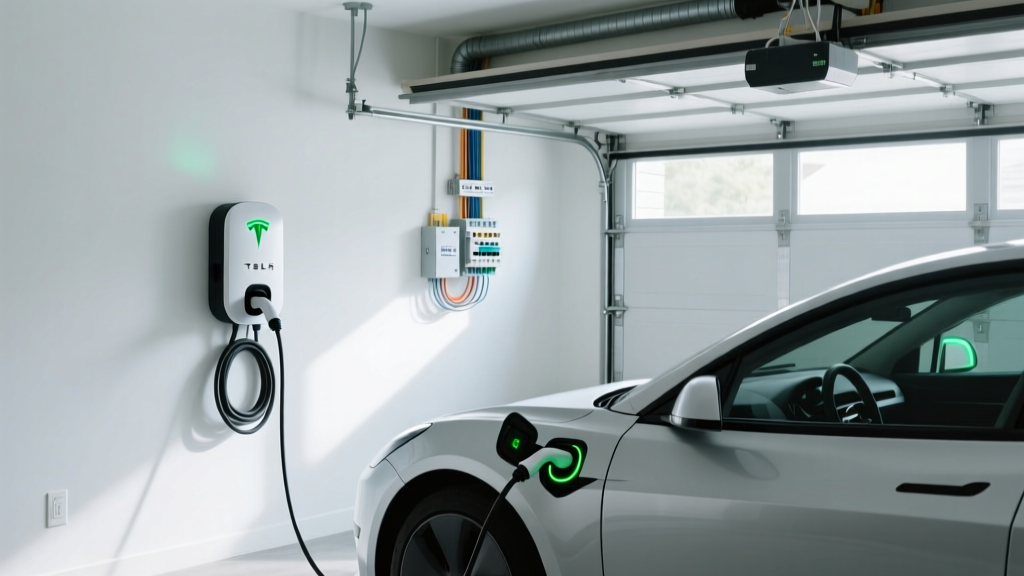
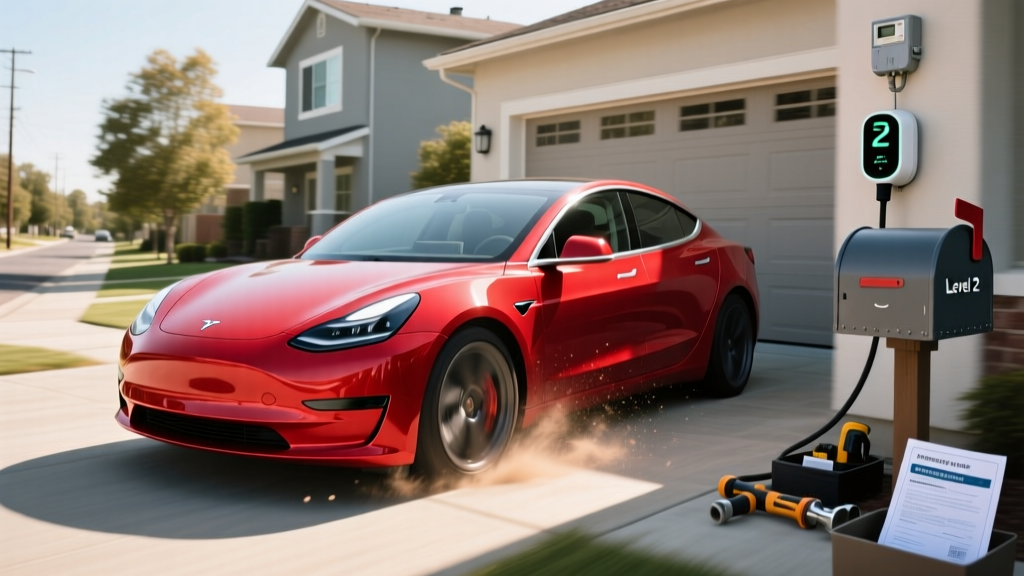
The 2020 Model S Long Range has an onboard charger capable of accepting up to 11.5 kW (48 amps) on Level 2 AC. To get that maximum rate, you need a 60-amp dedicated circuit (EVSEs must be derated to 80% of circuit capacity for continuous loads, per NEC Article 625). Most homes will need an electrician to install this circuit from the main panel.
Electrical Requirements at a Glance
- Circuit: 60A, 240V dedicated breaker (for full 48A charging)
- Alternative: 40A circuit for 32A charging (7.7 kW) — adequate for most daily driving
- Wire gauge: 6 AWG copper for 60A; 8 AWG for 40A
- Outlet vs. hardwired: NEMA 14-60 outlet (plug-in) or hardwired — hardwired avoids GFCI nuisance tripping issues common with 240V receptacles in some jurisdictions
- Permit: Required in most US jurisdictions; inspection verifies NEC compliance
Do You Need a Panel Upgrade?
This is the cost variable most online guides gloss over. The NEC requires that your total calculated load not exceed your panel's rated capacity. If you have a 100-amp main panel (common in homes built before the 1990s) and you're already running central AC, an electric dryer, and an electric oven, adding a 60A EV circuit may push you over the limit. A panel upgrade to 200 amps typically costs $1,500–$3,500 before the EV charger circuit is even added. Homes with existing 200A panels usually have sufficient headroom.
Ask your electrician to perform a NEC Article 220 load calculation before quoting. If you're close to the limit, a smart panel-level load management device (like the Emporia Smart Panel or Span drive) can avoid a full upgrade by dynamically reducing charger draw when other loads spike.
| Component | Low-End Cost | High-End Cost | Notes |
|---|---|---|---|
| Level 2 EVSE (charger unit) | $350 | $750 | Tesla Wall Connector, ChargePoint, Emporia |
| Electrician labor (standard install) | $400 | $1,200 | Depends on run length, conduit, wall penetration |
| Permit & inspection | $50 | $250 | Varies by municipality |
| Panel upgrade (if needed) | $1,500 | $3,500 | 100A → 200A service upgrade |
| Total (no panel upgrade) | $800 | $2,200 | Most common scenario |
| Total (with panel upgrade) | $2,300 | $5,700 | Older homes with 100A service |
Connector Compatibility: NACS, CCS, and Adapters for the 2020 Model S
The 2020 Model S Long Range came from the factory with Tesla's proprietary connector — now formally designated as NACS (North American Charging Standard). In 2026, NACS is the dominant connector in North America, adopted by Ford, GM, Rivian, Volvo, and most major automakers. For the Model S owner, this means native access to the entire Tesla Supercharger network (over 25,000 stalls in North America) without any adapter.
| Connector Type | Native on 2020 Model S? | Adapter Needed? | Network Access |
|---|---|---|---|
| NACS (Tesla) | ✅ Yes | None | Superchargers, Tesla Destination, new NACS public chargers |
| CCS1 | ❌ No | Tesla CCS Adapter (~$250) | Electrify America, EVgo, ChargePoint DC stations |
| CHAdeMO | ❌ No | Setec CHAdeMO adapter (~$400) | Legacy stations (declining network) |
| J1772 (Level 2 public) | ❌ No | Tesla J1772 adapter (included with car) | Public Level 2 stations, hotels, workplaces |
Adapter advice for 2020 Model S owners: The J1772 adapter ships with the car (check the glovebox or frunk). The CCS1 adapter is worth buying if you frequently travel areas with limited Supercharger coverage — Electrify America's CCS-only stations fill gaps in rural corridors. The CHAdeMO adapter is harder to justify in 2026 as that network has largely been superseded by CCS and NACS.
Charging Cost: Per-Mile Breakdown vs. Gasoline
The 2020 Model S Long Range achieves an EPA-rated 120 MPGe combined, consuming roughly 28 kWh per 100 miles. Here's what that translates to in real dollars across common charging scenarios:
| Scenario | Rate ($/kWh) | Cost per 100 mi | Cost per Mile |
|---|---|---|---|
| Home (off-peak utility rate) | $0.09 | $2.52 | $0.025 |
| Home (national avg residential) | $0.16 | $4.48 | $0.045 |
| Tesla Supercharger (avg 2026) | $0.32 | $8.96 | $0.090 |
| Electrify America / third-party DC | $0.43 | $12.04 | $0.120 |
| Gasoline equivalent (25 MPG, $3.40/gal) | — | $13.60 | $0.136 |
The bottom line: Charging primarily at home on off-peak rates saves roughly $1,100 per year vs. gasoline (assuming 12,000 miles/year). Even exclusive Supercharger use undercuts gas by ~$550/year. The savings are most dramatic when you can charge at home overnight on a time-of-use utility plan — some utilities offer EV-specific rates as low as $0.06/kWh during off-peak hours.
Best Level 2 Chargers for the 2020 Model S Long Range
Because the Model S uses NACS natively, you have two paths: buy a Tesla-native charger or buy a J1772 charger and use the included adapter. Tesla-native chargers eliminate the adapter step and often integrate with the Tesla app for scheduling and monitoring.
Tesla Wall Connector (Gen 3)
- Max output: 11.5 kW (48A)
- Connector: NACS (native)
- Cable length: 24 ft
- Smart features: Wi-Fi, OTA updates, load sharing between units, power-sharing with second Wall Connector
- Price: ~$475
- Best for: Tesla-only households wanting seamless app integration
Emporia Vue Level 2 Charger
- Max output: 11.5 kW (48A)
- Connector: J1772 (use Tesla adapter) or NACS version
- Cable length: 24 ft
- Smart features: Energy monitoring via Emporia app, solar integration, scheduled charging, load management
- Price: ~$399
- Best for: Solar owners wanting energy tracking and multi-EV households
ChargePoint Home Flex
- Max output: 12 kW (50A) — configurable down to 16A
- Connector: J1772 (use Tesla adapter) or NACS version
- Cable length: 23 ft
- Smart features: Alexa integration, ChargePoint app scheduling, flexible amperage settings for older panels
- Price: ~$599
- Best for: Homes needing adjustable amperage to avoid panel upgrades
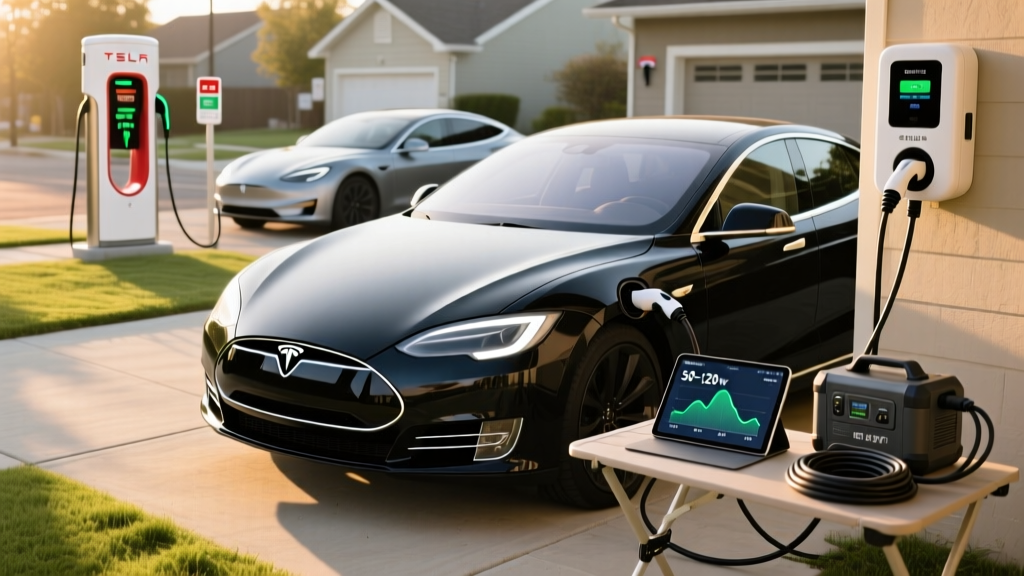
Tesla Mobile Connector (Included)
- Max output: 7.2 kW (30A) on 240V NEMA 14-50; 1.4 kW on 120V
- Connector: NACS (native)
- Cable length: 20 ft
- Smart features: None — basic charger, no Wi-Fi or scheduling
- Price: Included with vehicle (replacement ~$230)
- Best for: Budget install using existing NEMA 14-50 outlet, backup/travel charger
Safety, Electrical Code, and Installation Best Practices
A 240V EV charging circuit carries enough current to be a serious fire hazard if installed improperly. Here's what the National Electrical Code (NEC) requires and what a quality install looks like:
- Dedicated circuit: The EV charger must be on its own breaker — not shared with any other outlet or appliance. A 48A charger requires a 60A breaker.
- GFCI considerations: NEC 2020 and later require GFCI protection for outdoor receptacles. However, GFCI breakers on 240V/50A+ circuits are notorious for nuisance tripping with some EVSEs. Many electricians recommend hardwiring the charger (no receptacle) to avoid this issue — hardwired installations are exempt from the GFCI requirement in most jurisdictions.
- Outdoor rating: If mounting outside, the EVSE must be rated NEMA 4 (weatherproof). The Tesla Wall Connector, ChargePoint Home Flex, and Emporia all carry NEMA 4 ratings.
- Wire sizing: Undersized wire causes overheating and fire. 6 AWG copper for 60A circuits, 8 AWG for 40A. Aluminum wire requires larger gauge. Your electrician should pull the correct gauge — never substitute.
- Permit and inspection: Most jurisdictions require a permit for new 240V circuits. The inspection verifies wire gauge, breaker sizing, grounding, and proper mounting. Skipping the permit risks insurance denial in case of an electrical fire.
- Cable management: The charging cable should not drape across a driveway or walkway. Wall-mounted cable organizers or retractors prevent tripping hazards and cable damage.
Public Charging on the Road: Superchargers and Beyond
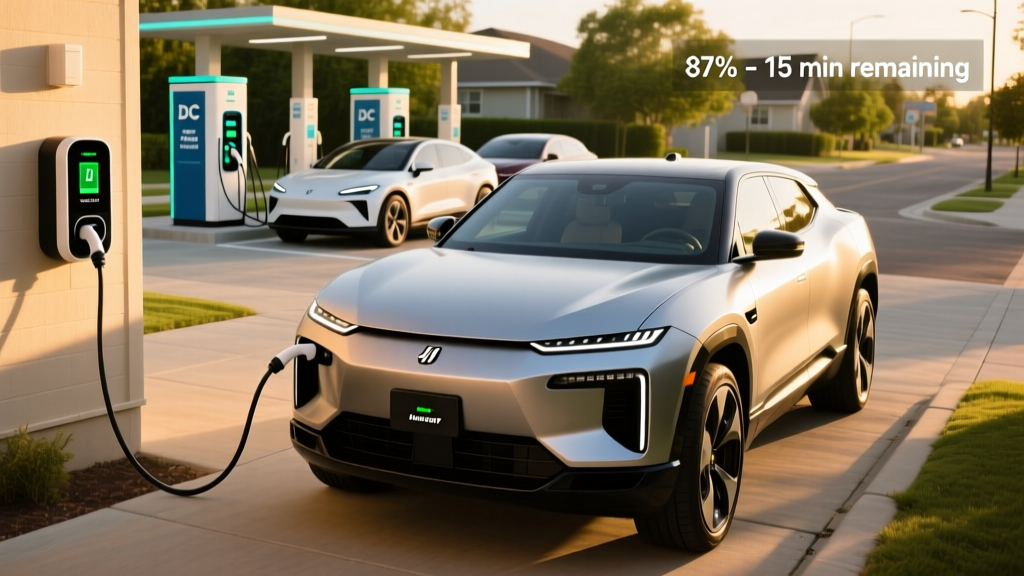
The 2020 Model S Long Range's killer advantage for road trips remains the Tesla Supercharger network. As of 2026, Superchargers are the most reliable DC fast-charging network in North America, with uptime consistently above 97%. The Model S can peak at 200 kW at V3 Superchargers, adding roughly 200 miles in 15 minutes during the initial fast-charge phase.
Charge curve reality check: The 200 kW peak only holds between roughly 10–30% state of charge. From 30–50%, expect ~150 kW. From 50–80%, the rate drops to 80–100 kW. This means a 10–80% session takes roughly 30–35 minutes — not the 15 minutes that peak-rate marketing might imply. Plan rest stops accordingly.
For non-Tesla DC networks, the Tesla CCS adapter unlocks Electrify America and EVgo stations. Reliability on these networks has improved significantly since 2023, but you may still encounter occasional offline stalls or payment-app issues. Always check PlugShare or the network's app for station status before diverting from your route.
Frequently Asked Questions
How much does it cost to install a home EV charger for the 2020 Model S Long Range?
Expect $800–$2,200 for a standard Level 2 installation (equipment, electrician, and permit) if your electrical panel has sufficient capacity. If your home needs a panel upgrade from 100A to 200A service, total costs can reach $2,300–$5,700. Get a load calculation from a licensed electrician before committing.
How fast will each charging level add range to the Model S?
Level 1 (120V) adds roughly 3–4 miles per hour. Level 2 at 48A (240V) adds 34–38 miles per hour — enough to fully recharge overnight. DC fast charging at a V3 Supercharger can add 200 miles in about 15 minutes at peak rate, though sustained rates taper significantly above 50% SoC.
Which connector and charger is compatible with the 2020 Model S?
The 2020 Model S uses the NACS (Tesla) connector natively. It plugs directly into Tesla Superchargers, Tesla Wall Connectors, and any NACS-equipped public charger. For CCS stations (Electrify America, EVgo), you'll need Tesla's CCS adapter (~$250). For J1772 Level 2 public stations, use the J1772 adapter that ships with the car.
How much does charging the Model S cost per mile compared to gas?
At the national average residential electricity rate (~$0.16/kWh), the 2020 Model S Long Range costs about $0.045 per mile to charge at home. A comparable gas sedan getting 25 MPG at $3.40/gallon costs $0.136 per mile. Home charging saves roughly $0.09 per mile, or about $1,100 over 12,000 miles of annual driving. Even exclusive Supercharger use (~$0.09/mile) saves ~$550/year.
What electrical upgrades might my home need for a Level 2 charger?
The most common upgrade is running a new dedicated 240V circuit from your main panel — typically a 60A breaker with 6 AWG wire for full 48A charging. If your panel is already near capacity (common with 100A service in older homes), you may need a panel upgrade to 200A, which adds $1,500–$3,500. A smart load-management device can sometimes avoid a full panel upgrade by dynamically limiting charger draw.
Can I use the included Tesla Mobile Connector instead of buying a wall unit?
Yes. The Mobile Connector delivers up to 7.2 kW (30A) when plugged into a NEMA 14-50 outlet — enough to add ~22 miles of range per hour and recharge overnight for most drivers. However, it lacks Wi-Fi, scheduling, and energy-monitoring features. If you drive more than 200 miles daily or want off-peak scheduling, a dedicated Wall Connector at 11.5 kW is a worthwhile upgrade.
Is the 2020 Model S Long Range eligible for any EV tax credits?
As a used vehicle, the 2020 Model S Long Range may qualify for the IRS §25E used clean vehicle credit — up to $4,000 or 30% of the sale price (whichever is lower), subject to buyer income caps ($75K single / $150K joint), a sale price cap of $25,000, and purchase through a licensed dealer. Consult a tax professional for your specific eligibility.
Sources: EPA Fuel Economy — 2020 Tesla Model S, Tesla Home Charging, IRS Used Clean Vehicle Credit