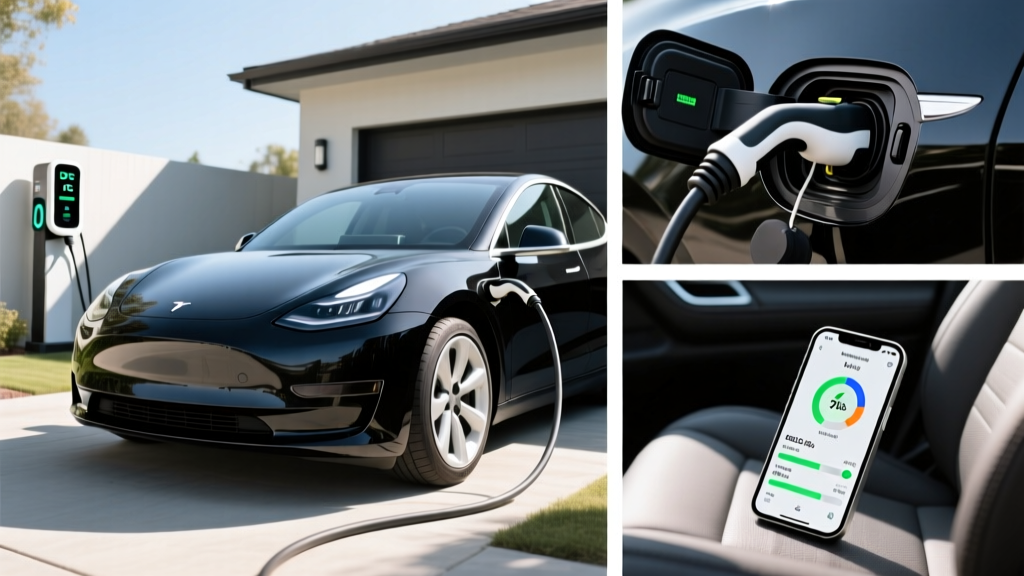
If you own or are considering a used 2020 Tesla Model 3 Standard Range Plus, understanding its charging behavior is essential for daily usability and long-term battery health. This compact sedan packs a ~50 kWh usable LFP (lithium iron phosphate) or NMC battery (depending on production batch), an EPA-rated 250 miles of range, and a peak DC fast-charge rate of 170 kW. But real-world charging speed, cost, and convenience depend heavily on which equipment you use and where you plug in.
This guide breaks down every charging scenario for the 2020 Model 3 SR+, from a standard 120V wall outlet to Tesla Superchargers and third-party DC networks — plus exactly what it takes to install a Level 2 home charger, what it costs, and how your per-mile fuel spend compares to a gas car.
2020 Model 3 Standard Range Plus: Key Charging Specs at a Glance
| Spec | Value |
|---|---|
| EPA Range | 250 miles (real-world highway ~210–225 mi; cold weather ~185–200 mi) |
| Battery Capacity (Usable) | ~50 kWh (NMC or LFP depending on production date) |
| Onboard Charger (Level 2 AC) | 11.5 kW max (48A) |
| Peak DC Fast Charge Rate | 170 kW |
| 10–80% DC Fast Charge Time | ~25–28 minutes (at V3 Supercharger, preconditioned) |
| Level 2 Charge Time (0–100%) | ~5 hours at 11.5 kW (48A/240V) |
| Connector | NACS (native Tesla) |
| EPA Efficiency | 141 MPGe combined (24 kWh/100 mi) |
| Battery Warranty | 8 years / 100,000 miles (≥70% capacity retention) |
Charging Levels Explained: Speeds in kW and Miles Per Hour
The three EV charging levels differ in power delivery (measured in kW, or kilowatts — the rate of energy flow). The battery capacity itself is measured in kWh (kilowatt-hours — the total energy stored). Confusing these two is the most common EV literacy mistake. Think of kW as the speed of water flowing through a hose, and kWh as the total volume of the tank you're filling.
| Level | Voltage / Amperage | Max Power (kW) | Miles of Range Added Per Hour | 0–100% Time (~50 kWh) |
|---|---|---|---|---|
| Level 1 (120V household outlet) | 120V / 12A | ~1.4 kW | ~3–4 mi/hr | ~36+ hours |
| Level 2 (240V home/public AC) | 240V / 48A | 11.5 kW | ~30–33 mi/hr | ~5 hours |
| DC Fast Charge (Supercharger V3) | 400V+ DC | 170 kW peak | ~170 mi in 15 min | 10–80% in ~25 min |
Level 1 is adequate only for overnight top-ups if your daily drive is under 30 miles. Level 2 is the practical home standard — a full overnight charge every time. DC fast charging is for road trips and quick top-ups; the Model 3 SR+ can accept up to 170 kW but only at low states of charge (SoC). Above 80%, the charge curve tapers sharply to protect battery longevity — this is why 10–80% is the standard metric rather than 0–100%.
Home Level 2 Charger Installation: Requirements, Costs & Panel Upgrades
Installing a Level 2 home charger for your 2020 Model 3 SR+ is the single most impactful upgrade for daily convenience. Here's what's involved electrically and financially.
Electrical Requirements
- Circuit: Dedicated 60A breaker (to deliver a continuous 48A to the car)
- Voltage: 240V split-phase (standard US residential)
- Wire gauge: 6 AWG copper (THHN in conduit or NM-B/Romex where code permits)
- Connector: NACS (Tesla proprietary) — hardwired units eliminate the need for a 14-50 receptacle, though a NEMA 14-50 outlet offers portability
Panel Upgrade Considerations
Many older homes (pre-2000) have 100A or 150A main panels. Adding a 60A EV circuit may exceed the panel's capacity, especially if you already run electric dryer, oven, and HVAC. A licensed electrician will perform a load calculation per NEC Article 220 to determine if your panel can handle the additional draw. If not, a panel upgrade to 200A is typically required.
| Component | Low Estimate | High Estimate | Notes |
|---|---|---|---|
| Level 2 Charger (hardware) | $400 | $700 | Tesla Wall Connector, ChargePoint Home Flex, Emporia |
| Electrician labor (standard install) | $600 | $1,500 | Short wire run, accessible panel, no conduit complexity |
| Electrical permit | $50 | $200 | Varies by municipality |
| Panel upgrade (if needed) | $1,500 | $3,500 | 100A→200A service upgrade; not always required |
| Conduit / trenching (long runs) | $200 | $2,000 | Garage adjacent to panel = cheap; detached garage = expensive |
| Total (no panel upgrade) | $1,050 | $2,400 | Most homes with 200A service |
| Total (with panel upgrade) | $2,550 | $5,900 | Older homes needing 200A service |
The IRS §30D credit does not cover home charger equipment for most taxpayers in 2026 — the alternative fuel vehicle refueling property credit (IRC §30C) was modified and is now subject to census-tract eligibility and a 30% cap up to $1,000. Check with a tax professional and verify your address qualifies.
Connector Compatibility: NACS, CCS1 & Adapter Needs
The 2020 Model 3 Standard Range Plus comes with a native NACS (North American Charging Standard) port — Tesla's proprietary connector, which was adopted as an industry standard in late 2022 and is now used by Ford, GM, Rivian, Volvo, and most major automakers as of 2025–2026.
| Connector Type | Native Support? | Adapter Needed? | Where You'll Find It |
|---|---|---|---|
| NACS (Tesla) | Yes — native | None | Tesla Superchargers, Tesla Destination Chargers, newer public stations |
| CCS1 | No | Tesla CCS Adapter (~$175–$250) | Electrify America, EVgo, ChargePoint DC stations |
| CHAdeMO | No | Third-party adapter (rare, ~$300+) | Legacy Nissan Leaf stations; increasingly obsolete |
| J1772 (Level 2 AC public) | No | Tesla J1772 Adapter (included with car) | Public Level 2 stations, workplaces, hotels |
For daily use, the Tesla Supercharger network remains the most reliable DC fast-charging option. However, owning a CCS adapter is strongly recommended for road trips through areas with sparse Supercharger coverage. The Tesla CCS Adapter enables charging at up to ~150 kW on compatible third-party stations. According to Tesla's official CCS adapter page, it's compatible with all Model 3 vehicles produced after 2020 — verify your specific VIN for firmware support.
Cost to Charge: Per-Mile Economics vs. Gasoline
One of the strongest ownership arguments for the 2020 Model 3 SR+ is fuel cost. At 24 kWh per 100 miles (per fueleconomy.gov), your per-mile cost varies dramatically based on where and when you charge.
| Scenario | Electricity Rate ($/kWh) | Cost per 100 Miles | Cost per Mile | Equivalent Gas MPG at $3.50/gal |
|---|---|---|---|---|
| Home — off-peak utility rate | $0.09 | $2.16 | $0.022 | 162 MPG |
| Home — average US residential | $0.17 | $4.08 | $0.041 | 86 MPG |
| Public Level 2 (ChargePoint, etc.) | $0.25 | $6.00 | $0.060 | 58 MPG |
| DC Fast Charge (Supercharger avg.) | $0.35 | $8.40 | $0.084 | 42 MPG |
| DC Fast Charge (peak pricing) | $0.50 | $12.00 | $0.120 | 29 MPG |
Gas comparison baseline: A comparable 2020 gas sedan averaging 30 MPG combined at $3.50/gallon costs $0.117 per mile. Even at public DC fast-charger peak pricing, the Model 3 SR+ is competitive. At home off-peak rates, it's roughly 5x cheaper per mile than gasoline.
For a driver covering 12,000 miles/year charging primarily at home (average US rate of $0.17/kWh), annual fuel cost is approximately $490. The equivalent gas car spends $1,400. That's ~$910/year in fuel savings alone — before factoring in reduced maintenance (no oil changes, fewer brake replacements due to regenerative braking).
Recommended Home Charging Equipment for the 2020 Model 3 SR+
The Model 3's 11.5 kW onboard charger means you can take full advantage of a 48A/240V circuit. Here are three proven Level 2 chargers optimized for this vehicle.
Tesla Wall Connector (Gen 3)
- Power Output: Up to 11.5 kW (48A)
- Connector: NACS (native, no adapter)
- Cable Length: 24 ft
- Smart Features: Wi-Fi, OTA updates, power sharing between two units, load management
- Price: ~$475
- Best For: Tesla-only households wanting seamless integration
ChargePoint Home Flex
- Power Output: Up to 12 kW (50A, configurable down to 16A)
- Connector: J1772 (use Tesla J1772 adapter) or NACS pigtail version
- Cable Length: 23 ft
- Smart Features: Wi-Fi, app scheduling, Alexa integration, flexible amperage
- Price: ~$550–$650
- Best For: Multi-EV households or renters who may move
Emporia Vue + EV Charger
- Power Output: Up to 11.5 kW (48A)
- Connector: J1772 (adapter needed) or NACS version available
- Cable Length: 24 ft
- Smart Features: Energy monitoring, solar integration, scheduling, load management
- Price: ~$400–$500
- Best For: Solar-panel owners wanting energy-aware charging
Safety, Code & Installation Best Practices
EV charging draws sustained high current for hours — this is fundamentally different from intermittent appliances. Proper installation isn't optional; it's a fire-safety requirement.
- Dedicated circuit: The charger must be on its own breaker — never shared with other outlets or appliances.
- GFCI protection: NEC 2020 and later require GFCI protection for all EV receptacles (NEMA 14-50). Hardwired installations may be exempt depending on local code — ask your electrician.
- Outdoor rating: If installed outside, the charger must carry a NEMA 4 (weather-resistant) rating. The Tesla Wall Connector and ChargePoint Home Flex are both rated for outdoor use.
- Permit and inspection: Most jurisdictions require an electrical permit and post-installation inspection. Skipping this can void homeowner's insurance coverage in the event of an electrical fire.
- Wire gauge compliance: 6 AWG copper minimum for a 60A breaker/48A continuous load. Never undersize wire — it's a leading cause of EV charger fires.
Frequently Asked Questions
How much does it cost to install a home EV charger for the 2020 Model 3 SR+?
Between $1,050 and $2,400 for a standard installation (charger + electrician + permit) if your home already has a 200A panel. If a panel upgrade is needed, total cost rises to $2,550–$5,900. The Tesla Wall Connector (~$475) paired with a straightforward garage install near the panel is the most cost-effective path.
How fast will each charging level add range to my Model 3 SR+?
Level 1 (120V): approximately 3–4 miles of range per hour. Level 2 (240V/48A): approximately 30–33 miles per hour. DC fast charging (Supercharger V3): up to 170 miles in 15 minutes at peak rate, though the charge curve tapers significantly above 80% SoC.
Which connector is compatible with the 2020 Model 3 Standard Range Plus?
The car has a native NACS (Tesla) connector. It charges natively at all Tesla Superchargers and Destination Chargers. For CCS1 public DC stations (Electrify America, EVgo), you need Tesla's CCS Adapter (~$175–$250). For public Level 2 J1772 stations, the J1772 adapter (typically included with the car) is required.
How much does charging cost per mile compared to gas?
At home on an average US electricity rate ($0.17/kWh), the Model 3 SR+ costs about $0.041 per mile — equivalent to driving an 86 MPG gas car. A comparable 30 MPG gas sedan at $3.50/gallon costs $0.117 per mile. Home charging saves roughly $910/year for a 12,000-mile driver. Even public DC fast charging at $0.35/kWh ($0.084/mi) beats gasoline.
What electrical upgrades might I need before installing a Level 2 charger?
If your home has a 100A or 150A main panel with several high-draw appliances (electric dryer, oven, central AC), you may need a panel upgrade to 200A. A licensed electrician will perform a NEC Article 220 load calculation. Alternatives include installing a lower-amperage charger (e.g., 32A/7.7 kW on a 40A breaker) or using a smart load-management device to avoid a full panel upgrade.
Can I charge the 2020 Model 3 SR+ to 100% daily?
If your vehicle has an LFP battery (common in later 2020 production), Tesla recommends charging to 100% at least once per week to maintain battery calibration. If your car has an NMC battery, daily charging to 80% is optimal for longevity, reserving 100% for road trips. Check your vehicle's battery type in the Tesla app under "Battery" settings — LFP models show a recommendation to charge to 100% regularly.
Does the 2020 Model 3 SR+ precondition its battery for faster DC charging?
Yes. When you navigate to a Supercharger via the car's built-in navigation, the thermal management system automatically warms or cools the battery to its optimal charging temperature before you arrive. This can shave 5–10 minutes off your 10–80% charge time, especially in cold weather. Always navigate to the charger rather than just driving there — the preconditioning cycle only activates with an active navigation route to a Supercharger.