Understanding the 2019 Tesla Model S Long Range Battery and Charging Architecture
The 2019 Tesla Model S Long Range (Raven update) shipped with a ~100 kWh battery pack (approximately 95 kWh usable) using Panasonic NMC (nickel-manganese-cobalt) cells. EPA-rated range was 370 miles for the Standard Range variant and up to 370 miles for the Long Range AWD, though real-world highway driving at 75 mph typically yields 300–330 miles, and cold weather (below 32°F) can knock that down another 15–25%. The onboard AC charger is 16.5 kW (48A), which is among the fastest Level 2 acceptance rates in any EV sold that year. DC fast charging peaks around 120–140 kW on V2 Superchargers and up to 200 kW on V3 Superchargers (with preconditioning), though sustained rates taper significantly above 60% state of charge.
EPA sticker: 370 miles (Long Range AWD).
Real-world highway (70–75 mph, moderate climate): ~300–330 miles.
Cold weather (20°F, highway): ~260–290 miles.
Plan road trips around 250 miles between stops to preserve a safety buffer.
Charging Levels Explained: kW, Miles Per Hour, and What Each Means
Before plugging in, the single most important distinction in EV charging is between kW (kilowatts), which measures power — the rate of energy flow — and kWh (kilowatt-hours), which measures energy — the total amount stored in the battery. A 100 kWh battery charged at 10 kW takes roughly 10 hours from empty. A kW rating tells you how fast; a kWh rating tells you how much.
| Level | Voltage | Power (kW) | Miles Added/Hour | Best Use Case |
|---|---|---|---|---|
| Level 1 | 120V AC | 1.0–1.4 kW | 3–5 mi/hr | Overnight trickle, emergencies |
| Level 2 | 240V AC | 3.3–19.2 kW | 12–60 mi/hr | Daily home/work charging |
| DC Fast | 200–500V DC | 50–250+ kW | 150–800+ mi/hr | Road trips, rapid top-ups |
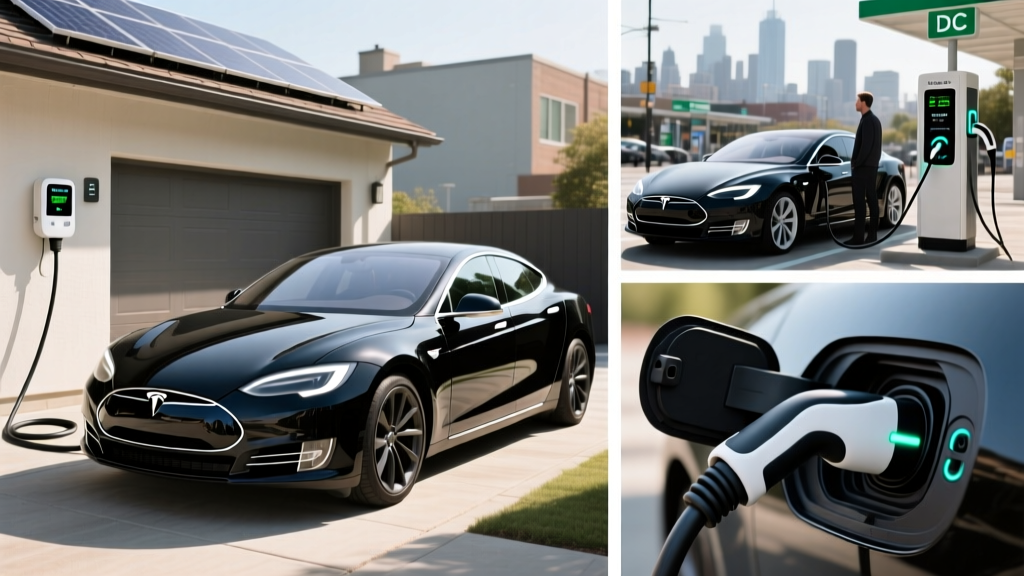
For the 2019 Model S Long Range, Level 1 at 1.4 kW adds roughly 4 miles per hour — enough only if you drive under 40 miles daily and have 12+ hours to park. Level 2 at the car's maximum 16.5 kW (48A, hardwired) adds approximately 52 miles per hour, refilling the 95 kWh usable pack from 10–100% in about 5.5 hours. DC fast charging on a V3 Supercharger (250 kW peak) can push 10–80% in roughly 35–45 minutes, though the charge curve tapers sharply above 60% — the car may only draw 40–60 kW in the final 20% to protect battery health.
Home Charger Installation: Electrical Requirements, Panel Upgrades, and Costs
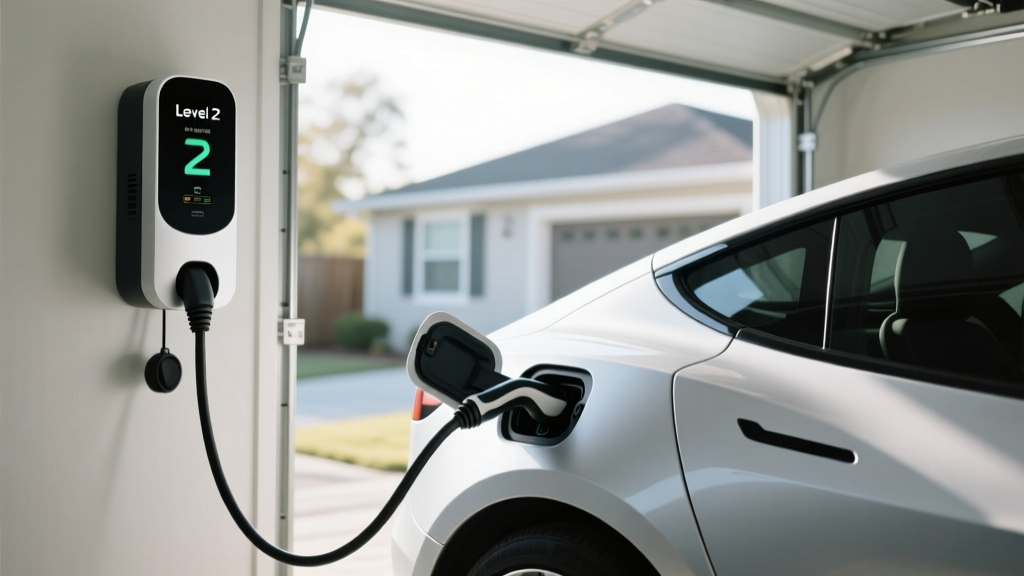
Charging a 100 kWh battery at home is where the 2019 Model S Long Range shines — if your electrical panel can support it. To unlock the car's full 16.5 kW onboard charger, you need a 240V/60A dedicated circuit (hardwired, NEMA 14-50 outlet is limited to 40A continuous / 9.6 kW). Most homes built after 2000 have a 200A main panel that can accommodate this, but older homes with 100A or 150A service may require a panel upgrade.
Key electrical requirements:
- Circuit: 60A dedicated, 240V, hardwired (for full 48A continuous draw)
- Wire gauge: 6 AWG copper (THHN in conduit) or 4 AWG aluminum
- Breaker: 60A double-pole
- GFCI: Required by NEC 2020+ for EV outlets in garages; hardwired units typically exempt but check local code
- Permit: Required in nearly all US jurisdictions for new 240V circuits
- Outdoor rating: NEMA 4 or NEMA 4X if the charger is mounted outside
| Item | Low Estimate | High Estimate | Notes |
|---|---|---|---|
| Level 2 charger hardware | $400 | $750 | Wall Connector, ChargePoint, Emporia |
| Electrician labor (run 240V circuit) | $600 | $2,000 | Depends on panel-to-charger distance, wall type |
| Permit fees | $50 | $250 | Varies by municipality |
| Panel upgrade (if needed) | $1,500 | $4,000 | 100A→200A upgrade; not always required |
| Total (no panel upgrade) | $1,050 | $3,000 | Typical for 200A-panel homes |
| Total (with panel upgrade) | $2,550 | $7,000 | Older homes with 100A service |
Always hire a licensed electrician and pull a permit — unpermitted electrical work can void homeowners insurance and create fire risk. Ask your electrician to perform a load calculation on your panel before committing to a 60A circuit; if your panel is near capacity (electric range, dryer, HVAC), you may need to downsize to a 40A circuit (NEMA 14-50), which still delivers 9.6 kW — adequate for most daily needs on the Model S.
Connector Compatibility: NACS, CCS, and Adapter Requirements
The 2019 Tesla Model S Long Range uses Tesla's proprietary connector (now standardized as NACS — North American Charging Standard). This is the native connector for all Tesla Superchargers, Destination Chargers, and the Tesla Wall Connector. Unlike newer EVs from Ford, GM, and Rivian that are transitioning to NACS, the Model S has always used this connector natively — so no adapter is needed for Tesla's own network.
However, for non-Tesla public Level 2 chargers (which use the J1772 standard) or DC fast chargers (which use CCS1 or CHAdeMO), you will need adapters:
| Connector | Network / Use | Adapter Needed? | Cost |
|---|---|---|---|
| NACS (Tesla native) | Superchargers, Destination, Wall Connector | No | N/A |
| J1772 (Level 2 public) | ChargePoint, Blink, public Level 2 | Tesla Mobile Connector J1772 adapter (included) or third-party | $0–$50 |
| CCS1 (DC fast) | Electrify America, EVgo, non-Tesla DCFC | Tesla CCS Adapter (official, ~$175) | $175 |
| CHAdeMO (DC fast) | Largely deprecated in US | Third-party CHAdeMO-to-Tesla adapter | $300–$450 |
The Tesla CCS1 adapter is essential if you plan to use Electrify America or EVgo's DC fast chargers on road trips outside the Supercharger network. It supports up to 250 kW, though real-world speeds depend on the station and the car's charge curve. Note that Tesla has opened select Supercharger stations to non-Tesla EVs via the Magic Dock (built-in CCS adapter), but for your Model S, the native NACS plug works everywhere in the Supercharger network without any adapter.
Charging Cost: $/kWh Scenarios and Cost Per Mile vs. Gas
One of the strongest ownership arguments for the 2019 Model S Long Range is the per-mile energy cost, but it varies dramatically depending on where and when you charge. The Model S Long Range achieves approximately 111 MPGe combined per the EPA, which translates to roughly 30 kWh per 100 miles (0.30 kWh/mile).
| Charging Scenario | $/kWh | Cost per 100 Miles | Cost per Mile | Equivalent Gas MPG (at $3.50/gal) |
|---|---|---|---|---|
| Home (off-peak utility rate) | $0.08–$0.12 | $2.40–$3.60 | $0.024–$0.036 | 97–146 MPG |
| Home (standard residential avg) | $0.15–$0.18 | $4.50–$5.40 | $0.045–$0.054 | 65–78 MPG |
| Tesla Supercharger (avg US) | $0.25–$0.35 | $7.50–$10.50 | $0.075–$0.105 | 33–47 MPG |
| Electrify America / EVgo DCFC | $0.30–$0.48 | $9.00–$14.40 | $0.090–$0.144 | 24–39 MPG |
| Gas car baseline (25 MPG avg) | — | $14.00 | $0.14 | 25 MPG |
At home on a time-of-use (TOU) plan with off-peak rates around $0.10/kWh, the Model S Long Range costs roughly $3 per 100 miles — about one-fifth the cost of a 25 MPG gas car at $3.50/gallon. Even on the road using Superchargers at $0.30/kWh, the cost is comparable to a 35 MPG hybrid. The key to maximizing savings is installing a home Level 2 charger and charging during off-peak hours; a smart charger with scheduled charging (see equipment picks below) automates this.
For a driver covering 12,000 miles per year, home charging at $0.12/kWh costs approximately $432/year in electricity. The same miles in a 25 MPG gas car at $3.50/gallon would cost $1,680/year — a savings of over $1,200 annually, which helps offset the Model S's higher purchase price over time.
Recommended Home Charging Equipment for the Model S Long Range
The 2019 Model S's 16.5 kW (48A) onboard charger is faster than most home chargers can deliver, so choosing the right equipment matters. Below are three proven options, all with NACS connectors native to Tesla:
Tesla Wall Connector (Gen 3)
- Power output: Up to 11.5 kW (48A) on a 60A circuit
- Connector: NACS (native Tesla)
- Cable length: 24 ft
- Smart features: Wi-Fi, firmware updates, load sharing (pair two units on one circuit), access control
- Price: ~$475
- Why pick it: Best integration with Tesla vehicles; cleanest installation; supports power sharing for two-car garages
ChargePoint Home Flex (NACS version)
- Power output: Up to 12 kW (50A) on a 60A circuit, adjustable down to 16A
- Connector: NACS (2025+ models) or J1772 with adapter
- Cable length: 23 ft
- Smart features: Wi-Fi, app scheduling, Alexa integration, flexible amperage dial
- Price: ~$550–$650
- Why pick it: Adjustable amperage is ideal if your panel has limited headroom; strong app with detailed session data
Emporia Vue Smart EV Charger
- Power output: Up to 11.5 kW (48A) on a 60A circuit
- Connector: NACS (2025+ models) or J1772
- Cable length: 24 ft
- Smart features: Wi-Fi, solar integration (pairs with Emporia Vue energy monitor), TOU scheduling, load management
- Price: ~$400–$500
- Why pick it: Best value; excellent if you have solar panels and want to charge only on excess solar production
For the 2019 Model S Long Range, the Tesla Wall Connector is the default recommendation — it's purpose-built for the car, requires no adapter, and offers the simplest setup. If you need flexible amperage due to panel constraints or want a charger that can serve a future non-Tesla EV, the ChargePoint Home Flex is a strong alternative. Note: all three units require hardwiring for maximum output; NEMA 14-50 plug installations cap at 40A (9.6 kW).
DC Fast Charging: Charge Curve, Supercharger Generations, and 10–80% Times
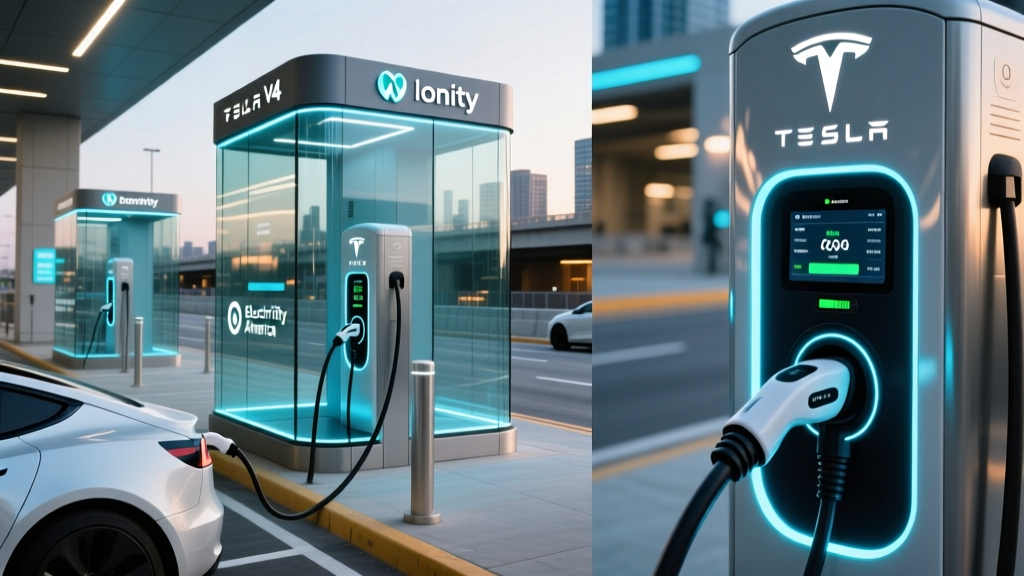
On road trips, the 2019 Model S Long Range relies primarily on Tesla's Supercharger network. Understanding the charge curve is essential for planning efficient stops:
- V2 Supercharger (150 kW): The most common station type in 2019–2023. Expect peak rates of 120–140 kW, tapering to ~60 kW by 60% SoC. A 10–80% charge takes approximately 45–55 minutes.
- V3 Supercharger (250 kW): The Model S Long Range (Raven) can accept up to ~200 kW with proper battery preconditioning. Peak rates hold from roughly 10–30% SoC, then taper progressively. A 10–80% charge takes approximately 35–45 minutes.
- V4 Supercharger (newest, 2024+): Higher power cabinets, but the 2019 Model S is limited by its own battery management system to roughly V3-level speeds.
Preconditioning matters: Navigate to a Supercharger using the car's built-in navigation, and the battery thermal management system will warm (or cool) the pack to optimal temperature before you arrive. This can add 20–40 kW to your initial charge rate. Arriving without preconditioning — for example, by using a third-party app to navigate — can result in significantly slower charging, especially in cold weather.
The charge curve taper is a battery-protection feature. Above 80% SoC, the car dramatically reduces charging speed to prevent lithium plating and thermal stress on the NMC cells. On a road trip, it's faster to charge from 10–80% and drive on than to wait for a full charge — the last 20% can take as long as the first 70%.
Safety, Code Compliance, and Ownership Tips
Beyond the electrical basics, a few safety and code items are critical for any 2019 Model S home charging setup:
- Dedicated circuit: Your Level 2 charger must have its own dedicated breaker — never share a circuit with a dryer, range, or HVAC unit.
- GFCI protection: NEC 2020 and later requires GFCI protection for EV charging outlets (NEMA 14-50). Hardwired chargers like the Wall Connector are generally exempt from this specific requirement, but local AHJ (Authority Having Jurisdiction) rules vary — confirm with your inspector.
- Outdoor installations: If your charger is outside, it must carry a NEMA 4 (weather-resistant) rating. All three chargers recommended above meet this standard.
- Cable management: Use a wall-mounted cable organizer to prevent tripping hazards and reduce strain on the connector.
- Ventilation: Level 2 chargers generate minimal heat, but install in a location with basic airflow; avoid enclosed cabinets.
For battery longevity on the 2019 Model S, Tesla recommends setting the daily charge limit to 80–90% for NMC chemistry and charging to 100% only before long trips. Regular 100% charges accelerate degradation — expect roughly 8–12% capacity loss over 100,000 miles with proper charging habits. The battery and drive unit carry an 8-year / 150,000-mile warranty with a minimum 70% capacity retention threshold, per Tesla's warranty documentation.
Frequently Asked Questions
How much does it cost to install a home EV charger for a 2019 Tesla Model S?
Expect $1,050–$3,000 for a standard installation (charger + electrician + permit) if your home has a 200A panel. If a panel upgrade from 100A to 200A is needed, add $1,500–$4,000. The Tesla Wall Connector itself costs ~$475.
How fast will each charging level add range to the Model S Long Range?
Level 1 (120V): ~4 miles/hour. Level 2 at 48A (240V hardwired): ~52 miles/hour. DC fast charging at a V3 Supercharger: up to ~170 miles in 15 minutes at peak rate, though sustained average is lower due to charge-curve taper.
Which connector and charger is compatible with my 2019 Model S?
Your Model S uses the NACS (Tesla) connector natively. For Tesla Superchargers and the Wall Connector, no adapter is needed. For J1772 public Level 2 chargers, use the included J1772 adapter. For CCS1 DC fast chargers (Electrify America, EVgo), purchase the Tesla CCS1 adapter (~$175).
How much does charging cost per mile compared to gas?
At home on off-peak rates ($0.10/kWh), the Model S Long Range costs approximately $0.03/mile — equivalent to a 117 MPG gas car at $3.50/gallon. On Superchargers ($0.30/kWh), cost rises to ~$0.09/mile, still cheaper than most gas vehicles. A typical driver saves $1,000–$1,200/year vs. a 25 MPG gas car.
What electrical upgrades might I need for a 60A Level 2 circuit?
If your home has a 200A panel with available capacity (confirmed by an electrician's load calculation), no upgrade is needed. Homes with 100A or 150A panels, or panels near capacity with existing large loads (electric range, dryer, heat pump), may need a panel upgrade ($1,500–$4,000) or must downsize to a 40A circuit, which still provides 9.6 kW — enough to fully recharge the Model S overnight.
Can I use a NEMA 14-50 outlet instead of hardwiring?
Yes, but a NEMA 14-50 outlet is limited to 40A continuous (NEC 80% rule on a 50A breaker), delivering 9.6 kW instead of the full 16.5 kW. This adds roughly 31 miles/hour of range — sufficient for most daily driving. The advantage is portability: you can use the Tesla Mobile Connector and take it with you if you move. For maximum speed, hardwire at 60A.
Does the 2019 Model S Long Range qualify for any federal tax credits?
No. The IRS §30D clean vehicle credit applies only to new vehicle purchases. As a used 2019 model, it may qualify for the Used Clean Vehicle Credit (up to $4,000 or 30% of sale price, whichever is less), subject to income caps ($75K single / $150K joint), a dealer-sale requirement, and a sale price cap of $25,000. Confirm eligibility with a tax professional and the IRS guidelines for the current tax year.