Quick Verdict: Charging the 2019 Tesla Model 3 Standard Range Plus
The 2019 Tesla Model 3 Standard Range Plus (SR+) ships with a ~50 kWh usable LFP or NMC battery pack (chemistry varied by production month) and an EPA-rated 240 miles of range. In real-world highway driving at 70 mph, expect 190–210 miles; in freezing temperatures, that drops to roughly 170–190 miles. The car accepts up to 150 kW on DC fast charging and 7.7 kW on Level 2 AC — figures that directly dictate what home charger to buy and how long road-trip stops take.
- EPA sticker: 240 miles
- Real-world highway (70 mph, moderate temps): ~200 miles
- Real-world cold weather (below 32°F): ~175 miles
- Usable battery capacity: ~50 kWh
- Efficiency: 141 MPGe combined / 26 kWh per 100 miles (per fueleconomy.gov)
This guide covers every charging scenario for the SR+ — from a standard 120V wall outlet to Tesla Superchargers and third-party DC networks — plus the exact electrical requirements and costs for installing a home Level 2 charger in 2026.
Charging Levels Explained: Speeds in kW and Miles per Hour
Before buying equipment, you need to understand the three charging levels and how they map to the SR+'s onboard hardware. A critical distinction: kW (kilowatts) measures power — the rate of energy flow, like water pressure from a hose. kWh (kilowatt-hours) measures energy — the total amount stored in the battery, like gallons in a tank. Never confuse the two.
| Level | Voltage | Max Power (kW) | Miles of Range per Hour | Typical Use Case |
|---|---|---|---|---|
| Level 1 | 120V AC | ~1.0–1.4 kW | 3–5 mi/hr | Overnight trickle, emergency top-up |
| Level 2 | 240V AC | 7.7 kW (SR+ onboard limit) | 25–32 mi/hr | Daily home and workplace charging |
| DC Fast | 400V+ DC | 150 kW peak (SR+ limit) | ~170 mi in 15 min (10–50%) | Road trips, Superchargers, CCS stations |
The 2019 SR+ has an 11.5 kW onboard AC charger in some markets, but US-spec cars are limited to 7.7 kW on single-phase 240V (32 amps). Even if you install a 48-amp (11.5 kW) wall connector, the SR+ will only pull 32 amps. This means overspending on a high-amperage circuit for this specific car yields no speed benefit — a 40-amp circuit (which delivers 32 amps continuous per NEC derating rules) is the sweet spot.
On DC fast charging, the SR+ peaks at approximately 150 kW but only sustains that rate briefly. The charge curve tapers significantly above 50% State of Charge (SoC). Expect a 10–80% session to take roughly 35–40 minutes at a V2 Supercharger (150 kW) or a CCS station with an adapter. Above 80%, charging slows dramatically to protect the battery — this is normal for all lithium-ion packs.
Home Level 2 Installation: Electrical Requirements and Costs
Installing a home Level 2 charger is the single biggest upgrade an SR+ owner can make for daily convenience. Here's exactly what's involved.
Electrical Requirements for the 2019 Model 3 SR+
Since the SR+ draws a maximum of 7.7 kW (32 amps at 240V), the National Electrical Code (NEC) requires a circuit rated for 125% of the continuous load — that's a 40-amp breaker on a 240V dedicated circuit. You'll need:
- Circuit: Dedicated 40-amp, 240V double-pole breaker
- Wire: 8 AWG copper (THHN in conduit or NMB/Romex 8/2 with ground)
- Outlet option: NEMA 14-50 receptacle (50-amp rated, on a 40A or 50A breaker) — allows charger portability
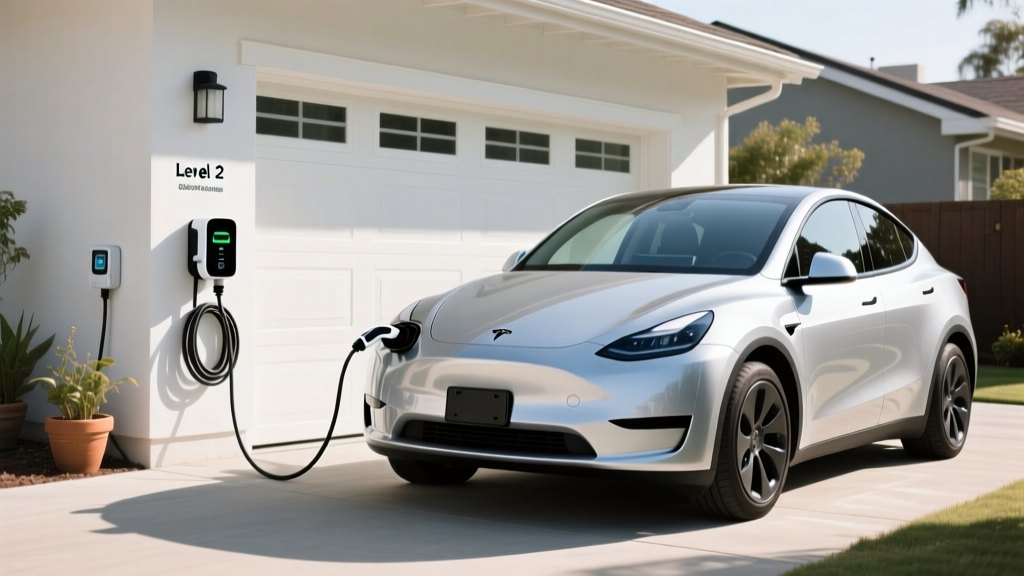
- Hardwire option: Direct wire to a Wall Connector (no outlet needed, often preferred for outdoor installs)
- GFCI: NEC 2020+ requires GFCI protection for outdoor receptacles; hardwired units often exempt
- Permit: Required in most jurisdictions — typically $50–$200 depending on your municipality
Panel Capacity: Will You Need an Upgrade?
Most modern homes with a 200-amp electrical panel have enough spare capacity for a 40-amp EV circuit. Older homes with 100-amp panels — common in houses built before the 1990s — may not. An electrician will perform a load calculation (NEC Article 220) to determine available headroom. If your panel is maxed out, a service upgrade to 200 amps typically costs $1,500–$3,500 before the charger circuit even begins.
Alternatives if a panel upgrade isn't feasible: a smart load-management device like the Emporia Load Center or a Tesla Wall Connector paired with a Neurio energy monitor can dynamically throttle charging to stay within panel limits, avoiding an upgrade entirely.
| Component | Cost Range | Notes |
|---|---|---|
| Level 2 Charger (Equipment) | $200–$580 | Varies by brand, power output, smart features |
| Electrician Labor (standard install) | $500–$1,500 | Depends on run length from panel to garage |
| Electrical Permit | $50–$200 | Varies by city/county |
| Panel Upgrade (if needed) | $1,500–$3,500 | 100A → 200A service upgrade |
| Total (no panel upgrade) | $750–$2,280 | Most common scenario |
| Total (with panel upgrade) | $2,250–$5,780 | Older homes with 100A service |
The wide range in electrician labor reflects real-world variability: a charger mounted on the garage wall directly behind the electrical panel might cost $500 in labor, while running 80 feet of conduit around the house to a detached carport could exceed $1,500. Always get at least two quotes from licensed electricians.
Connector Compatibility: NACS, CCS1, and Adapter Needs
The 2019 Tesla Model 3 SR+ was built with Tesla's proprietary connector — now formally known as the North American Charging Standard (NACS). Since late 2022, Tesla opened this connector to other automakers, and by 2026, NACS has become the dominant EV charging standard in North America. Here's what that means for your SR+:
| Connector Type | Native on 2019 Model 3 SR+? | Adapter Needed? | Where You'll Find It |
|---|---|---|---|
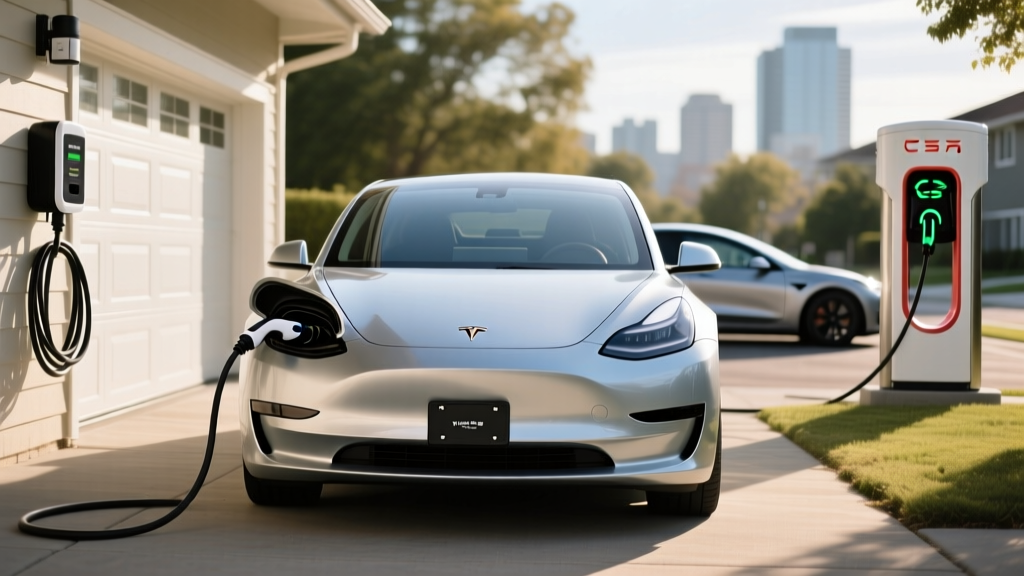
| NACS (Tesla) | Yes — native | None | Tesla Superchargers, Tesla Destination Chargers, many new third-party stations |
| CCS1 | No | Tesla CCS Adapter (~$175–$250) | Electrify America, EVgo, ChargePoint DC stations |
| CHAdeMO | No | Third-party adapter (rare, ~$400+) | Older Nissan Leaf stations — declining network |
| J1772 (Level 2 AC) | No | Tesla Mobile Connector J1772 adapter (included with car) | Public Level 2 stations, workplaces, hotels |
The SR+ ships with a Tesla Mobile Connector that includes a NEMA 14-50 plug and a J1772 adapter. For DC fast charging on non-Tesla networks, you'll need Tesla's official CCS1 adapter, which Tesla sells directly. As of 2026, many new third-party DC fast chargers (from Electrify America, EVgo, and others) have added native NACS cables, reducing the need for the CCS adapter — but carrying one remains essential for road-trip redundancy.
Cost to Charge: Home vs. Public vs. Gas Comparison
One of the strongest ownership arguments for the 2019 Model 3 SR+ is fuel cost savings — but the actual per-mile cost depends heavily on where and when you charge. The SR+ consumes roughly 26 kWh per 100 miles (per EPA data). Here's how that translates to dollars:
| Charging Scenario | Rate ($/kWh) | Cost per 100 Miles | Cost per Mile |
|---|---|---|---|
| Home (off-peak utility rate) | $0.08–$0.12 | $2.08–$3.12 | $0.02–$0.03 |
| Home (standard residential avg.) | $0.16 | $4.16 | $0.04 |
| Public Level 2 (ChargePoint, etc.) | $0.25–$0.49 | $6.50–$12.74 | $0.07–$0.13 |
| DC Fast (Tesla Supercharger avg.) | $0.28–$0.40 | $7.28–$10.40 | $0.07–$0.10 |
| DC Fast (Electrify America) | $0.35–$0.56 | $9.10–$14.56 | $0.09–$0.15 |
| Gasoline comparison (28 MPG avg, $3.50/gal) | — | $12.50 | $0.13 |
Home charging during off-peak hours is dramatically cheaper than gasoline — roughly one-quarter the per-mile cost. Even public DC fast charging is typically cheaper than gas for a comparable sedan, though the gap narrows at premium networks with per-kWh pricing above $0.45.
For a driver covering 12,000 miles per year, home-only charging at $0.12/kWh costs approximately $374 annually. A gas car averaging 28 MPG at $3.50/gallon costs $1,500 for the same distance. That's over $1,100 in annual fuel savings — before factoring in the SR+'s lower maintenance costs (no oil changes, minimal brake wear from regenerative braking).
Charging Time Examples: How Long Does a Full Session Take?
The 2019 Model 3 SR+ has a usable battery capacity of approximately 50 kWh. Here's how long common charging sessions take at each level:
- Level 1 (120V, 1.2 kW): 0–100% in roughly 42 hours. Adds ~4 miles of range per hour. Practical only for overnight top-ups if you drive less than 30 miles daily.
- Level 2 (240V, 32A / 7.7 kW): 0–100% in approximately 6.5 hours. A 20–80% session takes about 4 hours. This is the daily workhorse — plug in when you get home, wake up fully charged.
- DC Fast (150 kW peak, V2 Supercharger): 10–80% in approximately 35–40 minutes. 10–50% takes about 15 minutes. The charge curve tapers hard above 60% SoC — charging from 80–100% on DC can take as long as the 10–80% session.
- DC Fast (250 kW V3 Supercharger): The SR+ cannot accept 250 kW. It caps at ~150 kW, so V3 stalls offer only marginal improvement over V2 — roughly 2–3 minutes saved on a 10–80% session due to slightly better curve management.
For road-trip planning, the practical pattern is to arrive at a Supercharger with 10–15% SoC and charge to 60–70%, which takes about 18–22 minutes. Charging beyond 80% at a DC fast charger wastes time due to the taper — only do it if your next leg demands it.
Recommended Home Chargers for the 2019 Model 3 SR+
Since the SR+ maxes out at 7.7 kW (32 amps), you don't need a 48-amp charger. A 32-amp or 40-amp unit on a 40-amp circuit is ideal. Here are three strong options as of 2026:
Tesla Wall Connector (Gen 3)
- Power output: Up to 11.5 kW (48A) — SR+ will draw 7.7 kW (32A)
- Connector: Native NACS — no adapter needed
- Cable length: 24 feet
- Smart features: Wi-Fi, OTA updates, power sharing between multiple units, access control
- Price: ~$425
- Best for: Tesla-only households wanting seamless integration
ChargePoint Home Flex
- Power output: Configurable 16A–50A (up to 12 kW) — set to 32A for SR+ on a 40A circuit
- Connector: NACS or J1772 (select at purchase); NACS plug works directly with SR+
- Cable length: 23 feet
- Smart features: Wi-Fi, app scheduling, Alexa integration, energy tracking
- Price: ~$550–$650
- Best for: Multi-EV households (NACS + J1772 vehicles) or those wanting granular app controls
Emporia Vue Level 2 Charger
- Power output: Up to 48A (11.5 kW) — configurable down to 32A
- Connector: J1772 (use included Tesla adapter) or NACS version available
- Cable length: 24 feet
- Smart features: Wi-Fi, app control, integration with Emporia energy monitoring, load management
- Price: ~$350–$400
- Best for: Budget-conscious buyers, homes needing load management to avoid panel upgrades
All three units are hardwire-capable and outdoor-rated (NEMA 4). For the SR+ specifically, the Tesla Wall Connector offers the cleanest experience — native plug, no adapter fumbling, and firmware that communicates directly with the car. The ChargePoint Home Flex is the better pick if you also own or plan to own a non-Tesla EV.
Safety, Code, and Permit Considerations
EV charging involves sustained high-current draw — more like running an electric furnace than plugging in a phone. Cutting corners on installation creates fire risk. Here are the non-negotiable safety requirements:
- Dedicated circuit: Your Level 2 charger must be on its own breaker — never share a circuit with other appliances. The 2019 SR+ at 32 amps continuous requires a 40-amp dedicated breaker.
- NEC continuous-load rule: EV charging is classified as a continuous load (3+ hours). The circuit must be rated at 125% of the charger's maximum draw — so 32A × 1.25 = 40A minimum breaker size.
- GFCI protection: NEC 2020 and later require GFCI protection for outdoor EV receptacles (NEMA 14-50 outlets). Hardwired chargers like the Tesla Wall Connector are generally exempt from this requirement, which is one reason many electricians prefer hardwired installations.
- Outdoor rating: If your charger is installed outside or in an unsealed carport, it must carry a NEMA 4 (weather-resistant) rating. All three chargers recommended above meet this standard.
- Permit and inspection: Most jurisdictions require an electrical permit for a new 240V circuit. The permit fee is typically $50–$200, and a city inspector will verify the installation meets code. Skipping the permit can void your homeowner's insurance coverage for electrical fires.
- Wire gauge: 8 AWG copper minimum for a 40-amp circuit. If the run from the panel exceeds 100 feet, your electrician may specify 6 AWG to reduce voltage drop.
Always hire a licensed electrician — not a general handyman — for EV charger installation. Ask for a detailed quote that separates equipment, labor, permit, and any panel work. A reputable electrician will perform a load calculation before recommending a circuit size.
Frequently Asked Questions
How much does it cost to install a home EV charger for the 2019 Model 3 SR+?
A typical Level 2 home installation for the SR+ costs $750–$2,280 when no panel upgrade is needed. This includes the charger ($200–$580), electrician labor ($500–$1,500), and a permit ($50–$200). If your home has an older 100-amp panel that needs upgrading to 200 amps, add $1,500–$3,500 to the total.
How fast will each charging level add range to the SR+?
Level 1 (120V) adds 3–5 miles of range per hour. Level 2 (240V, 32A) adds 25–32 miles per hour — enough to fully replenish a day's driving overnight. DC fast charging at 150 kW adds roughly 170 miles in 15 minutes during the initial phase (10–50% SoC), tapering significantly above 60%.
Which charger and connector is compatible with my 2019 Model 3 SR+?
Your SR+ uses the NACS (Tesla) connector natively. At home, any NACS-equipped Level 2 charger (like the Tesla Wall Connector) plugs in directly. For public J1772 Level 2 stations, use the J1772 adapter that came with your Mobile Connector. For non-Tesla DC fast chargers (Electrify America, EVgo), you'll need a Tesla CCS1 adapter, sold separately for approximately $175–$250.
How much does charging cost per mile compared to gas?
Home charging at an average residential rate of $0.16/kWh costs about $0.04 per mile in the SR+ (which uses 26 kWh per 100 miles). Off-peak home rates can drop that to $0.02–$0.03 per mile. A comparable gas sedan at 28 MPG and $3.50/gallon costs about $0.13 per mile. Even public DC fast charging at $0.35/kWh ($0.09/mile) undercuts gasoline.
What electrical upgrades might I need for a home charger?
If your home has a 200-amp electrical panel with available capacity, you likely only need a new 40-amp double-pole breaker and a wire run to the garage. Homes with 100-amp panels may need a full service upgrade ($1,500–$3,500). Alternatives include smart load-management systems that throttle charging to stay within your panel's limits, potentially avoiding an upgrade. A licensed electrician can perform a load calculation to determine your exact situation.
Can I charge my 2019 SR+ at a Tesla Supercharger?
Yes — the 2019 Model 3 SR+ is fully compatible with all Tesla Supercharger stations, including V2 (150 kW) and V3 (250 kW) stalls. On V3 stalls, the SR+ will peak at approximately 150 kW due to its battery and BMS limitations, so charge times are similar to V2. Access to Superchargers is pay-per-use at rates typically between $0.28–$0.40/kWh depending on location and time of day.
Does frequent DC fast charging degrade the SR+ battery?
Occasional DC fast charging (road trips) has minimal impact on battery health. Daily DC fast charging can accelerate degradation slightly compared to Level 2 charging, primarily due to heat generation. Tesla's battery management system actively manages thermal conditions during charging to mitigate this. The SR+ battery is covered under Tesla's warranty for 8 years or 100,000 miles (whichever comes first) with a minimum 70% capacity retention threshold. For daily use, Level 2 home charging is gentler on the pack and more cost-effective.