The 2019 Tesla Model 3 Long Range AWD remains one of the most popular used EVs on the road. With its 75 kWh (usable) battery pack and EPA-rated 310 miles of range, it offers a compelling entry into electric ownership. But buying a used Model 3 is only half the equation — setting up reliable, cost-effective charging is what actually determines your day-to-day satisfaction. This guide covers every charging scenario for the 2019 Model 3 Long Range AWD, from overnight home charging to road-trip DC fast charging, with exact numbers, real-world costs, and equipment picks.
2019 Model 3 Long Range AWD: Battery and Charging Specs at a Glance
Before we break down charging options, here are the key numbers that govern how your 2019 Model 3 Long Range AWD charges. This model uses a lithium-ion NCA (nickel-cobalt-aluminum) battery with approximately 75 kWh of usable capacity. Tesla rates the onboard AC charger at 11.5 kW (48 amps) for Level 2 charging — that's the maximum rate the car can accept from a home wall connector. For DC fast charging, the 2019 Long Range AWD peaks at roughly 250 kW at V3 Superchargers, though sustained rates taper significantly above 50% state of charge (SoC).
| Spec | Value |
|---|---|
| Battery (usable) | ~75 kWh, NCA chemistry |
| EPA Range | 310 miles |
| Real-World Range (highway/cold) | ~250–275 miles |
| Max AC Charge Rate (Level 2) | 11.5 kW / 48A |
| Max DC Fast Charge Rate | 250 kW peak (V3 Supercharger) |
| 10–80% DC Fast Charge Time | ~25–30 minutes |
| Connector | NACS (Tesla proprietary) |
| Efficiency | 120 MPGe combined (fueleconomy.gov) |
Charging Levels Explained: How Fast Will Each Level Add Range?
EV charging comes in three tiers. Understanding the difference between kW (power — how fast energy flows) and kWh (energy — how much your battery holds) is essential. Think of kW as the flow rate of a hose and kWh as the size of the bucket. Here's what each level delivers to your 2019 Model 3 Long Range AWD:
| Level | Power Source | Max kW | Miles of Range Added Per Hour | Best For |
|---|---|---|---|---|
| Level 1 | 120V household outlet | ~1.4 kW | ~4–5 miles/hour | Emergency/top-off only |
| Level 2 | 240V (home wall connector or public) | 11.5 kW (car-limited) | ~37–44 miles/hour | Daily home charging, overnight |
| DC Fast (V3 Supercharger) | 480V+ DC public station | 250 kW peak | ~750+ miles/hour (at peak) | Road trips, rapid top-ups |
Level 1 reality check: Plugging into a standard 120V outlet using Tesla's included Mobile Connector adds roughly 4–5 miles per hour. A full 0–100% charge would take over 50 hours. This works only if your daily driving is under 30 miles and you can plug in for 10+ hours nightly.
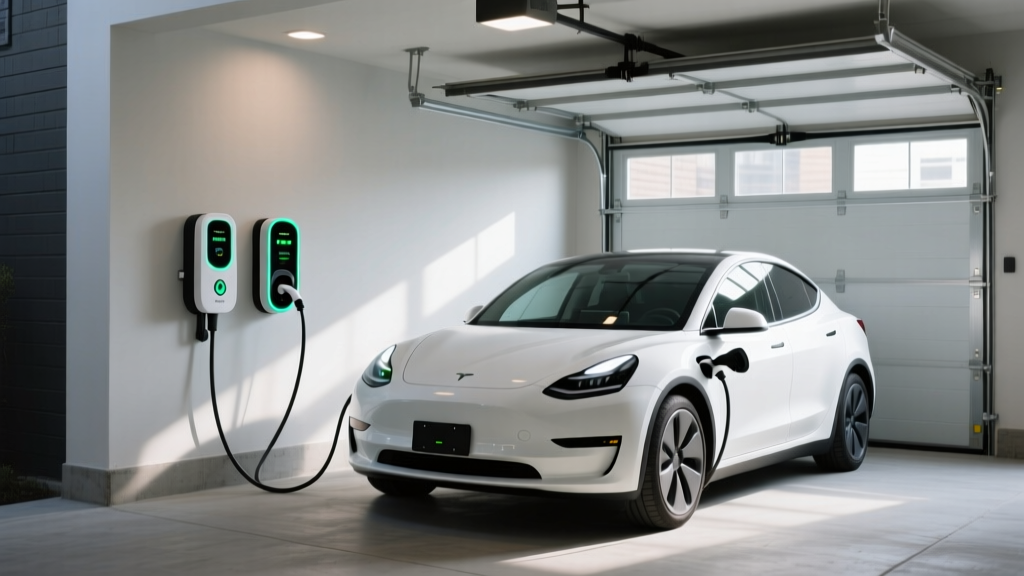
Level 2 is the sweet spot: A 240V home wall connector at 48 amps delivers the Model 3's maximum 11.5 kW AC rate, replenishing the 75 kWh battery from empty in roughly 7.5 hours. Most owners plug in overnight and wake up to a full charge. A 40-amp circuit (delivering ~9.6 kW / 32A continuous) is the minimum practical setup, adding about 30–34 miles per hour.
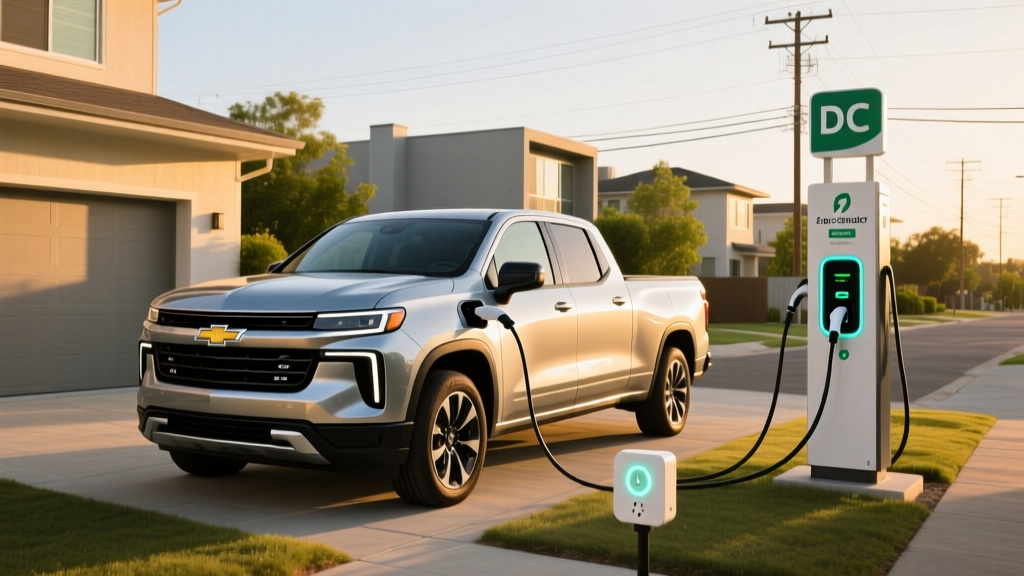
DC fast charging nuances: The 2019 Model 3 Long Range AWD supports V3 Superchargers at up to 250 kW, but only at low SoC and optimal battery temperature. The charge curve tapers sharply: expect 250 kW from ~10–30% SoC, dropping to ~100 kW by 60%, and ~40 kW above 85%. A 10–80% session takes roughly 25–30 minutes at a V3 stall. At older V2 Superchargers (150 kW max), plan on 35–40 minutes for the same session.
Home Charger Installation: Electrical Requirements, Costs, and Panel Upgrades
Installing a Level 2 home charger for your 2019 Model 3 Long Range AWD involves electrical work that varies significantly based on your home's panel capacity, wiring distance, and local code. Here's what you need to know.
Electrical Requirements
To maximize the Model 3's 11.5 kW onboard charger, you need a 60-amp dedicated circuit (which delivers 48 amps continuous, per NEC 80% rule). If your panel can't support a 60-amp circuit, a 50-amp circuit (40 amps continuous / 9.6 kW) is a common and still-effective alternative. The circuit must be 240V, and the wiring is typically 6 AWG copper for 60A or 8 AWG for 50A.
Panel capacity check: Most modern 200-amp service panels can accommodate a 60-amp EV circuit. Older homes with 100-amp or 150-amp service may need a panel upgrade (to 200A) or a load-management device that throttles the charger when other large appliances run. A panel upgrade from 100A to 200A typically costs $1,500–$3,500 depending on your utility and local labor rates.
Permit and Code Requirements
Virtually all jurisdictions require a permit for a new 240V circuit. The permit fee ranges from $50–$250. Your electrician will pull the permit, and an inspector will verify the installation meets NEC (National Electrical Code) requirements. Key code items include:
- Dedicated circuit: The EV charger must have its own breaker — no sharing with other outlets.
- GFCI protection: NEC 2020 and later require GFCI breakers for EV charging circuits in garages and all outdoor installations.
- Outdoor rating: If your charger is mounted outside, the unit and connector must carry a NEMA 4 or NEMA 4X weatherproof rating.
- Hardwired vs. plug: Hardwired installations (no plug) avoid the need for a NEMA 14-60 or 6-50 receptacle and are often preferred for 60A circuits. If using a plug, a NEMA 14-60 is standard for 50A circuits.
Installation Cost Breakdown
| Component | Simple Install (panel nearby, short run) | Complex Install (long run, conduit, panel work) |
|---|---|---|
| Level 2 Charger (equipment) | $400–$600 | $400–$600 |
| Electrician labor (2–4 hrs simple / 6–10 hrs complex) | $300–$600 | $900–$2,000 |
| Wiring, conduit, breaker, misc. materials | $100–$300 | $400–$1,200 |
| Permit fee | $50–$150 | $50–$250 |
| Panel upgrade (if needed) | N/A | $1,500–$3,500 |
| Total (no panel upgrade) | $850–$1,650 | $1,750–$4,050 |
| Total (with panel upgrade) | N/A | $3,250–$7,550 |
Connector Compatibility: NACS, Adapters, and Public Charging Access
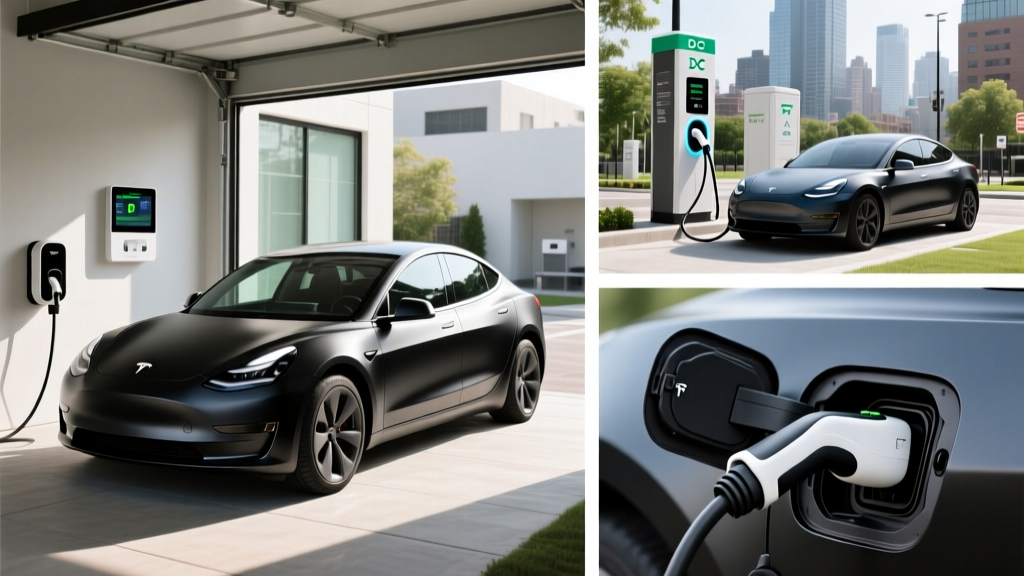
The 2019 Tesla Model 3 Long Range AWD uses Tesla's proprietary connector, which is now formally designated as NACS (North American Charging Standard). As of 2026, NACS has become the dominant connector in North America, adopted by Ford, GM, Rivian, Hyundai, and most other major automakers. This means your 2019 Model 3 has native access to the broadest charging network available.
| Connector Type | Native Support? | Adapter Needed? | Network Access |
|---|---|---|---|
| NACS (Tesla) | Yes — built-in | No | Tesla Superchargers, Tesla Destination Chargers, and NACS-equipped public stations (Electrify America, EVgo, etc.) |
| CCS1 | No | Yes — Tesla CCS Adapter (~$175–$250) | Electrify America, EVgo, ChargePoint, and other CCS networks |
| CHAdeMO | No | Yes — third-party adapter (limited availability, ~$300+) | Largely legacy; Nissan Leaf network. Not recommended for new investment. |
| J1772 (Level 2 public) | No | Yes — Tesla J1772 Adapter (included with vehicle or ~$95) | Public Level 2 stations at workplaces, malls, hotels |
Adapter guidance: The Tesla-to-J1772 adapter is essential for public Level 2 charging and was included with new 2019 Model 3 vehicles. If your used purchase didn't include one, buy it directly from Tesla. The CCS adapter unlocks non-Tesla DC fast chargers — useful as a backup on road trips through areas with sparse Supercharger coverage. As of 2026, Tesla Superchargers remain the most reliable DC fast-charging network, with over 6,500 stalls in North America.
Charging Cost Per Mile: Home vs. Public vs. Gas Comparison
One of the strongest ownership arguments for the 2019 Model 3 Long Range AWD is low fueling cost. But the savings depend heavily on where and when you charge. Here's a realistic breakdown using national average electricity and gas prices as of early 2026.
| Scenario | Rate | Cost to Add 200 Miles | Cost Per Mile |
|---|---|---|---|
| Home charging (off-peak utility rate) | $0.12/kWh | $6.00 | $0.030 |
| Home charging (national avg. residential) | $0.17/kWh | $8.50 | $0.043 |
| Public Level 2 (network pricing) | $0.25–$0.35/kWh | $12.50–$17.50 | $0.063–$0.088 |
| Tesla Supercharger V3 (avg. pricing) | $0.28–$0.36/kWh | $14.00–$18.00 | $0.070–$0.090 |
| Non-Tesla DC Fast (EA, EVgo) | $0.35–$0.55/kWh | $17.50–$27.50 | $0.088–$0.138 |
| Gas sedan (30 MPG combined, $3.40/gal) | $3.40/gallon | $22.67 | $0.113 |
Key takeaways: The 2019 Model 3 Long Range AWD achieves roughly 3.3–3.5 miles per kWh in real-world mixed driving (the EPA rates it at 120 MPGe combined, which translates to about 28 kWh per 100 miles, or ~3.6 mi/kWh). Home charging on an off-peak rate delivers fueling costs 70–75% below a comparable gas sedan. Even at Supercharger prices, you're typically paying less per mile than gasoline.
However, if you rely exclusively on premium-priced public DC fast chargers (some networks charge $0.48–$0.55/kWh in urban areas), your cost per mile can approach or exceed that of a fuel-efficient gas car. Home charging access is the single biggest factor in EV ownership economics.
Recommended Home Charging Equipment for the 2019 Model 3 LR AWD
Since the 2019 Model 3 Long Range AWD accepts up to 11.5 kW (48 amps) on Level 2, you want a charger that can deliver at least that rate. Here are top picks based on reliability, features, and value:
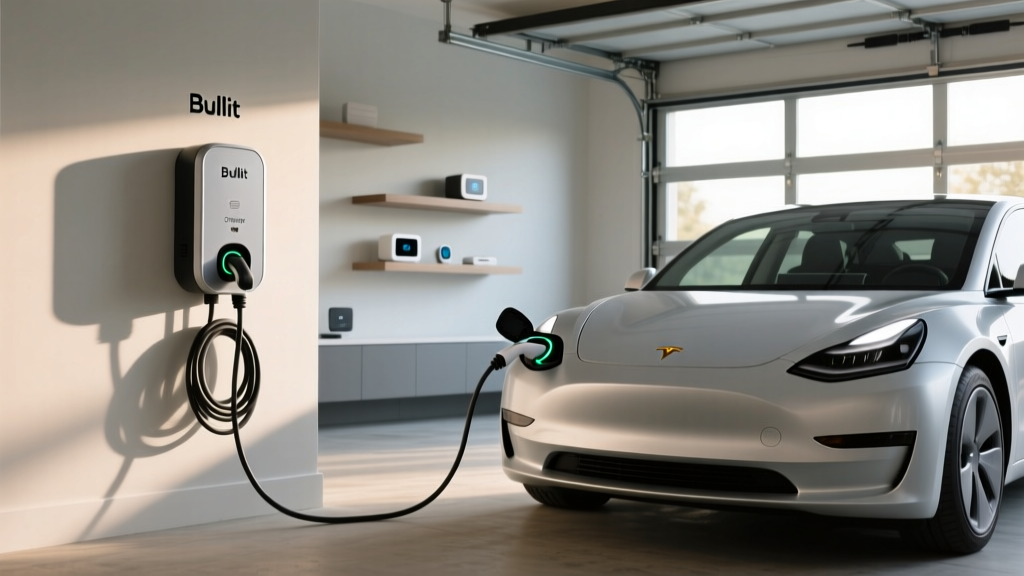
Tesla Wall Connector (Gen 3)
Power: Up to 11.5 kW (48A) on a 60A circuit
Connector: NACS (native — no adapter needed)
Cable length: 24 feet
Smart features: Wi-Fi updates, load sharing with second unit, Tesla app integration
Price: ~$425
Verdict: Best choice for Tesla-only households. Cleanest integration, fastest charging your Model 3 can accept, and competitive pricing.
ChargePoint Home Flex
Power: Up to 12 kW (50A) on a 60A circuit (adjustable down to any amperage)
Connector: J1772 (NACS adapter required for Tesla) or NACS version available
Cable length: 23 feet
Smart features: App scheduling, energy tracking, Alexa integration, flexible amperage setting
Price: ~$550–$650
Verdict: Best for multi-EV households (Tesla + non-Tesla). Adjustable amperage is ideal if your panel has limited headroom.
Emporia Level 2 EV Charger
Power: Up to 11.5 kW (48A) on a 60A circuit
Connector: J1772 (NACS adapter required for Tesla)
Cable length: 24 feet
Smart features: Detailed energy monitoring, solar integration, app-based scheduling, works with Emporia whole-home energy monitor
Price: ~$350–$400
Verdict: Best budget smart charger. Excellent energy monitoring at the lowest price in this tier.
Charging time examples with the 75 kWh battery (10–80%, ~52.5 kWh needed):
- Tesla Wall Connector at 11.5 kW: ~4.5–5 hours (ideal for overnight)
- 40A Level 2 (9.6 kW): ~5.5–6 hours
- 32A Level 2 (7.7 kW): ~6.8–7.5 hours
- Level 1 (1.4 kW, 120V): 37+ hours (not practical for full replenishment)
Public Charging Strategy: Superchargers, Destination Charging, and Road Trips
The 2019 Model 3 Long Range AWD has a major public-charging advantage: native access to Tesla's Supercharger network, which remains the most reliable and geographically comprehensive DC fast-charging system in North America. Here's how to optimize your public charging.
Tesla Superchargers: V3 stalls deliver up to 250 kW to your Model 3 LR AWD. Use the car's built-in navigation to route to Superchargers — this triggers battery preconditioning, which warms the battery to optimal temperature and can shave 5–10 minutes off your charge session, especially in cold weather. Expect to pay $0.28–$0.36/kWh at most Superchargers, with idle fees of $1/minute if you remain plugged in after reaching your charge limit.
Tesla opens Superchargers to non-Tesla EVs: As of 2026, many Supercharger stalls are accessible to NACS-equipped non-Tesla vehicles. This has increased congestion at some popular corridors during peak travel times. Plan road-trip stops using the Tesla app or A Better Routeplanner (ABRP) to check real-time stall availability.
Destination Chargers: Tesla's Destination Charging program places Level 2 Wall Connectors at hotels, restaurants, and shopping centers. These are typically free for patrons and deliver 11.5 kW — perfect for adding 100+ miles during a multi-hour stop.
Non-Tesla networks: With a CCS adapter, you can access Electrify America, EVgo, and ChargePoint DC fast chargers. This is useful as redundancy, but expect higher per-kWh pricing and occasionally lower reliability than Superchargers. Always check PlugShare or the network's app for real-time stall status before diverting.
Frequently Asked Questions
How much does it cost to install a home EV charger for a 2019 Tesla Model 3?
A straightforward Level 2 installation (panel nearby, short wire run, no panel upgrade) typically costs $850–$1,650 including equipment, electrician labor, materials, and permit. Complex installations with long conduit runs or a required panel upgrade can reach $3,250–$7,550. Always get 2–3 quotes from licensed electricians.
How fast will each charging level add range to my Model 3 Long Range AWD?
Level 1 (120V) adds ~4–5 miles per hour. Level 2 (240V, 48A) adds ~37–44 miles per hour. DC fast charging at a V3 Supercharger can add up to 170 miles in 15 minutes at peak rate (low SoC), but the charge curve tapers significantly above 50% SoC.
Which charger and connector are compatible with my 2019 Model 3?
Your Model 3 uses the NACS (Tesla) connector natively. For home charging, the Tesla Wall Connector is the simplest option. For public Level 2 stations with J1772 connectors, use the Tesla J1772 adapter. For non-Tesla DC fast chargers with CCS1 cables, you'll need Tesla's CCS adapter.
How much does charging cost per mile compared to gas?
Home charging at the national average residential rate (~$0.17/kWh) costs about $0.043/mile — roughly 62% less than a 30 MPG gas sedan at $3.40/gallon ($0.113/mile). Off-peak home rates ($0.12/kWh) drop that to $0.030/mile. Supercharger pricing ($0.28–$0.36/kWh) runs $0.070–$0.090/mile, still below gas.
What electrical upgrades might I need for a home charger?
If your home has a 200-amp electrical panel with available capacity, you likely need only a new 60-amp (or 50-amp) 240V circuit. Homes with 100-amp or 150-amp panels may require a panel upgrade ($1,500–$3,500) or a smart load-management device that reduces charger amperage when other large loads (dryer, oven, HVAC) are running simultaneously. A licensed electrician can perform a load calculation to determine your options.
Should I charge my 2019 Model 3 Long Range AWD to 100% daily?
No. The NCA battery in the 2019 Long Range AWD benefits from daily charge limits of 80–90%. Tesla's battery management system recommends setting the daily limit to 80% for routine use and charging to 100% only before long road trips. This practice reduces long-term degradation. Expect roughly 85–92% battery capacity retention after 100,000 miles based on fleet data from similar NCA packs.