The 2019 Tesla Model 3 Long Range remains one of the most popular used electric vehicles on the road in 2026, thanks to its blend of real-world efficiency, access to the Supercharger network, and strong performance. Buyers researching this model often start with one specific search: the 2019 Tesla Model 3 Long Range 0-60 time. But acceleration is only part of the ownership equation. Understanding how fast this car charges, what home electrical upgrades you might need, and what you'll actually pay per mile compared to a gas car is what separates a confident EV buyer from a frustrated one.
This guide covers the 2019 Model 3 Long Range's performance specs, then walks through every charging scenario you'll encounter — from a standard 120V outlet to a 250 kW Supercharger — with exact kW figures, installation costs, connector details, and equipment recommendations.
2019 Tesla Model 3 Long Range: Performance and Battery Specs
Before plugging in, here's what's under the floor. The 2019 Model 3 Long Range (dual-motor AWD variant, which was the volume seller that year) uses an NMC (nickel manganese cobalt) lithium-ion battery pack.
| Spec | Value |
|---|---|
| EPA Range | 310 miles |
| Real-World Range (highway, 70 mph) | ~250–270 miles |
| Real-World Range (cold weather, 32°F) | ~220–250 miles |
| Battery Capacity (usable) | ~75 kWh (NMC chemistry) |
| 0-60 mph | 4.4 seconds (AWD); 5.1 seconds (RWD) |
| Horsepower | ~346 hp (AWD combined) |
| EPA Efficiency | 120 MPGe combined (28 kWh/100 mi) |
| Max DC Fast Charge Rate | ~170 kW peak (V2 Supercharger capable) |
| 10–80% DC Fast Charge Time | ~30 minutes (at V2 Supercharger) |
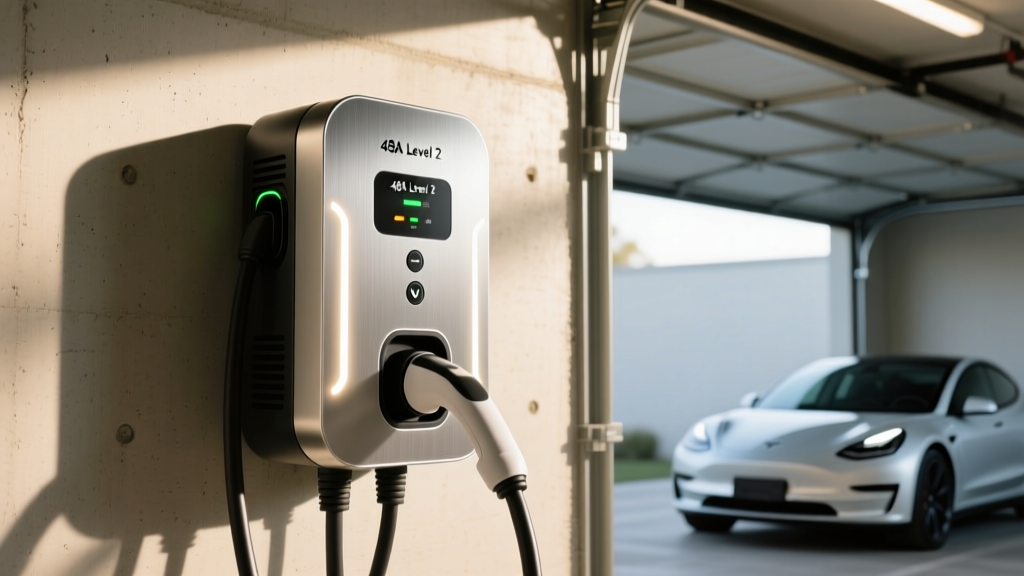
| Onboard AC Charger (Level 2) | 11.5 kW max (48A) |
| Battery Warranty (original) | 8 years / 120,000 miles (70% retention) |
Charging Levels Explained: kW, Miles Per Hour, and What They Mean
EV charging comes in three levels. The critical distinction: kW (kilowatts) measures power — how fast energy flows into the battery. kWh (kilowatt-hours) measures energy — the total capacity of the battery, like gallons in a fuel tank. A 75 kWh battery charged at 7.5 kW takes roughly 10 hours from empty to full (minus charging losses).
| Level | Voltage | Power (kW) | Miles of Range Added Per Hour | Best Use Case |
|---|---|---|---|---|
| Level 1 | 120V AC | ~1.4 kW | ~4–5 miles/hour | Overnight trickle; emergency top-ups |
| Level 2 | 240V AC | 3.8–11.5 kW | ~15–44 miles/hour | Daily home charging; destination charging |
| DC Fast (V2 Supercharger) | 400V DC | Up to 150 kW | ~300+ miles/hour (peak) | Road trips; rapid top-ups |
| DC Fast (V3 Supercharger) | 400V DC | Up to ~170 kW* | ~330+ miles/hour (peak) | Road trips on newer Supercharger stations |
*The 2019 Model 3 Long Range cannot accept the full 250 kW that V3 Superchargers can deliver. Its peak acceptance is approximately 170 kW, tapering as the battery state of charge rises above 50%. The charge curve is not linear — you'll see peak speeds between roughly 10–40% SoC, then a progressive taper.
Home Charger Installation: Electrical Requirements and Costs
Most 2019 Model 3 Long Range owners charge at home overnight on Level 2. The vehicle's onboard charger accepts up to 11.5 kW (48 amps) on a 240V circuit. To deliver that maximum, you need a dedicated 60-amp breaker (EV chargers are continuous loads under the National Electrical Code, requiring the circuit to be rated at 125% of the charger's max draw — so a 48A charger needs a 60A circuit).
What Your Electrical Panel Needs to Support
A 60-amp dedicated circuit is significant. Homes with a 100-amp main panel may not have the spare capacity, especially if you already run electric dryers, ovens, or HVAC on the same panel. A licensed electrician will perform a load calculation to determine if your panel can handle the addition or if an upgrade to 200 amps is necessary.
If a panel upgrade is needed, costs jump substantially. Here's a realistic breakdown:
| Component | Simple Install (panel has capacity, short run) | Complex Install (panel upgrade, long conduit run) |
|---|---|---|
| Level 2 Charger (Equipment) | $400–$700 | $400–$700 |
| Electrical Permit | $50–$200 | $50–$300 |
| Electrician Labor (2–4 hrs simple / 6–12 hrs complex) | $300–$800 | $1,200–$3,000 |
| Panel Upgrade (if needed: 100A → 200A) | $0 | $1,500–$3,500 |
| Conduit, Wiring, Junction Box | $100–$300 | $400–$1,000 |
| Total Estimated Cost | $850–$2,000 | $3,550–$8,500 |
For a 2019 Model 3, you don't need to max out the 48A onboard charger. Many owners install a 32A or 40A charger on a 40A or 50A breaker, which still delivers 25–35 miles of range per hour — more than enough to replenish a full day's driving overnight. This can avoid a panel upgrade entirely.
Connector Compatibility: NACS, CCS, and Adapters
The 2019 Tesla Model 3 Long Range was built with Tesla's proprietary connector, which is now standardized as NACS (North American Charging Standard). As of 2026, Tesla Superchargers remain NACS-native, and the Model 3 plugs directly into every Supercharger stall without an adapter.
However, many public DC fast-charging networks (Electrify America, EVgo, some ChargePoint stations) were built with CCS1 connectors. Tesla began providing CCS adapters to owners, and third-party NACS-to-CCS adapters are also available. Here's what you need to know:
| Connector Type | Native Support? | Adapter Needed? | Where You'll Find It |
|---|---|---|---|
| NACS (Tesla) | Yes — native | None | Tesla Superchargers, Tesla Destination Chargers, newer public NACS stations |
| CCS1 | No | NACS-to-CCS adapter (~$175–$250) | Electrify America, EVgo, ChargePoint DC stations |
| CHAdeMO | No | NACS-to-CHAdeMO adapter (~$300–$450) | Limited and declining; mostly older Nissan Leaf stations |
| J1772 (Level 2 public) | No | Tesla Mobile Connector J1772 adapter (included with car) | Public Level 2 stations, hotels, workplaces |
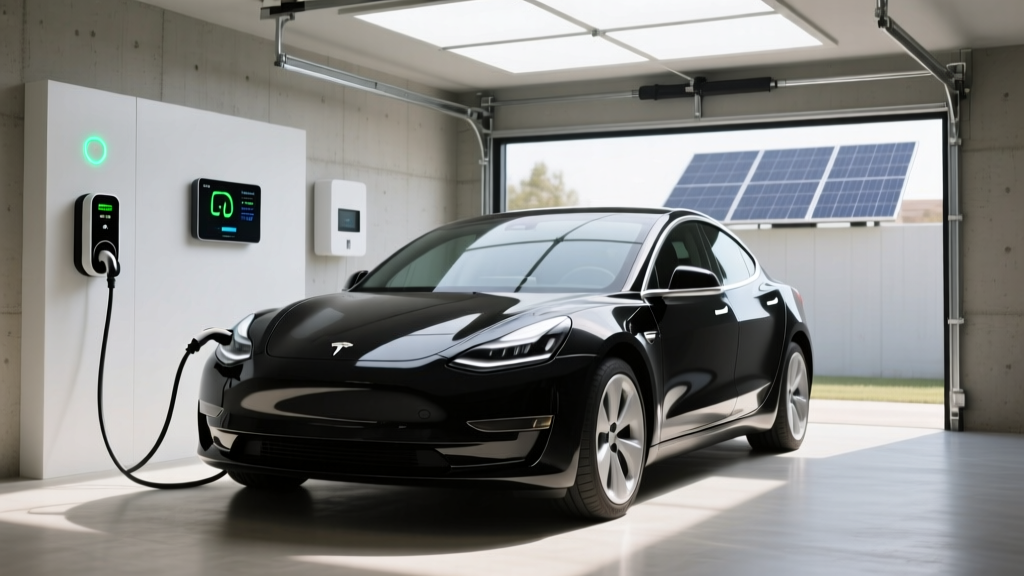
For daily home charging, the Tesla Wall Connector or any NACS-equipped Level 2 charger plugs in directly. For road trips outside the Supercharger network, carrying a CCS adapter is strongly recommended.
Cost to Charge: Per-Mile Comparison vs. Gasoline
Charging costs depend entirely on your electricity rate and where you charge. Here are realistic 2026 scenarios for a 2019 Model 3 Long Range, which consumes approximately 28 kWh per 100 miles (or 0.28 kWh/mile):
| Charging Scenario | Rate ($/kWh) | Cost Per Mile | Annual Cost (12,000 mi) |
|---|---|---|---|
| Home — Off-Peak (utility time-of-use) | $0.09 | $0.025 | $300 |
| Home — Standard Residential Avg | $0.16 | $0.045 | $540 |
| Public Level 2 (ChargePoint, etc.) | $0.25–$0.39 | $0.07–$0.11 | $840–$1,320 |
| DC Fast (Supercharger, avg 2026) | $0.30–$0.45 | $0.084–$0.126 | $1,008–$1,512 |
| DC Fast (Electrify America, CCS adapter) | $0.36–$0.52 | $0.10–$0.15 | $1,200–$1,800 |
| Gas Vehicle (28 MPG avg, $3.50/gal) | — | $0.125 | $1,500 |
The numbers are clear: home charging at off-peak rates delivers fuel costs roughly 80% lower than a comparable gas sedan. Even exclusive DC fast charging is often cost-competitive with gasoline, and you're getting 346 hp and a 4.4-second 0-60 time in return.
According to fueleconomy.gov, the 2019 Model 3 Long Range AWD achieves 120 MPGe combined, which translates to an estimated annual electricity cost of $550–$650 at average residential rates — compared to roughly $1,500–$1,800 in fuel for a 28 MPG gas car.
Recommended Home Level 2 Chargers for the 2019 Model 3
Here are three chargers that pair well with the Model 3's 11.5 kW onboard charger, each suited to different installation scenarios and budgets:
Tesla Wall Connector (Gen 3)
Power: Up to 11.5 kW (48A)
Connector: NACS (native Tesla)
Cable Length: 24 ft
Smart Features: Wi-Fi, over-the-air updates, load sharing between multiple units, Tesla app integration
Price: ~$475
Best For: Tesla-only households wanting maximum Level 2 speed and seamless integration. Requires a 60A circuit for full 48A output.
ChargePoint Home Flex (NACS version)
Power: Up to 12 kW (50A), adjustable down to 16A
Connector: NACS (available as of 2025+ production)
Cable Length: 23 ft
Smart Features: Wi-Fi, ChargePoint app scheduling, Alexa integration, amperage adjustable to match your circuit
Price: ~$550–$650
Best For: Homes with limited panel capacity — you can set it to 32A on a 40A breaker and still get ~25 mi/hr, avoiding a panel upgrade.
Emporia Level 2 EV Charger (NACS)
Power: Up to 11.5 kW (48A)
Connector: NACS
Cable Length: 24 ft
Smart Features: Wi-Fi, energy monitoring via Emporia Vue panel integration, time-of-use scheduling
Price: ~$350–$450
Best For: Budget-conscious owners who want energy monitoring and solar integration at a lower equipment cost.
Safety, Electrical Code, and Installation Best Practices
EV charging is a continuous electrical load — the NEC requires the circuit breaker to be rated at 125% of the charger's maximum amperage. A 48A charger demands a 60A breaker. A 32A charger needs a 40A breaker. Never undersize the circuit.
- Dedicated circuit: Your Level 2 charger must have its own dedicated breaker — no sharing with other appliances.
- GFCI protection: The 2020 NEC and later require GFCI protection for EV charging outlets (NEMA 14-50 receptacles). Hardwired installations may have different requirements depending on your local jurisdiction — your electrician will confirm.
- Outdoor rating: If your charger is installed outside (garage exterior, carport, driveway), the unit must carry a NEMA 4 or NEMA 4X rating for weather resistance. All three chargers recommended above are outdoor-rated.
- Permit and inspection: Virtually all jurisdictions require an electrical permit for a new 240V circuit. The inspection ensures the wire gauge, breaker size, and grounding meet code. Do not skip this — unpermitted work can void insurance coverage.
- Wire gauge: A 60A circuit typically requires 6 AWG copper wire (or 4 AWG aluminum). Longer runs may need thicker wire to reduce voltage drop.
Charging Time Examples: 10–80% and Full Charge Scenarios
The 2019 Model 3 Long Range's ~75 kWh battery yields these approximate charging times in real-world conditions:
| Charging Method | Power | 10–80% Time | 0–100% Time | Notes |
|---|---|---|---|---|
| 120V Outlet (Level 1) | 1.4 kW | ~40+ hours | ~55+ hours | Emergency only; ~4 mi/hr added |
| 240V / 32A (Level 2) | 7.7 kW | ~7.5 hours | ~10 hours | Good for overnight; ~29 mi/hr |
| 240V / 48A (Level 2, max onboard) | 11.5 kW | ~5 hours | ~7 hours | Fastest home AC charging; ~44 mi/hr |
| V2 Supercharger (DC Fast) | Up to 150 kW | ~30 minutes | ~60 minutes | Tapers significantly above 60% SoC |
| V3 Supercharger (DC Fast) | Up to ~170 kW | ~26 minutes | ~55 minutes | 2019 Model 3 capped below V3's 250 kW max |
| Electrify America (CCS adapter) | Up to ~150 kW | ~32 minutes | ~65 minutes | Speed depends on station output and adapter efficiency |
Frequently Asked Questions
How much does it cost to install a home EV charger for a 2019 Tesla Model 3?
A straightforward Level 2 installation on an existing 200-amp panel with a short wire run typically costs $850–$2,000 (equipment, labor, and permit combined). If your home has a 100-amp panel that needs upgrading to 200 amps, total costs can reach $3,500–$8,500. The single biggest variable is whether your panel has spare capacity for a new 40A–60A breaker.
How fast will each charging level add range to the 2019 Model 3 Long Range?
Level 1 (120V) adds approximately 4–5 miles per hour. Level 2 (240V) adds 15–44 miles per hour depending on amperage. DC fast charging at a V2 or V3 Supercharger can add 170+ miles in 15 minutes at peak rate, though the charge curve tapers significantly above 50% state of charge.
Which connector is compatible with the 2019 Tesla Model 3 Long Range?
The 2019 Model 3 uses the NACS (Tesla) connector natively. It plugs directly into all Tesla Superchargers and Destination Chargers. For non-Tesla DC fast chargers with CCS1 connectors, you'll need a NACS-to-CCS adapter. A J1772 adapter (typically included with the car) handles public Level 2 stations.
How much does charging cost per mile compared to gas?
At average residential electricity rates ($0.16/kWh), the 2019 Model 3 Long Range costs roughly $0.045 per mile to charge at home — about one-third the $0.125 per mile a 28 MPG gas car costs at $3.50/gallon. Off-peak home charging drops to around $0.025/mile. Even exclusive Supercharger use ($0.30–$0.45/kWh) is cost-competitive with gasoline.
What electrical upgrades might I need for a home charger?
If your home has a 200-amp electrical panel with spare capacity, you likely only need a new dedicated 40A–60A breaker and a wire run to your garage or parking spot. Homes with 100-amp panels, older wiring, or heavy existing electrical loads may require a panel upgrade to 200 amps — a $1,500–$3,500 job. A licensed electrician's load calculation is the definitive answer. For the IRS §30D tax credit on the vehicle itself (if purchasing from a dealer as a qualifying used EV under the separate §25E credit), consult a tax professional for current-year eligibility rules.
Is the 2019 Model 3 Long Range battery warranty still valid in 2026?
The original battery warranty was 8 years or 120,000 miles (whichever comes first), guaranteeing at least 70% capacity retention. A 2019 model's warranty expires in 2027 at the latest. If you're buying used, check the odometer and request a battery health readout from Tesla service. Real-world degradation for NMC packs in the Model 3 has been modest — many owners report 90%+ state of health after 80,000–100,000 miles, according to aggregated owner data.
For the official EPA efficiency and range figures, refer to the Department of Energy's fueleconomy.gov listing for the 2019 Model 3 Long Range.