Why Charging a 2019 Range Rover Supercharged PHEV Is Different From a Full EV
The 2019 Land Rover Range Rover P400e Supercharged is a plug-in hybrid (PHEV), not a full battery-electric vehicle. It pairs a 2.0-liter turbocharged four-cylinder engine with an 85-kW electric motor and a 13.1 kWh lithium-ion battery pack. Of that, roughly 11-12 kWh is usable — the rest is a buffer to protect battery longevity. The EPA rates its electric-only range at just 19 miles before the gasoline engine takes over.
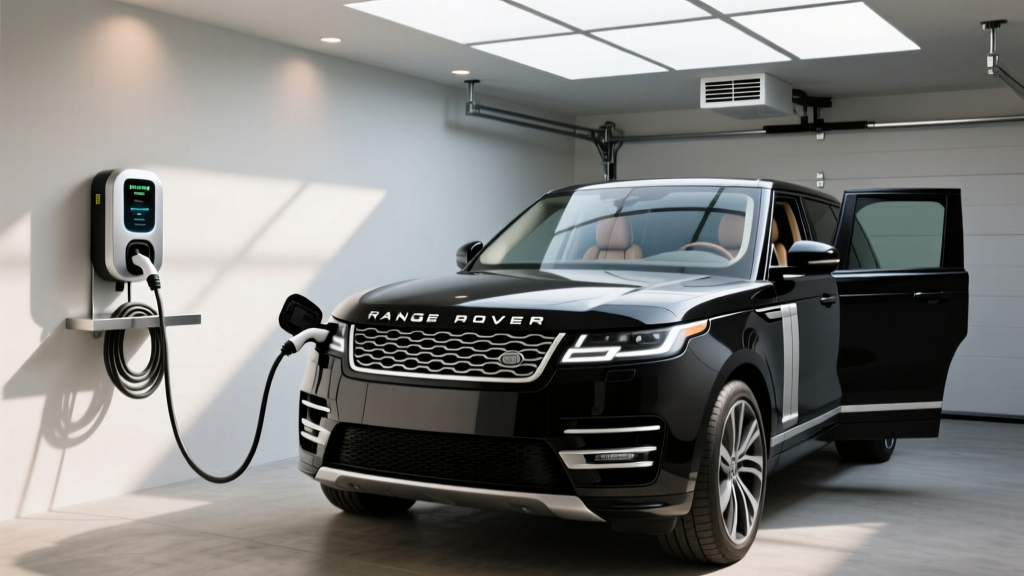
That modest battery size means charging logistics are simpler than a full EV's, but they're not trivial. You still need a reliable Level 2 home setup to maximize electric driving, minimize fuel burn, and protect the battery over the long haul. Here's exactly what that entails.
Charging Levels Explained: Speeds, kW, and Miles Added Per Hour
The single most common EV/PHEV confusion is between kW (power — how fast energy flows) and kWh (energy — how much the battery holds). Think of kW as the flow rate of a hose and kWh as the size of the bucket. The 2019 Range Rover P400e's 13.1 kWh bucket is small, so even modest kW rates fill it quickly.
| Level | Voltage | Max Power (kW) | Miles of Range Added/Hour | Time for 2019 RR P400e (0-100%) |
|---|---|---|---|---|
| Level 1 (Standard Outlet) | 120V | 1.4 kW | ~4-5 mi/hr | ~8-9 hours |
| Level 2 (Home/Public) | 240V | 3.3-7.2 kW | ~12-25 mi/hr | ~2-3.5 hours |
| DC Fast Charging | 400-800V DC | 50-350 kW | ~150-300+ mi/hr | N/A (P400e lacks DCFC) |
The 2019 Range Rover P400e's onboard charger is rated at 3.3 kW. That means even if you plug it into a 7.2 kW or 11.5 kW Level 2 wallbox, the car will only accept 3.3 kW. The good news: with a 13.1 kWh battery, a 3.3 kW feed fills it from empty in roughly 3.5 hours. For a PHEV you typically charge overnight, that's entirely adequate.
One critical note: the P400e does not support DC fast charging. Its charge port is AC-only (J1772 connector in North America). Don't plan road trips around DCFC stops — this vehicle relies on its gasoline engine for highway range beyond the electric buffer.
How Much Does It Cost to Install a Home EV Charger?
Most PHEV and EV owners install a Level 2 (240V) wall connector in their garage or driveway. Costs vary enormously based on your home's electrical panel, the distance from panel to charge point, and local labor rates.
| Component | Typical Cost Range | Notes |
|---|---|---|
| Level 2 Charger (Hardware) | $300 - $700 | 32A-48A smart chargers; P400e only needs 16A |
| Electrician Labor | $500 - $2,000 | Depends on run length, wall type, conduit |
| Electrical Permit | $50 - $200 | Required in most jurisdictions |
| Panel Upgrade (if needed) | $1,500 - $4,000 | 100A panels often need upgrade to 200A |
| Total (no panel upgrade) | $850 - $2,900 | Most homes with 200A service |
| Total (with panel upgrade) | $2,350 - $6,900 | Older homes with 100A service |
Homes built after the 1990s typically have 200-amp electrical panels with spare breaker slots, making a Level 2 install straightforward. If your home has an older 100-amp panel — or if your panel is already near capacity with HVAC, electric range, and dryer loads — you may need a service upgrade. A licensed electrician can perform a load calculation to determine this before you commit.
For the P400e's 3.3 kW onboard charger, you technically only need a 20-amp, 240V circuit (delivering ~3.8 kW continuous, derated to 80% per NEC code). However, most electricians recommend installing a 40-amp or 50-amp circuit with a NEMA 14-50 outlet or a hardwired 48A charger. This future-proofs your setup for a full EV later, and the incremental cost during initial installation is usually only $100-$300.
Which Connector and Charger Are Compatible With the P400e?
The 2019 Range Rover P400e uses the standard J1772 connector for AC Level 1 and Level 2 charging in North America. This is the universal AC connector for every non-Tesla EV and PHEV sold in the U.S.
| Connector | Type | Used By | P400e Compatible? |
|---|---|---|---|
| J1772 | AC (L1/L2) | All non-Tesla EVs/PHEVs | Yes (native) |
| NACS (Tesla) | AC + DC | Tesla (all), Ford, GM, Rivian, others (2025+) | AC only with adapter |
| CCS1 | DC Fast | Most non-Tesla EVs | No (no DCFC port) |
| CHAdeMO | DC Fast | Nissan Leaf (legacy) | No |
If you also own a Tesla or plan to buy a NACS-equipped vehicle in the future, you can purchase a J1772-to-NACS adapter (~$150-$250) to use a Tesla Wall Connector with the P400e. But for a single-PHEV household, a standard J1772 Level 2 charger is the simplest, most cost-effective choice.
Level 2 Charger Recommendations for the P400e
Since the P400e caps at 3.3 kW, you don't need a high-power charger — but buying one gives you headroom for future vehicles. Here are proven options:
Emporia Vue Level 2 Charger
- Power Output: Up to 48A (11.5 kW on 240V)
- Connector: J1772 (NACS adapter available)
- Cable Length: 24 ft
- Smart Features: Wi-Fi, app scheduling, energy monitoring, solar integration
- Price: ~$399
- Why it works: Budget-friendly, energy-tracking pairs well with PHEV owners monitoring electric vs. gas usage.
ChargePoint Home Flex
- Power Output: Configurable 16A-50A (3.8-12 kW)
- Connector: J1772 (NACS version available)
- Cable Length: 23 ft
- Smart Features: Wi-Fi, app, Alexa, flexible amperage dial
- Price: ~$549
- Why it works: The adjustable amperage lets you match the charger to your circuit exactly — set it to 16A for a 20A circuit feeding the P400e.
Grizzl-E Smart
- Power Output: Up to 40A (9.6 kW)
- Connector: J1772
- Cable Length: 24 ft
- Smart Features: OCPP-compatible, app control, extreme cold rated (-40°F)
- Price: ~$449
- Why it works: Built in Canada for harsh winters, rugged aluminum case, excellent for outdoor/driveway installs.
Any of these will charge the P400e from empty to full in approximately 3-3.5 hours — well within an overnight window. All are UL-listed and ENERGY STAR certified, which matters for safety and for qualifying for certain utility rebates.
Cost to Charge: Electricity vs. Gasoline Per Mile
The P400e's combined EPA fuel economy is 42 MPGe on electricity and 21 MPG combined on gasoline. Let's translate that into real cost-per-mile figures.
| Scenario | Energy Cost | Cost Per Mile (Electric) | Cost Per Mile (Gas at $3.50/gal) |
|---|---|---|---|
| Home Charging (Off-Peak) | $0.12/kWh | $0.04 | $0.17 |
| Home Charging (Peak) | $0.25/kWh | $0.08 | $0.17 |
| Public Level 2 | $0.35/kWh | $0.11 | $0.17 |
| Public DCFC | $0.48/kWh | N/A (P400e no DCFC) | $0.17 |
At the national average residential electricity rate of ~$0.16/kWh (per U.S. EIA data), charging the P400e's 13.1 kWh battery from empty costs roughly $2.10 and yields about 19 miles of electric range — that's $0.11/mile on electric versus $0.17/mile on gasoline. The savings are meaningful for daily commutes under 20 miles, where you can stay almost entirely on electric power.
If your utility offers time-of-use (TOU) rates, scheduling charges for overnight off-peak hours (often 11 PM - 6 AM) can cut your electric cost to $0.04-$0.06/mile — a 65-75% reduction versus gasoline.
Safety, Electrical Code, and Installation Best Practices
EV charger installations must comply with the National Electrical Code (NEC) and local building codes. Key requirements include:
- Dedicated circuit: Your Level 2 charger needs its own breaker — no sharing with other appliances. For the P400e, a 20A/240V circuit is the minimum; a 40A or 50A circuit is recommended for future-proofing.
- GFCI protection: NEC 2020 and later require GFCI (ground-fault circuit interrupter) protection for all EV charging outlets. Hardwired chargers often have GFCI built into the unit, but receptacle-based installs need a GFCI breaker.
- Outdoor rating: If installing outside, the charger must carry a NEMA 4 or NEMA 4X rating (weatherproof). All three chargers recommended above meet this standard.
- Permit and inspection: Most municipalities require an electrical permit and a post-installation inspection. This typically costs $50-$200 and ensures the work meets code. Skipping this step can void homeowner's insurance coverage for electrical fires.
- Wire gauge: A 40A circuit requires 8 AWG copper wire; a 50A circuit requires 6 AWG. Longer runs (over 50 feet from panel) may need thicker wire to prevent voltage drop.
Always hire a licensed electrician experienced with EV charger installations. Ask for a load calculation before work begins — this determines whether your panel can handle the added circuit without an upgrade.
Real-World Charging Expectations for PHEV Owners
The 2019 Range Rover P400e's 19-mile EPA electric range is modest by 2026 standards, where newer PHEVs like the Toyota RAV4 Prime deliver 42 miles. In practice, expect 14-17 miles of electric range in mixed driving, and as little as 11-13 miles in cold weather (below 30°F) when the battery's chemistry becomes less efficient and cabin heating draws additional power.
The P400e's regenerative braking helps recapture energy on downhill routes and in stop-and-go traffic, but the small battery limits how much you can recover. For maximum electric utilization, charge every night — the battery is small enough that a full top-up costs only ~$2, and daily shallow cycles are actually healthier for lithium-ion longevity than deep discharges.
Land Rover provides an 8-year/100,000-mile warranty on the P400e's high-voltage battery, covering defects and excessive capacity loss (typically defined as dropping below 70% of original capacity). According to Land Rover's warranty documentation, this is one of the longer PHEV battery warranties in the luxury segment.
Frequently Asked Questions
Can I charge the 2019 Range Rover P400e on a regular household outlet?
Yes. The P400e comes with a Level 1 (120V) charging cable that plugs into a standard NEMA 5-15 outlet. At 1.4 kW, a full charge takes approximately 8-9 hours. This works for overnight charging but is slow enough that if you deplete the battery during the day, you won't recover meaningful range before your next trip. A Level 2 install is strongly recommended for daily PHEV use.
Do I need a 48-amp charger if the P400e only accepts 3.3 kW?
No — you don't need one, but it's smart to install one anyway. A 48A charger costs only $100-$200 more than a 16A unit, and the electrician's labor is nearly identical. When you eventually replace the P400e with a full EV that accepts 11.5 kW or more, you won't need to redo the installation.
Is there a federal tax credit for installing a home EV charger?
The federal Alternative Fuel Vehicle Refueling Property Credit (IRS Form 8911) covers 30% of home charger hardware and installation costs, up to $1,000. However, eligibility is restricted to residents in census tracts that are not classified as urban areas or that meet specific low-income criteria, per current IRS guidelines. Check your census tract eligibility before counting on this credit.
How fast will each charging level add range to the P400e?
Level 1 (120V): approximately 4-5 miles of electric range per hour. Level 2 (240V at 3.3 kW): approximately 12-14 miles per hour. Since the P400e's total electric range is only 19 miles, a Level 2 session restores the full battery in about 2.5-3.5 hours.
What electrical upgrades might I need for a Level 2 charger?
If your home has a 200-amp electrical panel with available breaker slots, you likely need no upgrade — just a new 240V circuit. If you have a 100-amp panel, or if your panel is near capacity, you may need a service upgrade to 200A ($1,500-$4,000). Some utilities offer rebates covering $200-$500 of panel-upgrade costs when paired with EV charger installations.