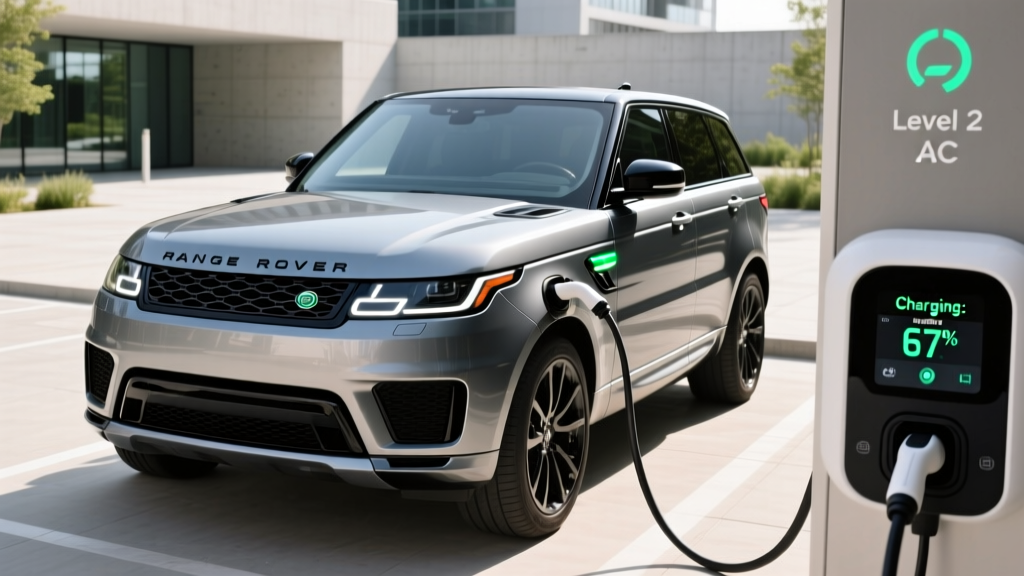
If you're researching the 2019 Range Rover Sport Supercharged and how it interacts with EV charging infrastructure, you've landed on the right guide — but with an important clarification up front. The 2019 Range Rover Sport Supercharged (5.0L supercharged V8, 518 hp) is not a plug-in hybrid or battery-electric vehicle. It's a conventional gasoline SUV with no charging port, no traction battery to plug in, and no electric-only range.
The plug-in hybrid in Land Rover's 2019 lineup is the Range Rover Sport P400e, which pairs a 2.0L turbocharged four-cylinder with a 13.1 kWh lithium-ion battery and an electric motor for a combined 398 hp and an EPA-rated 19 miles of electric-only range. If you're cross-shopping a used 2019 Range Rover Sport and wondering whether you'll need a home charger, this guide breaks down exactly what the P400e requires — and what Supercharged V8 owners should budget for at the pump instead.
2019 Range Rover Sport Lineup: Which Models Actually Plug In?
| Spec | Supercharged (5.0L V8) | P400e (PHEV) |
|---|---|---|
| Powertrain | 5.0L Supercharged V8, 518 hp | 2.0L Turbo I4 + Electric Motor, 398 hp |
| Battery | None (12V auxiliary only) | 13.1 kWh lithium-ion (NMC) |
| Electric-Only Range | N/A | 19 mi (EPA) |
| EPA Combined | 16 MPG | 42 MPGe / 25 MPG (gas only) |
| Charge Port | None | J1772 (Level 1/2) |
| Max AC Charge Rate | N/A | 3.6 kW |
| DC Fast Charging | N/A | Not supported |
| 0-60 mph | 5.0 sec | 6.3 sec |
| Original MSRP | ~$81,300 | ~$79,300 |
Sources: EPA fueleconomy.gov, Land Rover USA press archives.
Charging Levels Explained: Speeds in kW and Miles Per Hour
For P400e owners (or any PHEV shopper comparing the Range Rover Sport to rivals), understanding charging levels is essential. Power is measured in kW (kilowatts — the rate of energy flow), while battery capacity is measured in kWh (kilowatt-hours — the total energy stored). Think of kW as how fast water flows from a hose, and kWh as the size of the bucket.
| Level | Voltage / Amps | Power (kW) | Miles of Range Added Per Hour | P400e 0-100% Time |
|---|---|---|---|---|
| Level 1 (standard outlet) | 120V / 12A | ~1.4 kW | ~4-5 mi/hr (at PHEV efficiency) | ~9-10 hours |
| Level 2 (home/public AC) | 240V / 16-48A | 3.3 - 11.5 kW | ~12-35 mi/hr (PHEV) | ~2.75 hours (at 3.6 kW cap) |
| DC Fast Charging | 400-800V DC | 50 - 350 kW | 150-1,000+ mi/hr (BEV) | Not supported on P400e |
The P400e's onboard charger maxes out at 3.6 kW, meaning even if you plug into a 48-amp Level 2 station capable of 11.5 kW, the car will only draw 3.6 kW. This is common for PHEVs — their smaller batteries don't need high-power charging. For context, a full BEV like the Hyundai Ioniq 5 accepts up to 240 kW on DC fast charging, adding roughly 200 miles in 18 minutes (10-80%).
Home Charger Installation: Electrical Requirements and Costs
Even though the P400e only charges at 3.6 kW, installing a dedicated Level 2 circuit is the practical choice for daily use. A standard 120V outlet technically works, but a full charge takes nearly 10 hours — fine for overnight, but limiting if you need a midday top-up.
Electrical Requirements for the P400e
- Minimum circuit: 240V / 20A dedicated breaker (supports 3.6 kW continuous draw)
- Recommended circuit: 240V / 40A or 50A (future-proofs for a BEV or higher-power PHEV)
- Wire gauge: 10 AWG for 20A; 6 AWG for 50A (copper, THHN in conduit)
- Panel capacity: Most modern 200A panels can accommodate a 40-50A EV circuit. Older 100A panels may need an upgrade.
Installation Cost Breakdown
| Item | Low End | High End | Notes |
|---|---|---|---|
| Level 2 charger (hardware) | $200 | $650 | Depends on smart features, cable length |
| Electrician labor (240V run) | $400 | $1,200 | Varies by run length, wall type, attic/crawlspace |
| Permit fee | $50 | $200 | Required in most jurisdictions |
| Panel upgrade (if needed) | $1,500 | $3,500 | Only if existing panel lacks capacity |
| Total (no panel upgrade) | $650 | $2,050 | Most homes fall in this range |
| Total (with panel upgrade) | $2,150 | $5,550 | Older homes with 100A service |
Federal Incentive: §30D Alternative Fuel Refueling Property Credit
The IRS §30C credit (not §30D — that's the vehicle purchase credit) covers up to 30% of home charger hardware and installation costs, capped at $1,000, for equipment placed in service through 2032. Eligibility depends on census-tract requirements. Consult a tax professional for your specific situation.
Connector Compatibility: What Fits the P400e (and What Doesn't)
The 2019 Range Rover Sport P400e uses a J1772 connector for AC charging — the North American standard for Level 1 and Level 2. It does not have a DC fast-charge port (no CCS1, no CHAdeMO, no NACS).
| Connector | Type | P400e Compatible? | Notes |
|---|---|---|---|
| J1772 | AC Level 1/2 | ✅ Yes (native) | Standard on all non-Tesla PHEVs/BEVs sold in US |
| NACS (Tesla) | AC + DC | ⚠️ With adapter (AC only) | Tesla J1772 adapter works; native NACS on 2025+ models |
| CCS1 | DC Fast | ❌ No | P400e has no DC fast-charge capability |
| CHAdeMO | DC Fast | ❌ No | Largely legacy; Nissan Leaf, older Mitsubishi |
For P400e owners shopping for a home Level 2 charger, any J1772-equipped unit will plug directly into your car. If you anticipate your next vehicle being a Tesla or NACS-equipped Ford/GM/Hyundai, consider a charger with a NACS plug and use a NACS-to-J1772 adapter (~$150-250) for the P400e.
Cost to Charge vs. Gas: The Real Math for Range Rover Sport Owners
Whether you own the P400e or the Supercharged V8, fuel and energy costs matter. Here's how they compare using 2026 national averages.
| Scenario | Rate | Cost Per Mile | Annual Cost (12,000 mi) |
|---|---|---|---|
| Supercharged V8 (16 MPG combined) | $3.40/gal (2026 avg) | $0.213/mi | $2,550 |
| P400e — home charging (off-peak, $0.13/kWh) | $0.13/kWh | $0.043/mi | $516 (electric portion) |
| P400e — public Level 2 ($0.30/kWh avg) | $0.30/kWh | $0.099/mi | $1,188 (electric portion) |
| P400e — gas only (25 MPG combined) | $3.40/gal | $0.136/mi | $1,632 |
Key insight: The P400e's 13.1 kWh battery yields only ~19 miles of electric range (real-world: expect 14-16 miles in cold weather or at highway speeds). If your daily commute is under 15 miles round-trip and you charge at home nightly, you'll burn very little gas. But if you regularly exceed the electric range, the P400e reverts to a 25 MPG hybrid — better than the V8's 16 MPG, but not transformative.
Recommended Home Chargers for the P400e
Since the P400e caps at 3.6 kW, you don't need a 48-amp charger — but investing in one future-proofs your garage for your next EV. Here are three solid picks available in 2026:
Emporia Level 2 Smart Charger
- Power: Up to 48A / 11.5 kW (240V)
- Connector: J1772 (NACS version available)
- Cable length: 24 ft
- Smart features: Wi-Fi, energy monitoring, scheduling, solar integration
- Price: ~$299
- Best for: Budget-conscious buyers who want smart scheduling to exploit off-peak rates
ChargePoint Home Flex
- Power: Configurable 16-50A / up to 12 kW (240V)
- Connector: J1772 or NACS
- Cable length: 23 ft
- Smart features: Wi-Fi, app scheduling, Alexa integration, amperage dial
- Price: ~$549
- Best for: Owners who want adjustable amperage to match their circuit
Tesla Wall Connector (Universal)
- Power: Up to 48A / 11.5 kW (240V)
- Connector: NACS with integrated J1772 adapter (Magic Dock style)
- Cable length: 24 ft
- Smart features: Wi-Fi, OTA updates, power sharing (multiple units)
- Price: ~$599
- Best for: Households with mixed Tesla and non-Tesla EVs
For the P400e specifically, any of these will charge the 13.1 kWh battery from 0-100% in approximately 2 hours 45 minutes to 3 hours — well within an overnight window. The Emporia is the value pick; the ChargePoint Home Flex offers the most flexibility for varying electrical setups.
Safety and Electrical Code Considerations
EV charging is a continuous load (defined by the NEC as operating for 3 hours or more), which triggers specific code requirements:
- Dedicated circuit: Your EV charger must have its own breaker — no sharing with other outlets or appliances.
- 80% rule: Continuous loads can only use 80% of a breaker's rated capacity. A 40A breaker supports 32A continuous; a 50A breaker supports 40A continuous.
- GFCI protection: The 2020 NEC (and most 2026 local codes) requires GFCI protection for outdoor EV outlets. Hardwired chargers typically have built-in ground-fault protection, but confirm with your electrician and local inspector.
- Outdoor rating: If installing outside, the charger must be rated NEMA 4 (weatherproof). All three chargers above carry outdoor ratings.
- Permit and inspection: Most municipalities require an electrical permit for a new 240V circuit. The inspection ensures proper wire gauge, breaker sizing, and grounding. Skipping the permit risks insurance claim denials if an electrical fire occurs.
For Supercharged V8 Owners: What You're Spending at the Pump
If you own (or are buying) the 2019 Range Rover Sport Supercharged with the 5.0L V8, there's no plug and no charging decision to make. But the fuel economics are worth confronting:
- EPA combined: 16 MPG (14 city / 19 highway)
- Tank size: 27.7 gallons
- Cost to fill: ~$94 at $3.40/gal
- Range per tank: ~443 miles (EPA); real-world highway: ~500 mi; real-world city: ~370 mi
- Annual fuel cost (12,000 mi): ~$2,550
- 5-year fuel cost: ~$12,750 (assuming stable gas prices)
Compare that to a P400e owner who charges at home and drives 15 miles/day on electric: their annual fuel cost could be as low as $500-800 (electricity + occasional gas for longer trips). Over 5 years, that's a $7,000-10,000 fuel savings — enough to offset much of the P400e's used-market price premium.
Frequently Asked Questions
How much does it cost to install a home EV charger?
For a standard 240V/40A Level 2 installation without a panel upgrade, expect $650-$2,050 total (charger hardware + electrician labor + permit). If your home needs a panel upgrade from 100A to 200A, add $1,500-$3,500. The P400e only needs a 20A circuit, which is on the lower end of this range.
How fast will each charging level add range?
Level 1 (120V) adds roughly 4-5 miles of electric range per hour on a PHEV like the P400e. Level 2 (240V) at the P400e's 3.6 kW cap adds about 12-14 miles per hour. DC fast charging is not available on the P400e. For a full BEV with 250+ mile range, DC fast charging at 150+ kW can add 150-200 miles in 15-20 minutes.
Which connector/charger is compatible with my EV?
The 2019 Range Rover Sport P400e uses a J1772 connector for Level 1 and Level 2 AC charging. Any J1772-equipped home charger or public Level 2 station will work. The P400e has no DC fast-charge port (CCS1, CHAdeMO, or NACS DC). The 2019 Supercharged V8 has no charge port at all.
How much does charging cost per mile vs gas?
At home off-peak rates ($0.13/kWh), the P400e costs about $0.043 per mile on electricity — roughly 5x cheaper than the Supercharged V8's $0.213/mile on gas. Public Level 2 charging ($0.30/kWh) brings the P400e to ~$0.099/mile, still cheaper than gas. The savings are most dramatic when you maximize home charging and keep daily driving within the 19-mile electric range.
What electrical upgrades might I need?
The most common upgrade is a panel capacity increase from 100A to 200A ($1,500-$3,500), needed in older homes where the existing panel is near capacity. You may also need a new breaker slot (if your panel is full), a conduit run from panel to garage (if the panel is far from the charger location), or a sub-panel if your garage is detached. A licensed electrician's load calculation is the definitive answer — don't guess.
Is the 2019 Range Rover Sport P400e eligible for any tax credits in 2026?
No. The federal §30D new clean vehicle credit applies only to new vehicles, and the P400e was discontinued after the 2022 model year (replaced by the P460e in the redesigned 2023+ Sport). For used PHEVs, the §25E used clean vehicle credit offers up to $4,000 (30% of sale price, capped) for qualifying used EVs/PHEVs under $25,000 sold by a dealer — but the P400e's used-market price typically exceeds this cap. The §30C home charger credit (up to $1,000) may still apply to your installation. Always verify with a tax professional and consult IRS.gov for current-year rules.