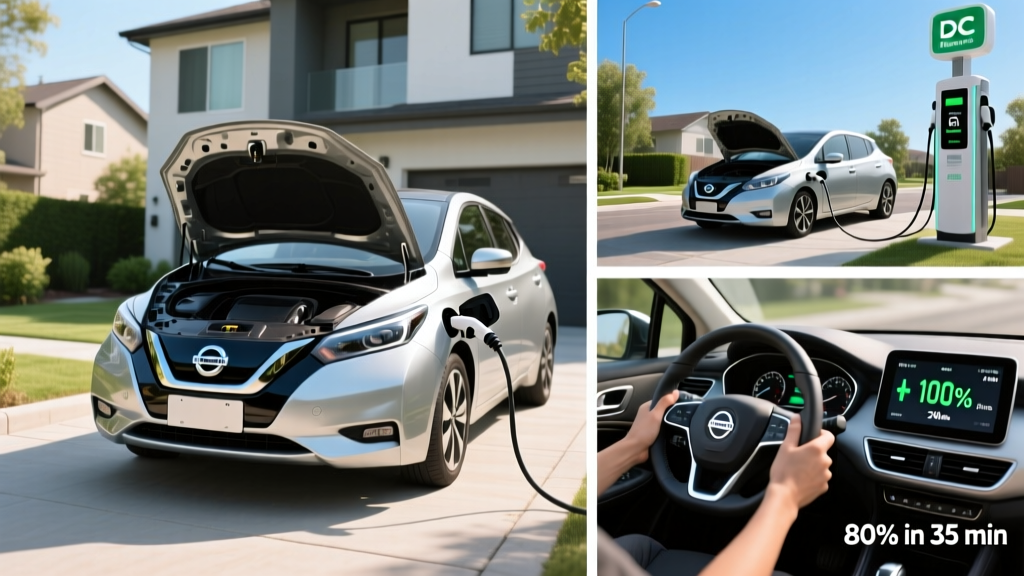
The 2019 Nissan Leaf SV remains one of the most popular used electric vehicles on the road, thanks to its accessible pricing and practical hatchback design. But for new owners — or those shopping the used market — understanding the 2019 Nissan Leaf SV range, its CHAdeMO charging quirks, and what it actually costs to keep it powered requires a detailed look at real-world numbers. This guide covers everything from EPA estimates versus highway reality to home Level 2 installation costs, public DC fast-charging speeds, and the exact equipment you need.
2019 Nissan Leaf SV: Range, Battery & Real-World Expectations
The 2019 Leaf SV came with a 40 kWh (usable) lithium-ion NMC battery and an EPA-rated range of 150 miles. Nissan also offered the Leaf SV Plus (sometimes badged S Plus or SL Plus) with a larger 62 kWh battery and an EPA range of 226 miles. For this guide, we focus on the standard 40 kWh SV, which is far more common on the used market.
| Spec | Value |
|---|---|
| Battery (usable) | 40 kWh, NMC lithium-ion |
| EPA Range | 150 miles |
| Real-World Range (highway) | ~120–135 miles |
| Real-World Range (cold weather) | ~100–115 miles |
| MPGe (combined) | 112 MPGe |
| Efficiency | 30 kWh/100 mi |
| Motor Output | 110 kW (147 hp), 236 lb-ft torque |
| 0–60 mph | ~7.9 seconds |
| DC Fast Charge Port | CHAdeMO (max ~50 kW) |
| Level 2 Onboard Charger | 6.6 kW |
| Battery Warranty (original) | 8 years / 100,000 miles (capacity loss below 9 bars of 12) |
Charging Levels Explained: How Fast Does Each Add Range?
Understanding the difference between kW (kilowatts) and kWh (kilowatt-hours) is essential. kW measures the rate of power delivery — think of it as the width of a hose. kWh measures total energy stored — think of it as the size of the bucket. Your Leaf SV's battery is a 40 kWh bucket, and the charger's kW rating determines how fast you fill it.
| Level | Power Source | Max kW | Miles of Range Added Per Hour | Full Charge Time (0–100%) |
|---|---|---|---|---|
| Level 1 (120V) | Standard household outlet | 1.2–1.4 kW | ~4–5 miles/hr | ~30–35 hours |
| Level 2 (240V) | Home wall charger or public L2 | 6.6 kW (car-limited) | ~22–24 miles/hr | ~6–7 hours |
| DC Fast (CHAdeMO) | Public DC fast station | ~50 kW (peak) | ~150–170 miles/hr (peak) | 10–80% in ~40–45 min |
Important charge-curve note: The Leaf's CHAdeMO port peaks around 50 kW only between roughly 10–50% State of Charge (SoC). Above 60%, the charge rate tapers significantly to protect battery health. A 10–80% DC fast charge takes approximately 40–45 minutes. Do not expect the peak 50 kW rate to be sustained across the entire session.
The Leaf's passive air-cooled battery is a known limitation. During repeated DC fast charging or in hot weather, the battery can heat-soak, causing Nissan's battery management system to throttle charging speeds — a phenomenon owners call "Rapidgate." For daily use with Level 2 home charging, this is rarely an issue, but it matters for road trips with multiple fast-charge stops.
How Much Does It Cost to Install a Home EV Charger?
For the Leaf SV, a Level 2 home charger is the sweet spot. The car's 6.6 kW onboard charger means you don't need a 48-amp or 80-amp station — a 32-amp or 40-amp Level 2 charger on a 240V circuit will fully utilize the car's acceptance rate. Here is a realistic cost breakdown for a 2026 installation:
| Cost Component | Typical Range | Notes |
|---|---|---|
| Level 2 Charger (Equipment) | $300–$700 | 32A–40A, J1772 connector, 20–25 ft cable |
| Electrician Labor | $500–$2,000 | Depends on panel proximity, conduit run length |
| Electrical Permit | $50–$250 | Varies by municipality |
| Panel Upgrade (if needed) | $1,500–$4,000 | Required if panel is maxed out or below 100A service |
| Total (no panel upgrade) | $850–$2,950 | Most homes with 200A service and nearby panel |
| Total (with panel upgrade) | $2,350–$6,950 | Older homes with 100A or heavily loaded panels |
Electrical Requirements for the Leaf SV
A 40-amp charger requires a dedicated 50-amp, 240V circuit (the National Electrical Code requires circuits to be rated at 125% of continuous load). If you opt for a 32-amp charger, a 40-amp breaker suffices. The installer will run conduit from your panel to the charger location — shorter runs mean lower costs. Garages adjacent to the electrical panel are the cheapest scenario.
Panel Upgrade Gotchas
Homes built before the 1990s often have 100-amp electrical service. Adding a 40A or 50A dedicated circuit on top of existing loads (dryer, oven, HVAC) may exceed panel capacity. An electrician will perform a load calculation to determine if an upgrade to 200A service is needed. Some utilities offer rebates for panel upgrades tied to EV adoption — check with your local provider.
Connector Compatibility: CHAdeMO, CCS, and NACS Explained
The 2019 Nissan Leaf uses two connectors:
- J1772 for Level 1 and Level 2 AC charging (the standard North American AC plug)
- CHAdeMO for DC fast charging
This is a critical ownership detail because the EV industry has largely standardized on CCS1 (Combined Charging System) and is now transitioning to NACS (North American Charging Standard, the Tesla connector). CHAdeMO infrastructure is shrinking in the U.S., though it remains available at many Electrify America, EVgo, and independent stations.
| Connector | Used For | Leaf SV Compatible? | Adapter Available? |
|---|---|---|---|
| J1772 | Level 1 & Level 2 AC | Yes (native) | N/A — standard port |
| CHAdeMO | DC Fast Charging | Yes (native) | N/A — standard port |
| CCS1 | DC Fast Charging | No | No reliable adapter exists |
| NACS (Tesla) | DC Fast (Supercharger) & L2 | No (DC); Yes (L2 with adapter) | Tesla J1772 adapter included with Tesla wall connectors; no NACS-to-CHAdeMO DC adapter exists |
Practical takeaway: At home, any J1772 Level 2 charger works perfectly. For public DC fast charging, you are limited to CHAdeMO-equipped stations. Apps like PlugShare let you filter for CHAdeMO availability. As of 2026, CHAdeMO stations are increasingly rare on new installations, so plan road trips carefully and identify CHAdeMO stops in advance.
Charging Cost Per Mile: Leaf SV vs. Gas Car
One of the strongest arguments for the Leaf SV is low operating cost. The car consumes approximately 30 kWh per 100 miles (or 0.30 kWh/mile), based on its EPA efficiency rating from fueleconomy.gov. Here is how charging costs compare across scenarios:
| Scenario | Rate | Cost Per Mile (Leaf SV) | Cost Per Mile (25 MPG gas car at $3.40/gal) |
|---|---|---|---|
| Home charging (off-peak utility rate) | $0.10/kWh | $0.030 | $0.136 |
| Home charging (average U.S. residential) | $0.17/kWh | $0.051 | $0.136 |
| Public Level 2 (network pricing) | $0.25/kWh | $0.075 | $0.136 |
| DC Fast Charging (CHAdeMO, public) | $0.40/kWh | $0.120 | $0.136 |
| DC Fast Charging (peak pricing) | $0.55/kWh | $0.165 | $0.136 |
At home on an off-peak rate, the Leaf SV costs roughly $0.03 per mile — about one-quarter the cost of a 25 MPG gas car. Even at public DC fast-charger pricing, the Leaf is often cheaper per mile than gasoline. However, frequent reliance on premium-priced DC fast charging can erode those savings, which is why home Level 2 charging is the economic foundation of EV ownership.
Recommended Level 2 Chargers for the Nissan Leaf SV
Since the Leaf SV's onboard charger caps at 6.6 kW, you don't need the most powerful station on the market. A quality 32A or 40A charger on a 240V circuit will deliver the full 6.6 kW (or close to it). Here are proven options for 2026:
Emporia Vue Level 2 Charger
- Power: 40A / 9.6 kW max (Leaf will draw 6.6 kW)
- Connector: J1772
- Cable Length: 24 ft
- Smart Features: Wi-Fi, app scheduling, energy monitoring, load management
- Price: ~$350–$400
- Best For: Budget-conscious buyers who want smart scheduling for off-peak rates
ChargePoint Home Flex
- Power: Configurable 16A–50A (up to 12 kW; Leaf draws 6.6 kW)
- Connector: J1772
- Cable Length: 23 ft
- Smart Features: Wi-Fi, Alexa integration, app scheduling, flexible amperage
- Price: ~$550–$650
- Best For: Owners who may upgrade to a faster-charging EV later
Tesla Wall Connector (with J1772 adapter)
- Power: 48A / 11.5 kW max (Leaf draws 6.6 kW)
- Connector: NACS native; Tesla sells a J1772 adapter (~$50)
- Cable Length: 24 ft
- Smart Features: Wi-Fi, over-the-air updates, power sharing between two units
- Price: ~$425 (charger) + ~$50 (adapter)
- Best For: Multi-EV households with a Tesla and a Leaf
Grizzl-E Smart
- Power: 40A / 9.6 kW max (Leaf draws 6.6 kW)
- Connector: J1772
- Cable Length: 24 ft
- Smart Features: OCPP-compatible, app control, outdoor-rated (NEMA 4)
- Price: ~$450–$500
- Best For: Outdoor installations, cold-climate durability
Safety, Electrical Code & Installation Best Practices
A safe installation is non-negotiable. Here are the key requirements your licensed electrician should follow, based on the National Electrical Code (NEC) and best practices for 2026:
- Dedicated circuit: Your Level 2 charger must be on its own dedicated breaker — it cannot share a circuit with other appliances.
- GFCI protection: NEC 2020 and later require GFCI (Ground Fault Circuit Interrupter) protection for EV charging outlets. Many modern chargers have built-in GFCI, but your electrician will verify compliance.
- Outdoor rating: If your charger is installed outside, it must carry a NEMA 4 or NEMA 4X rating for weather resistance. Indoor installations require at minimum NEMA 1 (standard enclosure).
- Hardwired vs. plug-in: Hardwired installations (no plug) are preferred for 40A+ circuits and may be required by local code for circuits above 40A. A NEMA 14-50 plug is common for 40A/50A circuits and allows charger portability.
- Permit and inspection: Most jurisdictions require an electrical permit and post-installation inspection. Do not skip this — it protects your home insurance coverage and ensures code compliance.
- Wire gauge: A 50A circuit requires 6 AWG copper wire (or 4 AWG aluminum). Your electrician will size appropriately.
Always hire a licensed electrician familiar with EV charger installations. Ask for their load calculation methodology and whether they pull permits as standard practice.
Frequently Asked Questions
How much does it cost to install a home EV charger for the 2019 Leaf SV?
Expect $850–$2,950 for a straightforward installation (no panel upgrade) with a 32A–40A Level 2 charger. If your home needs a panel upgrade from 100A to 200A service, total costs can reach $2,350–$6,950. The charger itself costs $300–$700; the rest is labor, conduit, wire, and permit fees.
How fast will each charging level add range to the Leaf SV?
Level 1 (120V) adds about 4–5 miles per hour. Level 2 (240V, 6.6 kW) adds about 22–24 miles per hour, fully recharging overnight. DC fast charging on CHAdeMO peaks at ~50 kW and can add ~80 miles in 30 minutes, but tapers significantly above 60% SoC.
Which connector and charger is compatible with my 2019 Leaf SV?
For Level 1 and Level 2, your Leaf uses the J1772 connector — the North American standard. Any J1772 charger works. For DC fast charging, the Leaf uses CHAdeMO. There is no reliable adapter from CCS1 or NACS to CHAdeMO for DC charging, so you are limited to CHAdeMO-equipped public stations.
How much does charging the Leaf SV cost per mile compared to gas?
At the U.S. average residential electricity rate of ~$0.17/kWh, the Leaf SV costs about $0.051 per mile. A comparable 25 MPG gas car at $3.40/gallon costs $0.136 per mile. Home off-peak charging can drop the Leaf's cost to $0.03/mile. Public DC fast charging at $0.40–$0.55/kWh narrows the gap to $0.12–$0.17/mile.
What electrical upgrades might I need for a Level 2 charger?
If your home has 200-amp service with available breaker slots near the garage, you likely need only a new dedicated 40A or 50A breaker and a conduit run. If your panel is 100-amp or fully loaded, a service upgrade to 200A may be required — adding $1,500–$4,000. An electrician's load calculation is the definitive answer. Some utilities and states offer rebates for panel upgrades tied to EV adoption; check the IRS §30D guidelines and your local utility for current incentive details.
Is the 2019 Leaf SV battery still reliable in 2026?
Nissan's original battery warranty covered 8 years/100,000 miles against capacity loss below 9 of 12 bars on the dash display. For a 2019 model, that warranty may have expired or be expiring in 2027. Real-world data from Leaf owners shows the passively cooled 40 kWh pack typically retains 80–88% of original capacity after 5–7 years in moderate climates. Hot climates and frequent DC fast charging accelerate degradation. A full battery replacement costs approximately $6,500–$9,000 as of 2026.
Can I use a Tesla Supercharger with the 2019 Leaf SV?
No. Tesla Superchargers use the NACS connector for DC charging, and there is no commercially available NACS-to-CHAdeMO adapter for DC fast charging. You can use a Tesla Wall Connector at home with a J1772 adapter for Level 2, but public Supercharger access is not possible with the Leaf.