The 2019 Audi e-tron was Audi's first all-electric SUV, and it remains a popular used-EV find in 2026. But its combination of a 204-mile EPA range, an 84 kWh usable battery (95 kWh gross), and a peak DC fast-charge rate of 150 kW means owners need to think carefully about their charging setup to make daily life effortless. Whether you just picked up a used e-tron or you're evaluating one, this guide covers exactly what it takes to charge it at home, on the road, and what you'll spend per mile.
2019 Audi e-tron Range: EPA Sticker vs. Real-World Expectations
Battery: 95 kWh gross / 84 kWh usable, NMC chemistry
Efficiency: 74 MPGe combined (2.22 kWh/mile) per fueleconomy.gov
Real-World Expectations:
• Highway (70 mph, mild weather): ~180–195 miles
• City / suburban mixed: ~195–210 miles
• Cold weather (below 30°F): ~150–170 miles (25–30% reduction without preconditioning)
• Towing (max 4,000 lbs): ~120–140 miles
The e-tron's efficiency penalty comes from its 5,765-pound curb weight and quattro all-wheel-drive system. However, Audi engineered one of the best charging curves in the industry for this generation — the e-tron can sustain 150 kW well past 80% state of charge, a rarity among 2019-era EVs. That means real charging stops are faster than peak-kW specs alone suggest.
Charging Levels Explained: How Fast Will Each Add Range?
Understanding the three charging levels is essential. The critical distinction: kW (kilowatts) measures power — the rate of energy delivery. kWh (kilowatt-hours) measures energy — the total amount stored in the battery. Think of kW as the width of a hose and kWh as the size of the bucket.
| Level | Voltage / Amps | Power (kW) | Miles of Range Added per Hour | Typical Use Case |
|---|---|---|---|---|
| Level 1 | 120V / 12A | 1.4 kW | ~3–4 miles/hr | Emergency / overnight trickle |
| Level 2 (Home) | 240V / 40A | 9.6 kW | ~22–26 miles/hr | Daily home charging |
| Level 2 (Max) | 240V / 48A | 11.5 kW | ~26–30 miles/hr | Faster home / workplace |
| DC Fast | 400V+ DC | Up to 150 kW peak | ~320+ miles/hr (peak) | Road trips, public stations |
The e-tron's onboard charger maxes out at 11.5 kW on Level 2 AC. That means even if you install a 48-amp (11.5 kW) home charger, you'll hit the car's ceiling. Installing a 60-amp charger won't speed things up further — but it future-proofs for your next EV.
How Much Does It Cost to Install a Home EV Charger?
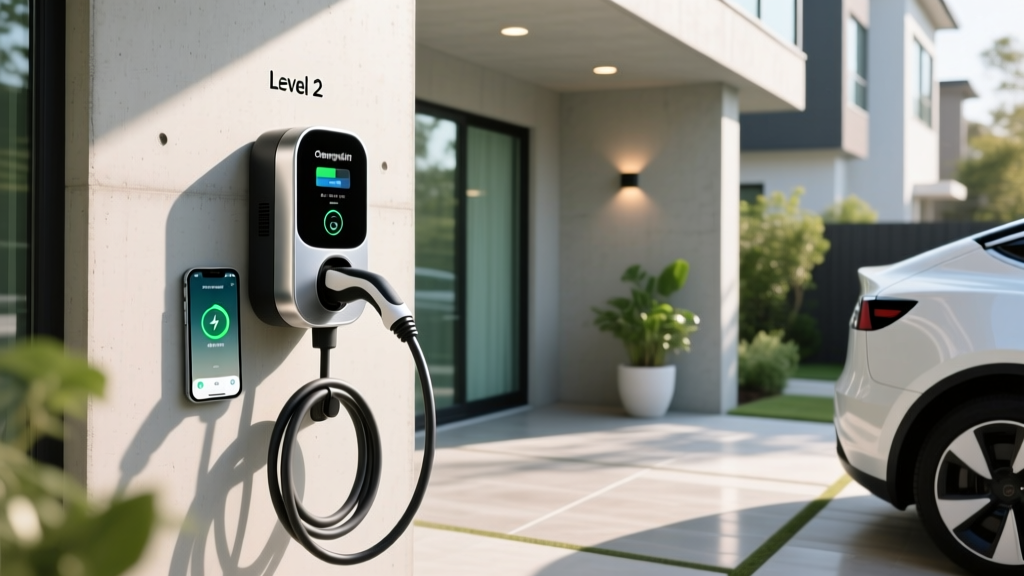
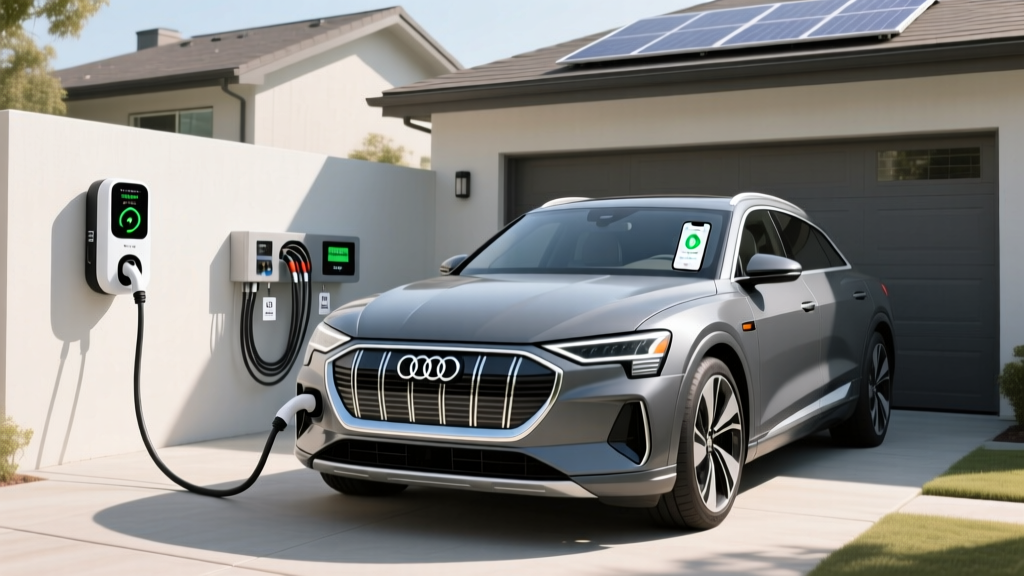
For the 2019 Audi e-tron, a 48-amp Level 2 charger on a dedicated 60-amp, 240V circuit is the optimal home setup. Here's what that actually costs in 2026:
| Component | Low-End | High-End | Notes |
|---|---|---|---|
| Level 2 Charger (40–48A, hardwired) | $400 | $750 | ChargePoint Home Flex, Emporia Vue, Wallbox Pulsar Plus |
| Electrician labor | $500 | $1,500 | Varies by region, run length, conduit needs |
| Electrical permit | $50 | $200 | Required in most jurisdictions |
| Panel upgrade (if needed) | $1,500 | $4,000 | 100A → 200A service upgrade for older homes |
| Total (no panel upgrade) | $950 | $2,450 | |
| Total (with panel upgrade) | $2,450 | $6,450 |
The panel-upgrade gotcha: Homes built before 2000 often have 100-amp electrical service. Adding a 60-amp dedicated EV circuit may push total load beyond your panel's capacity, requiring a service upgrade to 200 amps. Get an electrician to perform a load calculation before committing. Some utilities offer rebates of $250–$1,000 for panel upgrades tied to EV adoption — check with your local provider.
Electrical requirements for the e-tron's optimal home charge:
- Dedicated 240V circuit, 60-amp breaker (for 48A continuous draw — NEC requires circuits rated at 125% of continuous load)
- 6 AWG copper wire (or 4 AWG aluminum) for runs under 50 feet; larger gauge for longer runs
- Hardwired connection preferred over NEMA 14-50 outlet for 48A+ (many outlets aren't rated for continuous 40A+ draw)
- GFCI breaker required in garages per 2023 NEC update (code varies by locality — confirm with your electrician)
- Outdoor-rated (NEMA 4) enclosure if installing outside
Connector Compatibility: CCS1, NACS, and Adapter Needs
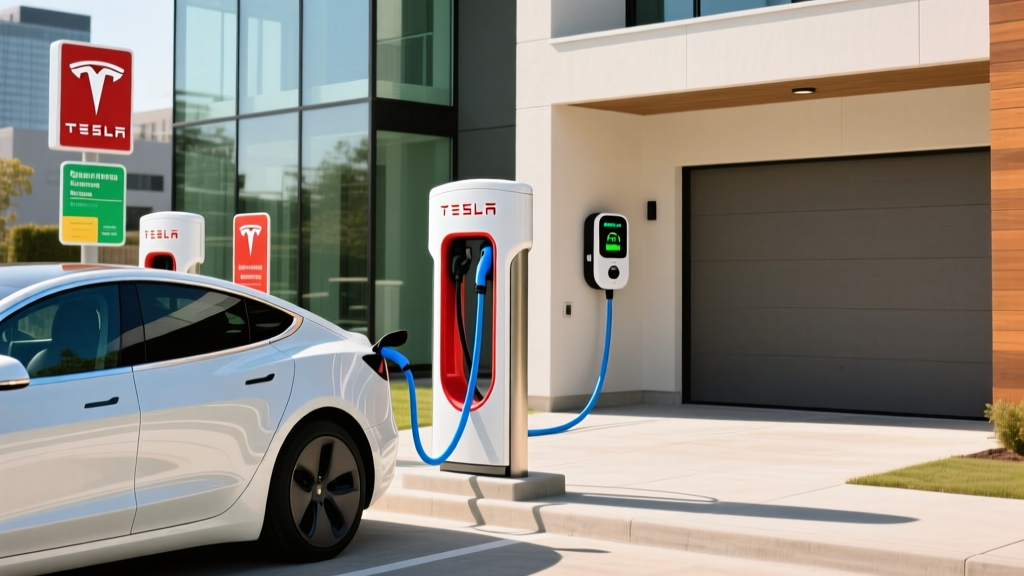
The 2019 Audi e-tron came equipped with a CCS1 (Combined Charging System) port for both AC Level 2 and DC fast charging. As of 2026, the North American charging landscape has shifted heavily toward Tesla's NACS connector, which Audi has adopted on new models starting with the 2025 model year. For your 2019 e-tron, here's what you need to know:
| Connector | Native Support? | Adapter Required? | Availability |
|---|---|---|---|
| CCS1 (DC fast + AC Level 2) | Yes — built-in | No | Electrify America, EVgo, most non-Tesla networks |
| NACS (Tesla Supercharger) | No | Yes — CCS-to-NACS adapter ($150–$250) | Tesla Supercharger network (opened to non-Tesla CCS vehicles via adapter) |
| CHAdeMO | No | Not practical (no reliable adapter) | Largely deprecated in North America |
| J1772 (AC Level 1/2 only) | Yes (upper portion of CCS port) | No | Standard for home and public Level 2 |
Practical recommendation: Buy a CCS-to-NACS adapter from an authorized supplier (Audi-approved or a reputable brand like Lectron or A2Z). This unlocks access to Tesla Superchargers, which remain the most reliable DC fast-charging network in North America. Keep the adapter in your frunk. For home Level 2 charging, any J1772-connector charger will plug directly into the e-tron's CCS port.
DC Fast Charging: Real-World Speeds and the e-tron's Standout Curve
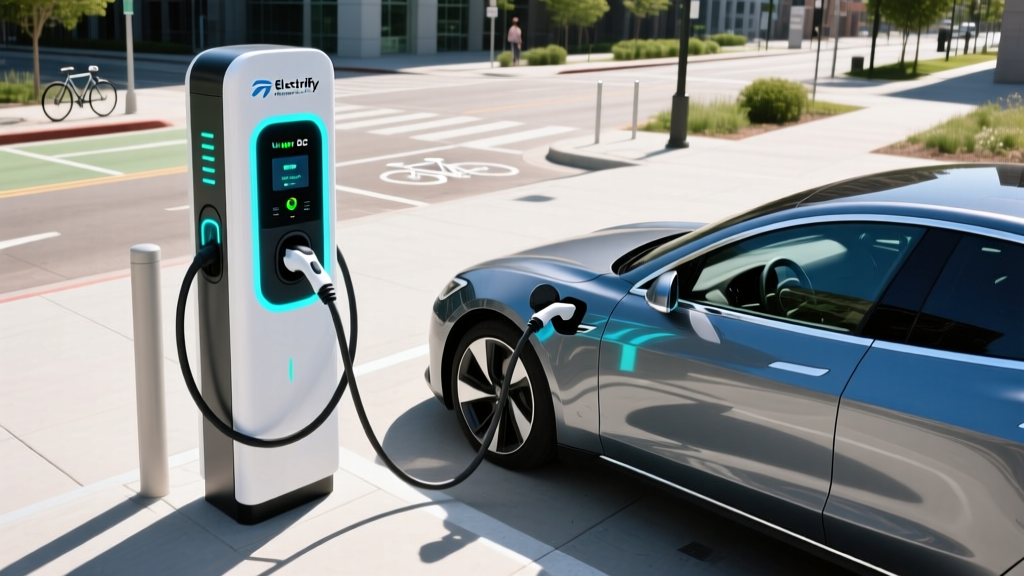
The 2019 e-tron's 150 kW peak DC fast-charge rate sounds modest by 2026 standards (many newer EVs hit 250–350 kW). But peak rate is only part of the story. What matters is the charging curve — how long the car sustains high power before tapering.
The e-tron's charging curve is exceptional:
- 10–80% charge time: approximately 30 minutes at a 150 kW+ station
- Sustained rate: Holds ~135–150 kW from 10% all the way to ~70% SoC, then gradually tapers to ~75 kW by 80%
- 80–100%: Tapers significantly; expect another 25–30 minutes (only do this when necessary)
- Energy added in 30 minutes: ~55–60 kWh, or roughly 130–140 miles of real-world range
Preconditioning matters: The e-tron will precondition its battery for faster DC charging when you set a DC fast-charger as your navigation destination. This warms the battery to optimal temperature (around 77–95°F). Without preconditioning — especially in cold weather — your peak charge rate may be limited to 75–100 kW until the battery warms up, adding 10–15 minutes to your stop.
For road trips, plan stops at Electrify America, EVgo, or Tesla Superchargers (with adapter) rated at 150 kW or higher. The e-tron can't take advantage of 350 kW stations beyond the 150 kW ceiling, but those stations often deliver more consistent power at 150 kW because they're not power-sharing with as many stalls.
Cost to Charge: Per-Mile Cost vs. Gas
The e-tron's efficiency of ~2.22 kWh/mile (or roughly 450 Wh/mile) means charging costs add up faster than on more efficient EVs like the Tesla Model Y (~280 Wh/mile). Here's what you'll actually pay in 2026:
| Scenario | Rate ($/kWh) | Cost per Mile | Full 84 kWh Charge |
|---|---|---|---|
| Home (off-peak utility rate) | $0.09 | $0.20 | $7.56 |
| Home (average US rate, ~$0.16) | $0.16 | $0.36 | $13.44 |
| Public Level 2 (ChargePoint, etc.) | $0.25–$0.35 | $0.56–$0.78 | $21.00–$29.40 |
| DC Fast (Electrify America, EVgo) | $0.35–$0.55 | $0.78–$1.22 | $29.40–$46.20 |
| Gas equivalent (25 MPG avg SUV, $3.40/gal) | — | $0.14/mile | — |
The honest math: Charging at home on off-peak rates, the e-tron costs roughly $0.20/mile — competitive with a 25-MPG gas SUV at $3.40/gallon ($0.14/mile). But relying primarily on DC fast charging pushes cost per mile above gas. The e-tron is not the most efficient EV on the road; home charging access is critical to making the economics work.
Annual cost estimate (12,000 miles/year):
- 80% home + 20% DC fast: ~$3,240/year
- 100% DC fast charging: ~$9,600/year
- Comparable gas SUV (25 MPG, $3.40/gal): ~$1,632/year
The e-tron's savings vs. gas are real but narrower than lighter, more efficient EVs. If you have access to cheap home electricity (especially solar or time-of-use plans with sub-$0.10/kWh overnight rates), the math improves dramatically.
Recommended Home Chargers for the Audi e-tron
ChargePoint Home Flex
- Power: Up to 50A (12 kW) — adjustable via DIP switches
- Connector: J1772 (plugs directly into e-tron's CCS port)
- Cable length: 23 feet
- Smart features: Wi-Fi, app scheduling, Alexa integration, energy tracking
- Price: ~$599
- Why for e-tron: Exceeds the e-tron's 11.5 kW onboard limit, future-proof for next EV. UL-listed, Energy Star certified.
Emporia Level 2 EV Charger
- Power: Up to 48A (11.5 kW)
- Connector: J1772
- Cable length: 24 feet
- Smart features: Wi-Fi, app control, solar integration, load management with Emporia Vue energy monitor
- Price: ~$399
- Why for e-tron: Best value. Matches the e-tron's 11.5 kW ceiling exactly. Load-management feature prevents panel overload without a costly upgrade.
Wallbox Pulsar Plus
- Power: Up to 48A (11.5 kW)
- Connector: J1772
- Cable length: 25 feet
- Smart features: Wi-Fi + Bluetooth, app scheduling, Power Sharing (daisy-chain two units on one circuit)
- Price: ~$499
- Why for e-tron: Compact, outdoor-rated (NEMA 4), good for garage or exterior wall. Power Sharing is ideal for two-EV households.
All three chargers support hardwired installation on a 60-amp breaker. For the e-tron's 11.5 kW onboard charger, any of these will deliver a full overnight charge. Starting from a 20% state of charge, you'll add ~80% (67 kWh) in roughly 6–7 hours — perfect for overnight replenishment.
Safety, Code, and Installation Best Practices
EV charging is a continuous high-load electrical operation — similar to running an electric oven for 8 hours straight. Cutting corners on installation creates fire risk. Here's what matters:
- Dedicated circuit: Your EV charger must have its own dedicated breaker — never share a circuit with other appliances.
- Continuous load derating: The NEC requires circuits to be rated at 125% of continuous load. A 48A charger requires a 60A breaker. A 40A charger requires a 50A breaker.
- GFCI protection: The 2023 NEC (Article 625.54) requires GFCI protection for EV charging outlets in garages. Hardwired installations may be exempt depending on jurisdiction — your electrician will advise.
- Outdoor rating: If mounting outside, the charger must be NEMA 4 rated (rain and splash resistant). All three recommendations above qualify.
- Permit and inspection: Most municipalities require an electrical permit and post-installation inspection for EV charger circuits. This protects your home insurance coverage. Budget $50–$200 for the permit.
- NEMA 14-50 outlet caution: If you opt for a plug-in charger on a 14-50 receptacle rather than hardwiring, ensure the receptacle is industrial-grade (Hubbell or Bryant) rated for continuous 40A+ draw. Consumer-grade 14-50 outlets (commonly used for dryers) can overheat under continuous EV charging loads.
Frequently Asked Questions
Can I charge the 2019 Audi e-tron on a regular 120V outlet?
Yes, but it's painfully slow. At 1.4 kW, you'll add roughly 3–4 miles of range per hour. A full charge from empty would take over 60 hours. Level 1 is acceptable only as a backup or for PHEVs with small batteries. For the e-tron's 84 kWh usable battery, Level 2 at home is essential.
How fast will each charging level add range to my e-tron?
Level 1 (120V): ~3–4 miles/hour. Level 2 (240V, 48A): ~26–30 miles/hour. DC Fast (150 kW peak): ~320+ miles/hour at peak, though this tapers as the battery fills. A 10–80% DC fast charge takes about 30 minutes at a 150 kW station.
Which connector does my 2019 e-tron use?
The 2019 e-tron uses CCS1 (Combined Charging System) for DC fast charging and J1772 for AC Level 1/2 charging. The J1772 connector is the upper portion of the CCS1 port, so any standard Level 2 home charger will plug in directly. To access Tesla Superchargers, you'll need a CCS-to-NACS adapter.
How much does charging cost per mile compared to gas?
At home on off-peak electricity ($0.09/kWh), the e-tron costs roughly $0.20/mile. A comparable 25-MPG gas SUV at $3.40/gallon costs about $0.14/mile. On DC fast charging ($0.45/kWh average), the e-tron costs $1.00/mile — significantly more than gas. Home charging access is the single biggest factor in EV cost savings.
What electrical upgrades might I need for a home charger?
If your home has 100-amp electrical service (common in homes built before 2000), adding a 60-amp dedicated EV circuit may require upgrading to 200-amp service, costing $1,500–$4,000. Homes with 200-amp service typically have sufficient headroom. An electrician will perform a load calculation per NEC Article 220 to determine if an upgrade is needed. Some utilities offer rebates for panel upgrades tied to EV adoption.
Does the 2019 e-tron qualify for any tax credits in 2026?
As a used vehicle, the 2019 e-tron may qualify for the IRS §25E Used Clean Vehicle Credit — up to $4,000 or 30% of the sale price (whichever is less) if purchased from a dealer for $25,000 or less, with buyer income limits ($75,000 single / $150,000 joint). The vehicle must be at least two model years old (the 2019 qualifies). Eligibility depends on your specific tax situation — consult a tax professional and review current IRS guidance.
How long will the e-tron's battery last?
Audi warranted the 2019 e-tron's battery for 8 years / 100,000 miles against defects and capacity loss below 70% of original. Real-world data from high-mileage e-trons suggests degradation of roughly 8–12% over the first 100,000 miles, which is moderate. The NMC chemistry in the e-tron benefits from avoiding frequent 100% charges and DC fast charging in extreme heat. Audi's generous 12% buffer (95 kWh gross, 84 kWh usable) means you have substantial reserve capacity before degradation becomes noticeable in daily driving range.