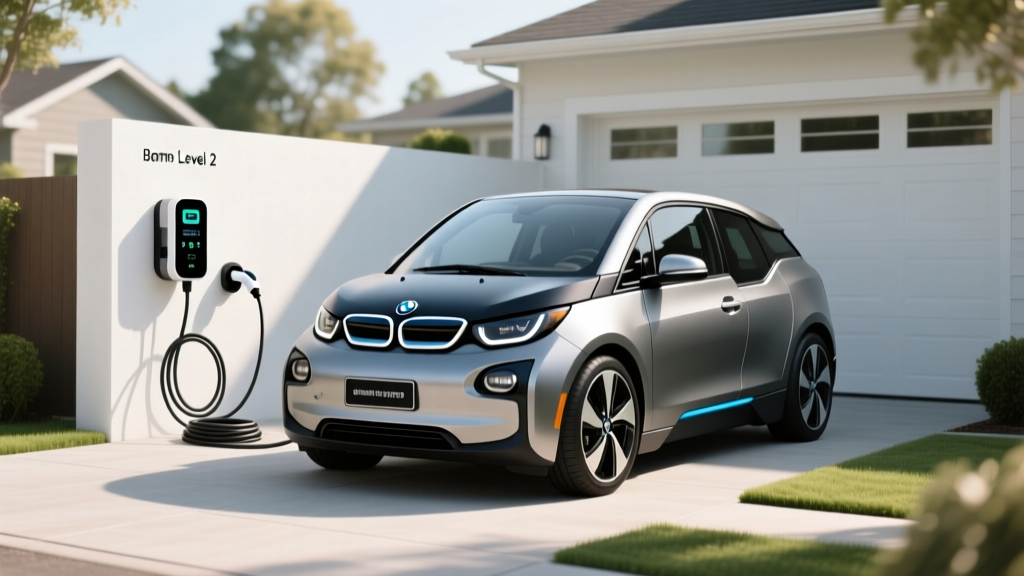
The 2018 BMW i3 remains one of the most distinctive used EVs on the market. Thanks to its 94 Ah battery upgrade that year, the 2018 BMW i3 range sits at an EPA-estimated 114 miles for the pure BEV version, or 111 miles of electric range for the Range Extender (REx) model before the two-cylinder gas engine kicks in. If you own one or are shopping for one, getting your charging setup right is the single biggest factor in daily satisfaction.
This guide covers everything you need to charge a 2018 i3 efficiently at home and on the road — from the exact kW speeds at each level to real installation costs and the best Level 2 equipment for BMW's Type 1 CCS connector.
2018 BMW i3 Range & Battery Specs at a Glance
Before setting up a charger, you need to know what you're filling. The 2018 i3 uses the second-generation battery pack (94 Ah cells), a significant upgrade from the original 60 Ah pack in 2014–2016 models.
| Spec | i3 BEV (Pure Electric) | i3 REx (Range Extender) |
|---|---|---|
| Battery Capacity (usable) | 27.2 kWh | 27.2 kWh |
| Battery Chemistry | NMC (Nickel Manganese Cobalt) | NMC |
| EPA Range (Electric) | 114 miles | 111 miles + ~80 mi gas |
| Real-World Range Expectation | ~90–105 mi (highway/cold) | ~85–100 mi electric |
| Max DC Fast Charge Rate | 50 kW (CCS1) | 50 kW (CCS1) |
| Max AC Level 2 Rate | 7.4 kW (single-phase) | 7.4 kW |
| Onboard Charger | 7.4 kW, single-phase | 7.4 kW, single-phase |
| 0–60 mph | 7.2 seconds | 7.7 seconds |
| Horsepower | 170 hp | 170 hp (electric motor) |
| Battery Warranty (original) | 8 years / 100,000 miles | 8 years / 100,000 miles |
Charging Levels Explained: How Fast Will Each Add Range?
Understanding the difference between kW (kilowatts — the rate of power delivery) and kWh (kilowatt-hours — the total energy stored in the battery) is critical. Think of kW as how fast water flows from a hose, and kWh as the size of the bucket you're filling. The 2018 i3's "bucket" is 27.2 kWh usable.
| Charging Level | Voltage / Amps | Power (kW) | Miles of Range per Hour | Full Charge Time (0–100%) |
|---|---|---|---|---|
| Level 1 (Standard Outlet) | 120V / 12A | ~1.4 kW | ~4–5 miles/hr | ~20–24 hours |
| Level 2 (Home/Public AC) | 240V / 32A | 7.4 kW (max for i3) | ~22–25 miles/hr | ~4 hours |
| DC Fast Charging | 400V+ DC | Up to 50 kW | ~120+ miles/hr (to 80%) | 10–80% in ~25–30 min |
Why the i3 caps at 7.4 kW on Level 2: The 2018 i3 has a single-phase onboard charger rated at 7.4 kW. Even if you plug into a 48A or 80A Level 2 station delivering 11.5 kW or 19.2 kW, the car will only accept 7.4 kW. This means installing a higher-amperage home charger won't speed up your i3 — but it will future-proof your setup for a next EV.
DC fast charging curve reality: The i3's 50 kW peak rate holds roughly from 10% to 50% state of charge, then tapers. From 50–80%, expect an average of ~30–35 kW. Above 80%, charging slows significantly to protect the NMC cells. This is why 10–80% is the standard benchmark — the last 20% can take as long as the first 70%.
Home Charger Installation: Costs, Electrical Requirements & Panel Upgrades
Most 2018 i3 owners will want a Level 2 home charger. Here's what the installation actually involves and what it costs.
Electrical Requirements for the i3
Since the i3's onboard charger maxes out at 7.4 kW, you need a 240V circuit rated for at least 32 amps. Per the National Electrical Code (NEC), continuous loads like EV charging must use only 80% of a circuit's rated capacity, so you'll need a 40-amp dedicated circuit to deliver 32 amps to the car.
- Voltage: 240V (same as a dryer or oven circuit)
- Circuit amperage: 40A minimum (breaker size)
- Delivered amperage: 32A continuous
- Wire gauge: 8 AWG copper (THHN in conduit or NM-B cable)
- Dedicated circuit: Required — cannot share with other appliances
Do You Need a Panel Upgrade?
This is the variable that can double or triple your install cost. Most modern homes have a 200-amp electrical panel, which can typically accommodate a 40A EV circuit without issue. However, older homes — particularly those built before 1990 — may have 100-amp panels that are already near capacity.
Your electrician will perform a load calculation (NEC Article 220) to determine if your panel has headroom. If your existing loads (HVAC, electric oven, dryer, water heater) consume most of your panel's capacity, you'll either need a panel upgrade to 200A or a smart load-management device like the Emporia Smart Load Center or a charger with built-in load sharing.
Installation Cost Breakdown
| Cost Component | Low End | Typical | High End |
|---|---|---|---|
| Level 2 Charger (Equipment) | $300 | $500 | $750 |
| Electrician Labor (40A circuit, standard run) | $500 | $900 | $1,500 |
| Permit & Inspection | $50 | $150 | $350 |
| Panel Upgrade (if needed) | $0 | $0 | $3,500 |
| Conduit / Wire Run (long runs over 50 ft) | $0 | $200 | $600 |
| Total (no panel upgrade) | $850 | $1,550 | $2,900 |
| Total (with panel upgrade) | $2,350 | $3,550 | $6,400 |
According to data compiled by the U.S. Department of Energy, the national average for a Level 2 home charger installation falls between $1,000 and $2,500 for a straightforward setup without a panel upgrade.
Connector Compatibility: What Plug Does the 2018 BMW i3 Use?
The 2018 BMW i3 sold in North America uses the J1772 connector for AC charging (Level 1 and Level 2) and the CCS1 (Combined Charging System) connector for DC fast charging. The CCS1 plug adds two large DC pins below the standard J1772 connector.
| Charging Type | Connector on 2018 i3 | Notes |
|---|---|---|
| Level 1 (120V AC) | J1772 | Portable cord included with car |
| Level 2 (240V AC) | J1772 | All public Level 2 stations in the US use this |
| DC Fast Charging | CCS1 | Most Electrify America, EVgo stations |
| Tesla Supercharger (NACS) | Not native — adapter required | Tesla Magic Dock or third-party CCS-to-NACS adapter |
| CHAdeMO | Not compatible | i3 does not have CHAdeMO; adapter not practical |
Tesla Supercharger access: As of 2025–2026, Tesla has opened select Supercharger stalls to non-Tesla EVs via the "Magic Dock" built-in CCS1 adapter at some stations. Additionally, aftermarket CCS1-to-NACS adapters (such as those from Lectron or A2Z) are available for roughly $150–$250, allowing i3 owners to access standard Tesla Supercharger stalls. Always verify adapter compatibility and safety certifications before purchasing.
Cost to Charge: Home vs. Public vs. Gas Comparison
One of the strongest arguments for the i3 is its low operating cost. Let's break down real charging expenses versus what a comparable gas car would cost.
| Scenario | Price per kWh | Cost to Charge 27.2 kWh (Full) | Cost per Mile |
|---|---|---|---|
| Home — Off-Peak Utility Rate | $0.08–$0.12 | $2.18–$3.26 | $0.02–$0.03 |
| Home — Standard Residential Rate | $0.14–$0.18 | $3.81–$4.90 | $0.03–$0.04 |
| Public Level 2 (ChargePoint, etc.) | $0.20–$0.35 | $5.44–$9.52 | $0.05–$0.08 |
| DC Fast Charging (Electrify America) | $0.35–$0.55 | $9.52–$14.96 | $0.08–$0.13 |
| Gas Car (30 MPG, $3.50/gal) | — | — | $0.12 |
The bottom line: Charging at home on off-peak rates, the i3 costs roughly 2–3 cents per mile to "fuel." Even at standard residential rates, you're at 3–4 cents per mile — roughly one-quarter the cost of a 30 MPG gas car at $3.50 per gallon. Public DC fast charging narrows the gap, but most i3 owners do 85%+ of their charging at home.
The i3 achieves an EPA-rated 118 MPGe combined (BEV), which translates to roughly 27–29 kWh per 100 miles. This efficiency is partly due to the car's lightweight carbon-fiber-reinforced plastic (CFRP) body, making it one of the most energy-efficient EVs ever sold in the US. You can verify these figures on fueleconomy.gov.
Best Level 2 Home Chargers for the 2018 BMW i3
Since the i3 accepts a maximum of 7.4 kW (32A) on Level 2, you have flexibility: a 32A charger matches it perfectly, while a 40A or 48A unit provides headroom for a future EV. All recommendations below use the J1772 connector compatible with the i3.
Emporia Vue Level 2 Charger
- Power Output: 48A / 11.5 kW (i3 will use 32A / 7.4 kW)
- Connector: J1772
- Cable Length: 24 ft
- Smart Features: Wi-Fi, app scheduling, energy monitoring, load management
- Price: ~$350–$400
- Best For: Budget-conscious buyers who want smart features and future-proofing
ChargePoint Home Flex
- Power Output: Up to 50A / 12 kW (configurable; i3 will use 32A)
- Connector: J1772
- Cable Length: 23 ft
- Smart Features: Wi-Fi, Alexa integration, app scheduling, amperage dial
- Price: ~$550–$700
- Best For: Reliable brand with excellent app and adjustable amperage for any panel
Grizzl-E Smart
- Power Output: 40A / 9.6 kW (i3 will use 32A / 7.4 kW)
- Connector: J1772
- Cable Length: 24 ft
- Smart Features: Wi-Fi, OCPP-compatible, extreme weather rated (-40°F)
- Price: ~$450–$550
- Best For: Cold-climate garages, outdoor installs, durability focus
Our pick for most i3 owners: The Emporia Vue offers the best value at under $400, with load-management features that can prevent panel overloads in older homes. If you plan to replace the i3 with a newer EV that accepts higher AC charge rates (many now accept 11.5 kW or 19.2 kW), the ChargePoint Home Flex's adjustable amperage makes it a strong long-term investment.
Safety, Permits & Electrical Code Requirements
EV charging is a continuous, high-draw electrical load that runs for hours — sometimes unattended overnight. Proper installation isn't optional; it's a safety and insurance requirement.
- Dedicated circuit: NEC requires EV chargers to be on a dedicated circuit not shared with other outlets or appliances.
- GFCI protection: The 2020 NEC update requires GFCI (Ground Fault Circuit Interrupter) protection for all EV charging outlets. Many modern Level 2 chargers have built-in GFCI, but your electrician will verify compliance.
- Outdoor rating: If your charger is installed outdoors (carport, driveway), ensure the unit is rated NEMA 4 (weather-resistant). The Grizzl-E and ChargePoint Home Flex both carry outdoor ratings.
- Permit required: Most US jurisdictions require an electrical permit for a new 240V circuit. Permit fees typically range from $50 to $350. Skipping the permit can void your homeowner's insurance in the event of an electrical fire.
- Inspection: After installation, your local electrical inspector will verify the work meets code. This usually takes 1–2 weeks to schedule.
- Use a licensed electrician: DIY 240V installations are dangerous and often violate code. A licensed electrician carries liability insurance and ensures the work passes inspection.
Frequently Asked Questions
How much does it cost to install a home EV charger for a 2018 BMW i3?
For a straightforward installation with an existing 200A panel and a short wire run, expect $850–$2,000 total (equipment, electrician, and permit). If your home needs a panel upgrade from 100A to 200A, add $1,500–$3,500. Long wire runs over 50 feet through finished walls also increase cost.
How fast will each charging level add range to my i3?
Level 1 (120V) adds roughly 4–5 miles of range per hour — adequate only for overnight top-ups if you drive under 30 miles daily. Level 2 (240V at 32A) adds about 22–25 miles per hour, fully recharging the 27.2 kWh battery in roughly 4 hours. DC fast charging at 50 kW can take the battery from 10% to 80% in about 25–30 minutes.
Which connector does the 2018 BMW i3 use, and will it work at public stations?
The i3 uses J1772 for AC charging and CCS1 for DC fast charging. Virtually all public Level 2 stations in the US have J1772 connectors, and most DC fast networks (Electrify America, EVgo) offer CCS1. Tesla Superchargers require an adapter or a Magic Dock-equipped station.
How much does charging the i3 cost per mile compared to a gas car?
At home on off-peak electricity ($0.10/kWh), the i3 costs about 2–3 cents per mile. A comparable gas car getting 30 MPG at $3.50/gallon costs about 12 cents per mile — roughly 4–5× more. Even public DC fast charging at $0.45/kWh comes to roughly 10–13 cents per mile, still competitive with gas.
What electrical upgrades might my home need for a Level 2 charger?
The most common upgrade is a panel capacity increase from 100A to 200A, needed in older homes already near their electrical limit. Your electrician will run a load calculation. Alternatives include smart load-management devices that throttle the charger when other appliances are drawing heavy power, avoiding a full panel upgrade.
Can I use the i3's included Level 1 cord for daily charging?
You can, but it's slow. The included 120V cord delivers about 1.4 kW, adding roughly 4–5 miles of range per hour. A full charge from empty takes 20+ hours. If your daily commute is under 25 miles and you can plug in for 10–12 hours overnight, Level 1 is technically sufficient — but Level 2 is strongly recommended for convenience and battery preconditioning.
Does the 2018 i3 battery warranty still apply?
BMW's original high-voltage battery warranty covers 8 years or 100,000 miles against capacity loss below 70%. For a 2018 model, that warranty extends through the 2026 model year. If you're buying used, verify the remaining warranty with a BMW dealer using the VIN. According to NHTSA records, the i3 has had minimal battery-related recalls, and real-world degradation data from i3 owners suggests most packs retain 85–92% capacity after 100,000 miles.