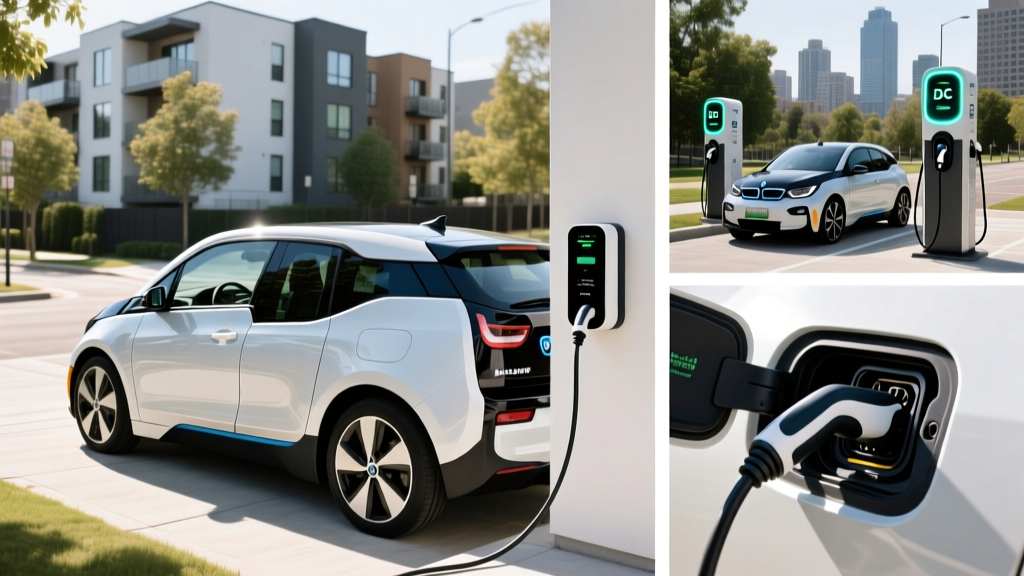
The 2018 BMW i3 with Range Extender (REx) remains one of the most distinctive plug-in vehicles on the used market. Its 94 Ah battery pack delivers an EPA-rated 114 miles of electric range, backed by a 650cc two-cylinder gasoline generator that extends total range to roughly 180 miles. Whether you've just picked one up or are evaluating one as a daily commuter, understanding exactly how to charge this car — and what it will cost — is essential to ownership satisfaction.
This guide covers every charging scenario for the 2018 i3 REx: home Level 2 installation, public DC fast charging, connector compatibility (including NACS adapter options now widely available in 2026), and real cost-per-mile calculations versus a comparable gas car.
Battery (usable): 33.2 kWh (NMC chemistry) | EPA EV range: 114 mi | Total range (w/REx): ~180 mi
Max DC fast charge: 50 kW (CCS1) | Onboard AC charger: 7.4 kW (single-phase)
10–80% DC fast: ~39 min | 0–100% Level 2 (240V/32A): ~4.5 hours
Connector: CCS1 (Combo) / J1772 (AC)
Charging Levels Explained: How Fast Will Each Add Range?
Before we get into installation and costs, let's clarify the three charging tiers and what they mean for the i3 REx specifically. Remember: kW (kilowatts) measures charging power — the rate at which energy flows. kWh (kilowatt-hours) measures energy capacity — the size of the battery. You fill a 33.2 kWh battery using a charger rated in kW.
| Level | Voltage / Amps | Power (kW) | Miles of Range per Hour | i3 REx 0–100% Time |
|---|---|---|---|---|
| Level 1 (120V) | 120V / 12A | ~1.4 kW | ~5 mi/hr | ~24 hours |
| Level 2 (240V) | 240V / 32A | 7.4 kW | ~25 mi/hr | ~4.5 hours |
| DC Fast (CCS1) | 400V+ DC | Up to 50 kW | ~110 mi/hr (peak) | 10–80% in ~39 min |
Real-world note: The i3's 50 kW DC fast-charge peak is modest by 2026 standards (many newer EVs accept 150–350 kW). The charge curve tapers significantly above 80% state of charge (SoC), so plan DC stops to 80% for optimal time efficiency. Level 1 is only practical as a trickle top-up or emergency option — at 5 miles of range per hour, fully recharging the 33.2 kWh pack takes a full day.
Home Level 2 Installation: Requirements, Costs & Panel Considerations
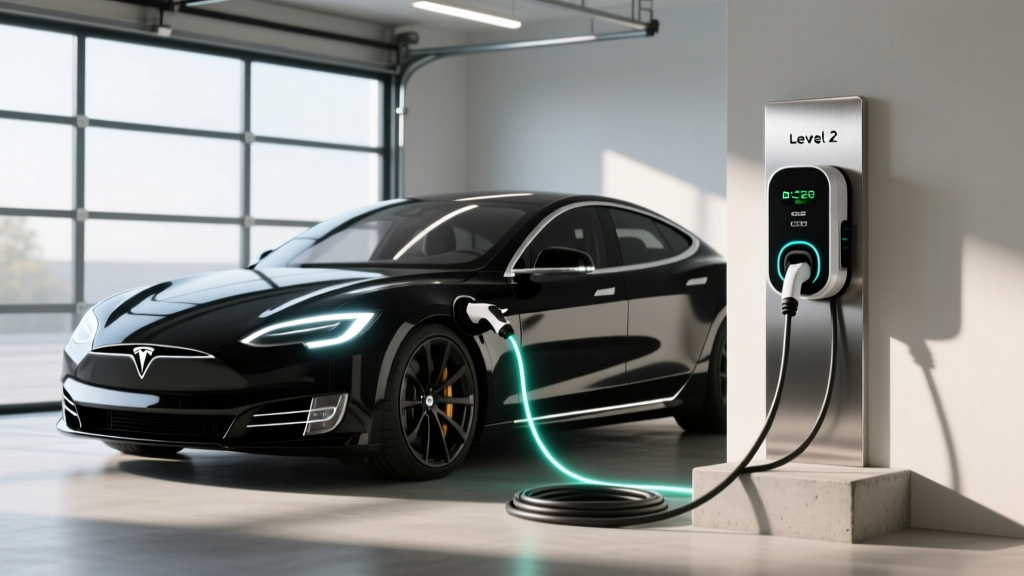
For daily ownership, a Level 2 home charger is the single best investment you can make for the i3 REx. Here's what's involved electrically and financially.
Electrical Requirements
The i3's onboard charger accepts up to 7.4 kW on AC power. To deliver this, you need a 240V circuit rated at 40 amps (a 32A continuous draw requires a circuit rated 25% higher per NEC Article 625). This typically uses a NEMA 14-50 outlet or a hardwired wall-mounted charging station.
Panel capacity check: Most modern homes have a 200-amp electrical panel. Adding a 40A circuit is straightforward if you have spare capacity. However, older homes (common in the Northeast and Midwest) with 100A panels may require a panel upgrade to 200A — this is the single largest variable in installation cost and can add $1,500–$3,000 to the project.
Installation Cost Breakdown
| Item | Low Estimate | High Estimate | Notes |
|---|---|---|---|
| Level 2 Charger (Equipment) | $300 | $700 | Varies by brand, smart features |
| Electrician Labor | $300 | $1,200 | Depends on run length, conduit |
| Permit / Inspection | $50 | $200 | Required in most jurisdictions |
| Panel Upgrade (if needed) | $1,500 | $3,000 | Only if existing panel is 100A or full |
| TOTAL (no panel upgrade) | $650 | $2,100 | |
| TOTAL (with panel upgrade) | $2,150 | $5,100 |
Always hire a licensed electrician and pull a permit. Unpermitted EV charger installs can void home insurance claims and create fire risk. Per NEC 625, outdoor installations require a GFCI-protected circuit, and all EVSE (Electric Vehicle Supply Equipment) must be on a dedicated circuit — not shared with other appliances.
Connector Compatibility: CCS1, J1772, and the NACS Adapter Landscape
The 2018 BMW i3 REx uses the CCS1 (Combo) connector for DC fast charging and the J1772 connector for Level 1 and Level 2 AC charging. This was the standard for virtually all non-Tesla EVs sold in the US through 2024.
With the industry's shift to NACS (North American Charging Standard) — Tesla's connector, now adopted by Ford, GM, Rivian, and others — the public charging landscape in 2026 is a mix of CCS1 and NACS stations. Here's what this means for your i3:
| Connector | Use Case | i3 REx Native? | Adapter Needed? |
|---|---|---|---|
| J1772 | Level 1 & Level 2 AC (home, public AC) | Yes | No |
| CCS1 (Combo) | DC Fast Charging (Electrify America, EVgo) | Yes | No |
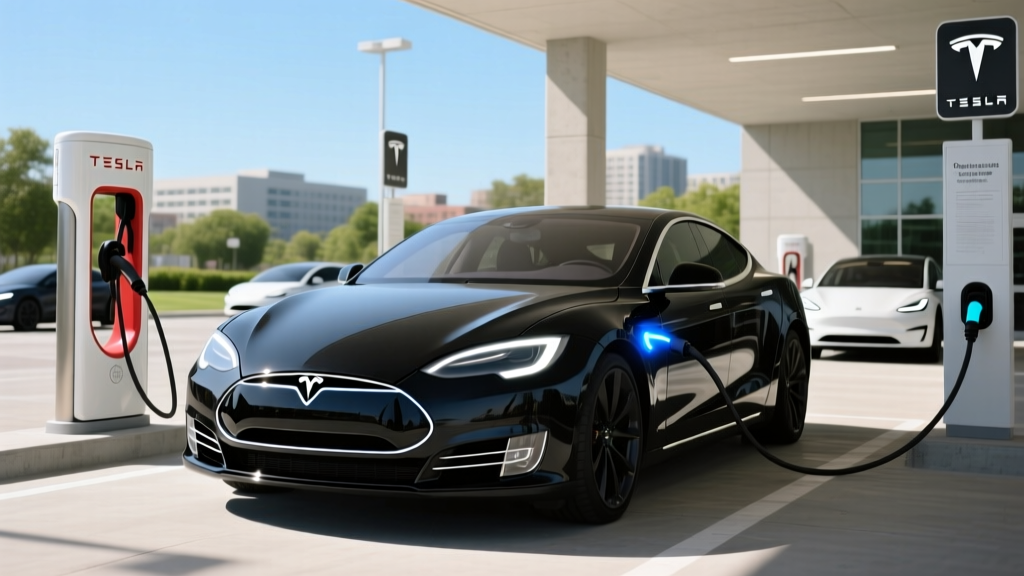
| NACS (Tesla) | Tesla Superchargers (now opening to non-Tesla) | No | Yes — CCS-to-NACS adapter (~$200–$300) |
| CHAdeMO | Legacy DC Fast (Nissan Leaf standard) | No | Not available for i3 |
Key 2026 update: Tesla has opened portions of its Supercharger network to non-Tesla CCS-equipped vehicles via the built-in "Magic Dock" adapter at select stalls, or via a purchased CCS-to-NACS adapter from Tesla or third-party manufacturers like Lectron or A2Z. If you travel frequently on routes dominated by Superchargers, a CCS-to-NACS adapter ($200–$300) significantly expands your DC fast-charging options. However, note that the i3's 50 kW DC charge cap means you won't benefit from the 250 kW V3 Supercharger speeds — you'll charge at 50 kW regardless of the station's capability.
Charging Cost Per Mile: i3 REx vs. Gasoline Car
One of the strongest arguments for the i3 REx is its low operating cost when driven on electricity. Let's compare real scenarios using the i3's efficiency of approximately 25 kWh/100 miles (or ~4 mi/kWh, per EPA data on fueleconomy.gov) against a comparable gas car averaging 30 MPG.
| Scenario | Rate | Cost per 100 Miles | Cost per Mile |
|---|---|---|---|
| Home (off-peak utility rate) | $0.10/kWh | $2.50 | $0.025 |
| Home (national avg. residential) | $0.16/kWh | $4.00 | $0.040 |
| Public Level 2 (ChargePoint, etc.) | $0.30/kWh | $7.50 | $0.075 |
| DC Fast (Electrify America) | $0.48/kWh | $12.00 | $0.120 |
| Gas car (30 MPG, $3.50/gal) | $3.50/gal | $11.67 | $0.117 |
The takeaway: Charging at home on off-peak rates, the i3 REx costs roughly 5× less per mile than a 30 MPG gas car. Even on public DC fast chargers at $0.48/kWh, the i3 is cost-competitive with gasoline. The economic advantage is strongest when you can charge at home — which is why Level 2 installation is the priority investment.
When the range extender activates (after the battery depletes to its ~6.5% hold buffer), the i3 REx returns roughly 31 MPG combined on gasoline, per the EPA. This means extended road trips cost similar to a compact gas car, but the majority of daily driving (within the 114-mile EV range) is dramatically cheaper on electricity.
Recommended Home Chargers for the 2018 BMW i3 REx
Since the i3 caps AC charging at 7.4 kW, you don't need a 48A charger — a 32A unit fully utilizes the car's onboard charger. That said, installing a 40A circuit and a higher-amperage charger future-proofs your setup for your next EV. Here are three proven options across price tiers:
Power: 48A max (11.5 kW) | Connector: J1772 (NACS adapter included in 2025+ models)
Cable Length: 24 ft | Smart Features: Wi-Fi, app scheduling, energy monitoring, solar integration
Price: ~$400 | Best for: Budget-conscious buyers who want smart features and future-proofing
Why for i3: Overkill on amperage but only $400; lets you charge any future EV at full speed.
Power: Up to 50A (12 kW, configurable) | Connector: J1772 (NACS version available)
Cable Length: 23 ft | Smart Features: Wi-Fi, app with scheduling, Alexa integration, detailed session history
Price: ~$550 | Best for: Reliable brand with robust app and wide utility rebate compatibility
Why for i3: Set to 32A for the i3, reconfigure to 48A for your next EV. Excellent track record.
Power: 40A (9.6 kW) | Connector: J1772 (NACS version available)
Cable Length: 24 ft | Smart Features: Wi-Fi, OCPP-compatible, works with multiple network apps
Price: ~$450 | Best for: Extreme durability (IP67 outdoor rated, -40°C operation), Canadian-built
Why for i3: Ideal for cold-climate outdoor installs; 40A matches the i3's circuit perfectly.
Important: All three chargers above deliver J1772 AC charging, which is what the i3 uses natively. For home Level 2, you do not need a CCS or NACS connector — those are only relevant for DC fast charging on the road.
Safety, Code & Installation Best Practices
EV charging draws sustained high current for hours — this is fundamentally different from most household loads. Proper installation isn't optional.
- Dedicated circuit required: NEC Article 625 mandates that EVSE be on its own dedicated circuit — no sharing with dryers, HVAC, or outlets.
- GFCI protection: Required for all outdoor installations and increasingly mandated indoors in the 2023 NEC revision (adopted by most states by 2026). A GFCI breaker or receptacle protects against ground faults.
- Hardwired vs. plug-in: Hardwired units avoid the NEMA 14-50 receptacle, which has been linked to overheating in some installations (documented by NEMA and insurance industry bulletins). If using a receptacle, choose an industrial-grade Hubbell or Bryant 14-50R — not a residential-grade unit.
- Outdoor rating: If your charger is mounted outside, ensure it carries an IP65 or higher ingress protection rating. All three recommended chargers above are outdoor-rated.
- Cable management: Use a wall-mounted holster or cable retractor to prevent tripping hazards and cable damage. Never run charging cables across walkways or driveways without a protective cable ramp.
- Permit and inspection: Most municipalities require an electrical permit for EVSE installation. Your electrician should pull this. The inspection verifies proper grounding, circuit sizing, and GFCI compliance.
Public DC Fast Charging: What i3 REx Owners Need to Know
The i3 REx's 50 kW DC fast-charge capability was competitive when the car was new, but in 2026 it's at the lower end of the spectrum. Here's how to make the most of it:
Charge curve reality: The i3 will peak near 47–50 kW between roughly 10–55% SoC, then taper to ~30 kW through 70%, and drop further to ~15 kW above 85%. A 10–80% session takes approximately 39 minutes at a 50 kW charger. If you connect to a 150 kW or 350 kW station, the car still only draws 50 kW — you won't charge faster, but you may pay a premium price per kWh that some networks charge at higher-power stalls.
Preconditioning: Unlike some newer EVs, the 2018 i3 does not have an automatic battery preconditioning feature triggered by navigation to a charger. In cold weather (below 40°F / 4°C), the battery will accept less power until it warms up through driving. Plan for longer DC fast-charge sessions in winter — potentially 50+ minutes for 10–80% in freezing conditions.
Real-world range caveat: The EPA rates the 2018 i3 REx at 114 miles of electric range. In real-world highway driving at 70+ mph, expect closer to 90–100 miles. In cold weather (below 32°F), range can drop to 75–85 miles due to cabin heating load and battery chemistry limitations. The range extender mitigates this — it activates automatically when the battery reaches its hold buffer — but fuel costs rise when the gasoline engine is running.
Frequently Asked Questions
How much does it cost to install a home EV charger for the BMW i3?
A typical Level 2 installation (40A/240V circuit with a $300–$700 charger) runs $650–$2,100 if your electrical panel has capacity. If a panel upgrade from 100A to 200A is needed, add $1,500–$3,000, bringing the total to $2,150–$5,100. Always get 2–3 quotes from licensed electricians and check for utility rebates — many utilities offer $250–$500 toward Level 2 installation.
How fast will each charging level add range to my i3 REx?
Level 1 (120V) adds roughly 5 miles of range per hour. Level 2 (240V/32A) adds about 25 miles per hour. DC fast charging at 50 kW can add up to 110 miles per hour at peak rate, but the charge curve tapers significantly above 80% SoC.
Which connector does the 2018 BMW i3 use, and do I need an adapter?
The i3 REx uses J1772 for AC charging (home and public Level 2) and CCS1 for DC fast charging. Both are native — no adapter needed. To use Tesla Superchargers that have opened to non-Tesla vehicles, you'll need a CCS-to-NACS adapter ($200–$300).
How much does charging the i3 cost per mile compared to gasoline?
Charging at home on the national average residential rate ($0.16/kWh), the i3 costs about $0.04 per mile on electricity. A comparable 30 MPG gas car at $3.50/gallon costs $0.12 per mile. That's a 3× savings on electricity, or up to 5× on off-peak utility rates ($0.10/kWh).
What electrical upgrades might I need for a Level 2 charger?
The most common upgrade is a panel capacity increase — if your home has a 100A panel or your existing panel is near capacity, you'll need an upgrade to 200A ($1,500–$3,000). Other potential upgrades include adding a sub-panel (if the charger is far from the main panel, adding $200–$500 in conduit and wiring), or replacing a standard NEMA 14-50 receptacle with an industrial-grade unit for safety.
Can I use a Tesla Supercharger with my 2018 i3 REx?
Yes, but only at Supercharger stalls equipped with Tesla's "Magic Dock" (a built-in CCS adapter) or with your own purchased CCS-to-NACS adapter. You'll still be limited to the i3's 50 kW DC charge cap. Use the Tesla app or PlugShare to verify which Supercharger locations support non-Tesla CCS vehicles.
Does the 2018 i3 REx qualify for any tax credits in 2026?
The federal §30D new-vehicle tax credit no longer applies (the i3 is discontinued and was only available new through 2021). However, if you purchase a used i3 REx from a dealer for $25,000 or less, you may qualify for the used clean vehicle credit — up to $4,000 or 30% of the sale price (whichever is lower), subject to buyer income caps ($75K single / $150K joint). Verify current eligibility rules at IRS.gov.