If you own or are considering a 2017 Range Rover Supercharged, you already know it's a masterpiece of luxury and performance. Its 5.0-liter supercharged V8 delivers 518 horsepower and a 0-60 mph time of around 5.1 seconds. But you also know the pain at the pump: with EPA ratings of 14 mpg city and 19 mpg highway (combined 16 mpg), fueling this 5,500-pound SUV is a significant ongoing expense.
This guide isn't about converting your Range Rover to electric. Instead, we use the 2017 Range Rover Supercharged as a real-world baseline to show exactly what modern EV charging looks like in 2026 — from home Level 2 installation to DC fast charging speeds, connector standards, and the per-mile cost math that's driving luxury SUV buyers toward electrification. Whether you're cross-shopping an all-electric luxury SUV or simply curious what the charging landscape offers, this breakdown gives you the hard numbers.
The 2017 Range Rover Supercharged: A Fuel-Cost Baseline
Before we map the EV charging landscape, let's anchor the comparison. The 2017 Land Rover Range Rover Supercharged 4WD carries EPA fuel economy ratings of:
- 14 mpg city / 19 mpg highway / 16 mpg combined
- Fuel tank: 27.7 gallons (premium required)
- Annual fuel cost (EPA estimate): ~$4,650 at 15,000 miles/year
- Cost per mile (at $4.20/gal premium): ~$0.26/mile
That's roughly $3,900 to $5,200 per year in fuel depending on your driving mix and local premium gas prices. Over five years, you're spending $19,500 to $26,000 just on gasoline. This is the benchmark modern EVs and their charging infrastructure are measured against.
EV Charging Levels Explained: Speeds, Power, and Range Added
EV charging is measured in kW (kilowatts), which represents the rate of power delivery — think of it like the flow rate of a gas pump nozzle. The energy stored in the battery is measured in kWh (kilowatt-hours) — the total volume of the tank. Never confuse the two: kW is how fast you're filling; kWh is how much the battery holds.
| Level | Voltage | Power (kW) | Miles of Range Added Per Hour | Typical Use Case |
|---|---|---|---|---|
| Level 1 | 120V AC | 1.0–1.4 kW | 3–5 mi/hr | Overnight trickle, PHEVs, emergency |
| Level 2 | 240V AC | 3.3–19.2 kW | 12–75 mi/hr | Home daily charging, workplaces, destinations |
| DC Fast Charge | 400–900V DC | 50–350 kW | 150–1,200+ mi/hr | Road trips, highway corridors |
Real-world context: A modern luxury electric SUV like the BMW iX xDrive50 (111.5 kWh usable battery, ~324 miles EPA range) charging on a 48-amp Level 2 home circuit (11.5 kW) will add roughly 35–40 miles of range per hour. A full 10–80% charge takes about 8–9 hours — ideal for overnight. On a 150 kW DC fast charger, that same 10–80% session takes approximately 30–35 minutes, though the charge curve tapers significantly above 80% SoC to protect battery health.
Home Level 2 Charger Installation: Requirements, Costs, and Panel Upgrades
Installing a Level 2 home charger is the single most impactful upgrade for EV ownership. Here's what's involved electrically and financially.
Electrical Requirements
A typical home Level 2 installation requires:
- 240V dedicated circuit (same voltage as your dryer or oven)
- 40-amp to 60-amp breaker, depending on charger amperage (continuous load rules require the breaker to be rated 125% above the charger's max draw — a 48A charger needs a 60A breaker)
- NEMA 14-50 outlet (for plug-in chargers) or hardwired connection (for higher-amperage units above 40A, often required by code)
- GFCI protection — required by NEC 2020 and later for EV charging outlets in garages
Panel Upgrade Reality
Many homes built before 2000 have 100-amp or 150-amp main electrical panels. Adding a 60A EV circuit may push total load beyond 80% of panel capacity, triggering a panel upgrade to 200A. This is one of the most underestimated costs in home EV charging. A licensed electrician will perform a load calculation per NEC Article 220 to determine if your panel can handle the additional draw.
| Item | Low Estimate | High Estimate | Notes |
|---|---|---|---|
| Level 2 Charger (Equipment) | $350 | $750 | 32A–48A Wi-Fi-enabled units |
| Electrical Permit | $50 | $250 | Varies by municipality |
| Electrician Labor (standard install) | $500 | $1,500 | Short run from panel, no upgrade |
| Electrical Panel Upgrade (if needed) | $1,500 | $4,000 | 100A→200A service upgrade |
| Conduit/Wiring (long runs) | $200 | $1,200 | If panel is far from garage |
| Total (no panel upgrade) | $900 | $2,500 | Typical suburban home |
| Total (with panel upgrade) | $2,400 | $6,500 | Older homes, detached garages |
Federal incentive note: The Alternative Fuel Vehicle Refueling Property Credit (IRS Form 8911) may cover up to 30% of home charger equipment and installation costs (capped at $1,000 for residential). Eligibility depends on your census tract meeting certain income or rural criteria. Consult a tax professional for your specific situation.
Connector Compatibility: NACS, CCS1, and CHAdeMO in 2026
The North American charging connector landscape has consolidated significantly. As of 2026, nearly every major automaker has adopted or committed to the North American Charging Standard (NACS), originally developed by Tesla. Here's where things stand:
| Connector | Brands Using It (Native) | Adapter Needed? |
|---|---|---|
| NACS (Tesla) | Tesla, Ford, GM, Rivian, Volvo, Polestar, Mercedes-Benz, BMW (newer), Hyundai/Kia (2025+ models) | No — native on new models |
| CCS1 | Legacy VW/Audi models, Stellantis, some Hyundai/Kia (pre-2025) | CCS1→NACS adapter (~$150–$230) for Tesla Supercharger access |
| CHAdeMO | Nissan Leaf (legacy only, discontinued) | Limited network; no adapter to NACS widely available |
Practical advice: If you're buying a new EV in 2026, choose one with a native NACS port for the broadest charging network access, including Tesla's Supercharger network (20,000+ stalls in North America). If you own a CCS1-equipped EV, a Tesla NACS DC adapter unlocks Supercharger access — critical for road trips where Electrify America or EVgo coverage is sparse.
Cost Per Mile: EV Charging vs. the Range Rover Supercharged V8
This is where the math gets compelling. Let's compare the per-mile fueling cost of the 2017 Range Rover Supercharged against a representative 2026 luxury electric SUV — the BMW iX xDrive50 (324 miles EPA, 111.5 kWh battery, 87 MPGe combined).
| Vehicle / Scenario | Energy Cost | Efficiency | Cost Per Mile |
|---|---|---|---|
| 2017 Range Rover Supercharged | $4.20/gal (premium) | 16 mpg combined | $0.263 |
| BMW iX — Home Level 2 (off-peak, $0.13/kWh) | $0.13/kWh | 2.4 mi/kWh (87 MPGe) | $0.054 |
| BMW iX — Home Level 2 (peak, $0.25/kWh) | $0.25/kWh | 2.4 mi/kWh | $0.104 |
| BMW iX — Public DC Fast ($0.48/kWh avg) | $0.48/kWh | 2.4 mi/kWh | $0.200 |
| BMW iX — Tesla Supercharger ($0.30/kWh avg) | $0.30/kWh | 2.4 mi/kWh | $0.125 |
The takeaway: Even at peak residential electricity rates, home-charged EV driving costs roughly 60% less per mile than fueling the Range Rover Supercharged. At off-peak rates, the savings exceed 80%. Over 15,000 miles annually, that's $2,700 to $3,600 in fuel savings per year — or $13,500 to $18,000 over five years.
Only when relying exclusively on expensive public DC fast chargers ($0.48/kWh) does EV charging approach the Range Rover's per-mile cost — and even then, it's still ~24% cheaper.
Equipment Recommendations: Home Level 2 Chargers Worth Buying
Not all Level 2 chargers are equal. Here are three proven units for 2026, each suited to different installation scenarios:
ChargePoint Home Flex (Up to 50A / 12 kW)
- Power output: Adjustable 16A–50A (3.8–12 kW)
- Connector: NACS (2025+ models) or J1772 with NACS adapter
- Cable length: 23 feet
- Smart features: Wi-Fi, scheduling via app, Alexa integration, energy tracking
- Price: ~$599
- Best for: Homes with 60A circuits; flexible amperage avoids panel upgrades
Wallbox Pulsar Plus (Up to 48A / 11.5 kW)
- Power output: 48A max (11.5 kW)
- Connector: NACS or J1772
- Cable length: 25 feet
- Smart features: Wi-Fi/Bluetooth, load balancing (shares panel capacity), Power Sharing for dual-charger setups
- Price: ~$549
- Best for: Tight electrical panels; load-balancing avoids costly upgrades
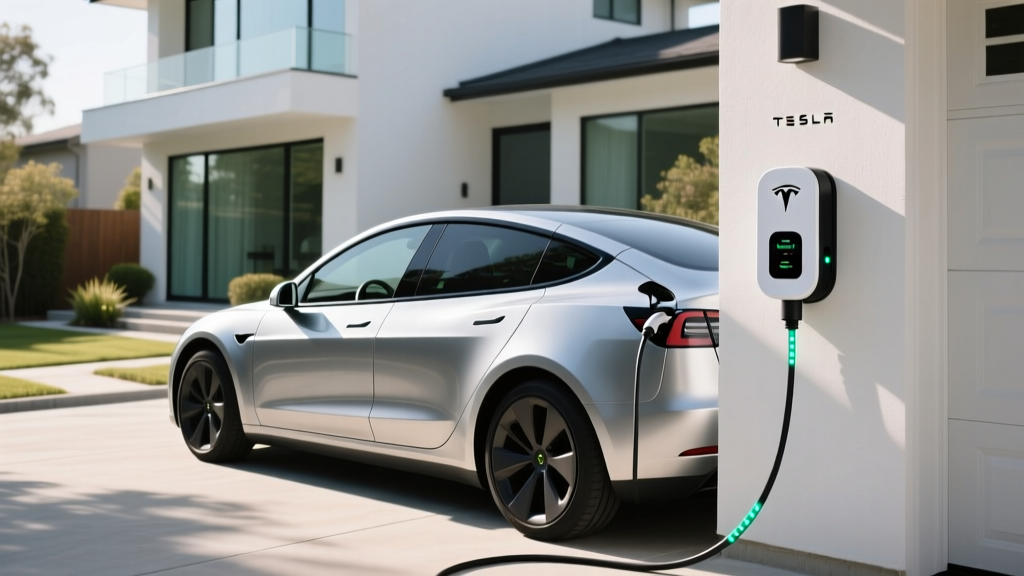
Tesla Wall Connector (Up to 48A / 11.5 kW)
- Power output: 48A max (11.5 kW)
- Connector: NACS native
- Cable length: 24 feet
- Smart features: Wi-Fi, OTA updates, power sharing, access control
- Price: ~$420
- Best for: Tesla or NACS-native vehicle owners; best value at this power level
Safety note: All three units are UL-listed and support outdoor-rated enclosures (NEMA 4). Hardwired installations above 40A are generally required by code — plug-in NEMA 14-50 setups are limited to 40A continuous (50A breaker). Always hire a licensed electrician and pull a permit; unpermitted work can void home insurance claims.
Charging Time Examples: What to Expect by Battery Size
Charge times depend on battery capacity (kWh), the charger's power output (kW), and the vehicle's onboard charge acceptance rate. Below are representative 10–80% charge times for common EV categories:
- Compact EV (60 kWh battery, e.g., Chevy Equinox EV):
- Level 2 at 11.5 kW: ~4.5 hours (10–80%)
- DC fast at 150 kW: ~22 minutes (10–80%)
- Luxury SUV (100–112 kWh battery, e.g., BMW iX, Rivian R1S):
- Level 2 at 11.5 kW: ~7–8 hours (10–80%)
- DC fast at 200+ kW: ~25–32 minutes (10–80%)
- Pickup truck (130–200 kWh battery, e.g., Silverado EV, F-150 Lightning Extended):
- Level 2 at 11.5 kW: ~10–14 hours (10–80%)
- DC fast at 350 kW (supported vehicles): ~35–45 minutes (10–80%)
Charge curve reality: Peak kW ratings are sustained only between roughly 10–50% SoC. Above 80%, charging speed drops dramatically — sometimes to under 30 kW — to prevent lithium plating and thermal stress. This is why we quote 10–80% times; the final 20% can take as long as the first 70%. For road trips, plan to charge to 80% and go rather than wait for a full battery.
Frequently Asked Questions
How much does it cost to install a home EV charger?
A standard Level 2 home installation (40–60A, 240V) costs between $900 and $2,500 when no panel upgrade is needed. If your home requires a 200A service upgrade, total costs range from $2,400 to $6,500. Equipment itself runs $350–$750; the remainder is labor, wiring, and permits.
How fast will each charging level add range?
Level 1 (120V) adds 3–5 miles per hour — suitable only for PHEVs or overnight trickle. Level 2 (240V, 48A) adds 30–40 miles per hour for a typical luxury EV SUV. DC fast charging at 150+ kW adds 150–500+ miles per hour, though speeds taper above 80% SoC.
Which connector/charger is compatible with my EV?
For 2026 model-year vehicles, NACS is the dominant standard across Tesla, Ford, GM, Rivian, Hyundai/Kia, BMW, and Mercedes-Benz. Older CCS1 vehicles can use a CCS-to-NACS adapter (~$150–$230) for Tesla Supercharger access. CHAdeMO is effectively discontinued. Check your vehicle's charge port or owner's manual for the definitive answer.
How much does EV charging cost per mile vs. gas?
Home charging at $0.13/kWh delivers roughly $0.05–$0.06 per mile for a luxury electric SUV — compared to $0.26 per mile in the 2017 Range Rover Supercharged at $4.20/gallon premium. Even public DC fast charging at $0.48/kWh ($0.20/mile) undercuts the Range Rover by ~24%.
What electrical upgrades might I need?
The most common upgrade is a 200A panel replacement if your existing panel is 100A or 150A and near capacity. Older homes may also need new conduit runs, a dedicated ground wire, or a sub-panel in the garage. A licensed electrician's load calculation (per NEC Article 220) determines this before any work begins. Budget $1,500–$4,000 for a panel upgrade if needed.
For official fuel economy data on the 2017 Range Rover Supercharged, visit fueleconomy.gov. For current federal charging equipment tax credits, consult IRS.gov's Alternative Fuel Vehicle Refueling Property Credit page.