Your 2017 Model 3 Long Range Battery and Charging Basics
The 2017 Tesla Model 3 Long Range was one of the first production vehicles to pair a 75 kWh usable battery (NMC chemistry) with an EPA-estimated 310 miles of range. Nearly a decade later, these cars remain popular on the used market — and their charging capabilities still hold up, provided you understand what the onboard hardware can and cannot do.
Before plugging in anywhere, nail down the single most important distinction in EV ownership: kW (kilowatts) measures power — how fast energy flows into your battery at any given moment, like water pressure in a hose. kWh (kilowatt-hours) measures energy — the total capacity of your battery, like the size of a water tank. Your 2017 Model 3 Long Range has roughly 75 kWh of usable capacity. How many kW you push into it determines how quickly that tank refills.
According to fueleconomy.gov, the 2017 Model 3 Long Range AWD achieves 120 MPGe combined with an energy consumption of 26 kWh per 100 miles. Real-world highway driving at 70+ mph typically drops that to around 240–270 miles of effective range, and cold weather (below 32°F) can shave another 15–30% off the top due to battery chemistry limitations and cabin heating load.
Charging Levels Explained: Level 1, Level 2, and DC Fast Charging
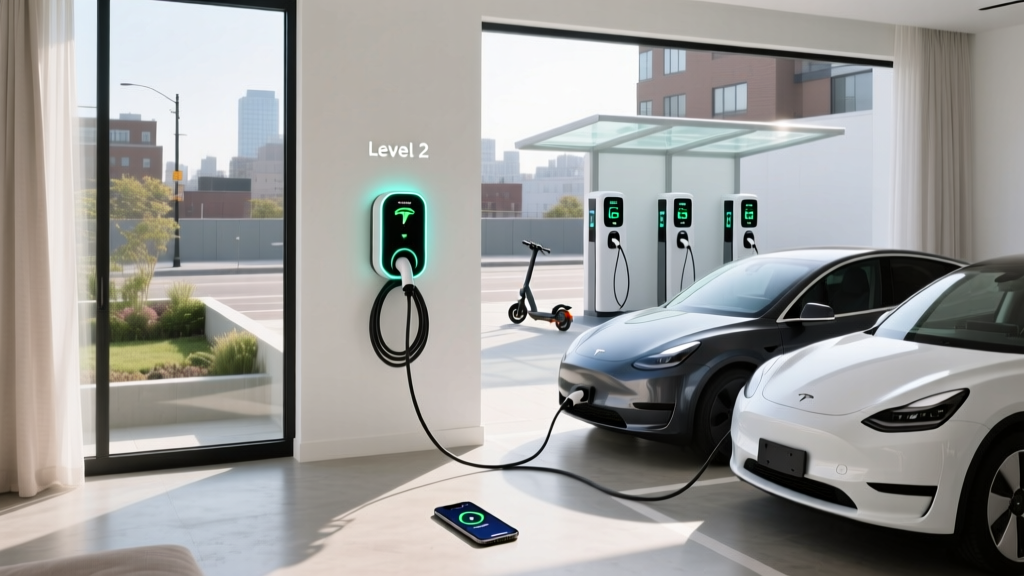
There are three tiers of EV charging, each with different power delivery, infrastructure requirements, and use cases. Here is exactly what each level delivers for your Model 3 Long Range:
| Level | Power (kW) | Miles of Range Added Per Hour | Full Charge Time (0–100%) | Best Use Case |
|---|---|---|---|---|
| Level 1 (120V outlet) | 1.0–1.4 kW | 3–5 miles | 50–75 hours | Emergency top-up, overnight trickle |
| Level 2 (240V home/public) | 7.2–11.5 kW | 30–44 miles | 7–10 hours | Daily home charging, overnight |
| DC Fast Charging (Supercharger/CCS) | Up to 150 kW (2017 Model 3 peak) | ~170 miles in 30 min | 10–80% in ~30 min | Road trips, highway travel |
The 2017 Model 3 Long Range has an onboard AC charger rated at 11.5 kW (48 amps). This is one of the best AC charging rates in its class — many competing EVs from the same era cap out at 7.2 kW. That means on a 48-amp Level 2 circuit, you will add roughly 44 miles of range per hour, enough to fully replenish the battery overnight in about 7 hours.
On DC fast charging, the 2017 Model 3 peaks at approximately 150 kW at Supercharger V2 stations and can accept up to 170 kW at V3 Superchargers, though sustained rates taper significantly above 50% state of charge (SoC). The charge curve is not linear: you will see 150 kW from roughly 10–30% SoC, then a steady taper to about 60 kW by 60%, and further reduction to under 25 kW by 80%. This is normal lithium-ion behavior — charging slows to protect battery health as cells approach full voltage. Always plan road-trip stops around the 10–80% window for maximum efficiency.
Home Charger Installation: Electrical Requirements and Costs
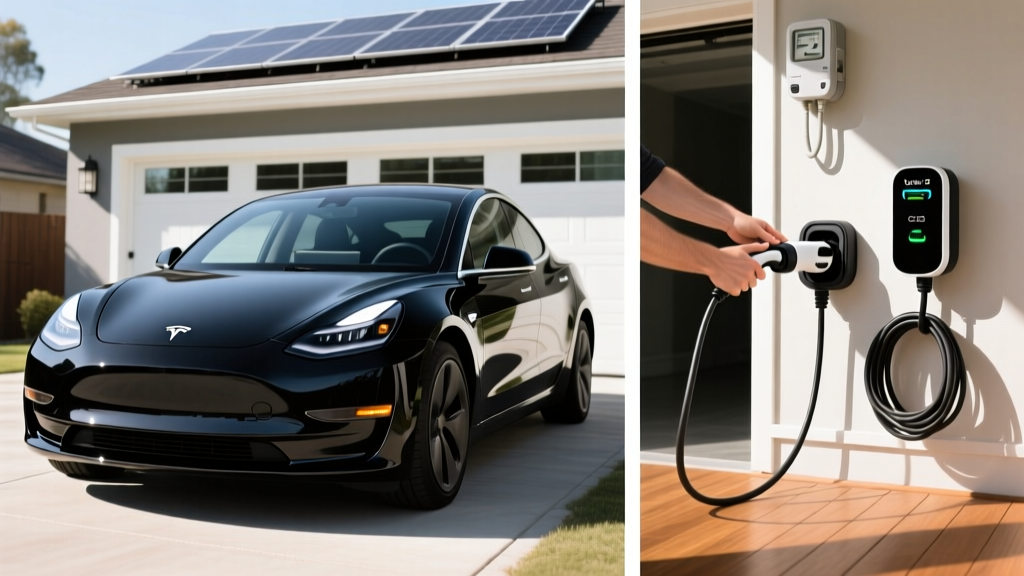
Installing a Level 2 home charger is the single most impactful upgrade for daily EV ownership. For a 2017 Model 3 Long Range with its 11.5 kW onboard charger, you want a 60-amp dedicated circuit with a 48-amp charger to maximize your charging speed. Here is what that installation looks like in practice.
Electrical requirements: A 60-amp, 240-volt dedicated circuit using 6 AWG copper wire (or 4 AWG aluminum) run from your electrical panel to the charger location. The circuit must be protected by a 60-amp double-pole breaker. If you opt for a 40-amp charger instead (32 amps continuous), a 50-amp breaker with 8 AWG wire suffices — but you will sacrifice some charging speed (roughly 30 miles of range per hour instead of 44).
Panel upgrade reality: Many homes built before 2000 have 100-amp or 150-amp main panels that may not have capacity for an additional 60-amp continuous load. If your panel is already near capacity — running electric range, dryer, HVAC, and water heater — a licensed electrician may recommend a panel upgrade to 200 amps. This is the single biggest variable in installation cost and can add $1,500–$3,500 to the project.
| Component | Simple Install (panel has capacity) | Complex Install (panel upgrade needed) |
|---|---|---|
| Level 2 charger (hardware) | $400–$700 | $400–$700 |
| Electrician labor + materials | $500–$1,200 | $800–$2,000 |
| Electrical panel upgrade | $0 (not needed) | $1,500–$3,500 |
| Permit and inspection | $50–$200 | $100–$350 |
| Total estimated cost | $950–$2,100 | $2,800–$6,550 |
Always pull a permit and have the work inspected. Unpermitted electrical work can void homeowners insurance and create fire risk. Your electrician should install a GFCI-protected circuit if the charger is outdoors, and all outdoor-rated chargers must carry a NEMA 4 or IP65 weather rating.
Connector Compatibility: NACS, CCS, and Your 2017 Model 3
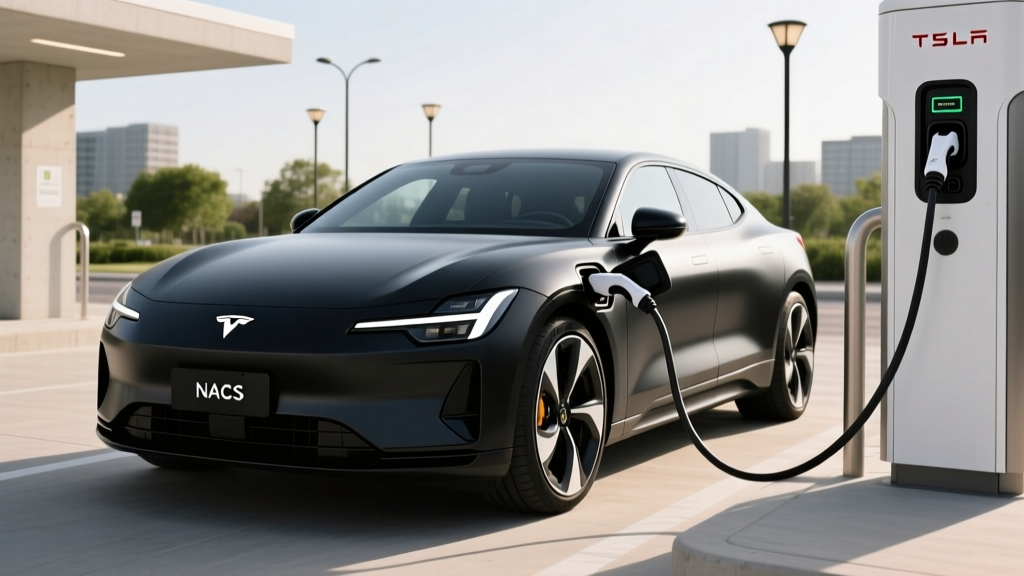
The 2017 Model 3 Long Range was built with Tesla's proprietary connector, which as of 2024 has been formally adopted as the North American Charging Standard (NACS) by SAE. This is excellent news for long-term compatibility: NACS is now the dominant connector in North America, adopted by Ford, GM, Rivian, Hyundai, and most other major automakers.
| Connector | Compatibility with 2017 Model 3 | Adapter Needed? |
|---|---|---|
| NACS (Tesla) | Native — built-in connector | No |
| CCS1 (Electrify America, most non-Tesla DC networks) | Yes, with adapter | Tesla CCS Adapter (~$175–$250) |
| CHAdeMO (Nissan Leaf, older DC stations) | Not supported | No reliable adapter available |
| J1772 (public Level 2, non-Tesla) | Yes, with adapter | J1772-to-Tesla adapter (~$95–$150, often included with car) |
Your 2017 Model 3 will plug directly into any Tesla Supercharger, Tesla Destination Charger, and Tesla Wall Connector. For non-Tesla DC fast-charging networks like Electrify America (which use CCS1 connectors), you will need the official Tesla CCS adapter. For public Level 2 stations with J1772 connectors — common at shopping centers, workplaces, and hotels — a J1772-to-Tesla adapter is required. Many 2017 Model 3s came with this adapter in the original kit; check your glove box or frunk before buying a replacement.
CHAdeMO is effectively a dead standard in North America as of 2026. If you encounter a CHAdeMO-only station, you cannot charge your Model 3 there. Plan accordingly using the Tesla app or PlugShare to verify connector types at your destination.
Cost to Charge: Home vs. Public vs. Gas Comparison
One of the strongest arguments for owning a 2017 Model 3 Long Range in 2026 is the per-mile fuel cost. Here is a realistic breakdown based on national averages and common scenarios:
| Scenario | Rate ($/kWh) | Cost Per Full Charge (75 kWh) | Cost Per Mile (26 kWh/100mi) |
|---|---|---|---|
| Home, off-peak TOU rate | $0.08–$0.12 | $6.00–$9.00 | $0.021–$0.031 |
| Home, standard rate | $0.14–$0.18 | $10.50–$13.50 | $0.036–$0.047 |
| Public Level 2 (ChargePoint, EVgo L2) | $0.20–$0.35 | $15.00–$26.25 | $0.052–$0.091 |
| Tesla Supercharger (DC fast) | $0.28–$0.42 | $21.00–$31.50 | $0.073–$0.109 |
| Gasoline car, 28 MPG combined | $3.40/gal (2026 avg) | $37.70 (equiv. 310 mi) | $0.121 |
Even at the most expensive public DC fast-charging rates, your Model 3 Long Range costs less per mile than a comparable gasoline car getting 28 MPG. At home off-peak rates, you are paying roughly one-quarter to one-third the per-mile cost of gasoline. Over 12,000 miles per year, home charging saves approximately $900–$1,200 compared to fueling a gas car — and those savings compound over the life of the vehicle.
Pro tip: If your utility offers a time-of-use (TOU) plan, schedule charging between 10 PM and 6 AM to capture the lowest rates. The Tesla app allows you to set scheduled charging so the car automatically begins charging when rates drop.
Recommended Level 2 Chargers for Your 2017 Model 3
Because your 2017 Model 3 Long Range can accept up to 11.5 kW (48 amps) on Level 2, you should pair it with a charger that can deliver at least that much. Here are three proven options for 2026:
Tesla Wall Connector (Gen 3)
Power output: Up to 11.5 kW (48A) on a 60A circuit
Connector: NACS (native Tesla)
Cable length: 24 feet
Smart features: Wi-Fi updates, load sharing between multiple units, Tesla app integration, power sharing
Price: ~$425
Verdict: The default choice for any Tesla owner. Native NACS connector means no adapter needed. Load-sharing capability lets you install two units on a single 60A circuit — useful for two-car households. No energy metering display in-app, however.
ChargePoint Home Flex
Power output: Up to 12 kW (50A) on a 60A circuit, configurable down to 16A
Connector: J1772 (NACS adapter included or available)
Cable length: 23 feet
Smart features: Wi-Fi, ChargePoint app with detailed energy tracking, Alexa integration, flexible amperage settings
Price: ~$550–$650
Verdict: Excellent if you also own a non-Tesla EV — the J1772 connector works universally, and the included NACS adapter handles your Model 3. The adjustable amperage (16A to 50A) is ideal if your panel cannot support a full 60A circuit.
Grizzl-E Smart
Power output: Up to 10 kW (40A) on a 50A circuit
Connector: J1772 (NACS adapter required for Tesla)
Cable length: 24 feet
Smart features: OCPP-compatible, adjustable amperage, rugged NEMA 4 outdoor rating, built-in GFCI
Price: ~$400–$500
Verdict: Built like a tank for outdoor installations in harsh climates. Lower max amperage (40A) means you will charge at roughly 9.6 kW — about 37 miles per hour instead of 44 — but the ruggedness and built-in GFCI make it ideal for garages without GFCI breakers or outdoor carports.
Safety, Code, and Maintenance Considerations
Level 2 EV charging is a continuous high-draw electrical load — your charger will pull maximum current for 6–10 hours at a stretch. This is fundamentally different from an appliance that cycles on and off. The National Electrical Code (NEC) requires that continuous loads not exceed 80% of a circuit's rated capacity. That is why a 48-amp charger requires a 60-amp breaker (48 ÷ 0.80 = 60).
Key safety requirements:
- Dedicated circuit: Your EV charger must have its own circuit — never shared with other outlets or appliances.
- GFCI protection: Required for outdoor installations and recommended for garages. Many modern chargers (like the Grizzl-E) have built-in GFCI, which can eliminate the need for a GFCI breaker at the panel.
- Outdoor rating: If your charger is mounted outside, it must carry at least a NEMA 4 rating (protected against splashing water and ice). NEMA 4X adds corrosion resistance for coastal areas.
- Wire gauge: Undersized wire causes voltage drop and heat buildup. For a 60A circuit, use 6 AWG copper or 4 AWG aluminum minimum. For runs longer than 100 feet, your electrician may upsize to reduce voltage drop.
- Permit and inspection: Required in virtually all US jurisdictions. The inspector will verify breaker sizing, wire gauge, grounding, and GFCI compliance. Skipping this step risks insurance denial in the event of an electrical fire.
For long-term battery health on your 2017 Model 3, Tesla recommends setting the daily charge limit to 80–90% and only charging to 100% when you need maximum range for a trip. The NMC battery chemistry in the 2017 Long Range degrades faster when held at 100% SoC for extended periods. After 8+ years of service, expect approximately 10–15% battery degradation — meaning your 310-mile EPA range may now read closer to 265–280 miles at full charge. You can monitor State of Health (SoH) through the Tesla service menu or third-party apps like Tessie.
Frequently Asked Questions
How much does it cost to install a home EV charger for my 2017 Model 3?
A straightforward Level 2 installation on an existing panel with available capacity typically costs $950–$2,100 including equipment, electrician labor, and permit. If your electrical panel needs an upgrade to 200 amps, total costs can reach $2,800–$6,550. Always get a load calculation from a licensed electrician before committing.
How fast will each charging level add range to my Model 3 Long Range?
Level 1 (120V wall outlet) adds about 3–5 miles of range per hour — essentially useless for daily needs but fine for emergencies. Level 2 (240V, 48A) adds approximately 44 miles per hour, fully charging the 75 kWh battery in about 7 hours. DC fast charging at a Tesla Supercharger can add up to 170 miles in 30 minutes, though the charge curve tapers significantly above 50% SoC.
Which connector and charger is compatible with my 2017 Model 3?
Your Model 3 uses the NACS (Tesla) connector natively. It plugs directly into all Tesla Superchargers, Destination Chargers, and Wall Connectors. For non-Tesla DC fast-charging stations with CCS1 connectors, you need a Tesla CCS adapter ($175–$250). For non-Tesla Level 2 stations with J1772 connectors, you need a J1772-to-Tesla adapter ($95–$150). CHAdeMO is not supported.
How much does charging cost per mile compared to gasoline?
At home off-peak rates ($0.10/kWh), your Model 3 Long Range costs about $0.026 per mile — roughly one-fifth the cost of a 28 MPG gasoline car at $3.40 per gallon ($0.121/mile). Even at the most expensive Supercharger rates ($0.40/kWh), you pay about $0.10 per mile, still cheaper than gas. Annual savings for 12,000 miles of driving: approximately $900–$1,200.
What electrical upgrades might I need for a Level 2 charger?
You need a dedicated 60-amp, 240-volt circuit for maximum 11.5 kW charging. If your electrical panel lacks spare capacity (common in homes with 100A or 150A panels running multiple high-draw appliances), you may need a panel upgrade to 200 amps, costing $1,500–$3,500. An alternative is to install a lower-amperage charger (32A/40A circuit) or use a smart charger with dynamic load balancing that reduces EV draw when other appliances are active.
Can I charge my 2017 Model 3 at non-Tesla Supercharger stations?
Yes, with the appropriate adapter. As of 2026, Tesla has opened many Supercharger stalls to non-Tesla vehicles, and conversely, Tesla owners can access an expanding network of CCS-equipped stations using the Tesla CCS adapter. Networks like Electrify America and EVgo now support Tesla vehicles with the CCS adapter. Check the Tesla app or PlugShare for real-time station availability and connector types before traveling.
Sources: EPA / fueleconomy.gov — 2017 Tesla Model 3 Long Range, Tesla Home Charging Installation Guide, IRS §30D Clean Vehicle Credits. Electrical installation costs are estimates; consult a licensed electrician for your specific situation. Federal and state incentive rules are subject to change.