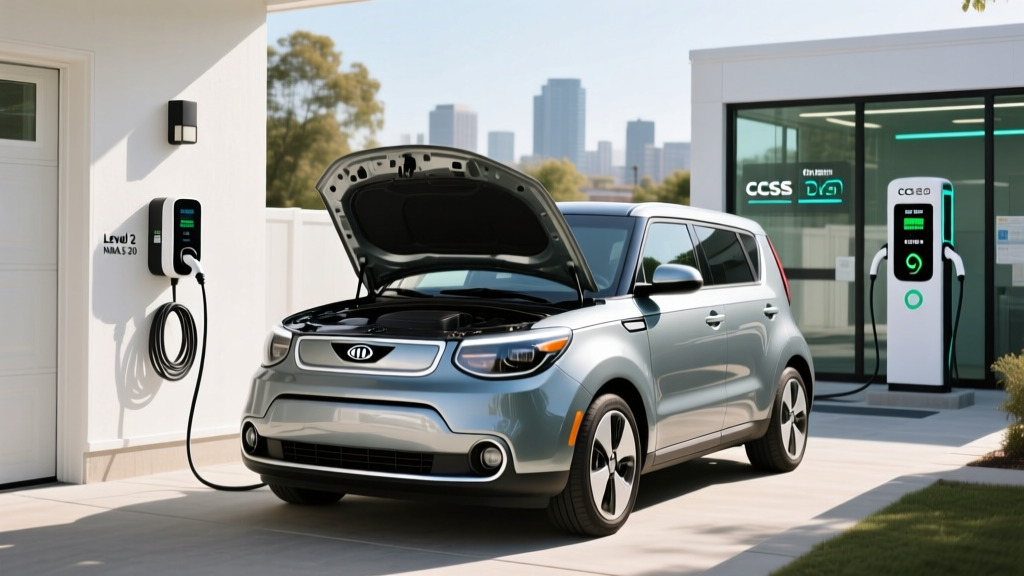
The 2017 Kia Soul EV occupies a specific niche in the used-EV market: a quirky, practical hatchback with a modest battery and a CHAdeMO fast-charging port. With an EPA-estimated 93 miles of range from its 30 kWh (27 kWh usable) lithium-ion polymer battery, this is a commuter and city car — not a road-trip vehicle. Understanding how to charge it efficiently, what equipment you need, and what it costs is essential before buying one in 2026.
This guide covers the full charging picture for the 2017 Soul EV: charging levels and speeds, home installation requirements and costs, public network compatibility, connector specifics (including the CHAdeMO reality in 2026), and the real cost-per-mile compared to gasoline.
2017 Kia Soul EV: Range, Battery, and Efficiency at a Glance
| Spec | 2017 Kia Soul EV |
|---|---|
| EPA Range | 93 miles |
| Real-World Range (highway/cold) | ~65–80 miles |
| Battery Capacity | 30 kWh total / 27 kWh usable |
| Battery Chemistry | Lithium-ion polymer (NMC) |
| Combined MPGe | 93 MPGe |
| Energy Consumption | 36 kWh/100 mi |
| Max DC Fast Charge | ~50 kW (CHAdeMO) |
| Level 2 Charge Rate | 6.6 kW (J1772) |
| Level 1 Charge Rate | ~1.4 kW (120V) |
| Motor Output | 109 hp / 210 lb-ft torque |
| 0–60 mph | ~11.2 seconds |
| Battery Warranty (original) | 10 yr / 100,000 mi |
Charging Levels Explained: How Fast Will Each Add Range?
Every EV owner needs to understand three charging levels. The critical distinction: kW (kilowatts) measures power — the rate of charging, while kWh (kilowatt-hours) measures energy — the battery's capacity. Think of kW as how fast water flows from a hose, and kWh as the size of the bucket.
| Level | Voltage | Max Power (kW) | Miles Added/Hour | Full Charge Time (27 kWh usable) |
|---|---|---|---|---|
| Level 1 (120V outlet) | 120V AC | ~1.4 kW | ~3–4 mi/hr | ~19–22 hours |
| Level 2 (240V home/public) | 240V AC | 6.6 kW (car-limited) | ~18–22 mi/hr | ~4.5 hours |
| DC Fast Charge | 200–500V DC | ~50 kW (CHAdeMO) | ~120–150 mi/hr (to 80%) | 0–80% in ~33 minutes |
The 2017 Soul EV's onboard charger maxes out at 6.6 kW on Level 2. Even if you plug into a 48-amp home charger capable of delivering 11.5 kW, the car will only accept 6.6 kW. This is a car-side limitation, not a charger limitation — and it means you don't need the most powerful (or expensive) home charger on the market.
Connector Compatibility: CHAdeMO, J1772, and the Adapter Question
The 2017 Kia Soul EV uses two connectors:
- J1772 — for Level 1 and Level 2 AC charging (home and public AC stations)
- CHAdeMO — for DC fast charging
| Connector | Used By | 2017 Soul EV Compatible? | Notes |
|---|---|---|---|
| J1772 | All non-Tesla EVs (Level 1/2) | Yes — native | Standard for home and public AC |
| NACS (Tesla) | Tesla, 2025+ Ford/GM/Rivian/Volvo | With adapter | J1772-to-NACS adapters available (~$150–250) |
| CCS1 | Most 2018+ non-Tesla EVs | No | Soul EV has CHAdeMO, not CCS |
| CHAdeMO | Leaf, Soul EV, older Mitsubishi | Yes — native | Declining network; Electrify America dropped it |
The CHAdeMO challenge in 2026: Most new DC fast-charging stations in the U.S. use CCS1 or NACS. Electrify America phased out CHAdeMO connectors from new installations, and many networks prioritize CCS/NACS. Soul EV owners can still find CHAdeMO chargers at many PlugShare-listed locations, but availability is shrinking. Plan road trips carefully and identify CHAdeMO stations in advance.
For home and Level 2 public charging, the J1772 connector is universal and will work at any standard AC station. If you want to charge at a Tesla Destination Charger, you'll need a J1772-to-Tesla adapter (Tesla sells one, and third-party options exist).
Home Charger Installation: Requirements, Costs, and Electrical Upgrades
Installing a Level 2 home charger is the single biggest ownership upgrade for any EV. For the 2017 Soul EV's 6.6 kW acceptance rate, a 240V / 30-amp or 40-amp circuit is ideal. Here's what that involves:
Electrical Requirements
- Circuit: Dedicated 240V circuit, 30A or 40A breaker
- Wire: 10 AWG (30A) or 8 AWG (40A) copper
- Outlet: NEMA 14-50 (most common for EV chargers) or hardwired connection
- GFCI protection: Required by NEC 2020+ for outdoor receptacles in most jurisdictions
- Permit: Required in virtually all U.S. municipalities
Do You Need a Panel Upgrade?
If your home has a 100-amp electrical panel (common in homes built before the 1990s), adding a 40A EV circuit may require a panel upgrade to 200 amps. A licensed electrician will perform a load calculation to determine if your existing panel can handle the additional draw alongside your HVAC, water heater, dryer, and range.
Warning: Never install an EV charger on a shared circuit. EVs draw sustained maximum current for hours — this is not like running a vacuum cleaner. A dedicated circuit prevents overheating and breaker trips.
| Cost Component | Low End | High End | Notes |
|---|---|---|---|
| Level 2 Charger (Equipment) | $250 | $700 | 24–40A, J1772 connector |
| Electrician Labor | $400 | $1,500 | Depends on run length, wall type |
| Permit & Inspection | $50 | $250 | Varies by municipality |
| Panel Upgrade (if needed) | $1,500 | $4,000 | 100A → 200A service upgrade |
| Total (no panel upgrade) | $700 | $2,450 | |
| Total (with panel upgrade) | $2,200 | $6,450 |
Homes with a modern 200A panel and a garage close to the electrical service typically fall in the $800–$1,500 total range. Older homes or those requiring long conduit runs (detached garages, finished walls) push higher. Always get 2–3 quotes from licensed electricians.
Cost to Charge: Home vs. Public vs. Gasoline
The 2017 Soul EV consumes roughly 36 kWh per 100 miles (per fueleconomy.gov). Here's what that costs in different scenarios:
| Charging Scenario | Rate ($/kWh) | Cost for Full Charge (27 kWh) | Cost per Mile (93 mi) |
|---|---|---|---|
| Home (national avg residential) | $0.16 | $4.32 | $0.046 |
| Home (off-peak TOU rate) | $0.09 | $2.43 | $0.026 |
| Public Level 2 (ChargePoint, etc.) | $0.25–$0.49 | $6.75–$13.23 | $0.07–$0.14 |
| DC Fast (CHAdeMO, where available) | $0.35–$0.55 | $9.45–$14.85 | $0.10–$0.16 |
Gas comparison: A comparable gas-powered Kia Soul gets about 27 MPG combined. At $3.40/gallon (2026 national average), that's $0.126 per mile. Home-charged Soul EV owners save 60–80% on fuel costs — roughly $800–$1,200 per year at 12,000 miles annually.
Recommended Level 2 Chargers for the 2017 Soul EV
Since the Soul EV maxes out at 6.6 kW, a 32A charger (7.7 kW) is the sweet spot — it provides headroom without overspending on power the car can't use.
Emporia Level 2 EV Charger
- Power: 48A (11.5 kW) — future-proof
- Connector: J1772
- Cable: 24 ft
- Smart Features: Wi-Fi, app scheduling, solar integration
- Price: ~$350–$400
- Why: Best value smart charger; energy monitoring helps track costs
ChargePoint Home Flex
- Power: Configurable 16–50A
- Connector: J1772 (NACS option available)
- Cable: 23 ft
- Smart Features: Wi-Fi, Alexa, scheduling
- Price: ~$550–$650
- Why: Adjustable amperage fits any panel; reliable brand
Grizzl-E Smart
- Power: 40A (9.6 kW)
- Connector: J1772
- Cable: 24 ft
- Smart Features: Wi-Fi, OCPP, firmware updates
- Price: ~$400–$500
- Why: Built for extreme cold (-40°F rated); rugged outdoor use
All three will fully charge the Soul EV's 27 kWh usable battery in approximately 4–4.5 hours. For a budget option, the Amazon Basics Level 2 charger (~$200, 32A) is a no-frills, non-smart unit that gets the job done.
Safety and Code Considerations
EV charging draws high current for extended periods. Safety isn't optional:
- Dedicated circuit: Never share the EV charger circuit with other appliances. NEC requires a dedicated breaker.
- GFCI breaker: Required for outdoor installations in most jurisdictions (NEC 2020, Article 625). Some chargers have built-in GFCI — confirm with your electrician to avoid nuisance trips from double GFCI.
- Outdoor rating: If installing outside, use a NEMA 4-rated (weatherproof) charger and enclosure. All recommended chargers above are outdoor-rated.
- Wire gauge: Undersized wire causes heat buildup and fire risk. Follow the electrician's spec — don't cut corners.
- Permit and inspection: Skipping the permit voids homeowner's insurance coverage for electrical fires. Always get the inspection.
DC Fast Charging the Soul EV: What to Expect
The 2017 Soul EV's CHAdeMO port accepts up to ~50 kW of DC power. On a compatible station, expect:
- 0–80% charge: ~33 minutes
- 80–100%: An additional 25–30 minutes (charge rate tapers sharply above 80% to protect the battery)
- Practical road-trip range added in 30 min: ~65–70 miles
This is slow by 2026 standards (modern EVs charge at 150–350 kW), and the shrinking CHAdeMO network makes road trips in the Soul EV impractical. This car is best suited as a daily commuter charged at home, with a gas or hybrid second vehicle for longer trips.
Frequently Asked Questions
How much does it cost to install a home EV charger for a 2017 Kia Soul EV?
Between $700 and $2,450 if your electrical panel doesn't need upgrading. If you need a 100A-to-200A panel upgrade, add $1,500–$4,000. The Soul EV only needs a 30–40A circuit, which keeps equipment costs modest.
How fast will each charging level add range to the Soul EV?
Level 1 (120V) adds ~3–4 miles per hour. Level 2 (240V) adds ~18–22 miles per hour. DC fast charging (CHAdeMO, 50 kW) adds ~120–150 miles per hour up to 80% SoC.
Which connector does the 2017 Kia Soul EV use?
J1772 for Level 1/2 AC charging and CHAdeMO for DC fast charging. It does not have CCS1 or NACS. Adapters exist for J1772-to-Tesla Destination Chargers, but there is no reliable CHAdeMO-to-CCS adapter for DC fast charging.
How much does charging cost per mile vs. gasoline?
At home on average residential rates ($0.16/kWh), the Soul EV costs about $0.046 per mile. A comparable gas Kia Soul costs about $0.126/mile. Off-peak home charging drops to ~$0.026/mile.
What electrical upgrades might I need for a home charger?
If your home has a 200A panel with spare capacity, you likely need only a new dedicated circuit ($400–$1,500 for labor and materials). Homes with 100A panels, full breaker slots, or detached garages may need a panel upgrade ($1,500–$4,000) or a long conduit run.
Is the 2017 Soul EV battery warranty still valid?
The original 10-year/100,000-mile battery warranty may still be active for low-mileage examples. However, Kia's warranty is typically non-transferable to second owners (it reduces to the 5-year/60,000-mile basic powertrain warranty on resale). Verify with a Kia dealer using the VIN.
The 2017 Kia Soul EV is a budget-friendly entry into EV ownership for buyers with home charging access and short commutes. Its 93-mile EPA range and CHAdeMO connector demand realistic expectations — this is a city and suburban car, not a cross-country cruiser. Install a Level 2 charger at home, take advantage of off-peak electricity rates, and you'll drive for roughly 3–5 cents per mile.