Why the 2017 Ford Focus Electric Still Matters in 2026
If you're shopping the used EV market or already own a 2017 Ford Focus Electric, understanding its real-world range and charging behavior is essential. The 2017 model year was a significant refresh: Ford upgraded the battery from 23 kWh to 33.5 kWh (usable), pushing the EPA-rated range from 76 miles to 115 miles. That's a meaningful jump, but like all EVs, the number on the window sticker isn't what you'll see in every driving condition.
This guide covers the 2017 Ford Focus Electric's range, charging speeds across Level 1, Level 2, and DC fast charging, home installation requirements and costs, connector compatibility, and what it costs to charge versus fueling a comparable gas car.
EPA Rated: 115 miles (combined)
Real-World Highway (70 mph): ~90–100 miles
Cold Weather (below 32°F): ~75–90 miles (expect 20–35% range loss without preconditioning)
Mild-Weather City: ~110–120 miles (regen braking helps in stop-and-go)
The 2017 Focus Electric uses a 107 kW (143 hp) electric motor paired with an LG Chem-sourced NMC (nickel manganese cobalt) lithium-ion battery. It achieves 107 MPGe combined (2.9 kWh/mile) according to fueleconomy.gov. Efficiency is decent, but the relatively small battery means charging habits matter more than they do in a 300-mile EV.
2017 Ford Focus Electric: Key Specs at a Glance
| Spec | Value |
|---|---|
| Battery Capacity (Usable) | 33.5 kWh (NMC) |
| EPA Range | 115 miles |
| Motor Output | 107 kW / 143 hp / 184 lb-ft torque |
| 0–60 mph | ~8.2 seconds |
| Efficiency (Combined) | 107 MPGe / 2.9 kWh/mile |
| Max DC Fast Charge Rate | 50 kW (CCS1) |
| Level 2 Onboard Charger | 6.6 kW |
| Original MSRP | $29,200 (before incentives) |
| Battery Warranty (Original) | 8 years / 100,000 miles |
Charging Levels Explained: How Fast Will Each Add Range?
Understanding the difference between kW (power — how fast energy flows) and kWh (energy — how much the battery stores) is critical. Think of kW as the flow rate of a hose and kWh as the size of the bucket. The 2017 Focus Electric has a 33.5 kWh bucket. Here's how fast each charging level fills it:
| Level | Voltage / Amps | Power (kW) | Miles Added per Hour | Full Charge Time (0–100%) |
|---|---|---|---|---|
| Level 1 (120V outlet) | 120V / 12A | ~1.4 kW | ~4–5 miles/hr | ~24–28 hours |
| Level 2 (240V home/public) | 240V / 27.5A (max) | 6.6 kW (car-limited) | ~22–24 miles/hr | ~5–5.5 hours |
| DC Fast Charge (CCS1) | 400V DC | 50 kW peak | ~150–170 miles/hr (peak) | ~45 min (10–80%) |
Key takeaway: Level 1 is essentially useless for daily driving on a 115-mile EV unless your commute is under 20 miles round-trip and you charge overnight every single night. A Level 2 home charger is a practical necessity for the Focus Electric. DC fast charging at 50 kW is modest by 2026 standards (many newer EVs accept 150–350 kW), but it's adequate for a 33.5 kWh battery — you'll reach 80% in roughly 30–45 minutes.
Note that DC fast charging slows significantly above 80% State of Charge (SoC) to protect the battery. Charging from 80–100% on DC fast can take as long as the 0–80% portion. For daily driving, charge to 80–90% and save 100% for road trips.
Home Charger Installation: Electrical Requirements & Costs
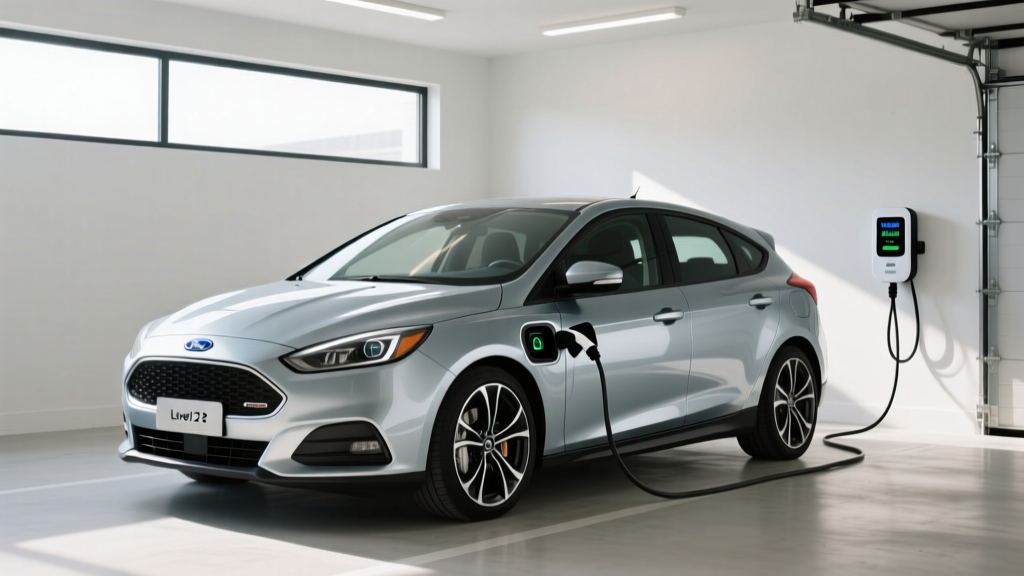
Installing a Level 2 home charger is the single biggest ownership upgrade for a 2017 Focus Electric. Here's what's involved electrically and financially.
Electrical Requirements
The Focus Electric's onboard charger accepts up to 6.6 kW, meaning it draws roughly 27.5 amps at 240V. Per National Electrical Code (NEC), continuous loads can only use 80% of a circuit's rated capacity, so you need a minimum 40-amp dedicated circuit (which allows up to 32A continuous draw — more than enough for this car).
- Voltage: 240V (same as a dryer or oven circuit)
- Amperage: 40A dedicated breaker minimum
- Wire gauge: 8 AWG copper (6 AWG if the run exceeds ~50 feet)
- Circuit type: Dedicated — cannot share with other appliances
- GFCI protection: Required by NEC 2020+ for EV charging outlets (some jurisdictions enforce this strictly, others grandfather older installs)
Do You Need a Panel Upgrade?
This is the make-or-break cost variable. Most homes built after 1990 have a 200-amp main panel, which typically has enough headroom for a 40A EV circuit. However, older homes (common in the Northeast and Midwest) may have 100-amp or even 60-amp panels. If your panel is already near capacity — running electric heat, a dryer, an oven, and central AC — adding 40A may require a panel upgrade to 200A, which costs $1,500–$3,500+ on top of the charger install.
Have an electrician perform a load calculation before quoting. This is a standard NEC requirement and will determine whether your existing panel can handle the EV circuit.
Installation Cost Breakdown
| Component | Simple Install (panel nearby) | Complex Install (long run, sub-panel) |
|---|---|---|
| Level 2 Charger Equipment | $300–$650 | $300–$650 |
| Electrician Labor (2–6 hrs @ $75–$150/hr) | $150–$400 | $450–$900 |
| Materials (wire, conduit, breaker, outlet) | $50–$150 | $200–$500 |
| Permit & Inspection | $50–$150 | $100–$250 |
| Panel Upgrade (if needed) | $0 (not needed) | $1,500–$3,500 |
| Total Estimated Cost | $550–$1,350 | $2,550–$5,800 |
Always get 2–3 quotes from licensed electricians. Some utilities offer rebates of $250–$500 for Level 2 charger installation — check with your local provider. The federal Alternative Fuel Vehicle Refueling Property Credit (§30C) may cover up to 30% of home charging equipment and installation costs (up to $1,000), but eligibility depends on census-tract requirements. Consult IRS guidelines or a tax professional.
Connector Compatibility: What Plug Does the 2017 Focus Electric Use?
The 2017 Ford Focus Electric uses the CCS1 (Combined Charging System) connector for DC fast charging and a J1772 inlet for Level 1 and Level 2 AC charging. CCS1 was the standard for most non-Tesla EVs sold in North America from 2013 through 2024.
| Connector Type | Used For | Native to Focus Electric? | Adapter Needed? |
|---|---|---|---|
| J1772 | Level 1 & Level 2 AC | Yes (native inlet) | No |
| CCS1 | DC Fast Charging | Yes (native inlet) | No |
| NACS (Tesla) | Tesla Superchargers | No | Yes — CCS1-to-NACS adapter (~$200–$250) |
| CHAdeMO | Older DC Fast stations | No | Not available (no CHAdeMO-to-CCS adapter exists for this car) |
Adapter reality in 2026: As the North American Charging Standard (NACS) has become dominant — with Ford's own newer EVs (F-150 Lightning, Mustang Mach-E) now shipping with NACS inlets — the CCS1 charging network is still well-supported at Electrify America, EVgo, and ChargePoint stations. However, Tesla has opened many Supercharger stalls to non-Tesla CCS1 vehicles via their built-in Magic Dock adapter, or you can purchase a third-party CCS1-to-NACS adapter (such as those from Lectron or A2Z) for roughly $200–$250 to access NACS-only stalls.
Cost to Charge: Home vs. Public vs. Gas
One of the strongest arguments for the 2017 Focus Electric is the cost-per-mile advantage over a comparable gas car. The Focus Electric consumes roughly 0.29 kWh per mile (based on its 107 MPGe rating). Let's compare real charging scenarios against a similar gas compact (assume 30 MPG combined, $3.40/gallon):
| Scenario | Rate | Cost per Mile | Cost for 115-Mile "Fill-Up" |
|---|---|---|---|
| Home (off-peak utility rate) | $0.10/kWh | $0.029/mile | $3.35 |
| Home (national avg residential) | $0.17/kWh | $0.049/mile | $5.64 |
| Public Level 2 (ChargePoint, etc.) | $0.30/kWh | $0.087/mile | $10.01 |
| DC Fast Charge (Electrify America) | $0.48/kWh | $0.139/mile | $16.01 |
| Gas Car (30 MPG @ $3.40/gal) | $3.40/gallon | $0.113/mile | $13.03 |
The math: Charging at home on an off-peak rate saves roughly $9.50 per full charge compared to gas — about $1,400 over 15,000 miles of annual driving. Even at the national average residential rate, home charging is less than half the per-mile cost of gasoline. Public DC fast charging, however, can actually exceed the cost of gas per mile — a strong incentive to install a Level 2 charger at home.
Recommended Level 2 Chargers for the 2017 Focus Electric
Since the Focus Electric's onboard charger caps at 6.6 kW, you don't need a 48-amp charger — but buying a higher-output unit is smart for future-proofing if you upgrade to a newer EV later. Here are proven options:
Emporia Level 2 Smart Charger
- Power: Up to 48A (11.5 kW at 240V)
- Connector: J1772 (NACS version available)
- Cable Length: 24 feet
- Smart Features: Wi-Fi, app scheduling, solar integration, energy monitoring
- Price: ~$399
- Best for: Budget-conscious buyers who want app control and energy data
ChargePoint Home Flex
- Power: Configurable 16–50A (up to 12 kW)
- Connector: J1772 (NACS adapter available)
- Cable Length: 23 feet
- Smart Features: Wi-Fi, app, Alexa integration, flexible amperage setting
- Price: ~$549–$699
- Best for: Adjustable amperage to match your panel's capacity
Grizzl-E Smart
- Power: Up to 40A (9.6 kW)
- Connector: J1772
- Cable Length: 24 feet
- Smart Features: Wi-Fi, OCPP compatibility, outdoor-rated (IP67)
- Price: ~$449
- Best for: Outdoor installs and cold climates (built in Canada, rated to -40°F)
Any of these chargers will max out the Focus Electric's 6.6 kW onboard charger. The Grizzl-E at 40A is a near-perfect match for this car, while the ChargePoint Home Flex and Emporia offer headroom for a future EV that may accept 11.5 kW or more on Level 2.
Safety, Code & Installation Best Practices
EV charging is a high-draw, continuous electrical load. Cutting corners here is a fire risk. Follow these non-negotiable guidelines:
- Dedicated circuit only. Never share the EV circuit with a dryer, HVAC, or other appliance.
- Permit and inspection required. Most jurisdictions require an electrical permit for a new 240V circuit. The inspection ensures proper wire gauge, breaker sizing, and grounding. Skipping this can void home insurance coverage in the event of a fire.
- GFCI protection. NEC 2020 and later require GFCI (ground-fault circuit interrupter) protection for EV charging outlets. Your electrician should install a GFCI breaker or use a hardwired charger (which may not require an external GFCI depending on local code interpretation).
- Outdoor rating. If your charger will be mounted outside or in an unconditioned garage, ensure it carries at least an IP55 rating (splash-resistant) or IP67 (submersion-resistant). NEMA 4 enclosures are the standard for outdoor electrical.
- Hardwired vs. plug-in. A NEMA 14-50 outlet gives you flexibility to unplug and take the charger if you move. Hardwired installs eliminate the outlet as a failure point and may simplify GFCI requirements. Discuss both options with your electrician.
Frequently Asked Questions
How much does it cost to install a home EV charger for the 2017 Focus Electric?
For a straightforward install with a 200-amp panel and a short wire run, expect $550–$1,350 total (charger + electrician + permit + materials). If you need a panel upgrade, long conduit runs, or a sub-panel, costs can reach $2,500–$5,800. Always get a load calculation from a licensed electrician before committing.
How fast will each charging level add range to the Focus Electric?
Level 1 (120V) adds about 4–5 miles per hour — roughly 40–50 miles overnight. Level 2 (240V at 6.6 kW) adds 22–24 miles per hour, fully recharging the 33.5 kWh battery in about 5 hours. DC fast charging at 50 kW can add roughly 70–80 miles in 30 minutes (10–80% SoC).
Which connector and charger is compatible with my 2017 Focus Electric?
The car has a J1772 inlet for AC charging (Level 1 and Level 2) and a CCS1 inlet for DC fast charging. Any J1772 Level 2 charger will work natively. For Tesla Supercharger access, you'll need a CCS1-to-NACS adapter (~$200–$250). CHAdeMO stations are not compatible.
How much does charging cost per mile compared to gas?
At the national average residential electricity rate ($0.17/kWh), the Focus Electric costs about $0.049/mile to charge at home. A comparable 30 MPG gas car at $3.40/gallon costs $0.113/mile. That's a 57% per-mile savings with home charging. Public DC fast charging at $0.48/kWh costs roughly $0.139/mile — slightly more than gas.
What electrical upgrades might I need for a home charger?
You need a 240V, 40-amp dedicated circuit with 8 AWG wire and a GFCI breaker. If your home has a 100-amp or 60-amp main panel, or if your panel is already near capacity, you may need a panel upgrade to 200 amps ($1,500–$3,500+). An electrician's load calculation will determine this. Some utilities offer "make-ready" programs that cover the wiring cost up to the charger location.
Is the 2017 Focus Electric's battery still reliable in 2026?
The original 8-year/100,000-mile battery warranty has now expired for most 2017 models. NMC batteries of this era typically retain 80–90% capacity after 8 years depending on climate and charging habits. If you're buying used, request a battery health check (State of Health / SoH) from a Ford dealer. Avoid cars that were routinely DC fast-charged to 100% in hot climates. Replacement battery costs for this model are estimated at $8,000–$12,000 — a significant expense relative to the car's current used-market value of roughly $6,000–$10,000.
Sources: U.S. EPA / fueleconomy.gov, IRS §30C Refueling Property Credit, NHTSA