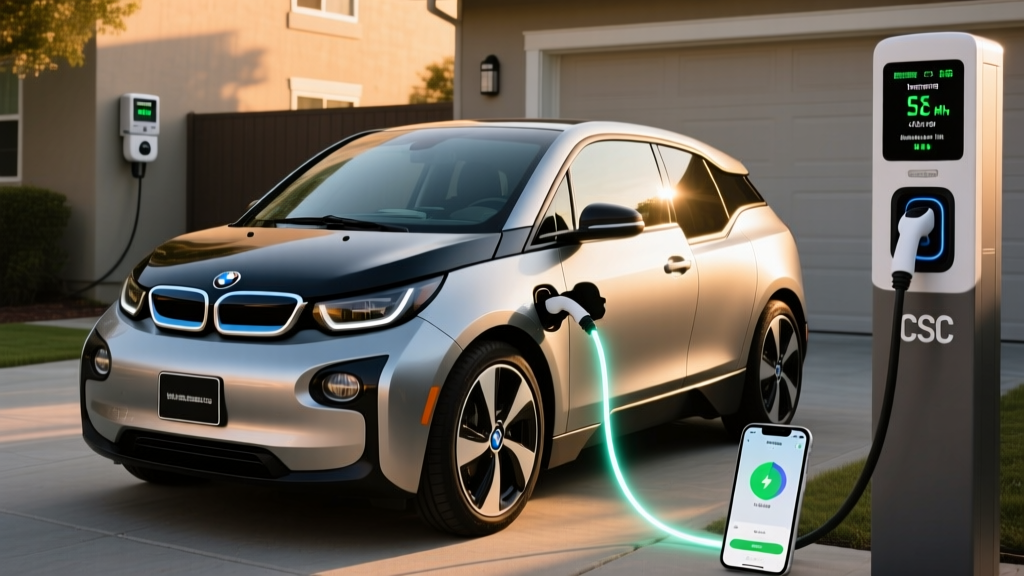
Understanding the 2017 BMW i3 Range Extender Battery and Charging Basics
The 2017 BMW i3 Range Extender (REx) pairs a 33.2 kWh gross lithium-ion battery (29.4 kWh usable) with a 647cc two-cylinder gasoline generator. On the electric side, it delivers an EPA-rated 114 miles of all-electric range before the range extender kicks in to preserve the remaining state of charge. The REx does not directly drive the wheels — it functions as a series hybrid generator, maintaining roughly 6-7% buffer to extend total driving range to approximately 180 miles combined.
Before we get into charging specifics, a critical distinction every i3 owner must internalize: kW (kilowatts) measures power — how fast energy flows into your car. kWh (kilowatt-hours) measures energy — how much your battery stores. Think of kW as the width of a hose and kWh as the size of the bucket. Your 2017 i3 REx has a 29.4 kWh usable bucket, and the width of the hose depends on your charging equipment.
Charging Levels Explained: How Fast Can You Refill the i3 REx?
The 2017 BMW i3 REx supports three charging levels, though its onboard charger and DC fast-charge capability define practical limits. The i3's onboard AC charger accepts up to 7.4 kW on Level 2. For DC fast charging, the 2017 model supports CCS1 (Combo) at up to 50 kW — a meaningful upgrade from earlier 2014-2016 models that were limited to slower DC rates.
| Level | Voltage | Max Power (kW) | i3 REx Actual Rate | Miles of Range Added per Hour | 0-100% Time (29.4 kWh usable) |
|---|---|---|---|---|---|
| Level 1 (Standard Outlet) | 120V | 1.4 kW | ~1.3 kW | ~4-5 mi/hr | ~22-24 hours |
| Level 2 (Home/Public AC) | 240V | 7.4 kW | 7.4 kW (onboard limit) | ~25-28 mi/hr | ~4-4.5 hours |
| DC Fast Charge (CCS1) | 400V+ | 50 kW | ~47 kW peak | ~120-150 mi/hr (to 80%) | 0-80% in ~28-32 min |
A few practical notes on these figures. On Level 1, plugging into a standard 120V household outlet works for overnight top-ups if your daily commute is under 30 miles round-trip — you'll recover roughly 40-50 miles overnight in 10 hours. But for most owners, Level 1 is painfully slow for the i3's relatively small battery when starting from near-empty.
Level 2 at 7.4 kW is the sweet spot for daily home charging. A full charge from 0% takes roughly 4 hours, meaning you can easily recharge overnight on a time-of-use electricity plan. The i3's 7.4 kW onboard charger means that even if you install a 48-amp (11.5 kW) home charger, the car will only draw 7.4 kW — so a 32-amp charger is perfectly matched to this vehicle.
DC fast charging on the i3 peaks around 47 kW but tapers significantly above 80% state of charge. The 0-80% sprint takes roughly 28-32 minutes at a 50 kW CCS1 station. From 80-100%, charging slows dramatically to protect battery health — expect another 25-30 minutes for the final 20%. Plan your road-trip stops around 80% to maximize efficiency.
Home Charger Installation: Electrical Requirements, Costs, and Panel Upgrades
Installing a Level 2 home charger for your 2017 BMW i3 REx is one of the best ownership upgrades you can make. Since the i3 caps at 7.4 kW, you need a 240V circuit rated for at least 40 amps (a 32-amp continuous-draw charger requires a circuit rated at 125% of that draw, hence 40A).
Electrical Requirements
- Voltage: 240V (standard split-phase residential service in the US)
- Circuit amperage: 40A breaker minimum for a 32A charger; 50A breaker for a 40A charger
- Wire gauge: 8 AWG copper (40A circuit) or 6 AWG copper (50A circuit)
- Outlet type: NEMA 14-50 (most common) or hardwired connection
- Dedicated circuit: Required — the EV charger must have its own breaker, not shared with other appliances
Panel Upgrade Reality
Many homes built before 2000 have 100-amp electrical panels. Adding a 40A dedicated circuit for EV charging may push your panel close to its load capacity, especially if you already run electric dryers, ovens, and central AC. A licensed electrician will perform a load calculation per NEC Article 220 to determine if your panel can handle the additional draw. If not, a panel upgrade to 200A typically costs $1,500-$3,000 — a significant but sometimes unavoidable expense.
| Component | Low End | High End | Notes |
|---|---|---|---|
| Level 2 Charger Equipment | $250 | $700 | 32A-40A smart charger (e.g., ChargePoint, Emporia, Wallbox) |
| Electrician Labor | $400 | $1,200 | Depends on run length from panel to garage/carport |
| Electrical Materials (wire, conduit, breaker) | $100 | $400 | Longer runs and outdoor conduit increase cost |
| Permit and Inspection | $50 | $250 | Varies by municipality; some jurisdictions waive for EV installs |
| Panel Upgrade (if needed) | $1,500 | $3,000 | 100A to 200A service upgrade; not always required |
| Total (no panel upgrade) | $800 | $2,550 | Typical range for most homeowners |
| Total (with panel upgrade) | $2,300 | $5,550 | Older homes with 100A service |
The federal Residential Clean Energy Credit (IRC §25C) may cover 30% of charger equipment and installation costs, up to $1,000, for equipment placed in service through 2032. Check irs.gov for current-year eligibility, as income and location-based restrictions can apply. Some utilities also offer rebates of $200-$500 for smart charger installations — check with your local provider.
Connector Compatibility: CCS1, CHAdeMO, and the NACS Transition
The 2017 BMW i3 REx uses a CCS1 (Combined Charging System) connector for DC fast charging and a standard J1772 connector for Level 1 and Level 2 AC charging. This was the dominant standard for non-Tesla EVs sold in North America through 2024.
However, the charging landscape has shifted dramatically. Starting in 2025, most major automakers adopted the NACS (North American Charging Standard), originally developed by Tesla. Electrify America, EVgo, and other networks have been retrofitting stations with NACS connectors alongside CCS1. By 2026, most new public DC fast chargers offer both connector types, but the long-term trend clearly favors NACS.
| Connector Type | Used For | 2017 BMW i3 REx Compatible? | Adapter Needed? |
|---|---|---|---|
| J1772 | Level 1 & Level 2 AC | Yes (native) | No |
| CCS1 (Combo) | DC Fast Charging | Yes (native) | No |
| CHAdeMO | DC Fast Charging | No | Not available (no CCS1-to-CHAdeMO adapter exists) |
| NACS (Tesla) | DC Fast & Level 2 AC | Not natively | CCS1-to-NACS adapter (~$200-$250) required for Tesla Superchargers |
Practical advice for i3 REx owners in 2026: Your native CCS1 connector still works at the majority of public DC fast chargers. However, if you want access to Tesla Supercharger stations — which represent the most reliable and extensive fast-charging network in North America — you'll need a CCS1-to-NACS adapter. BMW has not issued an official adapter for the i3, but third-party options from companies like Lectron and A2Z are available for approximately $200-$250. Verify adapter compatibility with your specific model year before purchasing, as the i3's CAN bus communication protocol must handshake correctly with the Supercharger.
Charging Cost Breakdown: Home vs. Public vs. Gas
One of the strongest ownership arguments for the i3 REx is the low cost of electric driving — but only if you charge primarily at home. Public DC fast charging erodes the savings advantage considerably.
| Scenario | Energy/Fuel Cost | Efficiency | Cost Per Mile |
|---|---|---|---|
| Home charging (off-peak, $0.12/kWh) | $0.12/kWh | 29 kWh/100 mi (4 mi/kWh) | $0.035 |
| Home charging (peak, $0.22/kWh) | $0.22/kWh | 29 kWh/100 mi | $0.064 |
| Public Level 2 ($0.30/kWh avg) | $0.30/kWh | 29 kWh/100 mi | $0.087 |
| DC Fast Charge ($0.45/kWh avg) | $0.45/kWh | 29 kWh/100 mi | $0.131 |
| i3 REx on gasoline (generator mode) | $3.40/gallon | 39 MPG combined | $0.087 |
| Average gas sedan (30 MPG combined) | $3.40/gallon | 30 MPG | $0.113 |
At off-peak home rates, the i3 REx costs roughly 3.5 cents per mile on electricity — about one-third the cost of driving a comparable gas car. Even on the range extender's gasoline generator, the i3 achieves approximately 39 MPG combined (per fueleconomy.gov), which undercuts most conventional compact cars.
The math shifts if you rely heavily on DC fast charging at $0.45/kWh — at that rate, you're paying nearly the same per mile as running the gasoline generator. This is why home Level 2 installation isn't just a convenience; it's central to the i3 REx's economic value proposition.
Recommended Level 2 Chargers for the 2017 BMW i3 REx
Since the i3 caps at 7.4 kW (32 amps at 240V), you don't need the most powerful charger on the market. A 32-amp or 40-amp unit is ideal. Here are three well-matched options for 2026:
Emporia Vue Level 2 Smart Charger
- Power Output: 40A (9.6 kW max) — i3 will draw 7.4 kW
- Connector: J1772 (native to i3)
- Cable Length: 24 feet
- Smart Features: Wi-Fi, app scheduling, energy monitoring, solar integration
- Price: ~$350-$400
- Why it fits the i3: Excellent value, energy monitoring helps track charging costs, 40A provides headroom if you upgrade vehicles later
ChargePoint Home Flex
- Power Output: Configurable 16A-50A (up to 12 kW) — set to 32A for i3
- Connector: J1772 (NACS version also available)
- Cable Length: 23 feet
- Smart Features: Wi-Fi, Alexa integration, scheduled charging, usage reports
- Price: ~$550-$700
- Why it fits the i3: Amperage flexibility means you can dial it to your circuit capacity; robust app and network integration
Wallbox Pulsar Plus
- Power Output: 40A (9.6 kW max)
- Connector: J1772
- Cable Length: 25 feet
- Smart Features: Wi-Fi + Bluetooth, app control, power-sharing between two units
- Price: ~$450-$550
- Why it fits the i3: Compact form factor, power-sharing feature useful for two-EV households on a single circuit
For the 2017 i3 REx specifically, the Emporia Vue offers the best value. You'll never use more than 7.4 kW regardless of the charger's maximum output, so paying a premium for a 48A unit doesn't yield faster charging. Invest the savings toward your electrical installation instead.
Safety, Electrical Code, and Installation Best Practices
EV charging involves sustained high-current draw — often for 4+ hours continuously. This is fundamentally different from short-burst appliances like a microwave. The National Electrical Code (NEC) treats EV chargers as continuous loads, which drives specific safety requirements:
- Dedicated circuit: Your Level 2 charger must be on its own breaker. Sharing a circuit with other outlets or appliances is a code violation and a fire risk.
- 125% rule: NEC requires the circuit to be rated at 125% of the charger's continuous draw. A 32A charger requires a 40A breaker. A 40A charger requires a 50A breaker.
- GFCI protection: The 2020 NEC (and subsequent editions adopted by most jurisdictions by 2026) requires GFCI protection for outdoor EV charging outlets. Hardwired chargers with integrated ground-fault protection may satisfy this requirement — confirm with your local inspector.
- Outdoor rating: If your charger is installed outside (carport, driveway), the unit must carry a NEMA 4 or IP65 weatherproof rating. All three chargers recommended above meet this standard.
- Permit and inspection: Most municipalities require an electrical permit for a new 240V circuit. The inspection verifies wire gauge, breaker sizing, grounding, and GFCI compliance. Skipping the permit risks insurance claim denials if an electrical fire occurs.
Hire a licensed electrician who has specific EV charger installation experience. Ask whether they perform a full NEC Article 220 load calculation — if they skip this step, find another electrician. The NHTSA and your local fire marshal both recommend professional installation over DIY for 240V circuits.
Real-World Charging Scenarios for the i3 REx Owner
Here's what charging looks like in practice with the 2017 BMW i3 Range Extender:
Daily commute (30 miles round-trip): Plug into a Level 2 charger at home when you arrive. The i3 will fully recharge in roughly 1.5 hours from a 50% state of charge. Set your charger to finish during off-peak hours (typically after 9 PM) to minimize electricity costs. You'll start each morning with a full 114-mile electric range — no gas needed.
Weekend road trip (150 miles): Depart with a full charge. You'll use approximately 85-95 electric miles before the range extender activates. The gasoline generator seamlessly maintains the battery buffer, and you'll consume roughly 1.5 gallons of premium fuel for the remaining distance. No charging stop needed — this is the REx's core advantage over the pure-electric i3 BEV.
DC fast charge stop (road trip): If you encounter a CCS1 DC fast charger, a 25-minute stop from 20% to 80% adds roughly 70-75 electric miles. The i3's 50 kW peak rate is modest compared to modern EVs charging at 150-350 kW, but for a 29.4 kWh battery, the session time is reasonable. Plan stops around amenities — you'll want a coffee break anyway.
Cold-weather charging: Below freezing, the i3's battery preconditioning is limited compared to newer EVs with active thermal management. DC fast charging speeds may drop to 30-35 kW in sub-20°F conditions, extending your 10-80% time to 40-50 minutes. The range extender provides a safety net — even if charging is slow, the gas generator ensures you reach your destination.
Frequently Asked Questions
How much does it cost to install a home EV charger for the 2017 BMW i3?
Expect $800-$2,550 for a standard Level 2 installation (equipment, electrician labor, materials, and permit) if your electrical panel has sufficient capacity. If your home requires a panel upgrade from 100A to 200A service, add $1,500-$3,000. The federal §25C credit may cover 30% of costs up to $1,000, and utility rebates can further reduce your out-of-pocket expense.
How fast will each charging level add range to the i3 REx?
Level 1 (120V) adds roughly 4-5 miles of range per hour. Level 2 (240V, 7.4 kW) adds approximately 25-28 miles per hour. DC fast charging at 50 kW CCS1 can add roughly 70-75 miles in a 25-minute session (20-80% SoC). These figures assume moderate temperatures; cold weather reduces charging speed and effective range.
Which connector and charger is compatible with the 2017 BMW i3 REx?
The i3 REx uses a J1772 connector for Level 1/2 AC charging and a CCS1 connector for DC fast charging. Any J1772 Level 2 home charger will work. For Tesla Supercharger access, a third-party CCS1-to-NACS adapter (~$200-$250) is required. CHAdeMO connectors are not compatible with the i3.
How much does charging the i3 REx cost per mile compared to gasoline?
At home off-peak rates ($0.12/kWh), the i3 costs approximately $0.035 per mile on electricity. On the gasoline range extender (39 MPG combined), it costs roughly $0.087 per mile. A comparable gas-only compact car at 30 MPG costs about $0.113 per mile at $3.40/gallon. Home charging delivers the strongest savings; DC fast charging at $0.45/kWh narrows the gap to near-parity with the range extender's gasoline cost.
What electrical upgrades might I need for a Level 2 charger?
The most common upgrade is adding a dedicated 40A or 50A 240V circuit from your electrical panel to your garage or parking spot. If your home has a 100A panel and is already near load capacity (electric HVAC, dryer, oven), you may need a panel upgrade to 200A service — a $1,500-$3,000 project. A licensed electrician's load calculation will determine this before installation begins. Older homes with aluminum wiring or outdated breaker panels (e.g., Federal Pacific, Zinsco) may require full rewiring or panel replacement regardless of EV charging.
Does the 2017 i3 REx support Tesla Superchargers?
Not natively. The i3 uses CCS1, while Tesla Superchargers use the NACS connector. A CCS1-to-NACS adapter from a reputable third-party manufacturer enables Supercharger access, but verify CAN bus protocol compatibility with the i3 specifically before purchasing. Supercharger speeds for the i3 will still be limited to the car's 50 kW DC fast-charge maximum.
How does cold weather affect the i3 REx charging and range?
In temperatures below 32°F, expect 25-35% electric range reduction (down to 70-85 miles) due to battery chemistry limitations and cabin heating demand. DC fast charging speeds may also taper to 30-35 kW in extreme cold because the i3 lacks the robust battery preconditioning found in newer EVs. The range extender's gasoline generator compensates by maintaining the battery buffer and providing cabin heat, ensuring total range remains around 150-160 miles even in winter conditions.